
⚡ TL;DR — Key Takeaways
- The scale: Roughly two-thirds of teenagers now use AI chatbots, and about a quarter use them daily.
- The AI predator risk: 45% of parents say their kids receiving inappropriate romantic or sexual responses from AI chatbots is a widespread problem.
- The exploitation surge: The Internet Watch Foundation recorded a 26,362% increase in AI-generated child sexual abuse material in a single year.
- The emotional risk: Common Sense Media concluded AI companions pose an “unacceptable risk” to teens under 18.
- The gap: 72% of parents are concerned about AI’s impact on their kids, but only 17% actively seek out information to understand these tools.
Table of Contents
Parents have spent years learning to watch for predators lurking in comment sections and DMs. In 2026, the more urgent conversation is about something less visible: the AI predator risk built directly into the chatbots millions of kids already talk to every day.
This isn’t a fringe concern anymore — it’s a documented, measurable, and rapidly growing problem, and most parents don’t yet have the tools to recognize it.
What makes the AI predator threat harder to spot than older online dangers is that it doesn’t always look like danger at all. There’s no suspicious stranger sending a friend request, no obvious red flag in a profile picture — just a chatbot app that looks, on the surface, like any other piece of entertainment or homework help software on a child’s phone.
That normalcy is precisely what makes AI predator risk so difficult for even attentive parents to catch early, and why understanding the pattern behind it matters more than trying to police every individual app.
What “AI Predator” Actually Means in 2026
The term AI predator covers two overlapping risks. The first is AI companion apps and general-purpose chatbots that, through weak safeguards or engagement-driven design, generate romantic, sexual, or otherwise inappropriate content directed at minors.
The second is human predators using AI tools to accelerate grooming, generate synthetic content, or impersonate someone a child would trust. Both versions of the AI predator threat share a common thread: they exploit a child’s developing judgment and a chatbot’s frictionless, always-available nature.
Nearly two-thirds of teens now use AI chatbots, with about 30% engaging daily, and more than half have used ChatGPT specifically, according to The American Prospect. That scale alone is why the AI predator problem has moved so quickly from theoretical to mainstream: when a technology reaches the majority of teenagers this fast, safeguards and family awareness routinely lag years behind actual usage.
The Numbers Parents Need to See
The data behind the AI predator risk is stark. According to Internet Safety 101, 45% of parents say kids receiving inappropriate romantic or sexual responses from AI chatbots is a widespread problem, 42% say the same about chatbots failing to report troubling behavior like talk of suicide, and 42% report kids forming intense emotional bonds with AI chatbots.
Separately, the Internet Watch Foundation detected a 26,362% increase in AI-generated child sexual abuse material year over year — a jump from just 13 confirmed videos to 3,440, with more than half classified as “category A,” the most graphic tier tracked.
The broader exploitation numbers reinforce how serious the AI predator problem has become. The National Center for Missing & Exploited Children’s CyberTipline received 21.3 million reports in a single year, encompassing 61.8 million images and videos of suspected child sexual exploitation, with AI-generated material identified as a key driver of that growth.
A Barna Group survey found 72% of parents concerned about AI’s impact on their children, yet only 17% strongly agreed they actively seek out information to understand the technology — a gap that leaves most families reacting to AI predator risk only after something has already gone wrong, rather than recognizing it in advance.
The World Economic Forum notes that AI is now “supercharging the speed, scale and realism of online harms,” warning specifically about automated grooming and AI companions that blur healthy emotional boundaries, according to WEF.
Common Sense Media went further, concluding that AI companion apps pose an “unacceptable risk” to teens under 18 due to exposure to sexual content and dangerous advice, per the Child Mind Institute. Taken together, these figures paint a consistent picture: the AI predator threat isn’t confined to a single platform, statistic, or watchdog report — it shows up across nearly every major study currently tracking how AI intersects with child safety.
Why Kids Are Especially Vulnerable
Children are developmentally primed to form intense attachments to responsive entities, but chatbot relationships lack the mutuality and accountability of real ones, according to Psychology Today. That frictionless quality is exactly what makes the AI predator dynamic so effective: a chatbot never gets tired, never judges, and is always available to reinforce whatever a child wants to hear — qualities that can make it easier for boundaries to blur than they would with a human stranger, where social instincts and hesitation typically slow things down.
Senator Ed Markey’s office, introducing the Youth AI Privacy Act, noted that emerging evidence shows minors are especially vulnerable to AI chatbots, particularly as companies rely on manipulative engagement design and large amounts of children’s personal data, according to Senator Markey’s office.
Rather than detailing specific tactics, the safest approach for parents is understanding the general pattern: any system optimized purely for engagement, without meaningful safety limits, can end up encouraging isolation, secrecy, or dependency in a child — hallmarks that deserve attention regardless of the exact platform involved.
7 Warning Signs of AI Predator Risk
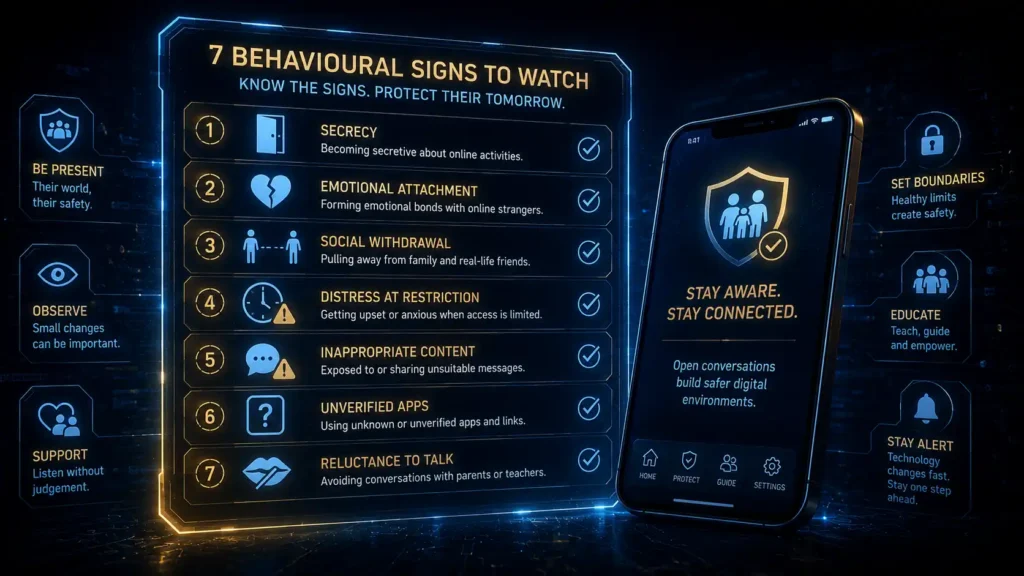
- Secrecy about chatbot conversations — reluctance to show you what they’re discussing, or quickly closing an app when you walk by.
- Emotional attachment to an AI companion — treating a chatbot like a close friend, boyfriend, or girlfriend rather than a tool.
- Withdrawal from real relationships — preferring chatbot conversations over time with friends or family.
- Distress when access is limited — reacting with unusual anxiety or anger if a chatbot app is removed or restricted.
- Age-inappropriate content coming up in conversation — romantic, sexual, or otherwise mature themes surfacing unprompted.
- Use of unverified or unbranded chatbot apps — no published safety policy, no age verification, no real company behind it.
- Reluctance to involve a trusted adult — a general pattern seen across all forms of exploitation, where isolation from parents or guardians is treated as normal or necessary.
What Parents Can Actually Do

Combating the AI predator threat doesn’t require becoming a cybersecurity expert. A few concrete steps make the biggest difference:
- Keep communication open, not accusatory. Ask what apps they’re using and why, without immediately treating it as a punishment conversation.
- Check for real safety architecture. Legitimate platforms publish privacy policies, offer age verification, and include parent-facing controls — apps missing all three are a red flag.
- Set boundaries on AI companion apps specifically, since general-purpose assistants and dedicated companion apps carry different levels of risk.
- Stay involved, not just informed. Only 17% of concerned parents actively seek out information on AI, according to Internet Safety 101 — closing that gap matters more than any single tool or setting.
The Bottom Line
The AI predator risk isn’t a distant, hypothetical concern — it’s already reflected in survey data, watchdog reports, and legislation moving through Congress right now. The technology driving this risk isn’t going away, and neither is its appeal to kids who are developmentally wired to seek connection wherever it’s offered. What can change is how prepared parents are to recognize the warning signs early, before an AI predator dynamic has a chance to take hold.
Legislation like the Youth AI Privacy Act signals that lawmakers are beginning to take the AI predator threat seriously, but regulation alone won’t move as fast as the technology itself, and it certainly won’t move faster than a curious teenager downloading a new app.
Waiting for Congress, app stores, or AI companies to fully close these gaps means leaving the burden of vigilance almost entirely on families in the meantime. That’s not a reason for panic — most kids using AI chatbots will never encounter the worst-case version of this risk — but it is a reason to treat AI predator awareness the same way most parents already treat conversations about strangers online: not a one-time warning, but an ongoing, low-key part of how a family talks about technology.
The families who start that conversation early, before a crisis forces the issue, are the ones best positioned to catch an AI predator situation while it’s still just a warning sign, not a full-blown problem.
Related: FBI Data Breach 2026: Inside the Chinese Hack of a Secret Wiretap System – FBI Wiretap Network Breached: How hackers infiltrated one of the FBI’s most sensitive surveillance systems—and what it means for U.S. national security.
Norton Genie AI Scam Detector: Does It Actually Stop Scams in 2026? – Read the major features of the Norton Genie AI Scam Detector and understand its benefits in your daily life.
AI Cyberattacks: How One AI Found 555 Flaws Attackers Wanted First – One AI uncovered 555 software vulnerabilities before attackers could exploit them—showing how AI is becoming one of cybersecurity’s most powerful defenders.
Frequently Asked Questions (FAQ)
Q1. What exactly is meant by “AI predator” risk?
It refers to two overlapping dangers: AI chatbots and companion apps that generate inappropriate content for minors due to weak safeguards, and human predators using AI tools to accelerate grooming or impersonation. Both exploit a child’s developing judgment and a chatbot’s always-available, non-judgmental nature.
Q2. How common is the AI predator problem, really?
It’s more widespread than most parents realize. 45% of parents report kids receiving inappropriate romantic or sexual responses from AI chatbots as a widespread problem, and the Internet Watch Foundation recorded a 26,362% increase in AI-generated child sexual abuse material in a single year.
Q3. Are AI companion apps worse than general-purpose chatbots like ChatGPT?
Generally, yes. Common Sense Media found that AI companion apps specifically pose an “unacceptable risk” to teens under 18, since they’re often designed to maximize emotional engagement rather than include the safety limits found in mainstream general-purpose assistants.
Q4. What’s the single biggest warning sign parents should watch for?
Secrecy combined with emotional attachment is the strongest combined signal — a child becoming defensive about a chatbot relationship, or showing distress when access is limited, deserves attention regardless of which app is involved.
Q5. Is legislation actually addressing the AI predator problem?
Some progress is underway. The Youth AI Privacy Act, introduced by Senator Ed Markey, would require disclosure that a chatbot isn’t human and restrict how AI companies use children’s data, but as of now it remains proposed legislation rather than enacted law, so protection still falls mainly on parents in the meantime.
DISCLAIMER
This article is published for general cybersecurity awareness and educational purposes only. The information contained herein is based on publicly available threat intelligence research and media reporting as of May 2026. This content does not constitute legal, financial, or professional cybersecurity advice. Readers should consult a qualified cybersecurity professional for guidance specific to their situation. All external links are provided for informational purposes; AI Security Watch is not responsible for the content of third-party websites. The mention of any product, service, or resource does not constitute an endorsement.Disclaimer