⚡ TL;DR — Key Takeaways
- The Identity Layer Dominance: Global telemetry within the 2026 Sophos Adversary Report confirms that identity-based vulnerabilities—encompassing stolen credential abuse, brute-force intrusions, and targeted phishing loops—now account for an overwhelming 67.32% of all investigated breaches, completely eclipsing traditional software code exploitation.
- Compressed Defensive Windows: The median adversary dwell time across enterprise environments has contracted down to an tight 3.00 days total, with Managed Detection and Response (MDR) monitored infrastructures dropping threat persistence down to an average of 2.00 days compared to a sluggish 5.00 days for unmonitored standard corporate systems.
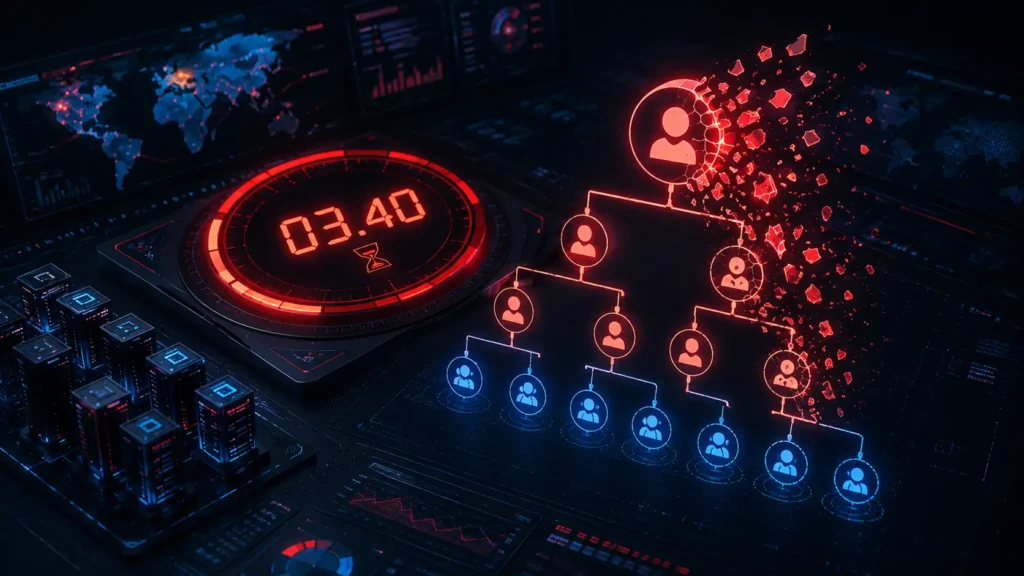
- Active Directory Infiltration Speed: Privilege escalation vectors have accelerated by over 70% year-over-year, with malicious actors now seizing administrative command over Active Directory (AD) systems in a median timeline of just 3.40 hours following their initial breach point.
- Exploiting Operational Blind Spots: Ransomware delivery groups continue to weaponize off-hours operational gaps, orchestrating exactly 88.10% of final ransomware payload executions during non-business hours, holiday breaks, or weekends when internal security teams run at severely reduced visibility.
Table of Contents
While mainstream media coverage fixates heavily on abstract AI-driven exploits and exotic zero-day code flaws, the 2026 Sophos Adversary Report confirms that real-world attackers consistently rely on the exact same basic, trusted administrative tools and stolen credentials they have weaponized for years. The report’s own structural summary is direct: “This year’s crop of attackers used the same tools, techniques, and procedures (TTPs) they have for years.” Despite widespread predictions of a massive shift toward autonomous, machine-driven warfare, no such watershed transformation materialized in the data.
This threat briefing draws on an expansive, telemetry-dense dataset of 661 real-world corporate cases handled natively by Sophos Incident Response (IR) and Managed Detection and Response (MDR) teams, including integrated Secureworks casework, between November 1, 2024, and October 31, 2025. The underlying investigations span 70 countries and 34 distinct industrial sectors, with Manufacturing representing the single largest target profile at 19.82% of all incidents, followed by Financial Services (8.93%), Construction (8.62%), Information Technology (6.96%), and Healthcare (6.35%).
Crucially, 84% of the analyzed entities were mid-market businesses maintaining fewer than 1,000 internal employees, and over half (56%) ran lean environments with 250 workers or fewer. This volume underscores that small businesses, not just massive Fortune 500 enterprises, face severe resource and asset protection constraints against identical, highly organized threat networks. Within this operational footprint, MDR active telemetry partnerships accounted for 69% of the case volume compared to 31% for standalone, retrospective emergency IR call-outs, with general network breaches continually outpacing standard ransomware deployments as the leading global incident type overall.
The tech media’s obsessive focus on hype-driven, sci-fi concepts like “autonomous AI offensive malware” does a massive disservice to small business owners. It distracts executive leadership from locking down basic, un-glamorous security configurations that actually stop real-world intrusions. While founders waste budget chasing shiny, marketing-driven “AI-insulated firewalls,” attackers are simply walking through the front door using un-patched VPN vulnerabilities or buying valid employee password dumps for twenty dollars on the dark web. Security is won or lost in the boring trenches of multi-factor authentication enforcement, strict asset mapping, and baseline user access logging—not by building defense structures against imaginary robot hackers.
This technical briefing navigates through four core areas uncovered by the data: the overwhelming dominance of identity-based initial entry points, shrinking adversary dwell times paired with rapid Active Directory compromise speeds, the calculated after-hours ransomware execution pattern, and an actionable, board-level strategic compliance roadmap.
SECTION 1: THE IDENTITY LAYER EXPLORATION (THE 67% CRITICAL BASELINE)
Identity-related systemic failures—comprising stolen credential exploitation, password brute-forcing, credential-harvesting phishing loops, session authentication token theft, and the abuse of trusted third-party vendor relationships—fueled an overwhelming 67.32% of all analyzed root causes. This marks the highest volume recorded since threat intelligence teams began tracking the metric, representing the fourth consecutive year of growth for identity-focused attack vectors. The data paints a clear picture: malicious actors are no longer relying on complex software exploits to crack corporate network edges; they are simply using valid credentials to log right through the front door.
Dissecting this high-risk identity category uncovers distinct operational trends. Incidents involving pre-compromised user credentials (where the explicit upstream extraction method remained unrecorded) made up 42.06% of all documented root causes. Automated brute-force credential attacks accounted for 15.58% of investigations, running practically neck-and-neck with traditional software vulnerability exploitation, which sat at 16.04%. This baseline proves that automated credential guessing has become just as common an entry vector as exploiting unpatched application code. Furthermore, targeted phishing campaigns made up 6.35% of identifiable root causes, more than doubling their occurrence rate compared to the previous year’s dataset.
The narrowing statistical gap between brute-force intrusions and software code exploits signals a fundamental structural shift in how cybercrime syndicates prioritize their engineering efforts. Because corporate software patching routines have improved globally across the tech sector, unpatched edge software vulnerabilities represent a shrinking target. Conversely, weak internal password rules or absent multi-factor authentication (MFA) controls remain an open, highly reliable infrastructure gap that requires absolutely zero advanced exploit development costs to weaponize. Remarkably, among the subset of cases where a specific software code vulnerability could be verified (accounting for only 52 out of the 661 total investigations), 67.31% were traced back to a single vulnerability: CVE-2024-40766, an access control flaw in SonicWall SonicOS. Despite patches being available throughout the year, organizations exhibited a median 322-day gap between the vendor’s security patch release date and the actual real-world exploitation event.
SECTION 2: COMPRESSED DWELL TIMELINES AND ACTIVE DIRECTORY RECONNAISSANCE SPEED
The overall median adversary dwell time across enterprise networks stabilized at exactly 3.00 days. Threat researchers attribute this compressed window to a dual dynamic: cybercriminals are aggressively accelerating their internal deployment speeds, while defensive engineering teams are simultaneously improving their real-time anomaly discovery times. However, this metric changes drastically depending on how the incident is discovered. General, all-cause incident response (IR) engagements showed a median dwell time of 5.00 days (a 29% contraction year-over-year), while environments paired with proactive Managed Detection and Response (MDR) active telemetry dropped threat persistence down to an average of 2.00 days. Conversely, non-ransomware IR cases ran the longest at a median of 6.00 days, as quiet espionage or data harvesting campaigns often remain hidden until a deep-dive forensic audit exposes the footprint.
The most critical and alarming acceleration uncovered in the dataset involves the weaponization of identity directories. The median timeline for malicious actors to attempt Active Directory (AD) access after their initial network breach dropped to a mere 3.40 hours—marking a stunning 70% increase in operational speed year-over-year. Compounding this structural risk, the timeframe between an attacker’s initial AD access attempt and its actual discovery by internal teams grew by 16% over the same operational span. This widening metric confirms that the delta between adversary execution speed and traditional internal response capability is shifting directly in the attacker’s favor.
Allowing your Active Directory domain controllers to sit on flat internal networks without multi-factor authentication (MFA) enforcement gates creates an instant, enterprise-wide game-over scenario during a breach. Once an initial access broker compromises a low-level workstation via a basic phishing hook, they do not pause. They harvest local memory caches, run automated scanning scripts, and target the central identity vaults right away. If your domain controller is single-factored or poorly isolated from standard office workstations, a threat actor can seize administrative root rights across your entire company within a single morning shift—giving them the keys to instantly push ransomware binaries to every server on your network simultaneously.
This hyper-compressed 3.40-hour AD compromise window is worsened by legacy infrastructure neglect across mid-market corporate targets. Of the specific Windows Server operating systems that field investigators could positively identify, 13% were running fully end-of-life (EOL) software versions lacking modern security updates, while an additional 27% were approaching EOL status. An active adversary reaching your core identity directory controllers inside a single morning shift, running on top of un-supported server infrastructure, leaves security defenders with virtually no realistic timeline to intervene before absolute network ownership is conceded.
SECTION 3: THE AFTER-HOURS EXECUTION PROTOCOL (THE 88% RANSOMWARE ANOMALY)
Ransomware delivery teams orchestrate final encryption sequences according to a highly calculated operational schedule: exactly 88.10% of all analyzed ransomware payloads were executed outside of standard business hours. This timing strategy is distributed fairly evenly throughout the week, with a minor concentration spikes landing on Thursdays and Fridays. Data exfiltration milestones mirror this exact timing architecture, with 78.85% of industrial data extraction events also transpiring during off-hours, showing a distinct escalation trend on Wednesdays and Thursdays.
Mapping these intrusion lifecycles across a 24-hour clock using 321 cases with verified initiation timestamps reveals that the highest-velocity attack window falls squarely between 11:00 PM and 3:00 AM local time, accounting for 37.1% of all tracked security incidents. Conversely, the quietest operational hours cluster between 6:00 AM and noon. Once data extraction begins, the complete exfiltration pipeline takes a median of 78.83 hours from initial breach. Shockingly, threat hunters detect these outbound movements an average of only 1.87 hours before the primary, devastating ransomware attack itself is deployed. This leaves an incredibly narrow detection margin for internal incident response teams. Compounding the downstream threat surface, 49.07% of confirmed ransomware cases with active exfiltration saw the stolen corporate records leaked on public leak sites within 19.5 days.
Reviewing the specific tooling utilized during these final deployment loops highlights that the Impacket framework family accounted for 36.01% of all attacker tool footprints—representing a massive 83.08% surge over the previous year. Because the Python environment is required to execute Impacket scripts, threat researchers explicitly recommend completely un-installing or blocking Python execution binaries on all non-development corporate workstations. Among legitimate, commercially available software applications abused by threat actors to execute commands, AnyDesk remains the most heavily weaponized remote desktop management asset. SoftPerfect Network Scanner represents the leading utility for internal infrastructure mapping, and WinRAR functions as the most abused platform for compressing data packages before extraction.
The Remote Desktop Protocol (RDP) maintains its position as the leading internal path for network lateral movement and reconnaissance. However, its public-facing exposure rate is actively declining: internal RDP lateral movement appeared in 66% of investigated cases, whereas uninsulated external RDP exposure dropped down to 10%, effectively halving its external footprint year-over-year. Finally, looking at secondary contributing operational failures, missing or completely bypassed multi-factor authentication (MFA) was flagged as a major culprit in 59% of all breaches. Severe firewall log retention restrictions—frequently defaulting to a useless seven-day archive or even a 24-hour purge loop—doubled as a massive visibility gap that routinely blocks retrospective forensic audits.
SECTION 4: STRATEGIC COMPLIANCE ROADMAP FOR EXECUTIVE LEADERSHIP
Converting this report’s raw threat intelligence into clear, board-level risk management strategies begins by sealing the most prominent vulnerability identified across the dataset: enforcing phishing-resistant multi-factor authentication (MFA) across all legacy remote access portals, moving beyond easily bypassed push-notifications. The underlying telemetry details a real-world case study where synchronous-replay, Adversary-in-the-Middle (AiTM) phishing frameworks (such as the FlowerStorm toolset) captured and replayed user credentials alongside active MFA prompts within seconds. This technical evidence proves that loose or traditional authentication methods provide significantly weaker protection than executive teams assume.
Furthermore, compliance teams must eliminate unmonitored infrastructure logging blind spots, specifically targeting edge firewall log retention policies. The report warns that small and mid-market organizations frequently leave their logging windows at out-of-the-box defaults as short as 24 hours. Because an active adversary can completely compromise an Active Directory domain controller in a median window of just 3.40 hours, a shallow log history or a brief visibility gap functionally blinds incident response teams during the exact technical window where containment is still possible.
Finally, organizational leaders should implement continuous, round-the-clock managed detection and response coverage rather than relying on periodic, reactive forensic cleanups. The dataset highlights this delta by showing that MDR-monitored infrastructures dropped threat persistence down to an average of 2.00 days, compared to a sluggish 5.00 to 6.00 days for standalone incident response engagements. From an endpoint governance perspective, IT leads should restrict or continuously monitor Python runtime binary usage on all non-development workstations due to its role in enabling the Impacket framework, which was responsible for over a third of all tracked attacker tool usage. To mitigate cloud identity exploits, teams must enforce bound session tokens and restrict session lifetimes within Microsoft 365 environments via Token Protection, as the report explicitly details an attack timeline where a threat actor successfully replayed a stolen, unbound session token nearly a week after the initial breach, completely bypassing MFA configurations during a secondary exploitation phase.
CONCLUSION & EXECUTIVE SUMMARY
The 2026 Sophos Adversary Report delivers an undeniable conclusion: cybercriminals had no incentive to develop complex new exploit methodologies because foundational identity and network visibility gaps remain wide open across mid-market enterprise perimeters. While generative AI tools have significantly increased the speed, volume, and linguistic accuracy of phishing campaigns, the research found zero evidence of a structural shift toward autonomous, AI-orchestrated cyberattacks. This reality means security professionals are still going head-to-head with the same operational threat playbook as prior years, simply accelerated by automated infrastructure.
Transitioning threat management into a stateful, continuous operational habit—rather than treating it as a static, periodic compliance checkbox exercise—is the single factor that separates organizations achieving a tight, 2-day MDR-monitored dwell time from those buried under 5 to 6 days of data destruction during a reactive incident response cleanup. For small and mid-market organizations managing restricted budgets, closing legacy MFA loopholes, enforcing strict session token lifetimes, and restricting unmanaged Python execution boundaries represent highly effective, immediate defensive controls that require zero massive capital investments—only sustained operational discipline.
Hardening an infrastructure footprint against rapid Active Directory compromise requires establishing absolute visibility before an attacker initiates lateral movement. What specific endpoint detection and response (EDR) platforms, managed security operations setups, or identity protection frameworks do you run across your internal infrastructure to intercept early credential abuse or off-hours network scanning patterns? Do you leverage automated session token bounding rules inside your cloud tenants, run open-source telemetry aggregators, or rely entirely on external third-party MDR providers to manage your monitoring windows? Drop a comment in the box below and share your operational insights—let’s swap our engineering playbooks and protect our corporate data networks together!
Related: Hardening Docker Daemon Configs Via 6 Proven Rules to Eliminate Root Risks – A practical six-rule guide to hardening Docker daemon configurations, reducing container escape risks, restricting privileged access, and strengthening host-level security.
Implementing NIST Frameworks Using 6 Proven Playbooks to Stop Hacker Threats – A practical guide to implementing NIST frameworks to structure cybersecurity governance, identify risks, strengthen controls, and build a measurable security program.
Disabling Meta AI Training in 4 Proven Steps to Protect Business Data Assets – A practical four-step guide to limiting Meta AI’s access to business content, strengthening privacy controls, and protecting proprietary digital assets from unwanted AI training.
Reporting Business Email Compromise Wire Fraud Via 5 Proven Steps to Freeze Stolen Assets – A practical five-step playbook for responding to business email compromise, freezing fraudulent wire transfers, and strengthening financial controls against repeat attacks.
FREQUENTLY ASKED QUESTIONS (FAQ)
Q1. If an attacker compromises an Active Directory (AD) controller within 3.4 hours, does that mean traditional perimeter firewalls are completely useless?
No, perimeter firewalls remain a necessary basic guardrail, but they are architecturally blind to identity-based exploits. Because threat actors are penetrating networks using valid, stolen employee credentials purchased from initial access brokers, firewalls treat their entry as standard, authorized web traffic. This rapid 3.4-hour timeline highlights why internal user behavior analytics, strict network segmentation, and endpoint-level monitoring are infinitely more critical than simple edge blockades.
Q2. Why do standalone incident response cases show a significantly longer adversary dwell time (5 days) compared to MDR-monitored environments (2 days)?
The 3-day delta exists because organizations running standalone architectures typically discover a breach only after a catastrophic event occurs—such as a massive ransomware payload locking down their databases. Managed Detection and Response (MDR) services use automated telemetry monitoring and round-the-clock security operations centers to catch early indicators of compromise (IoCs), isolating the threat actor during their early reconnaissance or lateral movement phase before they can execute final payloads.
Q3. Knowing that 88% of ransomware drops happen after hours, what operational adjustments should a small or mid-market firm prioritize right away?
Mid-market firms must transition away from standard “on-call” IT paging structures, which introduce critical communication delays during a midnight event. Leadership should implement automated host-isolation rules inside their Endpoint Detection and Response (EDR) agents to automatically quarantine any server showing sudden privilege escalation or log-deletion behaviors after 6:00 PM, buying internal teams critical hours to triage the incident the following morning.
Q4. How are initial access brokers (IABs) consistently gathering valid employee login credentials at a scale that fuels 67% of modern breaches?
Access brokers leverage highly automated infrastructure to fuel their supply chains. They continuously siphon user records from public data dumps, harvest corporate browser caches using low-cost infostealer malware hidden inside cracked software downloads, and run broad brute-force password-spraying scripts against un-monitored single sign-on (SSO) login portals that lack rate-limiting rules or geographic access restrictions.
Q5. Since brute-force attacks have drawn level with software flaw exploits, does this mean patching vulnerabilities is becoming less important?
Absolutely not. Patching remains mandatory to stop automated malware worms, but threat actors have realized that cracking a weak or reused password takes significantly less engineering effort than discovering a novel zero-day code flaw or bypassing modern web application firewalls. It signals that identity security and strict password hygiene must now be funded and audited with the exact same rigor as technical code patching schedules.
DISCLAIMER
Educational Notice: This article is published on AI Security Watch strictly for technical educational and general cybersecurity awareness purposes. The configurations and research discussed are based on public threat intelligence data. This content does not constitute professional IT architecture, legal, or financial advice. Because network configurations vary, always verify settings in an isolated test environment or consult with a qualified engineer before modifying live hardware or registries. AI Security Watch contains informational links to external resources; we are not responsible for third-party site accuracy or platform content.