
⚡ TL;DR — Key Takeaways
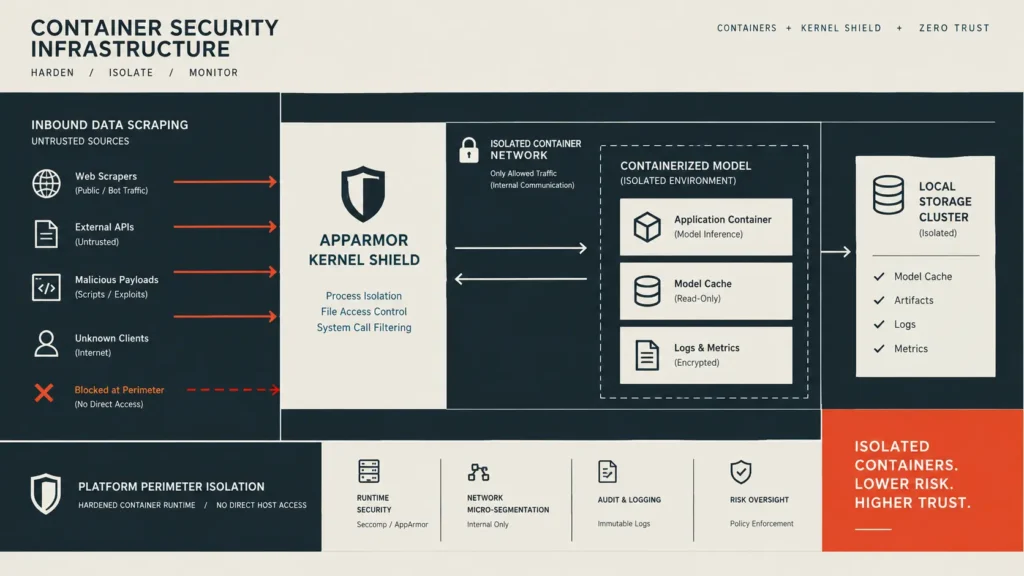
- Administrative access controls: Enforcing strict runtime perimeter controls shields your underlying local host infrastructure—establishing a highly secure docker llm deployment pipeline mandates that system architects treat default container runtime configurations as fundamentally unsafe until they have been explicitly hard-coded against host escape vectors.
- Vendor/client parameter validation: Restructuring default Linux kernel capabilities blocks unauthorized low-level system call triggers; enforce a strict drop-all privilege posture that completely strips default administrative root tokens from the container daemon, selectively whitelisting exclusively the granular micro-capabilities that local GPU-accelerated inference tasks actually require to bind hardware resources.
- Stream-optimized runtime flags: Monitoring containerized networking lanes eliminates unvetted lateral data migration routes; isolate bridge network perimeters immediately by disabling default host networking interfaces and severing direct external internet pathways from the running model tier to guarantee the inference microservice remains structurally sequestered from adjacent enterprise networks.
- Perimeter isolation validation: Shielding local storage volumes demands rigid container lifecycle isolation rather than standard post-incident file tracking—enforce completely read-only root filesystems across your model environments, forcing all runtime engine data modifications, weight logging steps, and model transactions to write exclusively into temporary, ephemeral scratch spaces that automatically clean themselves up at shutdown.
- Centralized threat mitigation registries: Mitigating system breakout hazards dictates continuous mandatory access control enforcement at the kernel boundary; bind highly restrictive, custom AppArmor profiles directly to the inference instance to programmatically block unauthorized container attempts to read or write to host-path filesystems even if the primary orchestration layers are completely bypassed by an exploit payload.
Table of Contents
Engineering groups pulling down open-source foundational models and spinning up local inference containers—Ollama, vLLM, or similar runtimes—routinely do so with default Docker configurations. That default setup shares a surprising amount of high-privilege kernel access with the host machine, and most teams never realize it, because the container appears fully isolated from the outside looking in. Failing to mathematically map and insulate these local execution nodes allows automated scripts to establish immediate footholds inside the underlying operating system long before standard tracking systems raise a configuration alert or drop a compromised network interface loop.
That structural gap is exactly where catastrophic risk lives across your development network. If a model environment processes a crafted injection payload—embedded in a document, a prompt, or an uploaded file the model is asked to analyze—a default-configured container gives an attacker a much shorter path from manipulated model output to arbitrary code execution on the host than most teams assume. Shifting past soft user-level constraints to construct a truly secure docker llm deployment architecture is an absolute necessity to prevent a compromised runtime process from triggering low-level kernel escapes that completely expose the core system hardware.
Deciding to deploy an explicit, structural roadmap around strict validation parameters and genuine secure docker llm deployment configurations is a critical operational engineering requirement, not an optional hardening pass reserved for internet-facing services. It prevents asset-handling drift, stabilizes enterprise procurement loops, and stops technical risk drift before a single misconfigured local dev box becomes the organization’s actual weakest link. Forcing these lifecycle constraints restricts local computing spaces to tight sandboxes, keeping your internal cloud processing nodes permanently partitioned, restricted, and clean.
There is a profound, stomach-dropping sense of technical disbelief that hits you when you conduct a quick infrastructure audit on a local AI development box and realize it is a total security disaster. You pull up the runtime configuration and watch your heart sink as you discover an open-source inference instance running with absolute root administrative privileges, paired with loose, unmapped volume bindings mounted straight to the parent server’s system directory.
Realizing that a single adversarial prompt injection inside a processed document could have dropped a shell payload that completely took over the hardware layer entirely undetected is a brutal wake-up call. It proves that local development setups require the identical rigid isolation rules applied to production cloud clusters, because a default container containerization setup means absolutely nothing if your engineers leave the backdoor wide open to the host kernel.
The technical blueprints detailed below provide a hardcoded checklist to translate these traditional isolation principles directly into active, containerized runtime boundaries.
STEP 1: DECONSTRUCTING LINUX KERNEL CAPABILITIES AND STRIPPING DAEMON PRIVILEGES
The first privilege elimination layer starts before the model container ever mounts. Default Docker runtimes grant a broad set of Linux kernel capabilities out of the box—far more than an inference workload actually needs to load a model and serve requests.
- Enforce a strict drop-all posture: Systems engineers must strip every kernel capability by default, completely neutralizing the baseline container authorization matrix.
- Selectively whitelist granular system calls: Whitelist only the narrow set of system calls actually required, such as the specific controls needed to mount GPU accelerators and compute clusters.
- Eliminate administrative-level capabilities entirely: Administrative tokens—the ones that would let a compromised process modify host system time, load malicious kernel modules, or bypass file-permission checks entirely—have no legitimate role in a self-hosted inference workload and must be withheld at initialization rather than disabled after the fact.
- Maintain strict whitelist discipline: Enumerating what to remove invites security gaps, while explicitly defining allowed parameters closes the containment perimeter completely.
STEP 2: ARCHITECTING ISOLATED DOCKER BRIDGE NETWORKS AND REMOVING HOST INTERFACES
Operating local models under default host network configurations exposes underlying system ports directly to the container’s network namespace. This exposure creates a path for remote execution bypasses that has nothing to do with the model itself and everything to do with network topology.
- Deploy a custom, isolated internal bridge network: Purpose-build a segmented internal network specifically for the inference workload to completely separate the model’s network interface from external internet routes and peer application tiers running elsewhere on the same host machine.
- Enforce absolute network containment: A model container that genuinely requires no outbound internet access must have none by network topology, not by soft application-layer policy that a manipulated process could potentially circumvent.
- Limit lateral blast radius across your infrastructure: Even if a container experiences a full semantic compromise, an isolated bridge network with zero routing paths to adjacent application tiers prevents that node from becoming a pivot point into the rest of the network stack.
STEP 3: ENFORCING READ-ONLY ROOT FILESYSTEMS AND ISOLATED CHASSIS VOLUME BINDINGS
Host-level filesystem protection provides your next defensive boundary, beginning with locking down the container environment via a read-only root filesystem. A container that cannot write to its own root filesystem cannot be used to persist a backdoor inside the container image itself, even if an application-layer vulnerability is successfully exploited.
- Restrict temporary write operations exclusively to ephemeral scratch spaces: Any temporary write operations the inference workload genuinely needs—such as cache files, intermediate tensors, and request buffers—must be handled in isolated scratch volumes that are wiped completely on container restart.
- Eliminate persistent landing zones for attackers: A writable scratch volume does not present the same risk as a writable root filesystem, because ephemeral scratch space gives an attacker nowhere persistent to land even if they achieve temporary write access.
- Ground configuration decisions in established community guidance: Infrastructure managers building this layer should reference the official OWASP container security and injection prevention blueprints rather than improvising capability lists from scratch. These industry-standard guidelines document capability limiting, read-only filesystems, and mandatory access control enforcement as foundational, non-negotiable controls for any container handling untrusted input—which an LLM inference endpoint processing arbitrary user prompts or document content unambiguously does.
STEP 4: DESIGNING ENFORCED APPARMOR PROFILES FOR INFRASTRUCTURE VISIBILITY BOUNDARIES
Mandatory access controls sit at the Linux kernel edge, beneath the orchestration layer, which is exactly what makes them valuable as a final line of defense to secure docker llm deployment targets. A custom AppArmor profile engineered specifically for the inference workload restricts the running model process from accessing or writing to high-privilege host paths, even in a scenario where the primary orchestration and capability controls above have somehow been bypassed entirely.
- Build the profile narrowly around actual runtime paths: System engineers must restrict access permissions exclusively to what the inference process actually touches—such as local model weight directories, ephemeral scratch spaces, and GPU device nodes—rather than adapting settings from a generic container template.
- Enforce boundaries completely independent of the application layer: A profile that is too permissive because it was copied from an unrelated workload defeats the purpose of having one at all; the value of AppArmor here is precisely that it enforces a hard boundary independent of whatever the application layer believes is happening.
- Prevent lateral filesystem exploitation: Restricting directory traversal at the kernel level ensures that even if a model environment faces a complete execution bypass, the compromised process cannot access adjacent host configuration directories or exfiltrate private system files.
STEP 5: AUTOMATED COMPLIANCE DRIFT SWEEPS AND PERSISTENCE TESTING CADENCES
Configuration correctness at deployment time does not guarantee configuration correctness a month later. System restarts, automated container updates, or a well-intentioned manual hotfix can silently drop AppArmor enforcement or reset network configurations back to permissive host defaults without anyone noticing until an incident forces the question. Maintaining an unyielding corporate posture requires continuous verification sweeps to guarantee that security layers remain structurally active over time.
- Implement low-overhead configuration tracking sweeps: Triage teams must establish recurring checks that systematically verify actual container states against the intended hardened baseline on an ongoing cadence tied to every restart, update, or manual intervention event.
- Move past point-in-time snapshots: A sweep that only runs once at launch is a snapshot of good intentions, not an operational control. Continuous programmatic monitoring is required to detect configuration drift before an exploitation window surfaces.
- Audit adjacent environment variations: Ensure that runtime updates to underlying container daemons or GPU driver stacks do not accidentally alter assigned network boundaries or capability constraints.
Assuming an inference container is safe simply because it runs completely offline or deep within an internal test loop introduces a dangerous false sense of security across your operational divisions. If an employee routes a data pipeline containing unvetted documents, corporate logs, or external attachments through that isolated endpoint, an embedded natural language prompt injection payload can trigger immediate application-layer vulnerabilities. Once executed, the malicious instructions manipulate the container runtime directly from within your local network boundary—seizing control of the microservice and attempting host breakout maneuvers while your perimeter firewalls report zero structural anomalies.
CONCLUSION & GOVERNANCE BOUNDARY SUMMARY
A resilient privacy and identity safety posture operates as an active, ongoing system engineering discipline rather than a static boardroom compliance checkbox reviewed once a year and forgotten. Telemetry across containerized systems makes the path clear: achieving a permanently secure docker llm deployment architecture dictates that systems leads treat Linux capability stripping, isolated network bridge configurations, read-only root filesystems, custom AppArmor profiles, and automated compliance drift sweeps as a single, connected engineering matrix.
Anchoring the core architecture gateway on automated token telemetry, credential isolation, and disciplined network blocks actively shields your compute cluster from the kind of catastrophic financial and operational drain that follows an unmanaged system exposure. Maintain an unyielding governance posture by transforming your runtime configurations into active programmatic limits, running routine validation sweeps to ensure your business preserves private server access permanently.
Balancing high-velocity local model development with rigid runtime container isolation remains one of the ultimate orchestration challenges facing modern DevSecOps architects and platform engineers. We invite you to join the technical discussion in the comments section below: What specific passive scanning architectures, kernel tracking profiles, or automated log monitoring platforms do you currently use to audit your local inference containers and enforce a secure docker llm deployment stack? Have you successfully shifted your docker-compose files to hardcoded read-only filesystems, or are you running basic runtime checks during staging builds? Drop your organizational workflows, AppArmor profiles, and hard-earned runtime security advice with the engineering community below!
Related: Block Grok AI Scraping: 4 Vital Adjustments to Shield Corporate Networks – A practical guide to blocking Grok AI scraping on X, using privacy controls, access restrictions, and defensive measures to reduce unauthorized use of brand content for AI training and data extraction.
Write Incident Response Plan: 5 Urgent Blueprints to Shield Corporate Networks – A practical five-step framework for building an incident response plan with severity-based triage, secure out-of-band communication, defined containment roles, regulatory notifications, and recurring simulation drills.
Microsoft Digital Defense Report 2025: Ultimate Summary to Shield Corporate Networks – A comprehensive summary of Microsoft’s Digital Defense Report 2025, examining the evolving threat landscape, AI-powered attacks, identity risks, cybercrime trends, and the defensive strategies organizations need to strengthen resilience.
ISO 27001 AI Controls: 5 Essential Cross-Walks to Stop Compliance Drift – A practical framework for mapping ISO 27001:2022 controls to AI infrastructure, covering asset inventories, inference logging, dataset security, regulatory alignment, and audit-ready GRC verification.
Secure LangChain Tool Execution: 6 Vital Steps to Shield Corporate Networks – Secure LangChain tool execution with strict input schemas, zero-trust isolation, pre-execution validation, and layered controls to stop prompt injection from becoming a system-level threat.
Secure Open WebUI Nginx: 7 Crucial Steps to Shield Corporate Networks – A practical seven-step guide to securing Open WebUI on Debian with Nginx reverse-proxy isolation, container segmentation, mTLS, hardened headers, and rate limiting to reduce exposure and abuse.
FREQUENTLY ASKED QUESTIONS (FAQ)
Q1. How can small business infrastructure leads grant an inference container access to host Nvidia GPUs via --gpus all without accidentally whitelisting the entire PCIe hardware bus?
System teams must explicitly restrict access parameters inside the Docker daemon configuration by specifying individual hardware device IDs within the runtime settings rather than passing generic flags, ensuring the container engine maps exclusively to the target GPU computing slots while leaving adjacent storage controllers and system buses entirely unreachable.
Q2. If an open-source inference engine like Ollama needs to pull fresh model weights down from a public repository, how does an isolated bridge network allow this without introducing an explicit internet backdoor?
Platform engineers must enforce a strict build-time separation model where model weights are completely pulled down, validated, and baked into an independent storage partition prior to runtime initialization, ensuring that when the inference lifecycle launches, the container operates with zero external network dependencies.
Q3. Will deploying a custom kernel-level AppArmor security profile across local inference containers disrupt our automated Promtail or Fluentbit logging collectors?
No, provided your infrastructure teams configure the mandatory access controls to allow outbound container writes exclusively to stdout and stderr streams rather than permitting direct directory path mapping, allowing local log shippers running on the host system to capture token telemetry without expanding the container’s write privileges.
Q4. External compliance auditors often flag self-hosted model deployments for lacking traditional file integrity monitoring (FIM). What technical metric satisfies this requirement in a containerized setup?
FIM requirements are programmatically satisfied by combining a hardcoded read-only root filesystem configuration with automated container image hash checks, allowing systems leads to demonstrate that since the absolute runtime environment state cannot execute any persistent disk storage writes, the system baseline maintains a permanent, unalterable configuration.
Q5. What is the fastest technical mechanism a lean operations team can deploy to prevent local inference container scratch spaces from experiencing a silent denial-of-service (DoS) disk exhaustion attack?
Systems leads must explicitly bind memory constraints or place rigid storage quota limits directly onto the container’s ephemeral temporary space allocations at startup, ensuring that if an adversarial prompt injection payload forces an inference container into an infinite loops sequence, the runaway log file terminates at a predefined ceiling before impacting parent host capacity.
DISCLAIMER
Educational Notice: This article is published on AI Security Watch strictly for technical educational and general cybersecurity awareness purposes. The configurations and research discussed are based on public threat intelligence data. This content does not constitute professional IT architecture, legal, or financial advice. Because network configurations vary, always verify settings in an isolated test environment or consult with a qualified engineer before modifying live hardware or registries. AI Security Watch contains informational links to external resources; we are not responsible for third-party site accuracy or platform content.