

⚡ TL;DR — Key Takeaways
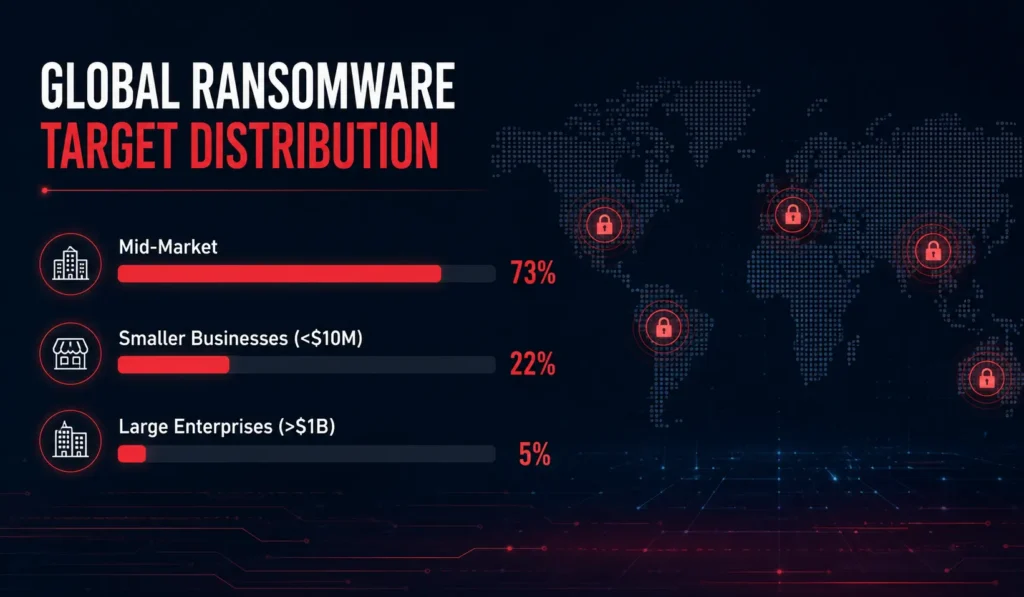
The Mid-Market Ransomware Focus: Comprehensive telemetry within the 2026 Black Kite Ransomware Report verifies that an overwhelming 73% of all global ransomware incidents with tracked financial data explicitly target mid-market organizations earning between $10 million and $1 billion annually. This high-risk industry concentration has remained stubbornly flat for three and a half consecutive years.
The Third-Party Vendor Squeeze: Supply chain connections heavily amplify this operational exposure. Mid-market companies find themselves caught in a dangerous double-bind—acting as integrated suppliers to massive enterprise buyers while simultaneously depending on hundreds of niche third-party vendors, typically with a lean internal IT team of two or fewer managing that entire external risk profile.
Severe Technical Patch Debt: Primary network breach points are heavily linked to uninsulated, internet-facing infrastructure vulnerabilities. Data reveals that 28.3% of audited mid-market operations maintain at least one known exploited vulnerability, while 54.7% carry a significant administrative patch-management failure within their perimeter defenses.
The Small-Team Governance Imperative: Implementing localized compliance architectures is no longer an optional security choice; it is a baseline survival rule. A staggering 34% of these mid-sized organizations currently function with zero formal security protocols, and 35% manage their day-to-day data pipelines completely detached from a structured risk management framework.
Table of Contents
Large Fortune 500 enterprises have successfully scaled their security budgets over the past several years, effectively forcing cybercrime syndicates to shift their attack paths toward mid-market companies and small businesses that manage massive data repositories but lack round-the-clock defense operations. The 2026 Black Kite Ransomware Report, titled “Mid-Market Is the Routine Target,” marks the first time Black Kite has examined the mid-market as a distinct segment in its own right, rather than as companies scattered anonymously through broader enterprise-wide studies.
The analysis draws on two independent datasets. The first tracks 13,336 disclosed ransomware and data extortion incidents carrying a verifiable annual revenue figure, drawn from 21,520 total reviewed records narrowed to 20,411 within the study’s North America and Europe geographic scope. The second dataset is an external security posture audit of 120,128 distinct mid-market organizations, capturing how these companies actually appear to an attacker scanning them from the outside, before any attack occurs.
Mid-market vulnerabilities have effectively turned independent businesses into primary targets for ransomware syndicates, not because they hold uniquely sensitive data, but because they combine meaningful ransom-paying capacity with materially weaker detection and monitoring infrastructure than enterprise-tier peers.
A dangerous delusion among mid-market business owners is the assumption that they are “too small to be targeted” by ransomware syndicates. They mistakenly believe hackers only care about hitting global banks or massive tech giants. What they completely ignore is that cybercrime networks treat mid-sized firms as high-value stepping stones. Your business might not have a billion-dollar valuation, but if you hold an unmonitored API connection, an active VPN tunnel, or a trusted supplier relationship with a Fortune 500 client, you are a goldmine. Attackers will compromise your weaker perimeter defenses specifically to pivot laterally into your largest enterprise customers, making your loose security controls a liability for your entire supply chain.
This technical briefing navigates through four core areas uncovered by the data: the mechanics behind the 73% mid-market concentration, the third-party and supply chain exposure surface, core technical and compliance vulnerability breakdowns, and an actionable roadmap for lean infrastructure teams.
SECTION 1: DECONSTRUCTING THE 73% MID-MARKET RISK ANOMALY
Out of the 13,336 ransomware incidents within the dataset containing verifiable financial metrics, 9,781 (73%) occurred squarely within mid-market revenue bounds. The remaining incidents were split between smaller businesses earning under $10 million (2,931 cases) and massive enterprise organizations generating $1 billion or more (624 cases). This intense industry concentration has remained remarkably flat year-over-year, tracking at 74.6% in 2023, 72.1% in 2024, 74.0% in 2025, and 72.3% during the first half of 2026. However, the absolute volume of mid-market infections surged by 44% over this three-and-a-half-year span, climbing steadily from 2,320 documented compromises in 2023 up to 3,340 in 2025.
Within the mid-market bracket itself, risk is heavily weighted toward lower financial tiers:
- The Lower Mid-Market ($10M–$50M): This sub-bracket represents the absolute majority of all victims, accounting for 50.5% in 2023, spiking to 57.2% in 2024, and stabilizing at 54.5% in 2025 and 53.9% in early 2026.
- The Core Mid-Market ($50M–$500M): This tier held a flat 40% to 45% share of the incident pool throughout the entire reporting window, though absolute victim counts climbed from 970 in 2024 to 1,474 in 2025.
- The Upper Mid-Market ($500M–$1B): Conversely, upper-tier organizations experienced a 64% decline in successful compromises over two years, dropping from 126 victims in 2023 down to 45 in 2025—though early 2026 data recorded a modest uptick of 29 victims compared to 21 during the same period the year prior.
Geographically, North American infrastructures bore the brunt of these campaigns, accounting for 72.4% (7,079) of the total 9,781 mid-market incidents, while European targets made up the remaining 27.6% (2,702). North American victim metrics jumped 64.7% between 2023 and 2025 (climbing from 1,568 to 2,582), whereas European incident rates remained flat. However, this regional trend inverted sharply during the first half of 2026: European mid-market compromises spiked 47.3% to reach 545 cases, while North American instances dropped 10.8%. The United States alone represents the single largest target landscape with 6,486 recorded victims; combined with the UK (612), Canada (593), Germany (411), France (303), Italy (302), and Spain (245), these seven nations absorb 91% of all global mid-market ransomware incidents.
Segmenting the data by vertical sector reveals that the Manufacturing industry alone swallows over a quarter of all mid-market ransomware campaigns: absorbing 2,521 of the 9,781 incidents (25.8%), which is more than the next two closest sectors combined. This is followed by Professional, Scientific, and Technical Services (1,453), Construction (671), Healthcare and Social Assistance (620), Wholesale Trade (540), Information (531), and Educational Services (525).
Manufacturing’s share of the breach pool widened from 20.7% in 2023 to 28.0% in 2025. Furthermore, comparing early 2026 data against 2023 baselines reveals that Construction compromises skyrocketed by 141.7% and Information tracks rose 88.5%, while Healthcare dipped slightly and Educational Services dropped 38.7%—marking the only sustained sector-wide decline across the full reporting window.
This targeted concentration reflects a clear, predatory economic logic exploited by modern cybercrime groups. Mid-market organizations are large enough to hold meaningful capital reserves capable of liquidating multi-million dollar extortion demands, yet they consistently lack the complex, continuous infrastructure monitoring tools and specialized security talent required to catch quiet intrusions early. This combination turns them into the ultimate sweet spot for threat actors looking to maximize financial margins with minimum technical friction.
SECTION 2: THE THIRD-PARTY EXPOSURE SURFACE AND SUPPLY CHAIN INFILTRATION
Every mid-market operation simultaneously balances two distinct corporate roles: acting as an upstream supplier to larger enterprise buyers, and serving as a downstream customer to smaller, niche vendors. The report frames this vulnerability directly: “Those two roles are usually treated as separate problems, handled by separate teams under separate budgets. In a mid-market company they are rarely handled by anyone at all.”
The business-to-business (B2B) nature of the sectors dominating mid-market breach volumes—including Manufacturing, Professional Services, Construction, and Wholesale Trade—means these entities are deeply integrated into the digital ecosystems of their corporate clients. A ransomware strike on a single parts supplier can instantly freeze an entire automotive assembly line; similarly, a breach at an outsourced IT services firm can expose customer databases and grant attackers an unmonitored gateway straight into client networks. Because of these cascading dependencies, regulatory bodies on both sides of the Atlantic are increasingly holding large enterprises accountable for the security postures of their suppliers, passing rigorous compliance and security questionnaire obligations straight down onto mid-market vendors.
- The European Framework (NIS2 Directive): Within the European Union, the NIS2 Directive’s Recital 56 explicitly outlines that small and medium-sized enterprises (SMEs) are targeted for supply chain intrusions precisely because they exhibit lower cybersecurity maturity and possess limited defensive resources. To address this, Article 21 mandates that covered entities actively govern the security of their direct supplier relationships rather than just monitoring internal enterprise environments. A strict size-cap rule pulls any mid-market organization meeting the medium-sized criteria defined in EU Commission Recommendation 2003/361/EC straight into scope.
- The United States Regulatory Landscape: In the United States, third-party governance arrives via a patchwork of sector-specific and state-level laws. New York’s strict financial services regulation (23 NYCRR 500) requires covered firms to enforce written policies for continuous due diligence over third-party service providers, offering no exemptions for lean operations. In the medical vertical, HIPAA holds covered entities directly accountable for a business associate’s breach if the organization knew, or reasonably should have known, of an insecure security pattern that violated their business associate agreement (BAA).
Granting unmonitored administrative access or persistent VPN tunnels to third-party contractors, marketing agencies, or outsourced IT vendors without enforcing strict zero-trust boundary limits is an absolute infrastructure disaster waiting to happen. Many mid-market companies hand over full domain administrative rights out of convenience, allowing an external developer to tweak a single application layer. The exact second that vendor’s local workstation is compromised by a basic infostealer malware infection, attackers inherit your administrative keys. They will use that un-throttled, trusted connection to bypass your firewall and deploy ransomware across your core database clusters, making a partner’s weak password hygiene your ultimate operational downfall.
On the buyer side, mid-market organizations routinely manage hundreds of vendor relationships with virtually zero centralized security oversight. The report reveals a massive resource deficit, noting a typical vendor-risk management (VRM) team size of just two or fewer individuals tasked with tracking a portfolio of over 300 suppliers. This systemic visibility gap forms long before active monitoring even begins; software tools enter the environment via department-level SaaS credit card purchases, unvetted free-tier utilities, and embedded software components that bypass formal procurement approvals.
This uncoordinated shadow IT ecosystem leaves corporate software inventories significantly shorter than the real list of third-party dependencies executing code across production environments. Supporting industry research from Techstrike underscores this lack of control, revealing that 34% of mid-market operations run with zero active security protocols, while 35% execute daily business tasks completely detached from any formal risk management framework.
SECTION 3: CORE COMPLIANCE AND VULNERABILITY BREAKDOWNS
Black Kite’s comprehensive external exposure audit evaluated 120,128 mid-market organizations—segmenting the pool into 41,960 lower-tier entities, 77,633 core-bracket operations, and 535 upper-tier firms. This massive scanning initiative maps out the exact technical security gaps and infrastructure vulnerabilities that cybercriminals intercept, analyzing the enterprise perimeter from the identical external vantage point an active threat actor uses during initial reconnaissance loops.
- Known Exploited Vulnerabilities (KEVs): Telemetry reveals that 28.3% of all audited mid-market operations maintain at least one verified Known Exploited Vulnerability that is actively being weaponized in the wild. This critical exposure rate climbs proportionally with corporate size, tracking at 23.9% for lower-tier companies, jumping to 30.1% across core mid-market systems, and hitting a peak of 32.0% among upper mid-market networks.
- The Patch Management Crisis: A staggering 54.7% of the entire monitored population carries a significant, high-risk patch-management failure on a public-facing system. This metric proves that over half of the mid-market landscape actively operates with at least one uninsulated, completely unpatched, and internet-exposed server running at any given time.
- High-Severity Exploitation Flaws: Exactly 48.1% of audited companies run infrastructure carrying a disclosed vulnerability rated 8.0 or higher on the Common Vulnerability Scoring System (CVSS), meaning nearly half of the entire mid-market market segment runs active operations on top of critical security flaws.
- Infostealer Logs & Credential Circulation: The data shows that 32.3% of tracked organizations match against active stealer-log data repositories. This means their legitimate employee login credentials, master session tokens, or internal corporate passwords have already been siphoned by stealthy infostealer malware families and are actively circulating on dark web criminal marketplaces. This specific leak exposure spikes dramatically as a company’s revenue band expands.
- Broken Email Authentication (DMARC): Domain defenses remain severely neglected, with 46.8% of businesses showing missing or fundamentally broken Domain-based Message Authentication, Reporting, and Conformance (DMARC) record rules. This gap allows external malicious threat actors to seamlessly spoof and forge official company email addresses, delivering phishing campaigns straight into client inboxes with perfect legitimacy.
The threat intelligence report highlights the deeper, systemic issue as a rapidly widening capacity gap between modern cybercriminal syndicates and under-resourced defensive teams. During 2025, out of a massive flood of roughly 48,000 newly disclosed vulnerabilities, only about 800 were ever successfully exploited in real-world environments (less than 2%).
Black Kite’s specialized supply-chain security research narrowed this pipeline down even further, pinpointing just 58 supply-chain-relevant threats that actually interacted with a monitored organization’s third-party vendor ecosystem. This data confirms that the true operational challenge is not the sheer volume of the 48,000-vulnerability flood itself. Rather, it is the intense, highly manual engineering labor required to isolate the exact 58 specific flaws impacting a company’s immediate systems or external suppliers—work that a lean mid-market IT department simply has zero staff capacity to execute at scale.
This defensive capacity gap is equally visible across corporate AI integration trends. While 30.36% of mid-sized European companies successfully integrated at least one functional artificial intelligence application into their core workflows by mid-2026, only 20% of mid-market operations report using automated AI tools specifically within their own internal security operations centers.
This stark contrast demonstrates an adoption gap that is significantly wider than generic business technology benchmarks suggest. The report’s strategic summary states the problem plainly: “The mid-market does not have to become more exposed in absolute terms to become a more efficient target; it only has to fall further behind the tier above it.”
SECTION 4: ACTIONS AND ROADMAP FOR LEAN INFRASTRUCTURE TEAMS
Converting these threat metrics into defensive corporate action begins by establishing continuous, automated monitoring across your entire external attack surface. A point-in-time vulnerability assessment is only technically accurate on the exact afternoon the scan is executed, whereas a cybercriminal’s view of your infrastructure vulnerabilities can shift dramatically the following week. Implementing ongoing, automated visibility over your externally visible digital footprint eliminates this visibility gap directly.
- Formalize Ongoing Third-Party Risk Vetting: Treat vendor security verification as a permanent, active process rather than a static onboarding checkbox. Because a typical mid-market vendor-risk management team consists of just two or fewer people handling over 300 supplier relationships, you must reject uniform tracking models that dilute your limited attention. Prioritize your active monitoring hours exclusively around the third-party providers that maintain the deepest lateral access routes into your production environment or process your highest-sensitivity corporate data datasets.
- Enforce a Living Software and Supplier Inventory: Mandate a centralized, continuously updated catalog indexing every software asset and external partner integration across your domain. This step is designed specifically to eliminate the department-level credit card shadow-purchasing gap that serves as the root cause of missing asset records. An infrastructure team cannot defend, patch, or monitor risk across a software dependency that it has never formally documented in the first place.
- Deploy Right-Sized Governance Frameworks: Align your baseline internal security settings with a modular compliance framework that fits your organization’s current scale. Do not attempt to duplicate complex, enterprise-level governance machinery using a fraction of the necessary employee headcount. Instead, channel your immediate administrative energy toward resolving the specific technical failures this threat report identifies as most prevalent: sealing unpatched public-facing systems, deploying missing DMARC email authentication records, and patching known exploited vulnerabilities (KEVs). These areas represent the exact, externally visible entry points that automated cybercrime scripts are actively scanning for across the mid-market landscape right now.
CONCLUSION & EXECUTIVE SUMMARY
The 2026 Black Kite Ransomware Report confirms with clear, quantitative evidence that the mid-market is not merely experiencing a temporary spike in security incidents; it has become the primary operational focus for modern ransomware networks. Cybercriminals return to this segment year after year due to its combination of high financial capital and soft defensive perimeters. Implementing a robust, small-team compliance strategy and enforcing continuous vendor security management are no longer optional security choices reserved for large enterprise budgets—they are foundational, baseline operational constraints required to guarantee business continuity across any firm managing a revenue footprint between $10 million and $1 billion.
The report’s central takeaway serves as a critical warning for all infrastructure operators: cybercriminals respond directly to the economic cost of execution. A mid-market organization does not need to introduce new technical vulnerabilities to become a highly attractive target for an attacker; it simply needs to fall further behind the rapidly expanding security capacity of the enterprise tier above it. Deploying continuous surface monitoring, maintaining honest third-party supplier inventories, and aligning internal controls with right-sized GRC frameworks are the exact mechanisms required to close this defensive gap before a breach occurs.
Hardening a mid-market organization against cascading third-party exposures requires transitioning to an automated, evidence-backed vendor oversight framework. What specific vendor risk management platforms, automated perimeter scanning tools, or standardized supply chain auditing questionnaires (such as SIG, CAIQ, or custom GRC templates) does your team deploy to evaluate external software dependencies across your network? Do you actively run automated risk scoring portals, or do you manage your vendor compliance files via manual internal spreadsheets? Drop a comment in the box below and share your implementation tips—let’s swap our administrative playbooks and shield our corporate perimeters together!
Related: Reconstructing the SolarWinds Hack Via 6 Corporate Safeguards – A step-by-step reconstruction of the SolarWinds hack, revealing how a trusted software update became the gateway to a stealthy, far-reaching supply-chain compromise.
Writing Corporate Security Policies via 3 Clean Core Templates – A practical guide to writing lean, enforceable corporate security policies that turn compliance requirements into clear, auditable day-to-day security practices.
Securing Pinecone Vector Databases Via 5 Proven Token Encryption Safeguards – Discover five proven security safeguards to protect Pinecone vector databases from credential exposure, unauthorized access, network threats, and sensitive data leakage.
The 2026 Sophos Adversary Report Analyzing Real Network Dwell Patterns – The 2026 Sophos Adversary Report reveals how attackers are winning through stolen identities, rapid Active Directory compromise, and after-hours ransomware—not sophisticated AI exploits.
FREQUENTLY ASKED QUESTIONS (FAQ)
Q1. If mid-market businesses are the primary target, why does mainstream media coverage still focus almost exclusively on large enterprise breaches?
Large enterprise breaches command more media attention because of widespread brand recognition and massive, headline-catching absolute dollar figures, even though they represent a far smaller percentage of total attacks. The report’s data addresses this discrepancy directly: focusing only on the largest market names creates a false impression that ransomware is mainly an enterprise crisis, when real-world incident metrics prove the opposite is true.
Q2. Does being classified as “mid-market” by revenue mean a organization automatically has fewer security resources than a similarly-sized company measured by employee count?
Not necessarily, but the dataset deliberately uses a revenue-only definition (excluding employee-count criteria) because threat actors pick targets based on ransom-paying capacity, which scales with revenue rather than headcount. A highly automated manufacturing firm with a small staff but $200 million in revenue faces the exact same targeting logic as a labor-intensive technical services firm pulling in identical revenue with thousands of employees.
Q3. Since North America and Europe moved in completely opposite directions in early 2026, does that mean ransomware syndicates are deliberately relocating their operations?
The analysis does not attribute this regional shift to an intentional geographic relocation by specific cybercrime groups; it highlights the regional reversal purely as an observed data pattern without claiming a definitive causal driver. Security professionals should treat this as an active trend to monitor rather than a confirmed strategic pivot, since a single half-year data block can reflect local law enforcement disruptions, varying disclosure laws, or temporary target adjustments.
Q4. If my organization falls into the “upper mid-market” band ($500M–$1B) where victim counts dropped the most, does that mean our real-world risk is now lower?
Not necessarily, it simply indicates that your tier holds a smaller share of the overall mid-market victim pool compared to lower and core mid-market companies. Crucially, the research does not attribute this decline to upper mid-market firms becoming significantly more secure. In fact, external scanning metrics (such as KEV rates and unpatched server findings) actually increase with organization size across most rows, suggesting the lower victim count may reflect pre-existing enterprise-grade defenses in select areas rather than a drop in attacker interest.
Q5. The report highlights a clear difference between a security questionnaire and an actual external vulnerability scan—which one should a lean team prioritize if resources are limited?
The report emphasizes that these two mechanisms are not substitutes for one another. A questionnaire is a static, point-in-time procurement document that your enterprise clients will continue to demand regardless of your preference. Conversely, an external vulnerability scan reveals exactly what an active adversary (or your client’s automated supply chain tool) can see about your perimeter right now. Prioritizing an external scan is far more actionable because it flags real, current infrastructure gaps you can patch before your next compliance reporting cycle arrives.
DISCLAIMER
Educational Notice: This article is published on AI Security Watch strictly for technical educational and general cybersecurity awareness purposes. The configurations and research discussed are based on public threat intelligence data. This content does not constitute professional IT architecture, legal, or financial advice. Because network configurations vary, always verify settings in an isolated test environment or consult with a qualified engineer before modifying live hardware or registries. AI Security Watch contains informational links to external resources; we are not responsible for third-party site accuracy or platform content.