
⚡ TL;DR — Key Takeaways
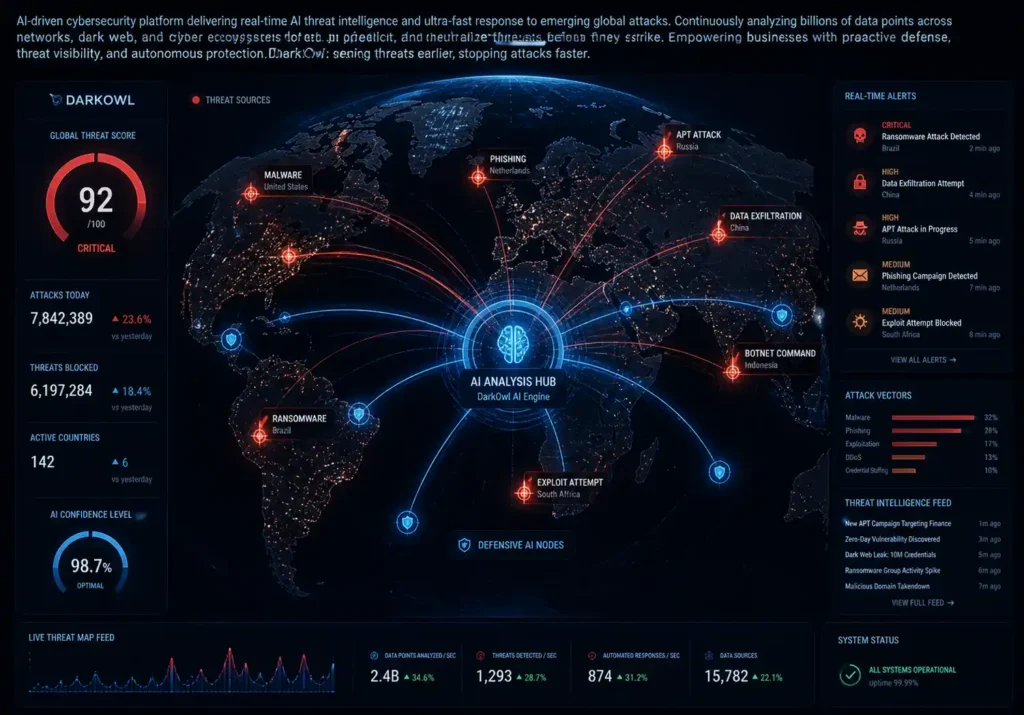
• AI threat intelligence is not a firewall or antivirus — it is a proactive system that collects, analyses, and acts on threat data before attacks reach your business.
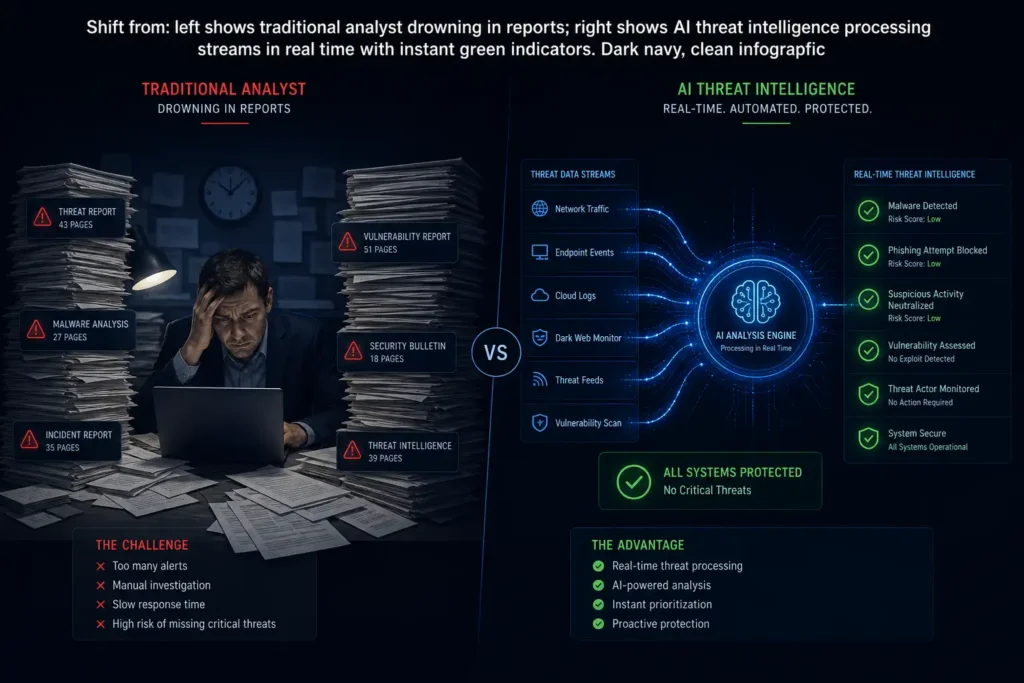
• Traditional threat intelligence relied on human analysts processing data manually. AI threat intelligence does this at machine speed — correlating millions of data points in seconds.
• According to IBM’s 2026 X-Force report, attacks exploiting public-facing applications rose 44% year-over-year. Businesses without threat intelligence are the targets.
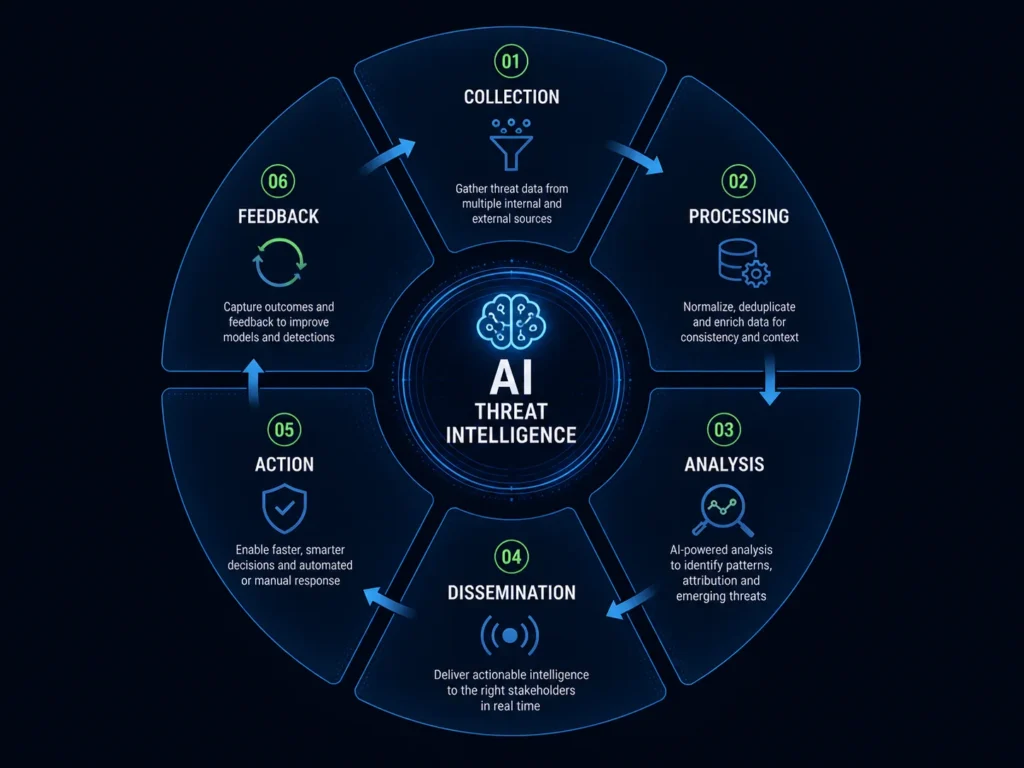
• AI threat intelligence covers six lifecycle stages: collection, processing, analysis, dissemination, action, and feedback — all automated in modern platforms.
• Tools like Microsoft Defender Threat Intelligence, IBM X-Force, Darktrace, and Cyware make AI threat intelligence accessible at every business size and budget.• The average cost of a cyberattack on a small business is $200,000 — more than enough to justify investment in AI threat intelligence at any scale.
Table of Contents
What is AI threat intelligence, and does your business actually need it? Yes — and you almost certainly already face the threats it is designed to stop. According to IBM’s 2026 X-Force Threat Intelligence Index, attacks exploiting public-facing applications rose 44% year-over-year and active ransomware groups surged 49% — driven by AI tools that help attackers identify weaknesses faster than ever. AI threat intelligence turns this threat data into automated defence before attacks reach you. This article explains what it is, how it works, which tools to use, and why every business needs it in 2026.
What Is AI Threat Intelligence?
AI threat intelligence is the use of artificial intelligence and machine learning to collect, process, analyse, and act on cybersecurity threat data at a scale no human team can match alone. According to Darktrace’s threat intelligence guide, it collects data from various sources within and outside your systems and conducts advanced analytics to produce actionable insights — not just alerts, but context, confidence scores, and recommended responses.
Traditional threat intelligence required human analysts to manually monitor feeds and make decisions. The volume of threat data in 2026 has made this approach impossible at any meaningful scale. Threat intelligence automates the bottleneck — ingesting millions of data points simultaneously, correlating signals across disparate sources, and delivering finished intelligence to the right people in time to act. It is not a firewall that blocks known threats. It is a system that monitors the threat landscape continuously, learns from patterns, and tells your defences what to expect before an attacker has chosen a target.
How AI Threat Intelligence Works: The 6-Stage Lifecycle
AI threat intelligence operates through a continuous six-stage lifecycle. According to Cyware’s threat intelligence platform guide, most organisations subscribe to dozens of threat feeds and ingest millions of indicators daily — yet still struggle to answer the fundamental question: what does this mean for us? AI threat intelligence solves that gap.
| AI THREAT INTELLIGENCE LIFECYCLE — HOW IT WORKS | ||
| Stage | What Happens | Without AI vs With AI |
| 1. Collection | AI aggregates data from endpoints, logs, dark web feeds, and global sensors simultaneously | Manual: analysts monitor a fraction of sources. AI: every source, 24/7, real time |
| 2. Processing | Raw data cleaned, normalised, de-duplicated. AI filters signal from noise | Manual: days per feed. AI: seconds at scale |
| 3. Analysis | Machine learning maps indicators to threat actor TTPs and assigns confidence scores | Manual: slow, experience-dependent. AI: millions of data points instantly |
| 4. Dissemination | Intelligence sent to the right teams — indicators to SIEMs, summaries to executives | Manual: analyst-written reports. AI: automated and real time |
| 5. Action | Defences automatically updated — firewall rules, detection signatures, response playbooks | Manual: hours to days. AI: automated blocking in minutes |
| 6. Feedback | AI learns from every incident, improving accuracy and reducing false positives | Manual: knowledge siloed in analysts. AI: institutional learning at scale |
The key development in 2026 is the shift from reactive to predictive. According to Cyble’s 2026 AI threat intelligence analysis, agentic AI is now being integrated into threat intelligence platforms — giving them the ability to evaluate scenarios, prioritise risks, and initiate responses at machine speed without human intervention.
Why Every Business Needs AI Threat Intelligence in 2026
The Threat Environment Has Changed Faster Than Most Defences
According to Microsoft’s March 2026 threat intelligence analysis, threat actors are now using AI operationally — generating synthetic identities, cloning executive voices, automating phishing at scale, and building agentic attack workflows with no human involvement. Threat intelligence is designed to operate at the same speed — monitoring for behavioural signals and attack indicators that precede a breach and triggering defences before the attack lands.
Small Businesses Are a Primary Target — Not an Afterthought
According to Hi Tech Hui’s 2026 IBM X-Force analysis, AI boosts the effectiveness of phishing and credential attacks to a degree that makes small businesses viable targets at scale. The average cost of an attack is $200,000 — existential for most SMBs. AI threat intelligence turns potential breaches into blocked attempts.
70% of Security Professionals Are Already Seeing Positive Results
According to a 2025 ISC2 survey cited in BizTech’s Google Cloud Next 2026 coverage, 70% of cybersecurity workers are already seeing positive results from AI-powered security tools. At Google Cloud Next 2026, security leaders declared AI threat intelligence an operational necessity — not a competitive advantage but a baseline requirement. Businesses that have not yet integrated it are falling behind the standard their threats already operate at.
AI Threat Intelligence Tools Available to Businesses in 2026
AI threat intelligence is accessible at every budget level in 2026:
• Microsoft Defender Threat Intelligence — Built into Microsoft’s security ecosystem, this threat intelligence tool provides real-time threat data and attacker profiles drawn from 65 trillion daily signals — directly accessible for Microsoft 365 and Azure customers.
• IBM X-Force Threat Intelligence — One of the most respected AI threat intelligence platforms. The annual X-Force Index provides strategic intelligence for security planning at any business size.
• Google Chronicle — Google’s cloud-native platform ingests and analyses security telemetry at Google-scale, providing automated threat hunting through threat intelligence.
• Darktrace — An AI-native platform using unsupervised machine learning to model normal behaviour for every user and device, then flagging deviations in real time. Particularly strong for network and endpoint threat intelligence.
• Cyware — A threat intelligence platform focused on operationalising threat intelligence — automating ingestion, correlation, and response workflows across SIEMs, SOAR tools, and security teams. Strong for organisations that need to share intelligence across teams or industry partners.
How to Get Started with AI Threat Intelligence — Practical Steps
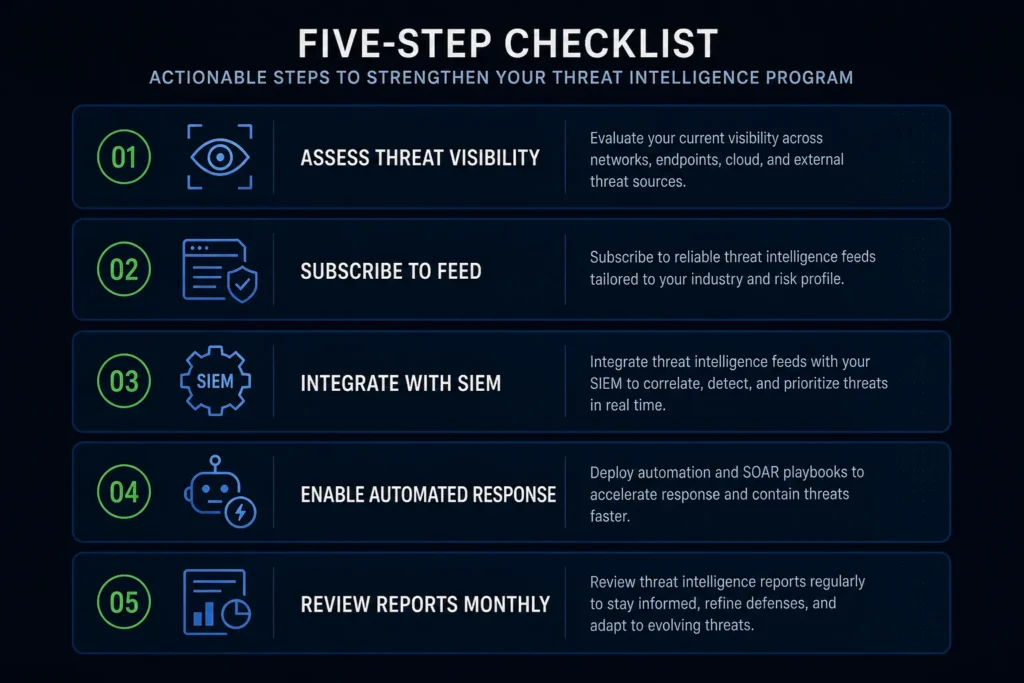
• Step 1 — Assess your current threat visibility. Map what data you already collect — endpoint logs, firewall logs, email alerts, cloud access logs. AI intelligence needs data to work with. Know what you have before adding anything new.
• Step 2 — Subscribe to a free AI threat intelligence feed. CISA, AlienVault OTX, and IBM X-Force Exchange all provide threat intelligence data at no cost. This is the fastest way to add external intelligence to your existing defences.
• Step 3 — Integrate AI threat intelligence with your SIEM. Splunk, Microsoft Sentinel, and Chronicle all accept external threat intelligence feeds. Connecting threat intelligence data to your existing tools immediately improves detection without replacing anything.
• Step 4 — Enable automated response. The value of AI threat intelligence degrades rapidly if it takes humans days to act on it. Configure tools to automatically block IPs, isolate devices, or trigger alerts when intelligence thresholds are crossed.
• Step 5 — Review strategic AI threat intelligence reports quarterly. Reports like the IBM X-Force Index should reach business leaders quarterly to inform budget and operational decisions. The threat landscape your business faces in Q3 2026 will differ from Q1. Your defences must adapt.
Verdict: AI Threat Intelligence Is No Longer Optional in 2026
AI threat intelligence answers the question traditional tools cannot: what is being planned against us right now, and how do we stop it before it arrives? The 44% increase in AI-enabled attacks in IBM’s X-Force 2026 report is not a prediction — it is last year’s data.
You do not need to start with a full-scale deployment. Subscribe to a free threat feed. Integrate it with your SIEM. Enable automated blocking on the highest-confidence indicators. Review a strategic threat intelligence report this quarter. Each step moves your business from reacting to attacks to being positioned to prevent them.
For more on how AI threat intelligence connects to specific threats, read our guide on the 5 worst data breaches of 2026 and the 7 deadly AI cyberattacks businesses must prepare for.
Related: AI Threat Detection: How It’s Redefining Cybersecurity in 2026 — the foundational overview that pairs with this guide.
FREQUENTLY ASKED QUESTIONS
Q1. What is AI threat intelligence in simple terms?
AI threat intelligence uses artificial intelligence to collect, analyse, and act on cybersecurity threat data before attacks reach you. Unlike traditional tools that react to attacks, AI threat intelligence identifies warning signs in advance and triggers defensive action automatically. Think of it as a global early-warning radar for cyber threats — running continuously at machine speed.
Q2. Do small businesses need AI threat intelligence?
Yes. AI has made it cheap for attackers to scan millions of businesses for weak points simultaneously. The average cyberattack costs a small business $200,000 — and 60% go out of business within six months of a significant incident. Free threat feeds from CISA, IBM X-Force Exchange, and Microsoft Defender’s built-in AI threat intelligence capabilities give small businesses meaningful coverage at low or no cost.
Q3. What is the difference between threat intelligence and AI threat intelligence?
Traditional threat intelligence required human analysts reading reports and manually processing data feeds. AI threat intelligence automates the entire lifecycle — ingesting millions of data points from hundreds of sources, correlating and analysing at machine speed, scoring threats automatically, and distributing intelligence to the right teams in real time. Same output, but orders of magnitude faster and more accurate.
Q4. What are the best free AI threat intelligence resources for businesses?
The best free AI threat intelligence resources in 2026: CISA free threat feeds and advisories; IBM X-Force Exchange — free platform with indicators of compromise; AlienVault OTX — community-driven feed with millions of real-time indicators; Microsoft Defender Threat Intelligence — free for Microsoft 365 and Azure customers; and the annual IBM X-Force Threat Intelligence Index — a comprehensive free report with actionable recommendations for all business sizes.
SOURCES
1. IBM — 2026 X-Force Threat Intelligence Index (Newsroom)
2. Microsoft Security Blog — AI as Tradecraft: How Threat Actors Operationalize AI
3. BizTech — Google Cloud Next 2026: Agentic AI Operational Necessity for Security
4. Cyble — Top 5 Breakthroughs in AI Threat Intelligence 2026
5. Cyware — What Is a Threat Intelligence Platform?
6. Darktrace — Threat Intelligence: How It Applies to Cybersecurity
7. Palo Alto Networks — What Is the Role of AI in Threat Detection?
8. Hi Tech Hui — AI-Powered Cyberattacks: What Small Businesses Need to Know
9. aisecuritywatch.com — AI Threat Detection 2026
10. aisecuritywatch.com — The 7 Deadly AI Cyberattacks 2026
11. aisecuritywatch.com — The 5 Worst Data Breaches of 2026
DISCLAIMER
This article is for educational and informational purposes only. Tool mentions are for informational purposes and are not sponsored. For full editorial standards, see aisecuritywatch.com/disclaimer.