
Picture this. A hacker breaks into your company’s network. Within four minutes, they have moved from the entry point to your most sensitive servers. Your security team doesn’t even know they are there yet.
That’s not a hypothetical. That’s what actually happened in the fastest incidents recorded in 2025, according to ReliaQuest’s 2026 Annual Threat Report. And its exactly the kind of scenario that traditional cybersecurity tools, the kind built around rule books and known-threat libraries, simply cannot handle.
This is where AI threat detection comes in. Its one of the most significant shifts in cybersecurity in a generation, and in 2026, it’s no longer a futuristic concept. It’s the technology that’s keeping organisations one step ahead of attackers who are themselves using AI to strike faster, smarter and harder than ever before.
In this article, we will break down what AI threat detection actually is, how it works, why it matters and what the real-world data says about its impact. No jargon – just in simple terms, for you.
Why did the old way of detecting threats stop working?
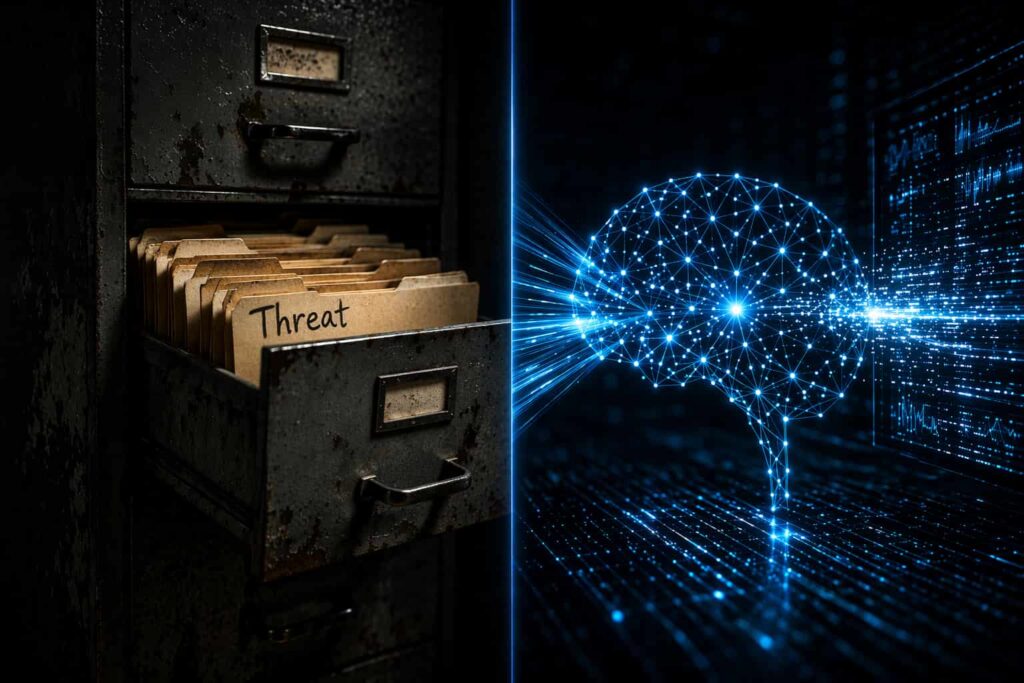
For most of the internet age, cybersecurity worked by building a list of known threats, specific virus signatures, malicious IP addresses, suspicious file patterns and checking everything coming into a network against that list. If something matched, it was blocked. If it didn’t match, it was let through. Something had to change. And that something is AI threat detection.
So what exactly is AI threat detection?
Basically, AI threat detection is cybersecurity that learns. Instead of relying on a pre-written rulebook of known bad things, it uses machine learning to study what normal looks like and then flag anything that deviates from that normal, even if it’s never been seen before.
Think of it like a security guard who knows every single employee’s face, their usual working hours, which doors they normally use, and how many files they typically access in a day. The moment someone starts behaving differently, logging at 3 am, accessing folders they have never touched, downloading unusual volumes of data, the guard notices. Even if the person looks perfectly legitimate on paper.
That’s the core principle of modern AI threat detection: it understands context and behaviour not just identities and signatures. There are 3 main ways it does this:
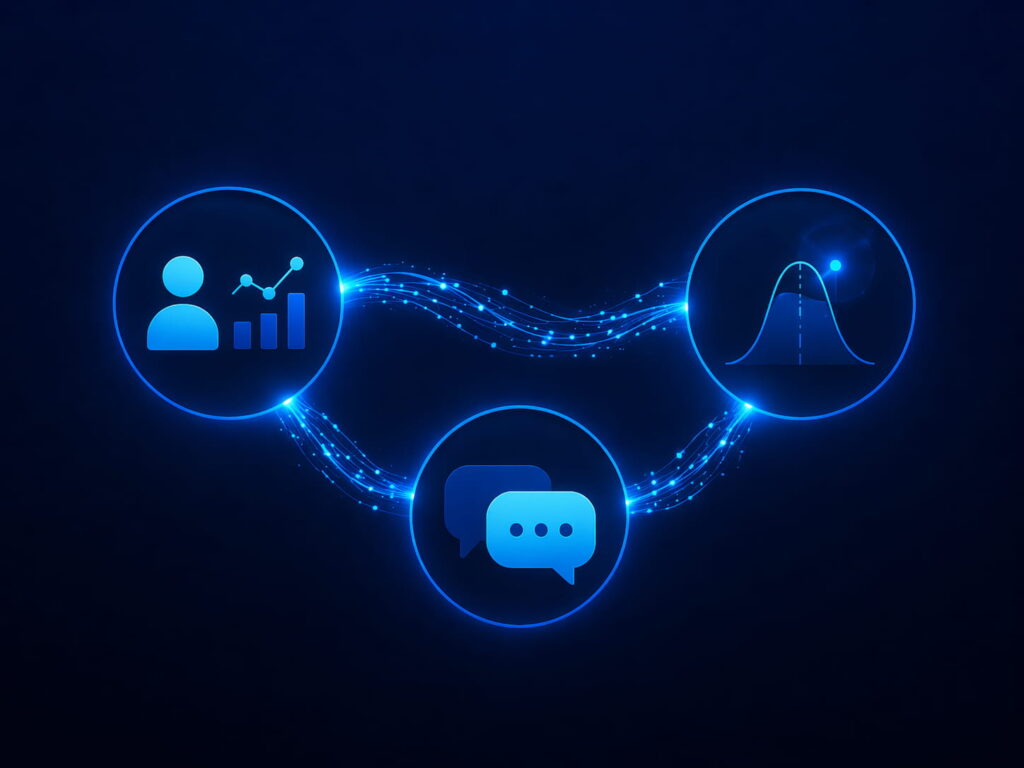
- Behavioural Analytics: The AI builds a baseline of what normal activity looks like for every user and device. Any significant deviation, unusual login times, unexpected data transfers, abnormal network traffic, triggers an alert, even if the specific action has never appeared in any threat detection.
- Anomaly Detection: Rather than looking for specific threats, the system watches for statistical outliers across the entire environment. Something doesn’t need to match a known attack pattern to be flagged, it just needs to be unusual.
- Natural Language Processing(NLP): This is what powers AI email security. Instead of just checking links and attachments, the AI reads and understands the content of messages, spotting impersonation attempts, manipulation tactics and social engineering language that a rule-based filter would completely miss.
The uncomfortable truth: attackers are using AI too
Here’s what makes AI threat detection so urgent in 2026: the people trying to break into systems are not using the old playbook any more. They have adopted AI just as aggressively and in some areas, they got there first.
“With AI-driven phishing volume surging by over 1,200% in 2025, lures are now linguistically perfect, hyper-personalized, and contextually relevant.” Kobalt.io

Those aren’t just more phishing emails, they are better ones. Grammatically perfect. Personally tailored. Written in style that matches the person supposedly sending them. Traditional spam filters, which were trained to catch clumsy mass-email campaigns, were not built for this.
It goes beyond email. According to the IBM X-Force Threat Intelligence Index 2026, exploitation of public-facing applications increased by 44% last year, driven significantly by AI tools that scan for vulnerabilities automatically, no human hacker needed at the keyboard.
Deepfakes have become a serious corporate fraud tool. Attackers are now creating convincing audio and video replicas of executives, using them to authorise fake wire transfers, override security protocols, or manipulate employees into handing over access credentials. This financial sector has seen a 47% year-on-year increase in AI-enhanced malware and remains the top target for this kind of attack, according to All About AI’s AI Cyberattack Statistics 2026.
And Trend Micro’s 2026 Security Predictions report warns of something even more alarming: agentic AI is now handling entire portions of the ransomware attack chain, reconnaissance, vulnerability scanning, even ransom negotiations, with zero human involvement form the attacker.
The attack is automated. The response has to be too. That’s the driving force behind AI threat detection.
How AI threat detection catches what humans can’t?
One of the most practical advantages of AI threat detection is sheer scale. A human analyst cannot memorise the normal behaviour of 10,000 employees. An AI model can, and it can monitor all of them simultaneously, around the clock, without fatigue.
Behavioural AI threat detection doesn’t need to know what an attack looks like. It only needs to know what normal looks like. Any deviation from that baseline, however novel the attack, triggers investigation.
This is particularly powerful for catching what security teams call ‘low and slow’ attacks, intrusions where the attacker moves very carefully, doing nothing dramatic enough to trip an obvious wire. These are exactly the attacks that human analysts, overwhelmed by higher-priority alerts, tend to miss.
The State of AI cybersecurity 2026 report found that anomaly detection and novel threat identification are the areas where AI delivers its greatest impact, cited by 72% of security professionals. This makes sense: AI’s strength is pattern recognition at scale, and catching novel threats – things that have never appeared in any rulebook – is exactly where that strength shines.
Platforms like Darktrace are built entirely on this principle, continuously building behavioural models for every entity in an environment and flagging anything that deviates. Crowdstrike’s Falcon uses AI threat detection to correlate signals across identity systems, endpoints, network traffic and cloud environments – giving analysts a complete picture instead of isolated alerts that individually look innocent.
The rise of agentic SOC: AI that acts, not just alerts
For most of cybersecurity history, detection was only the first step. After AI threat detection flagged something suspicious, a human analyst still had to investigate it, gathering evidence, correlating data across multiple systems, determining severity, and then deciding what to do. In a world where attackers move in four minutes, that process taking hours is a problem.
The most significant development in AI threat detection in 2026 is the shift toward systems that don’t just alert – they act. These are called agentic AI systems, and they are transforming how security operations centers(SOCs) work.

Here’s what this looks like in practice. A suspicious login attempt is flagged. Instead of sitting in an analyst’s queue waiting to be reviewed, an AI agent immediately begins investigating: it pulls login history, checks the device’s behaviour, reviews recent file access, cross-references the IP address and assesses whether this matches any known attacker patterns. By the time an analyst opens their dashboard, the investigation is already done – the agent has either contained the threat automatically or presented a fully assembled case for the analyst to review.
“76% of defenders say AI agents now handle more than 10% of their SOC workload. Large enterprises expect 30%+ of SOC workflows to be executed autonomously by agents by the end of 2026.” – Vectra AI SOC Operations Guide 2026
Microsoft published a detailed whitepaper on this approach in April 2026, describing the agentic SOC as a three-layer model: automated systems handle the clear-cut threats instantly; AI agents investigate the ambiguous ones and assemble evidence; human analysts make the final strategic calls on complex cases. Humans aren’t removed – their role is elevated. Less time spent on manual data gathering, more time spent on the decisions that actually require human judgment.
The results are measurable. Google Cloud Security reports that organisations using its AI-powered security operations are seeing a 50% faster Mean Time to Respond(MTTR). Microsoft Security Copilot users report a 30% improvement in the same metric. Some platforms are processing security alerts up to 20 times faster than traditional methods.
The numbers that make the case
If you want to understand why AI threat detection has become such a priority in 2026, the data tells a pretty compelling story.
“$4.44 million – the global average cost of a single data breach in 2026.” – IBM’s Cost of Data Breach 2025
“Organisations using AI-powered detection save an average of $1.9 million per breach and cut their breach lifecycle by 80 days. – IBM’s Cost of Data Breach 2025
“AI threat detection delivers 95% detection accuracy versus 85% for traditional systems, and cuts incident response times by 30-50%.” – AllAboutAI – AI Cyberattack Statistics 2026
“77% of organisations now use generative AI or large language models in their security stack. 67% have deployed agentic AI for autonomous or semi-autonomous security operations.” – State of AI Cybersecurity 2026 (kiteworks)
“623 ransomware incidents were recorded in October 2026 alone – the sixth consecutive monthly increase and up 50% year-to-date.” – Cyble Threat Landscape Report
The last number matters. Even as AI threat detection improves rapidly on the defender side, the volume of attacks continues to grow. AI is not a foolproof fix; it’s a tool that makes it possible to keep up.
What AI threat detection still can’t do
It wouldn’t be an honest assessment without talking about the limits. AI threat detection is genuinely transformative, but in 2026, it comes with real challenges that organisations need to understand.
The biggest one isn’t technology – it’s people. According to the State of AI Cybersecurity 2026 report, the number-one barrier holding organisations back from effective AI threat detection is not budget, and it’s not headcount. It’s a lack of knowledge and skills related to AI. Nearly 46% of organisations admit they are not adequately prepared for AI-powered threats, and despite near-universal adoption of AI tools, satisfaction with those tools ranks last among SOC technologies in the SANS 2025 survey.
Organisations are buying the tools. They just can’t always use them to their full potential yet.
There’s also the governance question. As AI threat detection systems become more autonomous – automatically isolating devices, revoking access, blocking traffic – the question of what happens when the AI gets it wrong becomes genuinely important. An AI agent that mistakenly locks out a senior executive during a critical business period is a real operational risk. Clear rules about what AI is allowed to do autonomously and what still requires human approval are essential, and many organisations haven’t written those rules yet.
Finally, the adversarial arms race is real. The same capabilities that make AI threat detection powerful – pattern recognition, automation, continuous learning – can be turned against defences. Attacks are already probing AL detection systems to understand what triggers alerts and what doesn’t. The technology isn’t static on either side.
What you can actually do to protect your business from Cybersecurity
Whether you are running IT security for a large organisation or just trying to understand what ‘good’ looks like for a smaller business, AI threat detection doesn’t have to feel overwhelming. Here’s a practical way to think about it:
- Check what your current tools actually do: Are they signature-based, matching known threats, or do they use behavioural analytics and anomaly detection? If it’s mostly the former, your detection capability has a meaningful gap when it comes to novel, AI-generated attacks.
- Prioritise quality of alerts over quantity: More alerts is not better security. The best AI threat detection systems reduce the noise, giving analysts fewer, higher-confidence alerts with context already assembled, rather than hundreds of raw signals to manually investigate.
- Look into agentic AI for your SOC if your team is stretched: If analysts are spending most of their time on repetitive triage tasks, gathering evidence, correlating data, writing up findings, this is exactly the work agentic AI threat detection tools are built to automate.
- Define what AI is allowed to do on its own: Before deploying any autonomous AI threat detection and response capability, establish clear governance: which containment actions can happen automatically and which ones need a human to approve first. Set those rules before an incident, not during one.
- Invest in training alongside technology: The skills gap is real and it’s the biggest barrier to getting value from AI threat detection. If your team can’t interpret what the AI is flagging, understand why it made a certain call, or now when to override it, the technology underperforms regardless of how good it is.
For a practical example of AI-powered protection in action, see our detailed breakdown of Malwarebytes Free vs Premium 2026 and what the Katana AI engine actually does in real time.
The bottom line

The story of AI threat detection in 2026 isn’t about technology, it’s about speed.
Attackers are operating at machine speed, automating, reconnaissance, generating personalised lures, moving through networks in minutes. Human-speed defence, built around manual processes and known-threat libraries, simply cannot keep pace with that. AI threat detection is the response the industry has built: systems that learn what normal looks like, notice when something deviates from it, investigate autonomously, and contain threats in the time it would take a human analyst to open their email.
The data backs it up. $1.9 million saved per breach. 80 fewer days of exposure. 95% detection accuracy. 50% faster response times. These aren’t marginal improvements, they are the difference between catching an attack before it escalates and reading about your own data breach in the news.
The honest caveat is that AI threat detection is a tool, not a silver bullet. It requires skilled people to operate it, governance frameworks to guide its autonomy and continuous investment to keep pace with attackers who are using the same underlying technology. But for organisations that get the combination right, the results in 2026 are genuinely compelling.
The question isn’t whether AI threat detection is worth investing in. The data has answered that. The question is how fast your organisation can put it to work.
Related reading: https://aisecuritywatch.com/ai-threat-intelligence-2026/
Disclaimer: This article is for educational purposes only and does not constitute professional cybersecurity advice. This article contains no affiliate links. For articles that do contain affiliate links, see our full Affiliate Disclosure policy.
For full details on our editorial standards and affiliate policy, please read our Disclaimer.
The detail “Think of it like a security guard who knows every single employee’s face, their usual working hours, which doors they normally use, and how many files they typically access in a day.” stood out because it turns the broader topic into something specific. Has your view of that point changed since publishing? Disclosure: I am associated with
evidence-backed idea research , a separate product-idea research tool.