
⚡ TL;DR — Key Takeaways
- Analyzing the Stuxnet exploit reveals the moment cyberattacks stopped being purely digital: a piece of malware physically destroyed industrial hardware for the first time in documented history.
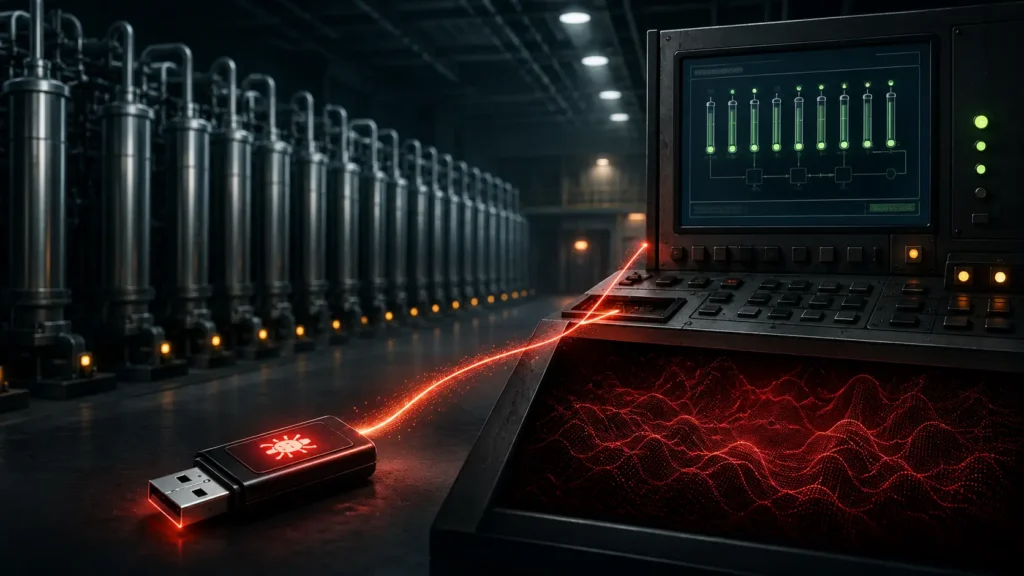
- The initial intrusion vector bypassed the internet entirely, riding into a fully air-gapped facility on an infected USB flash drive carried by a human.
- The payload weaponized four distinct zero-day vulnerabilities simultaneously, an unprecedented number for a single campaign, alongside stolen digital certificates to evade detection.
- The physical result was the destruction of an estimated 1,000 uranium enrichment centrifuges at Iran’s Natanz facility, and the incident permanently reshaped supply chain and vendor segmentation compliance standards worldwide.
Table of Contents
In 2010, security researchers uncovered a self-replicating malware payload weighing in at roughly 500 kilobytes, well under 1 megabyte, that shattered a core assumption of industrial cybersecurity: the physical network “air gap” (source: Symantec, “W32.Stuxnet Dossier,” Falliere, Murchu & Chien, 2011 — hosted via Internet Archive). This weapon was engineered to specifically target Siemens Step7 software environments controlling specialized frequency converter drives inside Iran’s Natanz nuclear enrichment facility (source: CSS ETH Zürich, “Hotspot Analysis: Stuxnet”).
Analyzing the Stuxnet exploit is a mandatory exercise for modern business leaders, operational technology (OT) directors, and risk officers precisely because of what it disproved. Natanz’s control systems were deliberately isolated from the internet, and that isolation still failed to stop a determined, well-resourced attacker.
An air-gapped network is not automatically a secure network. Stuxnet proved that human behavior, specifically the physical handling of removable media, can bridge any digital moat an organization builds.
As a GRC analyst, I find the core history of this incident deeply sobering because it represents the exact moment software permanently crossed the boundary from digital data bits into physical, destructive reality. For decades, the worst-case scenario for a security failure was data exfiltration, system downtime, or a corrupted operating system file registry. Analyzing the Stuxnet exploit forces corporate executives to confront a much more terrifying reality: a weaponized string of logic can command physical concrete-and-steel machinery to literally tear itself apart. It completely alters our threat modelling parameters from protecting information databases to actively safeguarding human life, mechanical assets, and physical infrastructure perimeters.
This case study walks through five strategic lessons drawn directly from the Stuxnet incident: the air-gap illusion, multi-zero-day defense, PLC and vendor software security, digital certificate integrity, and modern network segmentation architecture.
Why Analyzing the Stuxnet Exploit Matters for Corporate Risk
It’s tempting to file Stuxnet away as a nation-state weapon irrelevant to ordinary businesses. That framing misses how directly its techniques have trickled down into commercial threat activity over the past decade.
Targeted industrial sabotage is no longer confined to nuclear facilities. Manufacturing plants, logistics hubs, food and beverage production lines, and utility providers now run on the same category of programmable logic controllers (PLCs) and human-machine interfaces (HMIs) that Stuxnet demonstrated could be silently manipulated.
Ransomware groups and criminal actors have since adapted Stuxnet-era techniques, including PLC targeting and stealth manipulation of monitoring data, for purely financial extortion against mid-market manufacturers. A company doesn’t need to be a geopolitical target to inherit this same category of operational technology risk; it only needs a connected production line and a vendor relationship somewhere in its supply chain.
Lesson 1: Deconstructing the Air-Gap Illusion via USB Vector Controls
Stuxnet’s infection chain didn’t rely on any internet-facing pathway at all. It was carried physically into the Natanz facility on a compromised USB flash drive, exploiting a Windows shortcut file (LNK) vulnerability that executed malicious code automatically the moment the drive’s contents were viewed (source: Institute for Science and International Security, “Stuxnet Malware and Natanz”).
This is the core lesson behind analyzing the Stuxnet exploit for any modern organization: your most expensive network perimeter defenses are irrelevant the moment a single employee inserts an unvetted physical device into a workstation. No firewall, intrusion detection system, or network monitoring tool sits between a USB port and the operating system it’s plugged into.
Governance controls need to address this directly, not just technically. Formal policies restricting or disabling removable media ports on machines with any connection to operational technology, combined with a documented process for vetting any external device before it touches a corporate or industrial workstation, close the exact gap Stuxnet exploited.
Let me hand you an explicit, non-negotiable policy warning that every operational technology manager needs to enforce immediately: a single employee or outside contractor plugging an unvetted personal USB drive into a corporate machine can instantly bypass millions of dollars in enterprise firewall architecture. It does not matter how robust your network monitoring layers are if your physical access endpoints are left open to casual human carelessness. In our risk frameworks, we mandate the physical removal or software-level disablement of all unused USB ports on operational machines, forcing all required files to travel through strict, isolated staging inspection airlocks first.
Lesson 2: Mitigating Multi-Zero-Day Cascades through Defense-in-Depth
Once inside, Stuxnet’s payload weaponized four distinct zero-day vulnerabilities simultaneously, an unprecedented scale for a single campaign at the time of its discovery. These included the LNK shortcut execution flaw (CVE-2010-2568), a Print Spooler service vulnerability enabling remote code execution across networked systems (CVE-2010-2729), and two separate privilege escalation vulnerabilities used to gain SYSTEM-level administrative control (source: CSO Online, “Stuxnet explained: The first known cyberweapon”).
A single zero-day alone was historically rare and valuable; reports at the time noted a single such exploit could fetch six figures on black markets. Stuxnet’s developers burned through four in one coordinated operation, a clear signal of substantial, likely state-level resourcing behind the campaign.
The governance lesson here is architectural: any security model built around a single boundary shield, one firewall, one endpoint tool, one detection layer, fails completely the moment an attacker has this many simultaneous bypass paths available. Defense-in-depth means layering independent controls so that a failure in any single layer doesn’t cascade into full compromise, which is precisely what allowed Stuxnet to move undetected through multiple systems at once.
Lesson 3: Securing Programmable Logic Controllers (PLCs) and Vendor Software
Stuxnet’s most sophisticated capability wasn’t gaining access; it was what it did once inside. The malware specifically targeted Siemens PLCs, altering the rotational frequency commands sent to centrifuge motors while simultaneously feeding pre-recorded, normal-looking sensor data back to the SCADA monitoring interface operators relied on (source: CSO Online, “Stuxnet explained: The first known cyberweapon”).
Operators watching their monitoring screens saw nothing unusual while their equipment was actively being destroyed. This is the defining characteristic that separates OT-targeted attacks from typical IT breaches: the attacker isn’t just stealing data, they’re actively deceiving the humans responsible for physical safety oversight.
Any organization running PLCs, industrial vendor software, or SCADA systems needs governance controls that treat monitoring interface integrity as a security-critical function in its own right, not just a operational convenience. This means auditing vendor software update paths, restricting who can push configuration changes to PLC logic, and never assuming that a clean-looking dashboard confirms clean underlying system behavior.
Lesson 4: Hardening Digital Certificate Authorities Against Supply Chain Spoofing
Forensic analysis revealed that Stuxnet used valid, stolen digital certificates from two legitimate Taiwanese hardware companies, RealTek and JMicron, to sign its driver files (source: History Rise, “The Stuxnet Attack: Cyber Intelligence Failures in Iran’s Nuclear Program”). This allowed the malware’s kernel-level drivers to pass Windows’ built-in signature verification checks, appearing to the operating system as legitimate, trusted hardware software.
This detail exposes a supply chain trust assumption most organizations still rely on today: a valid digital signature is treated as sufficient proof of legitimacy, when in reality it only proves the certificate itself hasn’t been revoked. If the certificate’s private key has been stolen, the signature becomes a tool for deception rather than verification.
Governance responses should include maintaining active certificate revocation monitoring, treating any vendor’s compromised certificate disclosure as an urgent internal audit trigger, and not relying on code-signing status alone as a complete security control for third-party software entering your environment.
Lesson 5: Establishing Stateful Air Gaps and Strict Network Segmentation
The final lesson from analyzing the Stuxnet exploit is architectural: isolation only works when it’s actively maintained and monitored, not simply declared once and left unchecked. A “stateful” air gap assumes that even physically isolated environments need ongoing verification that no unauthorized bridge, human or technical, has been introduced since the last audit.
Critical operational technology environments should be segmented from corporate Active Directory and general business IT networks with hard boundaries, not just VLAN-level separation that a determined attacker or careless administrator can bypass. Any legitimate need for data to cross that boundary, firmware updates, diagnostic exports, vendor patches, should flow through a controlled, logged, and ideally one-directional transfer process rather than open bidirectional connectivity.
Regular penetration testing specifically targeting the boundary between IT and OT environments, not just the perimeter facing the public internet, closes the exact class of gap that made Stuxnet’s operation possible in the first place.
Conclusion
Analyzing the Stuxnet exploit ultimately reveals that even the most sophisticated attack in cybersecurity history relied on a fundamentally human vulnerability: the assumption that physical isolation and vendor trust require no ongoing verification. Four zero-days, stolen certificates, and precisely targeted PLC manipulation all mattered, but none of it would have worked without a single infected USB drive crossing a boundary nobody was actively watching.
Continuous, data-driven security governance, not a one-time architectural decision, is what actually defends operational technology and physical asset perimeters from modern cyberattacks. The threat landscape has moved well past nation-state targets into commercial manufacturing and infrastructure, meaning the lessons Natanz taught the world in 2010 are now every OT director’s operational responsibility.
Implementing strict perimeter isolation requires moving completely past static policy configurations and enforcing active, behavioral audits across your supply chain networks. What specific operational technology tracking protocols or supply chain vendor audits do you utilize to shield your physical assets and industrial endpoints? Do you deploy hardware-enforced unidirectional security gateways, enforce mandatory cryptographic verification on all third-party firmware packages, or manage your device perimeters via continuous air-gap validation audits? Drop a comment in the box below and share your industrial governance strategies—let’s share our compliance playbooks and keep our infrastructure protected!
Related: Blocking AI Resume Screeners Via 3 Proven Rules to Pass Job Screenings – Beat AI resume screening without gimmicks: optimize for clean ATS-friendly formatting, honest keyword alignment, and stronger privacy protection.
2026 Verizon DBIR Report: Executive Threat Intelligence Briefing – The 2026 Verizon DBIR reveals a shifting threat landscape in which the exploitation of vulnerabilities, ransomware, third-party risk, and Shadow AI are reshaping enterprise cybersecurity priorities.
Passing a SOC 2 Audit Via 5 Rigid Compliance Controls to Avoid Risks – Passing a SOC 2 audit requires more than policies—it demands continuous, provable controls across access, change management, encryption, monitoring, and vendor risk.
Dissecting the Creeper Worm Via 4 Forensic Analysis Steps of the First Cyberattack – Creeper, the experiment that pioneered self-moving code in 1971, offers a fascinating look at how network trust, malware propagation, and the first cybersecurity countermeasure shaped modern cyber defense.
Frequently Asked Questions (FAQ)
Q1. Has Stuxnet’s source code or techniques ever been reused by other attackers since 2010?
Yes, related malware families like Duqu and Flame, discovered in 2011 and 2012, were built by developers with access to Stuxnet’s source code or shared toolchains, according to Symantec’s own follow-up research. More broadly, criminal ransomware groups have since adapted PLC-targeting and stealth-monitoring-manipulation techniques for financially motivated attacks against commercial manufacturers, well outside any nation-state context.
Q2. Who was officially blamed for creating Stuxnet, and was anyone ever held accountable?
No government has ever officially claimed responsibility, though multiple independent investigative journalists and security researchers, including reporting by the New York Times, have attributed the operation to a joint U.S.-Israeli effort known as “Operation Olympic Games.” No individual or state has faced formal legal accountability, since attribution in nation-state cyber operations rarely leads to prosecution under current international law frameworks.
Q3. Did Iran ever fully recover from the Stuxnet attack, or did it permanently damage their nuclear program?
Estimates suggest the attack set Iran’s uranium enrichment timeline back by an estimated 18 to 24 months, according to intelligence assessments cited in later analysis, rather than permanently crippling the program. Iran ultimately replaced the destroyed centrifuges and continued its enrichment activities, meaning Stuxnet functioned as a significant delay tactic rather than a permanent solution.
Q4. Could a Stuxnet-style attack happen again today, or have industrial control systems gotten meaningfully more secure since 2010?
Security has improved in some areas, like more widespread PLC firmware signing and increased OT network monitoring adoption, but many of the same core weaknesses persist industry-wide, including USB-based initial access and implicit trust in vendor software. Security researchers generally consider a similar attack not just possible but likely already happening in less publicized forms against critical infrastructure and manufacturing targets globally.
Q5. How is Stuxnet different from a typical ransomware attack that also affects a manufacturing company today?
The core difference is precision versus opportunism: Stuxnet was purpose-built to identify one specific facility’s exact PLC configuration and cause deliberate physical damage while hiding from operators, whereas most modern ransomware against manufacturers is comparatively indiscriminate, aiming to encrypt or exfiltrate data for extortion rather than engineer precise physical sabotage. That said, some modern industrial-targeted malware families have since incorporated Stuxnet-inspired PLC manipulation techniques into otherwise standard ransomware operations.
DISCLAIMER
Educational Notice: This article is published on AI Security Watch strictly for technical educational and general cybersecurity awareness purposes. The configurations and research discussed are based on public threat intelligence data. This content does not constitute professional IT architecture, legal, or financial advice. Because network configurations vary, always verify settings in an isolated test environment or consult with a qualified engineer before modifying live hardware or registries. AI Security Watch contains informational links to external resources; we are not responsible for third-party site accuracy or platform content.