⚡ TL;DR — Key Takeaways
- The enterprise deal risk: Passing a SOC 2 audit has become the price of admission for closing mid-market and enterprise contracts, not an optional certification for later.
- Continuous monitoring: Auditors expect controls operating consistently over time, not a one-time policy document written the week before an audit.
- Evidence collection automation: Manually gathering screenshots and logs across every control area doesn’t scale; automation platforms exist specifically to close this gap.
- TSC framework alignment: Every control decision should map directly back to the AICPA’s five Trust Services Criteria, not be built in isolation from the actual audit standard.
Table of Contents
Industry survey data compiled by Comp AI found that over 60% of businesses say they’re more likely to partner with a startup that has SOC 2 certification, roughly 70% of VCs prefer investing in SOC 2-compliant startups, and over a third of organizations report having lost a deal due to lacking a required security certification like SOC 2 (source: Comp AI, “SOC 2 Checklist for SaaS Startups”).
Separately, procurement-side guidance from enterprise legal advisors confirms that companies with 200 or more employees routinely require a completed SOC 2 report before approving a new vendor, and without one, security reviews stall or the buyer moves to a competitor that already has one (source: Primum Law, “Does My Startup Need SOC 2 to Close Enterprise Deals?”).
SOC 2 is a compliance framework introduced by the American Institute of Certified Public Accountants (AICPA), built around five principles known as the Trust Services Criteria (TSC): Security, Availability, Processing Integrity, Confidentiality, and Privacy. A SOC 2 Type I report attests that your controls are designed correctly at a single point in time; a SOC 2 Type II report, which most enterprise buyers ultimately require, attests that those same controls operated effectively over an observation period typically spanning three to twelve months.
Passing a SOC 2 audit is no longer a discretionary security initiative for a small business operating in a B2B cloud ecosystem; it’s a direct precondition for revenue. Once an enterprise buyer’s InfoSec and procurement teams get involved, the presence or absence of a current SOC 2 report often determines whether the deal proceeds at all.
When a small startup team looks at the AICPA’s raw Trust Services Criteria documentation for the very first time, the sheer volume of compliance variables feels completely paralyzing. Facing hundreds of pages of abstract compliance language while trying to keep your daily business afloat can trigger a severe wave of operational panic. You realize very quickly that trying to track these intricate control mappings manually inside scattered Excel sheets is a recipe for disaster, making a structured framework roadmap an absolute necessity to prevent your internal teams from drowning in audit administrative overhead.
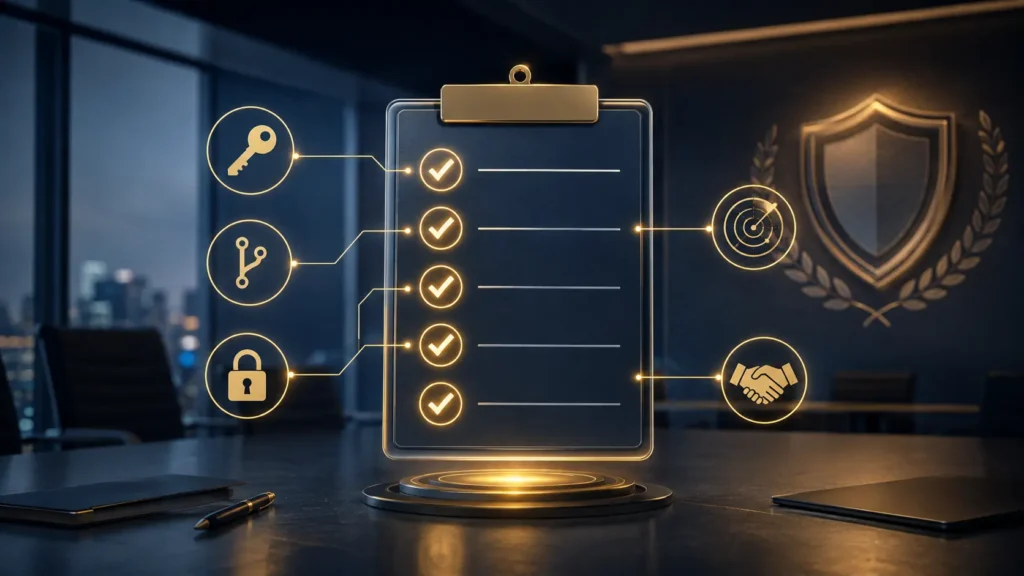
This guide covers five rigid controls: identity and access management, automated change management, continuous encryption protocols, centralized logging and incident response, and formal third-party vendor risk audits.
Control 1: Implementing Strict Identity and Access Management (IAM)
Access control is where most SOC 2 audits begin, and it’s also where poorly governed startups accumulate the most risk. The core principle is straightforward: every person’s access to systems and data should match their current role, nothing more.
Formalize onboarding and offboarding as documented, repeatable workflows rather than ad hoc tasks handled inconsistently by whoever happens to be available. New hires should receive access provisioned against a defined role template, and departing employees should have every credential revoked immediately, not “at some point this week.”
Enforce mandatory Single Sign-On (SSO) across all business-critical systems, consolidating authentication through one identity provider rather than allowing scattered, unmanaged logins across dozens of tools. This gives you both stronger security and a single, auditable source of truth for who has access to what.
Conduct quarterly privileged access reviews, where designated owners formally confirm that every person with elevated system access still requires it. Document these reviews explicitly, since auditors will ask for evidence that the review actually happened, not just that a policy exists stating it should.
Let me hand you an explicit, non-negotiable compliance warning that catches many early-stage operators off guard: leaving an offboarded employee’s corporate email, AWS account, or Slack profile active for even 24 hours after their official termination is an automatic critical audit failure. Auditors don’t look at intentions; they look at system log timestamps. If they sample an offboarding date and cross-reference it with a cloud access logs history to find trailing active keys, your entire logical access protocol falls apart instantly, throwing up a major red flag on your final report.
Control 2: Establishing Automated Change Management Pipelines
Uncontrolled changes to production systems represent one of the clearest risks a SOC 2 auditor will probe. The governance requirement here isn’t about slowing down development; it’s about proving that changes go through a consistent, reviewable process every time.
Require peer code review through mandatory pull request approvals before any code merges into a production-bound branch. This isn’t just a quality practice; it’s the specific evidence artifact auditors look for to confirm no single individual can unilaterally push unreviewed changes to a live system.
Maintain strict separation between development, staging, and production environments, with distinct access controls and credentials for each. A developer with full production database access during routine feature work is a governance gap that auditors flag immediately, regardless of how trustworthy that individual is.
Document your change management policy formally, covering who can approve changes, what testing is required before deployment, and how rollback procedures work if a change causes an incident. Auditors expect to see this policy followed consistently across a sampled set of actual historical changes, not just described in a document nobody references.
Control 3: Committing to Continuous Asset Encryption Protocols
Confidentiality, one of the five Trust Services Criteria, centers heavily on how data is protected both at rest and in transit. This control area translates directly into concrete, auditable technical requirements across your entire device and infrastructure fleet.
Mandate full-disk encryption on every employee laptop that can access company systems or data, enforced and centrally verified through a Mobile Device Management (MDM) solution rather than left to individual employee discretion. Auditors will expect a compliance dashboard or report confirming encryption status across 100% of managed devices, not a policy stating employees “should” enable it.
Enforce TLS 1.3 for all data transmitted between your systems and any external service or client connection, eliminating older, weaker protocol versions from your infrastructure entirely. For data at rest, standardize on AES-256 encryption across your databases, storage buckets, and backup systems.
Document these encryption standards in a formal policy, and maintain evidence, configuration exports, MDM compliance reports, infrastructure-as-code definitions, that demonstrates these settings are actually enforced in production rather than aspirational.
Control 4: Deploying Centralized Log Collection and Incident Response
The monitoring criteria within SOC 2 require demonstrable visibility into system activity and a tested plan for responding when something goes wrong. Scattered, siloed logs across individual services don’t satisfy this requirement on their own.
Pipe system alerts, authentication events, and infrastructure logs into a centralized logging platform, giving your team a single place to detect anomalies rather than reconstructing an incident after the fact from disconnected sources. This centralization is also what makes evidence collection for future audits dramatically faster.
Build a formal, written incident response playbook defining roles, escalation paths, communication protocols, and remediation steps for different categories of security events. A playbook that exists only in someone’s head doesn’t satisfy an auditor’s evidence request.
Test this playbook annually through a tabletop exercise, where your team walks through a simulated incident scenario and documents how the response actually unfolded. Auditors specifically look for evidence that this exercise happened, including dated notes, participant lists, and any process improvements identified afterward.
Control 5: Standardizing Formal Third-Party Vendor Risk Audits
Your own controls only cover part of the risk surface. Every cloud vendor, payment processor, or sub-service organization you depend on introduces risk that SOC 2 explicitly requires you to manage and document.
Maintain a formal inventory of critical vendors, cloud infrastructure providers like AWS, payment processors like Stripe, and any other service handling sensitive data on your behalf. For each vendor, collect and review their own SOC 2 report or an equivalent security documentation package on an annual basis.
Establish a documented vendor risk assessment process, evaluating each critical vendor’s security posture, data handling practices, and compliance certifications before onboarding, and reassessing that risk profile annually thereafter. This isn’t a formality; auditors specifically test whether your vendor management program is active and current, not just written down once and forgotten.
Assign clear ownership for this vendor review process internally, since an undocumented or inconsistent review cadence is a common finding auditors flag as a governance gap, even when the underlying vendors themselves are genuinely secure.
Conclusion
Passing a SOC 2 audit requires building and maintaining five interlocking control areas: identity and access management, change management governance, continuous encryption enforcement, centralized monitoring with tested incident response, and formal third-party vendor oversight. Each control area maps directly back to the AICPA’s Trust Services Criteria, and gaps in any single area can result in audit findings that delay your report.
Continuous, automated compliance governance is foundational for building long-term enterprise market trust and unlocking contract valuations that remain inaccessible without a current SOC 2 report. Treating compliance as an ongoing operational discipline, rather than a one-time project completed before an audit deadline, is what actually keeps your report clean year over year.
Moving away from scattered spreadsheets and using modern tools saves massive operational engineering hours. What specific GRC automation platforms, like Vanta, Drata, or Secureframe, or custom evidence-tracking setups do you run to streamline your corporate audits? Do you use API-driven collection rules to link your cloud environments, or do you still manually track your control matrices inside standalone internal drives? Drop a comment in the box below and share your auditing strategies—let’s share our compliance workflows and clear our framework hurdles together!
Related: Dissecting the Creeper Worm Via 4 Forensic Analysis Steps of the First Cyberattack – Creeper, the experiment that pioneered self-moving code in 1971, offers a fascinating look at how network trust, malware propagation, and the first cybersecurity countermeasure shaped modern cyber defense.
Implementing Rate Limiting for OpenAI API Endpoints Via 7 Rigid Tiers to Stop Billing Attacks – A seven-tier, code-level guide for Node.js developers on implementing rate limiting for OpenAI API endpoints to stop Denial of Wallet attacks, layering in-memory limits, Redis-backed token buckets, cost-based throttling, and edge-layer Cloudflare/Nginx defenses.
Prevent API Key Leakage When Building Local AI Applications Via 5 Rigid Rules to Eliminate Risk – Protect your local AI applications from accidental API key leaks with simple, practical security controls that keep secrets out of code, logs, and public repositories.
Blocking AI Data Scraping on Shopify Stores Via 5 Proven Steps to Stop Theft – Learn how to block AI data scraping on Shopify stores, protect valuable product content, and control unwanted automated access to your online store.
Frequently Asked Questions (FAQ)
Q1. How long does the entire SOC 2 process typically take from start to finish, including the observation period?
Most startups need three to six months for readiness assessment and control remediation before a Type I audit, and Type II reports require an additional observation period of three to twelve months where those controls must operate consistently. Budgeting six to twelve months total before you actually need the report in hand is a realistic timeline for most first-time applicants.
Q2. What’s the actual cost difference between a Type I and a Type II SOC 2 report?
A Type I report is generally less expensive since it only requires a point-in-time control review, while a Type II report costs more due to the extended observation period and more extensive evidence collection required. Many startups pursue Type I first to unblock an immediate deal, then run the Type II observation period in parallel while already collecting revenue.
Q3. Do all five Trust Services Criteria need to be included in every SOC 2 audit, or can a company choose which ones apply?
Security is the only mandatory criterion; the other four (Availability, Processing Integrity, Confidentiality, and Privacy) are optional and should be scoped based on what your specific enterprise customers actually require. Adding unnecessary criteria increases audit cost and complexity without adding sales value, so it’s worth confirming exactly what your target customers ask for before finalizing scope.
Q4. Can a small startup with only a handful of employees realistically pass a SOC 2 audit without a dedicated compliance team?
Yes, this is increasingly common, since GRC automation platforms handle much of the evidence collection and control monitoring that used to require a dedicated internal team. A small startup typically assigns SOC 2 ownership to an existing engineering or operations lead rather than hiring a standalone compliance function from day one.
Q5. What happens if an auditor finds a control gap or exception during the audit; does that mean automatic failure?
Not necessarily. Auditors often note exceptions in the final report rather than failing the audit outright, and many customers will still accept a report with minor, well-explained exceptions as long as the overall control environment is sound. Significant, unaddressed gaps are the real risk, which is why remediating findings quickly during the audit process matters more than achieving a flawless report on the first attempt.
DISCLAIMER
Educational Notice: This article is published on AI Security Watch strictly for technical educational and general cybersecurity awareness purposes. The configurations and research discussed are based on public threat intelligence data. This content does not constitute professional IT architecture, legal, or financial advice. Because network configurations vary, always verify settings in an isolated test environment or consult with a qualified engineer before modifying live hardware or registries. AI Security Watch contains informational links to external resources; we are not responsible for third-party site accuracy or platform content.