⚡ TL;DR — Key Takeaways
- Weaponizing Trusted Delivery Vectors: Deeply analyzing and reconstructing the SolarWinds hack exposes a highly calculated supply chain entry corridor where target entities unknowingly provisioned the malicious payload themselves by installing a legitimate, verified, and digitally signed vendor application package.
- Intercepting Build-Pipeline Integrity: Internal code injection loops managed by the SUNSPOT utility silently altered underlying source files directly during active compiler execution, baking the SUNBURST backdoor artifact into the system before any cryptographic signatures were applied to the release binary.
- Bypassing Identity Authentication Realms: Advanced Security Assertion Markup Language (SAML) credential forgery methodologies—frequently classified as Golden SAML mechanics—granted adversaries the ability to fabricate persistent administrative session tokens and entirely circumvent multi-factor authentication (MFA) controls after compromising root identity provider signing keys.
- Enforcing Pervasive Zero-Trust Guardrails: Deploying continuous zero-trust validation metrics across software build clusters, code-signing infrastructures, network egress tunnels, and enterprise identity nodes represents the singular architectural model capable of disrupting every link within this specific macro-threat ecosystem.
Table of Contents
The 2020 SolarWinds attack completely transformed global enterprise security parameters. It delivered definitive proof that an organization can maintain pristine firewall edges and flawless password controls, yet still suffer a total network compromise if its trusted third-party software suppliers are weaponized from within. By infiltrating the vendor’s Orion software build ecosystem, the adversaries successfully delivered a malicious update package to approximately 18,000 corporate and government clients. This customer base included multiple high-level United States federal agencies and Fortune 500 enterprises, all of whom authorized the installation specifically because the patch carried a valid digital signature and matched all standard deployment benchmarks.
Reconstructing the SolarWinds hack forces modern risk management teams to shift their vendor validation strategies away from passive compliance assertions—such as signed liability contracts or basic, static SOC 2 checkboxes—and toward a continuous, stateful software supply chain verification architecture. Detailed forensic attribution points directly to APT29 (widely tracked as Nobelium), an elite cyber-espionage syndicate linked to Russia’s Foreign Intelligence Service (SVR). This group operated with an extreme degree of patience, executing calculated maneuvers that exploited internal trust models most enterprise security teams had never historically cross-examined.
The SolarWinds breach permanently shattered the classic corporate illusion of perimeter security. For decades, enterprise networks were engineered like medieval castles—heavily fortified at the outer gates with firewalls, entry proxies, and multi-factor authentication checkpoints, under the assumption that everything inside the walls was inherently safe. SolarWinds completely flipped that model on its head by proving that automated, trusted software updates function as an unrestricted backdoor straight into your core database vaults. When an infrastructure team downloads an enterprise patch, they bypass every single edge defense they spent millions of dollars constructing. If a state-sponsored threat network can silently slip malicious code into a vendor’s compilation engine, your entire enterprise castle is compromised before a single alert is triggered.
This architectural case study deconstructs the structural breakdown of the compromise across six interlocking enterprise safeguards: build pipeline isolation, cryptographic code-signing verification loops, strict network egress constraints, identity provider hardening, continuous supply chain auditing, and long-term log retention frameworks.
SAFEGUARD 1: INSULATING AND ISOLATING THE SOFTWARE BUILD PIPELINE
The opening phase of this supply chain breach featured an advanced level of technical execution inside the vendor’s application development environment. A specialized utility, historically catalogued as SUNSPOT, was deployed directly onto active compilation servers. This malware was engineered specifically to monitor host process lists for the invocation of MsBuild.exe—the core Visual Studio engine tasked with compiling the production Orion software package. The exact second a build trigger was registered, SUNSPOT dynamically swapped out legitimate source code text files with malicious variants in real time, right before binary assembly concluded.
As a direct result of this runtime manipulation, the secondary SUNBURST backdoor artifact was baked into the application at the precise millisecond of code compilation. The moment the compiler process terminated, the malware instantly restored the original, clean source files on the disk, leaving no traces within the developer’s reviewable repository. This transient technique highlights why traditional static code review schedules are completely blind to compile-time injections; the malicious code never actually resided inside the persistent source control pipeline, existing only as a ghost element inside the active memory of the build toolchain.
Mitigating this vulnerability requires implementing an institutional governance shift toward ephemeral build architectures. Compilation environments must be dynamically provisioned from immutable images for each unique build request and completely destroyed immediately upon artifact output, preventing long-term malware implants from maintaining persistent monitoring roots on compilation hosts. Furthermore, enforcing multi-signature engineering gates—where no single developer account possesses the structural permission to merge code into production branches independently—adds a robust layer of administrative verification directly on top of this technical isolation.
SAFEGUARD 2: IMPLEMENTING RIGID CODE SIGNING AND CRYPTOGRAPHIC VERIFICATION
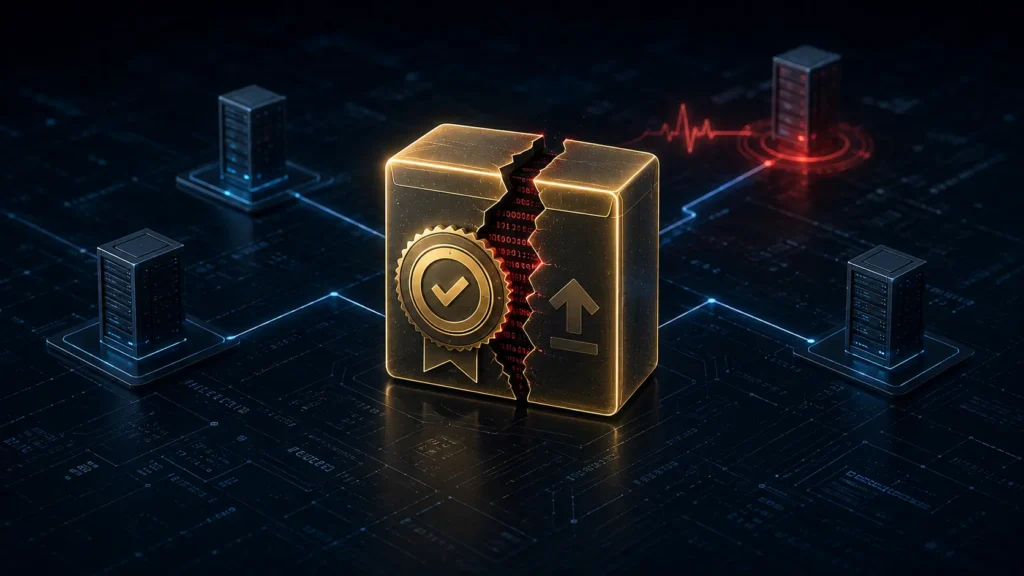
The compromised Orion patch was not just an unsigned piece of rogue malware; it was a fully valid, digitally signed asset carrying the exact cryptographic signature that corporate customers had been trained to trust implicitly. This unique validation parameter is precisely why 18,000 distinct organizations authorized the installation across their active servers without hesitation, since code signing serves as the default industry-standard mechanism enterprises use to verify software authenticity.
The structural failure point was not a breakdown of the signing process itself, but rather that the malicious payload was injected before any cryptographic validation took place. This sequencing allowed a legitimate certificate signature to authenticate a binary package that had already been altered upstream. A valid code signature proves only that a file remained unmodified after the certificate was stamped; it provides zero diagnostic context regarding the architectural integrity of the compile process that outputted the source file.
Resolving this blind spot requires implementing a two-layer administrative control system:
- Isolate Code-Signing Private Keys: Store all active code-signing keys inside dedicated, tamper-proof Hardware Security Modules (HSMs) that never expose raw cryptographic key material to the development pipeline or build nodes.
- Enforce Independent Pre-Production Validation: Deploy separate, automated validation checkpoints that execute a checksum comparison matching the final signed file against a completely independent reference binary. This separate evaluation loop is exactly what would have exposed the compile-time tampering, as its verification logic does not rely on trusting the specific build infrastructure that was subverted upstream.
SAFEGUARD 3: GATING EGRESS TELEMETRY AND SECURING NETWORK MICRO-SEGMENTATION
Once installed on a victim network, the SUNBURST backdoor deliberately remained dormant for 12 to 14 days before initiating its first outbound connection to its command-and-control (C2) infrastructure—a domain generation algorithm resolving to avsvmcloud[.]com. This extended dormancy period served as a calculated evasion technique designed specifically to outlast standard incident response observation windows and threat-hunting detection timelines.
When the backdoor finally went active, its DNS-based C2 traffic was deliberately structured to mimic legitimate SolarWinds Orion Improvement Program telemetry. This allowed the malicious outbound communication to blend seamlessly into traffic patterns that security teams already expected and whitelisted. Because of this masquerading technique, baseline network traffic volume reviews frequently failed to flag the activity as an anomaly.
Allowing internal, high-privilege production application servers to resolve unrestricted public outbound DNS queries is an invitation for disaster. Many engineering teams mistakenly leave outbound port 53 wide open, believing that DNS traffic is inherently safe background noise. This operational oversight provides a direct, unmonitored communication channel for sleeping backdoors. An attacker who gains a foothold inside your network doesn’t need to fight their way through your firewall; they can simply encode stolen corporate data into subdomains and send it straight out over public DNS requests. If your backend infrastructure can talk directly to arbitrary public name servers, your internal perimeters are effectively nonexistent.
The governance safeguard requires implementing strict, zero-trust egress filtering. Production application servers must never be granted unrestricted outbound DNS or HTTP access to the public internet by default. Reviewing CISA’s official supply chain security directives provides current, authoritative guidance on structuring these network segmentation requirements. Completely isolating internal tracking systems from direct internet access neutralizes a dormant backdoor, regardless of how many weeks it is programmed to wait before attempting to phone home.
SAFEGUARD 4: HARDENING IDENTITY PROVIDERS AGAINST SAML TOKEN FORGERY
The most critical downstream phase of this threat campaign centered on an identity manipulation technique known as Golden SAML. Once the cyber-espionage actors secured administrative privileges within a target network, they extracted the root token-signing certificate used by the organization’s central identity provider (typically Active Directory Federation Services, or ADFS).
With that master cryptographic signing key compromised, the adversaries could forge valid Security Assertion Markup Language (SAML) authentication tokens for any identity across the enterprise domain, including high-level global administrators. This loophole granted them seamless, authenticated entry into Microsoft 365 tenants and other connected cloud ecosystems without ever needing a user password or attempting to bypass multi-factor authentication (MFA) mechanisms directly. The forged authentication token simply presented itself to cloud providers as an already-verified identity session, completely sidestepping MFA gates rather than trying to defeat them through brute force or interception.
Defending against this identity threat requires treating token-signing certificates with the exact same level of defensive protection as the application code-signing keys detailed in Safeguard 2. Security administrators must isolate these identity certificates from general administrative account lines, run continuous audit tracking against token generation histories to catch anomalous issuance patterns, and enforce shorter session token lifespans so that any fabricated token holds a highly restricted window of validity before requiring an absolute system re-validation event.
SAFEGUARD 5: ENFORCING CONTINUOUS VENDOR SECURITY COMPLIANCE QUESTIONS
Prior to this major incident, SolarWinds maintained standard cybersecurity certifications and was universally classified as a highly reputable, trusted enterprise software vendor. This pattern highlights a significant corporate governance blind spot: point-in-time compliance audits (like a standard SOC 2 Type II report) only validate a third party’s administrative controls at a specific historical moment. They provide zero continuous assurance regarding the underlying integrity of future software patches that a vendor might ship down the line.
- Mandate Software Bill of Materials (SBOM) Declarations: Move vendor risk evaluation past surface-level certification checkboxes by requiring an itemized Software Bill of Materials (SBOM) for all critical third-party applications. This declaration acts as a granular inventory indexing every software library, open-source component, and nested dependency baked into a particular release version.
- Enforce Ongoing Software Integrity Appraisals: Demand current, independent software penetration testing data and dynamic code analysis metrics as a mandatory requirement for recurring vendor evaluations. Do not rely on static procurement checklists completed years prior during initial onboarding loops.
- Scale Scrutiny to Internal System Privileges: Treat any third-party tool holding broad internal network clearance as a standing, continuous risk that demands structured re-assessments proportional to its system integration depth. A pervasive network orchestration suite managing your internal routing layers requires significantly higher inspection rigor and continuous logging than a sandboxed, low-privilege SaaS productivity plugin.
SAFEGUARD 6: DEPLOYING STATEFUL LOG ARCHIVING AND LONG-TERM RETENTION WINDOWS
The initial SolarWinds network infiltrations began in early 2020, yet the compromise was not publicly exposed until December of that year. This 11-month delta means that the cyber-espionage threat actors operated completely undetected inside victim network perimeters for nearly a year. Standard 30-day or 90-day data retention configurations—which form the default setup across most corporate logging platforms—had already completely overwritten and erased the exact historical traffic logs that incident response teams needed to reconstruct the initial compromise paths by the time anyone realized a breach had occurred.
This pervasive visibility gap represents a direct data governance failure entirely separate from any specific technical perimeter control. An infrastructure stack backed by state-of-the-art telemetry and detection software remains completely useless if the historical log records needed to investigate an anomaly have been automatically purged from the server before anyone knew to look for them. Highly organized, state-sponsored cybercrime syndicates intentionally execute quiet, slow-moving operations because they know standard corporate log rotation cadences will destroy the evidence of their entry path for them.
To mitigate this forensic blind spot, organizations must deploy immutable, long-term log storage hubs that enforce a minimum retention lifespan of six months to a full year for all critical infrastructure directories. These archived logs must be streamed to an isolated, cold-storage target environment that a compromised internal network cannot edit, modify, or delete. Your log storage timeline must be strategically scaled to outlast the known baseline persistence windows of advanced persistent threats (APTs), rather than blindly accepting whatever default, cost-saving archive duration your logging platform ships with out of the box.
CONCLUSION & RISK MANAGEMENT GOVERNANCE SUMMARY
Reconstructing the SolarWinds hack across all six layers of defense—enforcing build pipeline isolation, cryptographic code-signing verification loops, strict network egress constraints, identity provider validation hardening, continuous third-party vendor compliance auditing, and stateful long-term log retention archives—demonstrates why no single technical check could have stopped this attack in isolation. Each unique safeguard directly neutralizes a distinct phase of a highly sequenced, multi-stage cyber-espionage threat campaign. The complete absence of any single operational barrier left an unlocked gateway that the state-sponsored adversaries systematically and methodically exploited to compromise downstream networks.
True software supply chain safety demands continuous, active infrastructure verification rather than blind trust in third-party vendor digital certificates, no matter how reputable or certified that software provider appears on paper. The enterprises and government agencies that navigated this historical compromise with the minimal amount of structural damage were consistently the ones that had already deployed internal network micro-segmentation and egress connection rules entirely independent of any specific SolarWinds advisory warning. This operational reality proves that a proactive defense-in-depth security architecture inherently insulates your environment against advanced, un-glamorous threats you have not specifically anticipated yet, rather than simply protecting against the ones you have.
Transitioning to a zero-trust architecture requires continuous validation across your third-party technology stack. What specific supply chain validation protocols, automated Software Bill of Materials (SBOM) orchestration tools, or third-party risk management (TPRM) software pipelines does your operations team rely on to identify and monitor external software vulnerabilities across your infrastructure? Do you actively mandate SBOM declarations during vendor procurement reviews, run automated binary composition scanners, or leverage continuous network egress logging to monitor third-party appliance behaviors? Drop your comments below and share your engineering roadmaps—let’s swap our compliance practices and harden our enterprise perimeters together!
Related: Writing Corporate Security Policies via 3 Clean Core Templates – A practical guide to writing lean, enforceable corporate security policies that turn compliance requirements into clear, auditable day-to-day security practices.
Securing Pinecone Vector Databases Via 5 Proven Token Encryption Safeguards – Discover five proven security safeguards to protect Pinecone vector databases from credential exposure, unauthorized access, network threats, and sensitive data leakage.
The 2026 Sophos Adversary Report Analyzing Real Network Dwell Patterns – The 2026 Sophos Adversary Report reveals how attackers are winning through stolen identities, rapid Active Directory compromise, and after-hours ransomware—not sophisticated AI exploits.
Hardening Docker Daemon Configs Via 6 Proven Rules to Eliminate Root Risks – A practical six-rule guide to hardening Docker daemon configurations, reducing container escape risks, restricting privileged access, and strengthening host-level security.
FREQUENTLY ASKED QUESTIONS (FAQ)
Q1. How was the SolarWinds compromise ultimately exposed after remaining completely hidden for nearly a year?
The breach was discovered by the cybersecurity firm FireEye (now Mandiant) while executing an intense internal investigation into a separate intrusion on its own corporate network in December 2020. Their forensics team tracked the core infiltration path back to a compromised third-party Orion software update. This timeline confirms that the initial breakthrough came entirely from a downstream victim’s independent forensic research, rather than from any internal detection mechanisms built by SolarWinds to monitor their own compilation engines.
Q2. Did every single company that deployed the tainted Orion update suffer a network breach, or did the adversaries cherry-pick specific targets?
While approximately 18,000 corporate and government organizations authorized the malicious update patch, the SUNBURST backdoor ran a strict reconnaissance filtering phase. The malware evaluated gathered environmental telemetry to selectively identify which networks were worth pursuing. The threat actors only advanced to deep-level infrastructure compromise (such as executing Golden SAML operations) against a highly restricted pool of high-value targets. This selective execution model is precisely why the espionage campaign remained hidden for so long despite having an incredibly wide initial footprint.
Q3. Could modern Endpoint Detection and Response (EDR) agents have intercepted SUNBURST if they had been active back in 2020?
While some EDR tools might have flagged minor behavioral anomalies, SUNBURST was specifically engineered to run internal host inventory checks to detect and actively evade known security and forensic tracing agents before launching its code blocks. If it uncovered certain endpoint monitoring programs running on the machine, the backdoor would immediately terminate its own execution string. This built-in defensive evasion architecture is the precise reason why layered network-level egress filters—rather than relying solely on endpoint software agents—are heavily emphasized throughout modern infrastructure deployment frameworks.
Q4. Have there been other documented cyberattacks that deployed a build-pipeline injection methodology similar to SUNSPOT?
Yes, this specific technical method—injecting code arrays during active compiler routines rather than checking malicious text files into persistent source control repositories—has been observed across several high-impact supply chain intrusions. This pattern is exactly why shifting to isolated, ephemeral compilation environments remains a top-tier infrastructure mandate rather than an optional, SolarWinds-specific patch. Global security teams classify build-pipeline subversion as an ongoing threat matrix rather than a temporary historical anomaly.
Q5. Does completing these six security safeguards grant an absolute guarantee of protection against nation-state-level supply chain campaigns?
No single architectural control matrix can guarantee absolute protection against a highly funded, patient, and state-sponsored adversary, as these elite threat groups continuously evolve their offensive tools. However, deploying these six strategic safeguards dramatically drives up the engineering cost and operational complexity for an attacker trying to compromise your systems. Closing the precise architectural gaps exposed during this historic event establishes a realistic, hardened risk management threshold rather than chasing a mythical goal of absolute invulnerability.
DISCLAIMER
Educational Notice: This article is published on AI Security Watch strictly for technical educational and general cybersecurity awareness purposes. The configurations and research discussed are based on public threat intelligence data. This content does not constitute professional IT architecture, legal, or financial advice. Because network configurations vary, always verify settings in an isolated test environment or consult with a qualified engineer before modifying live hardware or registries. AI Security Watch contains informational links to external resources; we are not responsible for third-party site accuracy or platform content.