⚡ TL;DR — Key Takeaways
- Administrative access controls: Enforcing an exhaustive, verification-backed equipment log forms your baseline security perimeter—the cisa siemens s7 advisory confirms an active, weaponised threat targeting operational networks, meaning teams must complete an immediate hardware component inventory before deploying secondary network rules.
- Vendor/client parameter validation: Accelerate patch management workflows across all unhardened control systems—prioritise updating firmware versions on internet-exposed and demilitarized zone (DMZ) resident controllers to intercept known high-severity vulnerability exploits.
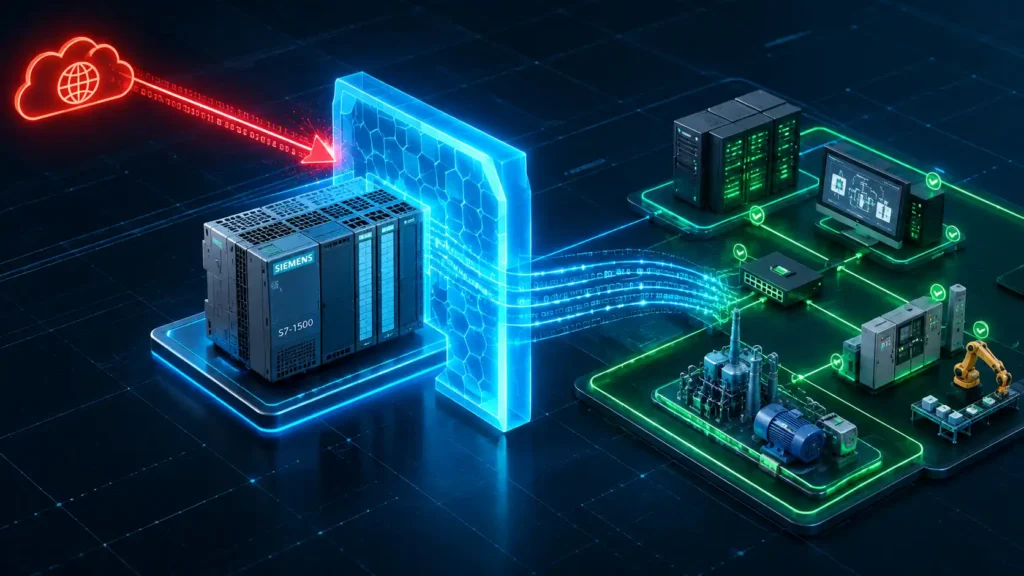
- Stream-optimized runtime flags: Rigidly secure your cell block segmentation boundaries against external scanning operations—block Transmission Control Protocol (TCP) port 102 entirely at your perimeter firewalls and continuously verify that no programmable logic controller is exposed to public routing.
- Perimeter isolation validation: Transition your security operations from passive compliance to active threat hunting—deploy specialized, ICS-aware platform monitoring tools and treat any anomalous
S7commprotocol behavior or unauthorized data block write commands as a live indicator of compromise.
Table of Contents
In August 2026, a high-stakes joint cybersecurity advisory was issued by a coalition of federal authorities—including the National Security Agency (NSA), the Cybersecurity and Infrastructure Security Agency (CISA), the FBI, the Department of Energy (DOE), and the Environmental Protection Agency (EPA)—delivering an urgent warning regarding an immediate, hostile campaign targeting Siemens S7 Series programmable logic controllers. The authoring agencies did not mince words regarding the severity of the operational landscape, explicitly stating that the exploitation risks are an active threat rather than a far-off, theoretical vulnerability.
Threat actors have fundamentally evolved their operational technology (OT) infiltration capabilities by combining open-source industrial automation protocol libraries—specifically snap7.dll and python-snap7—with advanced AI-assisted script generation. This lethal combination allows attackers to rapidly assemble bespoke, malicious tools that masquerade cleanly as legitimate SCADA network monitoring software while secretly executing unauthorized commands.
Adversarial groups are systematically scanning the open web using high-velocity internet search indices like Censys and ZoomEye to locate vulnerable, outdated, or insufficiently segmented Siemens S7 PLC controllers.
According to the threat brief, this aggressive reconnaissance activity is actively aimed at essential domestic infrastructure verticals, directly impacting Critical Manufacturing, Energy grid installations, Water and Wastewater treatment facilities, Chemical processing networks, Food and Agriculture distribution nodes, and Commercial Facilities. Furthermore, because these specific industrial controllers are deeply embedded across the broader Defense Industrial Base (DIB), military manufacturing support chains face an identical, highly critical risk profile if their local operational perimeters remain unhardened.
There is a profound, stomach-churning sense of technical disbelief that hits you when you conduct a routine industrial site asset audit and map out the network topography of a live facility. You expect to find air-gapped systems or at least strict firewall isolation boundaries separating corporate business operations from heavy machinery control layers.
Instead, you discover core manufacturing PLCs—units managing high-pressure valves, volatile chemical balances, or massive physical assembly lines—sitting completely exposed on a flat, unsegmented network architecture that is directly reachable from the corporate office Wi-Fi. It is a terrifying realization that any corporate user downloading a bad email attachment, or a guest logging into the office internet lobby, could inadvertently tunnel straight into a high-severity S7comm protocol port and trigger a catastrophic physical failure on the plant floor.
The technical breakdown below completely deconstructs the cisa siemens s7 advisory framework, unpacking the mechanical threat vectors utilized by modern threat groups. By methodically applying the seven authoritative engineering mitigations—fully cross-referenced with the advisory’s official MITRE ATT&CK for ICS and MITRE D3FEND countermeasure standards—OT asset managers can transform their exposed control systems into a resilient, highly defensible industrial architecture.
SECTION 1: TECHNICAL DECONSTRUCTION OF THE THREAT ACTOR VECTOR
The joint cybersecurity warning explicitly enumerates the highly precise hardware footprints under active exploitation across industrial architectures. The targeted infrastructure comprises the legacy S7-200 Series across all CPU configurations, the mid-tier S7-300 Series across all variations—specifically noting the ubiquitous 314, 315, and 317 processor modules—and the heavy-duty S7-400 Series. Modern deployments are equally vulnerable, with the brief highlighting the S7-1200 Series including the 1211C, 1212C, 1214C, 1215C, and 1217C controller variants.
Crucially, the premium S7-1500 Series across all CPU configurations—including the highly sensitive F-series fail-safe controllers designed for emergency systems—is actively targeted. Threat actors exploit these systems by executing AI-crafted Python scripts embedded with the open-source snap7.dll driver stack. This automation allows unauthorized external nodes to establish full read and write hooks into the PLC register matrices, extract critical device configurations, and alter active ladder logic logic blocks entirely over the native S7comm communication protocol.
The cisa siemens s7 advisory systematically categorises this hostile operation by mapping it across seven critical MITRE ATT&CK tactics and techniques within the specialized ICS and Enterprise taxonomies:
- T1596.005 (Search Open Technical Databases: Scan Databases): Threat actors leverage automated internet scanning architectures to identify unshielded or poorly routed industrial control ports.
- T1587.004 (Develop Capabilities: Exploits) & T1588.007 (Obtain Capabilities: Artificial Intelligence): Adversaries utilize generative language modeling environments to rapidly iterate functional exploitation scripts, dramatically dropping the historical technical barrier to entry for executing SCADA-level attacks.
- T0834 (Native API): Attackers bypass standard verification by executing scripts compiled directly against public communication libraries to mimic standard engineering inputs.
- T0821 (Modify Controller Tasking): Threat actors issue rogue network packets to rewrite specific programmatic instructions and data blocks, pre-positioning capabilities for downstream physical disruption.
- T0849 (Masquerading): Malicious execution processes actively spoof their network headers to resemble authorized SCADA monitoring nodes, hiding in plain sight from typical Security Operations Center analysts.
- T1694 (Insecure Credentials): The exploitation campaign targets out-of-the-box system deployments running factory-default administrative credentials or completely unconfigured security levels.
- T0893 (Data from Local System): Malicious entities continuously pull data registers to map out proprietary process designs and internal memory maps.
Federal intelligence groups assess that this operational pattern represents a coordinated campaign of persistent cyber reconnaissance designed to map the deep technical layout of core utility and manufacturing facilities. By systematically evaluating exploit behaviors against specific hardware variations, attackers continuously optimize their tools while harvesting read-only telemetry. This data collection serves as the foundational stepping stone required to plan future malicious write operations, giving threat actors the ability to trigger unexpected physical equipment overrides, disrupt municipal services, or cause severe physical plant failure.
SECTION 2: THE 7 CRITICAL HARDENING STEPS FOR INDUSTRIAL CONTROLLERS
- STEP 1: Hardware Component Inventory [D3-HCI] — Perform an immediate, comprehensive hardware validation audit across your entire footprint to account for every single active controller. Cross-reference existing firmware profiles on all deployed S7-200, S7-300, S7-400, S7-1200, and S7-1500 processors against a verified backup gold copy to detect unrecorded unauthorized revisions. Systematically isolate any assets holding direct or indirect connectivity to untrusted networks, and maintain a rigorous map of all engineering workstations running TIA Portal, STEP 7, or legacy S7 programming suites.
- STEP 2: Software Update Application [D3-SU] — Accelerate firmware update lifecycles by deploying the latest vendor-issued security updates, ensuring you prioritize internet-exposed or demilitarized zone (DMZ) controllers first. Upgrade your localized TIA Portal and STEP 7 development software to current versions, continually review active Siemens ProductCERT threat intelligence advisories for temporary operational workarounds, and validate all updates within a sandboxed staging environment before pushing changes to the active plant floor.
- STEP 3: Network Isolation Boundaries [D3-NI] — Execute a thorough structural firewall rule audit to sweep for any exposed
S7commcommunication vectors, and implement an absolute block on TCP Port 102 across all external perimeter perimeters. Enforce a rigid DMZ architecture to completely sever flat links between the IT enterprise space and the OT runtime network, install unidirectional hardware data diodes for historian connections, and audit internal routing tables to guarantee corporate data packets cannot cross into the control infrastructure.
- STEP 4: Network Access Mediation & Credential Hardening [D3-NAM, D3-CH] — Lock down engineering suite communication paths so that only pre-approved workstations can interface with your hardware, enforcing this restriction via hardcoded MAC and IP address allowlisting directly on the controller blocks. Enable comprehensive password authentication structures on every active S7 device, configure granular protection levels—such as strict write constraints and full read/write access barriers—and replace factory-default SNMP community strings. Additionally, enforce rigid application allowlisting across engineering endpoints, and mandate hardware-backed multi-factor authentication (MFA) for every remote operational access link.
Leaving factory-default administrative credentials or unencrypted engineering passwords active across legacy PLC installations introduces a catastrophic security blind spot that completely undermines your outer defenses. If an internal network node—such as an office workstation or an IoT device on a shared corporate network—is compromised, a threat actor can easily utilize basic scripts to probe the network, authenticate directly against the controller, and send malicious commands. Because the system treats this as a legitimate engineering session, the traffic passes cleanly through standard firewalls without triggering an alert. This allows unauthorized internal nodes to rewrite core execution logic and completely hijack physical plant operations from the inside out.
- STEP 5: Platform Monitoring & Traffic Analysis [D3-PM, D3-NTA] — Integrate specialized, ICS-aware intrusion detection platforms (such as Dragos, Claroty, or Nozomi Networks) directly into your passive network aggregation mirrors. Track all
S7commprotocol traffic traversing TCP Port 102 to flag any sessions initiated outside formal maintenance windows, configure automated system alerts to intercept unauthorized PUT/GET commands aimed at data memory blocks, and log all TIA Portal connections with immutable cryptographic timestamps. Furthermore, deploy endpoint monitoring tools to detect unauthorized Python environments calling thesnap7.dllorpython-snap7libraries, and actively hunt for sequential port scanning or brute-force register read attempts.
- STEP 6: Application Configuration Hardening [D3-ACH] — Deactivate the integrated HTTP/HTTPS web server interfaces on all S7 modules if there is no specific operational justification for remote web management, and turn off unused legacy communication layers like unencrypted Modbus TCP or native PROFINET protocols. Adjust internal device resource pools to strictly limit the number of concurrent active sessions allowed, activate TIA Portal “complete restart protection” alongside “know-how protection” logic constraints to prevent reverse-engineering of code blocks, and continuously audit logic files to catch unauthorized variations between online and offline programming states.
- STEP 7: Model-Specific Vendor Hardening Guidance — Coordinate directly with Siemens Technical Support and ProductCERT engineering divisions to request specialized security configurations tailored precisely to your specific CPU model numbers and active firmware revisions. Systematically verify that newly released vendor patches maintain full operational compatibility with your existing third-party SCADA software and downstream hardware integrations, and leverage official developer guidance to ensure your internal access levels and controller protection steps are properly hardened against the current threat landscape.
POTENTIAL OPERATIONAL IMPACTS AND RADIAL BUSINESS RISK
The cisa siemens s7 advisory outlines severe operational and physical consequences if these high-severity controller vulnerabilities remain unmitigated. The immediate disruption of core industrial processes directly threatens daily manufacturing throughput, compromises output consistency, and can instantly paralyze vital public utility services like water distribution or power generation. Far more critical is the immediate risk of severe safety incidents affecting plant floor personnel; by exploiting unshielded network access, threat actors can maliciously override hardware safety interlocks, silence emergency shutdown routines, or alter critical physical thresholds like pressure and temperature variables.
- Catastrophic hardware destruction and downtime: Manipulating system variables allows attackers to trigger severe process upsets, introduce improper device sequencing, or force heavy plant machinery to run far outside its structural engineering tolerances. This leads to permanent physical equipment destruction, massive repair costs, and months of operational downtime.
- Intellectual property exfiltration: Unauthorized access allows adversaries to easily extract highly sensitive operational data, including proprietary manufacturing recipes, closely guarded control strategies, and complex facility network maps—introducing a massive business risk that extends long after the network breach is resolved.
- Cascading supply chain failures: The operational impact of a control system breach rarely stops at the plant boundary; localized process failures quickly trigger massive cascading supply chain disruptions, crippling dependent production facilities and severing integrated corporate workflows.
- Severe regulatory and legal liability: The threat brief highlights that failing to defend these assets leads directly to catastrophic regulatory compliance violations, heavy environmental fines, and massive civil liabilities stemming from severe process safety management failures.
CONCLUSION & OT COMPLIANCE BOUNDARY SUMMARY
The joint cybersecurity warning delivers a stark, definitive final assessment: the convergence of unpatched high-severity vulnerabilities, widely accessible automation libraries, and rapid, AI-driven exploit generation creates a high-probability attack scenario against inadequately shielded controller networks. Achieving a resilient, secure operating posture requires an active, continuous systems engineering discipline rather than treating security as a static checklist implemented once and abandoned.
Industrial organizations must treat this cisa siemens s7 advisory with immediate urgency—coordinating cross-functional response playbooks that unite corporate information security, automation engineers, executive leadership, plant floor operators, and vendor support divisions to rapidly deploy these vital detection and defensive perimeters. Furthermore, companies leveraging external systems integrators or third-party managed service providers must immediately share these technical mandates with their partners; asset owners are frequently entirely unaware that their core production lines have been quietly exposed to the public web through a contractor’s poorly configured remote access link.
Securing legacy industrial control systems while balancing continuous plant uptime is one of the most complex challenges in modern engineering. We invite you to join the technical discussion in the comments section below: What specific passive network monitoring systems or OT-aware intrusion detection platforms—such as Dragos, Claroty, or Nozomi—are you currently deploying to audit your distributed industrial environments without introducing latency?
Are you utilizing automated asset discovery tools to sweep for hidden snap7.dll instances, or are you executing manual configuration reviews against your gold-copy firmware backups? Share your infrastructure architectures, network isolation strategies, and hard-earned advice with the community below!
Related: 9 Practical Ways B2B Software Startups GRC Certification is Achieved – B2B software startups can build enterprise trust and accelerate growth by embedding GRC into their operations, turning security, compliance, and risk management into a competitive advantage.
7 Practical Ways to Protect OpenAI Custom GPT Prompts from Leakage – Protect your OpenAI Custom GPTs by securing sensitive instructions, controlling access, minimizing data exposure, and applying layered defenses against prompt injection and misuse.
5 Simple Steps to Secure Ollama Nginx Proxy Gateways Instantly – Secure Ollama behind Nginx with authentication, streaming-aware proxy controls, and perimeter validation to prevent unauthorized access, GPU resource abuse, and exposed AI model endpoints.
How to Disable Windows 11 Recall to Obliterate Dangerous Privacy Risks – Disable Windows 11 Recall to protect sensitive activity and regain control over how your personal data is captured and stored.
The Top 50 Cybersecurity Threats Report Summary Analyzing Modern Attack Vectors – A comprehensive breakdown of the top 50 cybersecurity threats shaping today’s attack landscape—from AI and cloud risks to identity, ransomware, phishing, and web application attacks.
FREQUENTLY ASKED QUESTIONS (FAQ)
Q1. Will deploying a deep packet inspection (DPI) firewall directly inside the OT cell cause latency that could disrupt real-time industrial process loops?
No, provided you use industrial-grade firewalls deployed in a passive mirror configuration. When set up to ingest data via a network TAP or switch SPAN port, the DPI engine parses S7comm protocol traffic out-of-band without sitting directly in the active communication line, ensuring zero latency impact on critical millisecond-level controller execution loops.
Q2. We cannot take a production system offline to patch firmware right now due to continuous operations. What are the most effective compensatory controls?
If immediate patching is impossible, you must immediately enforce strict physical and logical access controls. Pivot the physical keyswitch on the S7 hardware into the absolute “RUN” position to block all remote code changes, update perimeter firewall parameters to drop all inbound packets on TCP Port 102, and implement aggressive MAC/IP allowlisting directly on the controller to restrict access exclusively to a single, hardened engineering workstation.
Q3. How exactly do threat actors use AI to exploit Siemens S7 PLCs when these systems use highly specialised industrial protocols?
Threat actors use generative AI platforms to bypass the historical requirement for deep SCADA programming expertise. By feeding the AI public protocol documentation and open-source automation libraries like python-snap7, attackers can instantly generate functional Python scripts designed to systematically sweep memory blocks, query data registers, and alter ladder logic layouts without writing raw hex code manually.
Q4. The advisory mentions removing default SNMP community strings. How does an exposed SNMP service threaten actual PLC operations?
Factory-default SNMP strings (like “public” or “private”) allow anyone on the network to read and write system metadata. An attacker can query the device via SNMP to instantly map out the exact CPU model numbers, hardware slots, and active firmware revisions, giving them the precise data needed to launch a targeted exploit string against that controller version.
Q5. What is the technical difference between TIA Portal “know-how protection” and standard PLC password protection?
Standard PLC password protection restricts network-level access to the controller, preventing unauthorized users from uploading or downloading configurations. “Know-how protection” is an encryption block applied to the specific software blocks inside your project code; it prevents an attacker from reading, reverse-engineering, or stealing your proprietary algorithm logic even if they manage to download the project files off the controller.
DISCLAIMER
Educational Notice: This article is published on AI Security Watch strictly for technical educational and general cybersecurity awareness purposes. The configurations and research discussed are based on public threat intelligence data. This content does not constitute professional IT architecture, legal, or financial advice. Because network configurations vary, always verify settings in an isolated test environment or consult with a qualified engineer before modifying live hardware or registries. AI Security Watch contains informational links to external resources; we are not responsible for third-party site accuracy or platform content.