
⚡ TL;DR — Key Takeaways
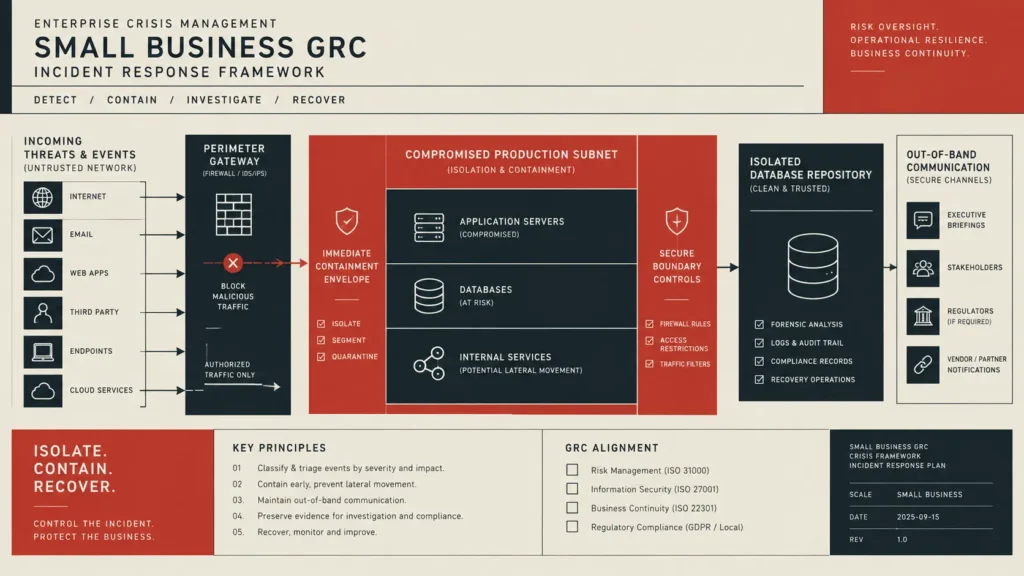
- Administrative access controls: Establishing automated baseline metrics shields your corporate environments—the process required to write incident response plan execution books dictates that systems engineers define strict, mathematical severity parameters rather than relying on subjective judgment calls made mid-crisis.
- Vendor/client parameter validation: Restructuring internal network directory layouts provides vital isolation against secondary administrative compromise loops; establish secure out-of-band communication paths immediately, as a compromised organizational inbox can never be trusted to coordinate or verify its own containment workflows.
- Stream-optimized runtime flags: Monitoring live database infrastructure prevents unchecked parameter manipulation during a perimeter incursion; assign clear out-of-band mitigation rights to guarantee technical operators possess the standing authority to pull a compromised datastore completely offline before an incident escalates rather than waiting for an emergency executive panel review.
- Perimeter isolation validation: Shielding core business data frameworks demands active control testing under load rather than passive data archiving—schedule regular validation simulation drills across your distributed teams, since an un-rehearsed emergency playbook functions as a static text document rather than a functional corporate security capability.
Table of Contents
Early-stage tech scaleups and bootstrapped startups frequently treat incident response as an enterprise-only luxury rather than a core survival requirement. A single unmanaged production database breach or credential exposure can trigger immediate operational death before internal teams even establish who owns containment authority. Failing to mathematically map and insulate your core application subnets allows automated port sweeps to quietly extract sensitive customer data records, introducing devastating financial liabilities long before legacy monitoring configurations can flag the threat profile or initialize an emergency alert routing block.
Deciding to deploy an explicit, structural roadmap to construct strict validation parameters and write incident response plan documentation is a critical operational engineering requirement rather than a task deferred until the company can afford a dedicated security team. Enforcing these centralized response parameters is the only technical mechanism that successfully prevents asset-handling drift, stabilizes enterprise procurement loops, and stops technical risk drift before a breach becomes an extinction-level event for a small team. Moving past passive security assumptions allows backend teams to transform structural crisis guidelines into active, code-enforced boundaries, locking down network interfaces before an active exploitation window paralyzes your business operations entirely.
There is a profound, stomach-dropping sense of technical disbelief that hits you when you are the lone engineer on call during a major holiday weekend and realize that your production infrastructure is actively draining into the open web. You check your cloud console and watch your heart sink as you discover an advanced data-exfiltration loop targeting an unmonitored staging cluster, while realizing your startup has zero documentation mapping out who has the authority to pull the database offline or how to alert clients without triggering immediate legal liability.
Standing completely isolated at 3:00 AM, guessing which production tokens to revoke while watching proprietary customer tables vanish in real time, is a brutal wake-up call. It proves that microservices and high-velocity code drops mean absolutely nothing if your lean development team operates without a hard-coded crisis manual to dictate containment rights under duress.
STEP 1: ESTABLISHING RIGID SEVERITY THRESHOLDS AND TRIAGE MATRIX METRICS
The first thing any team needs to write incident response plan documentation correctly is an objective way to classify what is actually happening—long before emotion or panic takes over the engineering group. Implementing this hard-coded prioritization framework removes operational uncertainty when response speeds matter most.
- Build an objective triage matrix that strips emotion out of crisis events: A severity classification system must rely on hardcoded, unambiguous criteria that any team member can apply consistently, completely independent of how alarming the infrastructure compromise feels in the moment.
- Define Severity 1 as Critical Infrastructure Exposure: This tier covers catastrophic events like active database data exfiltration, full production cluster compromise, or exposed cloud root credentials—high-velocity vectors demanding immediate, all-hands engineering mitigation with zero administrative debate.
- Define Severity 2 as Degraded System Integrity: This covers secondary operational situations like a compromised non-critical service, suspicious but unconfirmed backend access patterns, or a partial application outage tied to a security anomaly—events that are serious, but do not yet demand the same total mobilization as a Severity 1 event.
- Define Severity 3 as Isolated Operational Anomaly: This covers low-impact anomalies like a single flagged failed login attempt or a completely contained configuration error—events worth investigating and logging, but not worth triggering a full cross-functional incident response mobilization loop.
- Ensure classification skips administrative debate entirely during a live breach: The precise objective of hardcoded triage metrics is ensuring a team member facing a Severity 1 event never needs to convene an emergency meeting to confirm the classification—they activate isolation boundaries immediately, based on criteria decided calmly, in advance.
STEP 2: ARCHITECTING OUT-OF-BAND COMMUNICATION TREES AND ESCALATION LAYERS
The identical communication channels a development team normally uses to collaborate are exactly the lines an attacker may already control—this step builds a resilient alternative. Implementing separate coordination lanes is a critical milestone when teams write incident response plan templates for shared hosting environments.
- Recognize the risk of using primary corporate channels during a live breach: If an adversary has compromised your email infrastructure or internal workspace messaging platforms, using those same systems to coordinate mitigation hands the attacker absolute visibility into your engineering response itself.
- Define separate, independent communication structures: A locked external signal network or a dedicated, out-of-band messaging space—established and cryptographically verified before any incident occurs—ensures the core response team can coordinate securely even if primary internal networks are fully compromised.
- Map a clear escalation tree in advance to eliminate administrative friction: Every team member must know exactly who to contact first, in what numerical order, and through which specific secure channel. Eliminating ambiguity across your call sheets protects critical minutes during an actual exploit event.
- Test the out-of-band communication channels outside of an active crisis: A secure communication utility that nobody has logged into until the exact moment of a production server breach introduces severe operational friction and delay; technical familiarity must be built well in advance through peaceful testing cycles.
STEP 3: PRE-FORMATTED NOTIFICATION MATRIX PIPELINES AND REGULATORY COMPLIANCE
Legal and regulatory notification obligations operate on a strict countdown that triggers the exact moment a security breach is uncovered. Establishing pre-configured alert matrices ensures that your engineering leads are not drafting highly sensitive communication strings from scratch while working under intense operational pressure.
- Draft pre-formatted data breach notification templates before an incident occurs: Having a legally reviewed text template prepared in advance guarantees that your response team is simply inputting technical incident specifics during a crisis, rather than composing high-risk legal declarations under strict timeline constraints.
- Map out strict notification windows in advance across targeted jurisdictions: Modern data protection frameworks specify an unyielding, fixed disclosure window—frequently measured in distinct hourly or daily timelines—within which regulatory bodies and affected users must be notified. These timelines must be clearly cataloged before a breach occurs, completely bypassing the need to look up administrative compliance status mid-incident.
- Satisfy international compliance metrics proactively across distributed customer accounts: For any scaleup handling data across multiple borders, notification criteria will vary by region. Your template library must account for these variations rather than assuming a single standard applies globally.
- Reference established federal guidance when structuring this pipeline: Software teams engineering this notification pipeline must map their parameters to the official NIST computer security incident handling guidelines. Grounding your templates in these public directives guarantees your communication workflows satisfy elite compliance metrics, helping you write incident response plan templates that remain highly defensible during external partner evaluations.
STEP 4: MAPPING CONTAINMENT ROLES AND NATIVE SYSTEM ISOLATION ASSIGNMENTS
Technical containment authority must be assigned long before an incident occurs. Asking “who can actually execute this” during a live breach costs precious time that a lean development team simply does not have. To successfully write incident response plan guidelines that preserve your runtime architecture, you must lock down binary execution roles across your staging configurations.
- Assign clear, binary mitigation responsibilities across a tiny team: Every critical containment action—isolating a system, revoking active access, or rotating an exposed credential—needs exactly one clearly designated owner, rather than a loose group of people who each assume someone else has handled the task.
- Define who holds the direct system privileges to isolate virtual machines: The specific engineer authorized to pull a compromised computing server offline must already possess the active, pre-provisioned root access rights to do so, completely eliminating the need for an emergency credential escalation loop mid-incident.
- Define who can revoke cloud access tokens without waiting for executive approval: In a severe Severity 1 event, waiting for an executive board sign-off to drop a compromised API token can be the exact operational difference between a quickly contained incident and a massive, domain-wide data breach.
- Define who can rotate master production keys under duress: This represents one of the most highly consequential administrative actions a small team can execute during an active crisis. It requires a designated engineering owner armed with standing, pre-vetted authority established well before any emergency begins.
STEP 5: DRIFT PREVENTION CADENCES AND SIMULATED INCIDENT VALIDATION
An emergency playbook that has never been tested against a realistic adversary scenario is merely a collection of loose assumptions rather than a functioning defensive capability. This final layer closes the operational feedback loop, transforming your text documentation into an active, code-enforced institutional defense asset.
- Execute routine, low-overhead table-top simulations: Systems leads must run periodic, structured walkthroughs of hypothetical breach scenarios to aggressively surface gaps in your communication trees, role assignments, and notification templates without incurring the cost or risk of an actual system exploitation event.
- Test communication trees against realistic deployment variations: A simulation drill scenario must occasionally replicate the exact failure mode this plan is designed for—such as primary email and slack channels being completely unavailable—to confirm that the out-of-band architecture functions flawlessly under intense psychological pressure.
- Validate notification templates against current regulatory requirements: Compliance frameworks shift continuously; a legal alert template drafted two years ago may no longer reflect modern corporate notification windows or required data disclosure headers, making quarterly documentation tracking mandatory.
Assuming your bootstrapped startup or early-stage platform is naturally safe simply because it operates a relatively small user base or leverages managed cloud-native tools introduces a highly dangerous and severe false sense of security across your operational divisions. Automated scanning botnets and credential-stuffing script syndicates target open network ports, misconfigured container networks, and exposed API secrets completely indiscriminately, without checking your company’s revenue ledger, venture funding status, or team size first. If you leave your infrastructure perimeters unmapped and operate without a hard-coded crisis manual to dictate immediate containment rights under duress, a single script sweep can compromise your entire production workspace, leaving your lone developers completely paralyzed while your business operations face immediate extinction.
- Execute data-driven playbook updates based on drill outcomes: System architects must immediately translate all internal simulation tracking data into updated infrastructure controls; enforcing an active post-incident revision cycle ensures that when a table-top drill surfaces an infrastructure or documentation variance, the gap is closed through programmatically updated security configurations rather than leaving team members with passive awareness that fails to alter your production security baseline.
CONCLUSION & GOVERNOR BOUNDARY SUMMARY
A resilient privacy and identity safety posture operates as an active, ongoing system engineering discipline rather than a static boardroom compliance checkbox reviewed once a year and forgotten. Choosing to write incident response plan documentation built on rigid severity classification matrices, secure out-of-band communication networks, pre-formatted regulatory notification templates, clearly assigned containment authority, and routine simulation drills turns crisis readiness into a permanent piece of standing infrastructure, rather than a loose hope that a catastrophic breach never happens on a lean team’s watch. Maintaining an unyielding governance posture requires engineering groups to continuously refine their infrastructure perimeters against structural decay, transforming your internal crisis workflows into active programmatic limits to ensure your business preserves private server access permanently.
Balancing high-velocity software feature deployment with rigid incident response framework readiness remains one of the ultimate orchestration challenges facing modern DevSecOps leads and startup engineering teams. We invite you to join the technical discussion in the comments section below: What specific out-of-band tracking architectures, secure communications meshes, or automated log monitoring platforms do you currently use to audit your infrastructure perimeters against global threat indexes and write incident response plan frameworks that survive real-world strain? Have you successfully shifted your crisis workflows to hardcoded cryptographic token binding rules, or are you running basic table-top mock exercises during staging builds? Drop your organizational workflows, active directory patterns, and hard-earned runtime security advice with the engineering community below!
Related: Microsoft Digital Defense Report 2025: Ultimate Summary to Shield Corporate Networks – A comprehensive summary of Microsoft’s Digital Defense Report 2025, examining the evolving threat landscape, AI-powered attacks, identity risks, cybercrime trends, and the defensive strategies organizations need to strengthen resilience.
ISO 27001 AI Controls: 5 Essential Cross-Walks to Stop Compliance Drift – A practical framework for mapping ISO 27001:2022 controls to AI infrastructure, covering asset inventories, inference logging, dataset security, regulatory alignment, and audit-ready GRC verification.
Secure LangChain Tool Execution: 6 Vital Steps to Shield Corporate Networks – Secure LangChain tool execution with strict input schemas, zero-trust isolation, pre-execution validation, and layered controls to stop prompt injection from becoming a system-level threat.
Secure Open WebUI Nginx: 7 Crucial Steps to Shield Corporate Networks – A practical seven-step guide to securing Open WebUI on Debian with Nginx reverse-proxy isolation, container segmentation, mTLS, hardened headers, and rate limiting to reduce exposure and abuse.
Disable Apple Intelligence Training: 3 Crucial Steps to Stop Corporate Leaks – A practical guide to disabling Apple Intelligence across enterprise Macs using MDM controls, configuration hardening, and continuous endpoint validation to reduce background telemetry and corporate data leakage.
ENISA Threat Landscape 2025: Ultimate Summary to Shield Corporate Networks – A comprehensive summary of the ENISA Threat Landscape 2025, examining evolving cyber threats, supply-chain risks, ransomware, AI-driven attacks, vulnerabilities, and the controls organizations need for stronger resilience.
FREQUENTLY ASKED QUESTIONS (FAQ)
Q1. How should a bootstrapped team legally structure its internal playbook to limit the founder’s personal liability if an incident forces a delayed breach disclosure?
Startups must embed a clear “regulatory trigger protocol” that ties the disclosure countdown straight to objective forensic evidence of data exfiltration rather than the initial discovery of anomalous network traffic. By routing early investigative status updates through designated legal counsel under attorney-client privilege frameworks, you shield internal analytical conversations from immediate discovery while ensuring the clock for mandatory reporting remains tightly managed against precise statutory guidelines.
Q2. Will setting up a completely disconnected, out-of-band communication channel introduce compliance issues during external corporate SOC 2 Type II asset tracking audits?
No, provided the external coordination space is officially registered as a critical corporate security asset within your primary configurations. You must ensure that administrative access policies restrict workspace entry via single sign-on (SSO) or rigid cryptographic verification tokens, allowing you to present a clean, auditable log of coordinate access to external assessors without exposing your backup channels to everyday corporate network scanning vectors.
Q3. What fast operational mechanism can a lean DevOps team deploy to prevent an engineer from accidentally running a destructive script during an emergency containment rush?
Enforce a non-negotiable “two-man rule” inside your deployment console architecture for all high-risk administrative containment tasks. Configure your cloud service roles to require two independent hardware token approval clicks before executing high-impact tasks—such as wiping a persistent database layer or permanently de-provisioning an active microservice subnet—safeguarding your startup against catastrophic human execution error when adrenaline is running high.
Q4. For startups utilizing third-party managed database-as-a-service providers, who owns the dynamic execution authority to drop connection pools during a ransomware attack?
Your internal engineering lead must retain immediate, local administrative control to cycle your application-tier database access keys and rotate database access credentials instantly. While the managed hosting vendor exclusively manages underlying physical infrastructure availability, your startup holds total operational liability for the connection strings, requiring your team to sever application-layer access lines at the first sign of credential manipulation.
Q5. How do we prevent our pre-formatted notification templates from becoming obsolete when scaling into new international markets with tighter privacy rules?
Link your compliance runbooks directly to an automated continuous regulatory monitoring framework or dynamic GRC linting tools during regular software staging builds. Programmatically scanning your policy files against global privacy updates ensures that any shift in cross-border disclosure windows (such as newly enforced local notification brackets) automatically triggers a compilation error, forcing your development team to update the template fields before launching new regional endpoints.
DISCLAIMER
Educational Notice: This article is published on AI Security Watch strictly for technical educational and general cybersecurity awareness purposes. The configurations and research discussed are based on public threat intelligence data. This content does not constitute professional IT architecture, legal, or financial advice. Because network configurations vary, always verify settings in an isolated test environment or consult with a qualified engineer before modifying live hardware or registries. AI Security Watch contains informational links to external resources; we are not responsible for third-party site accuracy or platform content.