
⚡ TL;DR — Key Takeaways
- Administrative access controls: Enforcing strict data-sharing boundaries shields your company’s proprietary messaging—the primary mechanism to block grok AI scraping dictates that marketing operations groups disable the data-sharing toggles across every secondary corporate account rather than focusing exclusively on the flagship brand profile.
- Vendor/client parameter validation: Restructuring platform inventory configurations eliminates unmanaged automated text mining; acknowledge that public posts, custom media files, and historical account interaction threads remain entirely open to crawler ingestion by default until the data portability checkboxes are explicitly turned off.
- Stream-optimized runtime flags: Monitoring external extraction paths protects corporate intellectual property from third-party model reinforcement—systems engineers must verify runtime perimeter tracking configurations, recognizing that shifting to a protected account structure removes data feeds from ingestion loops completely, as public visibility and training exposure operate as a single connected threat vector.
- Perimeter isolation validation: Shielding digital repositories demands continuous administrative verification checks to counter unexpected environmental changes—schedule regular confirmation audits across your digital footprint, since background system upgrades or layout shifts can silently reset your privacy toggles back to permissive defaults without issuing any administrator notifications.
Table of Contents
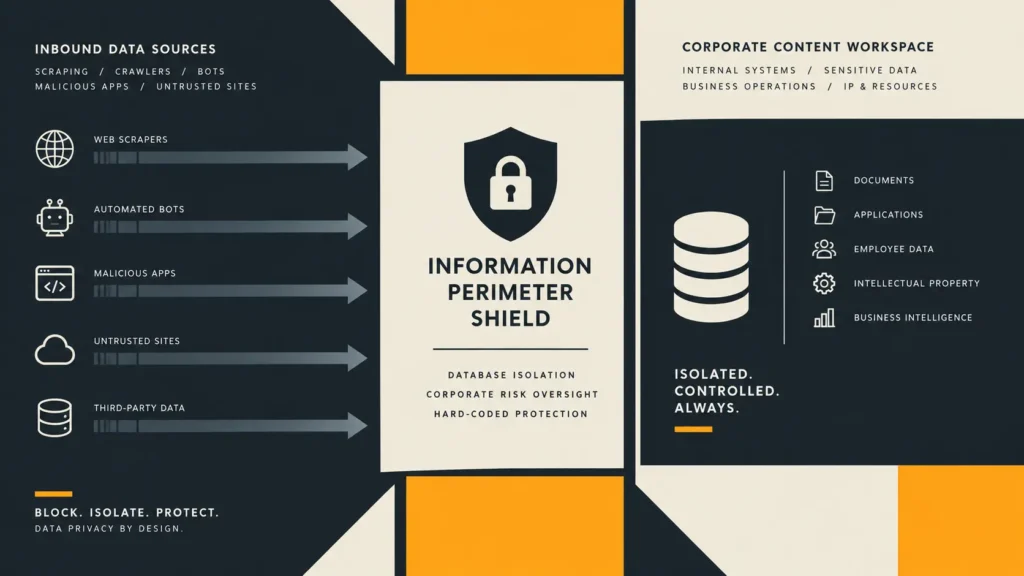
Companies aggressively push high-value marketing content, detailed product guides, and original brand copy onto public media channels, often without realizing that xAI’s crawlers treat public profile interactions and media arrays as raw, unencrypted training fuel by default. Internal teams frequently never verify how these digital assets affect corporate model protection or cross-tenant intellectual property risk before publishing them to the open web. Failing to programmatically isolate these public communication spaces allows automated collection scripts to scrape and index proprietary brand assets, feeding them directly into frontier data models before internal security leads can audit the downstream legal vulnerabilities.
Deciding to deploy an explicit, structural roadmap to construct strict validation parameters and block grok AI scraping vectors is a critical operational engineering requirement, not a marketing-team afterthought. Enforcing centralized data-isolation controls is the only technical mechanism that successfully prevents asset-handling drift, stabilizes enterprise procurement loops, and stops technical risk drift before a competitor can simply prompt their way into your internal operational playbook. Without a rigid profile-hardening runbook, your public messaging footprint remains heavily exposed to deep token ingestion pipelines that can strip away your platform competitive advantages entirely undetected.
There is a profound, stomach-dropping sense of technical disbelief that hits you when you run a comprehensive brand asset audit and realize that your proprietary marketing tactics have been completely vacuumed up by an external AI scraper. You open a frontier model chat prompt, enter a generic industry query, and watch your heart sink as the engine outputs your internal customer resolution scripts, exact pricing formulas, and custom training copy word-for-word—revealing that an automated crawler had quietly ingested your public brand feeds months prior.
Realizing that your unique content velocity has been repurposed to train a competitor’s enterprise LLM proves that public media channels function as a direct data-exfiltration pipe if your marketing technology teams treat default platform settings as safe configurations.
The four adjustments detailed below build that protection from understanding the crawler framework through to the ongoing automated compliance audits that keep your privacy configurations from silently drifting back open.
STEP 1: DECONSTRUCTING THE xAI CRAWLER ARCHITECTURE AND INGESTION PIPELINES
Deeply understanding exactly how the ingestion pipeline operates is the absolute prerequisite for any serious engineering effort to block grok AI scraping—your security and privacy teams cannot close a data exposure gap that they have not systematically mapped out.
- Understand how automated data harvesters parse raw public feeds: The underlying training pipeline draws tokens directly from live public platform activity. Text posts, account profile biographies, and associated media attachments are systematically ingested as structured input variables for model reinforcement rather than treated as incidental background noise.
- Recognize that text variables and media attachments are both explicitly in scope: Platform data-use policies explicitly treat corporate images, custom illustrations, and raw video components as public data eligible for model training under the identical default-enabled settings that govern standard text variables, meaning a visual asset receives zero special protection simply because it lacks written copy.
- Identify where hidden data exposure vectors sit across unsecured corporate channels: A corporate account’s thread replies, public quote posts, and engagement metadata profiles are all parts of the identical ingestion surface as its primary flagship posts. Narrowly locking down only your primary corporate account pages leaves these secondary brand communication channels completely exposed to ingestion.
- Treat the data crawler as a continuous pipeline rather than a one-time sweep: Information harvesting is never a single, static indexing event that executes once and stops. It operates as an ongoing web-scraping pipeline that continuously pulls from an enterprise profile’s activity for as long as your data portability settings remain enabled.
STEP 2: DISABLING DATA PORTABILITY TOGGLES AND ACCOUNT PIPELINE HARDENING
Executing this configuration path functions as the single most direct, definitive technical control available to block grok AI scraping at the account level. Corporate technology leads must apply this configuration deliberately across all corporate nodes rather than passively assuming it is already turned off.
- Navigate to Settings and Privacy on the account in question: This structural menu interface operates as the absolute operational entry point for every downstream security configuration amendment detailed across this roadmap.
- Enter the Privacy and Safety matrix: Triage teams must select this specific control directory to isolate the settings governing model training data portability, which are managed completely separately from general account visibility parameters.
- Locate the Grok data sharing control sub-panel: Identify the specific interactive configuration toggle designated to permit public data posts, user interactions, prompt inputs, and search results to be repurposed for model reinforcement loops.
- Explicitly uncheck the data sharing permission checkbox: This parameter is enabled by default on the vast majority of active accounts, meaning that the absolute absence of a programmatic alteration leaves a brand profile actively contributing proprietary assets to third-party data pools. The control variable must be deliberately switched off rather than merely reviewed.
- Understand the physical boundaries of this platform toggle: Disabling this data portability setting successfully blocks the future ingestion of an account’s digital output, but it does not retroactively pull down or strip out content assets that have already been integrated into a completed training run. Execution timing remains critical, and earlier architecture hardening preserves more corporate history from extraction.
STEP 3: PLATFORM PERIMETER ISOLATION VIA METADATA PROTECTIONS AND MEDIA WRAPPING
Beyond the primary data-sharing opt-out, applying structural adjustments to your profile architecture delivers a secondary, more absolute tier of data isolation. Implementing these platform perimeter protections is a critical engineering requirement to permanently block grok AI scraping loops before automated scraping tools can sweep your brand feeds.
- Transition public feeds toward protected states where appropriate: Converting an exposed corporate profile’s visibility parameters to a protected state excludes that content from public indexing directories entirely. Platform security directives explicitly confirm that data originating from private, protected accounts is fundamentally excluded from AI training queues and model output generation loops.
- Apply granular media-handling restrictions to strip clean structural layouts: Highly organized, consistently formatted brand text copy and structured media arrays are significantly easier for automated web scrapers to parse into clean training vectors. Introducing structural noise and reducing formatting predictability in how your digital media assets are published injects severe programmatic friction against automated data harvesters.
- Recognize that profile protection serves as the strongest operational boundary control: Unlike a standard data-sharing checkbox that only isolates future training runs on public material, restricting account visibility entirely removes your proprietary textual resources from the public surface a crawler is capable of reaching.
- Reference official platform documentation when auditing this configuration: Systems leads verifying their account infrastructure switches must cross-reference their architecture straight against the official W3C dynamic data and script isolation rules to gain vital operational context for their audits. Aligning your infrastructure blocks with these core web platform specifications allows security managers to analyze exactly how account visibility flags, metadata properties, and public resource parameters interact with automated extraction algorithms.
STEP 4: AUDITING COMPLIANCE DRIFT VIA AUTOMATED SIMULATION DRILLS
A privacy toggle configured correctly once can silently revert during backend platform upgrades. This final layer ensures that any configuration variance is caught quickly, rather than discovered months later after massive corporate assets have already leaked into public training loops.
- Execute routine, low-overhead tracking sweeps: Marketing technology leads must establish recurring, scheduled checks of every corporate account’s internal privacy profile to catch data drift before it creates a significant exposure window.
- Test account profiles against a documented configuration baseline: Each corporate identity must be mapped to a recorded, expected baseline state. This structural alignment allows an audit to quickly flag any deviation rather than requiring a team member to re-derive what a correct configuration looks like during every sweep.
- Confirm platform updates have not silently reset toggles to permissive defaults: Major platform interface adjustments and database migrations have previously reintroduced default-enabled data sharing settings without issuing explicit administrative alerts. An account correctly hardened last quarter is never guaranteed to remain secure today.
Assuming a public brand profile is secure simply because you hold a verified verification badge introduces a highly dangerous and severe false sense of security across your operational divisions. Platform verification badges protect account identity authenticity and mitigate impersonation threats, but they leave your underlying data portability permissions fully exposed to automated scraping by default. If your digital media team operates under default settings, platform-wide architecture shifts can silently re-enable data sharing flags—allowing automated web crawlers to harvest your high-value copy while your marketing dashboards show perfect brand validation.
- Extend the audit to every account with brand-adjacent access: Secondary product accounts, localized regional brand profiles, and employee-managed corporate spokesperson feeds all represent the identical data exposure surface. Leaving these peripheral nodes unaudited completely compromises your broader efforts to block grok ai scraping across the enterprise network.
CONCLUSION & GOVERNANCE BOUNDARY SUMMARY
A resilient data privacy and corporate safety posture operates as an active, ongoing system engineering discipline rather than a static boardroom compliance checkbox reviewed once a year and forgotten. A deliberate, systematic effort to block grok ai scraping arrays—combining a deep architectural mapping of the automated ingestion pipeline, disciplined account toggle configurations, structural platform visibility controls, and recurring compliance drift audits—is the only technical control that keeps your proprietary brand assets and technical copy from becoming unencrypted training fuel for a third-party model a direct competitor can query for free.
Maintaining an unyielding corporate posture requires compliance groups to continuously refine their public application perimeters against structural validation decay, transforming your external digital footprint into active programmatic limits to ensure your business preserves private data access permanently.
Balancing high-velocity digital marketing campaigns with rigid AI data privacy protections remains one of the ultimate orchestration challenges facing modern DevSecOps architects and digital asset managers. We invite you to join the technical discussion in the comments section below: What specific passive scanning architectures, framework tracking layers, or automated log monitoring platforms do you currently use to audit your public perimeters against global scraping indexes and block grok ai scraping tracks across your corporate footprint? Have you successfully shifted your profile workflows to protected brand environments, or are you running basic script validation checks during staging builds? Drop your organizational workflows, active directory patterns, and hard-earned runtime security advice with the engineering community below!
Related: Write Incident Response Plan: 5 Urgent Blueprints to Shield Corporate Networks – A practical five-step framework for building an incident response plan with severity-based triage, secure out-of-band communication, defined containment roles, regulatory notifications, and recurring simulation drills.
Microsoft Digital Defense Report 2025: Ultimate Summary to Shield Corporate Networks – A comprehensive summary of Microsoft’s Digital Defense Report 2025, examining the evolving threat landscape, AI-powered attacks, identity risks, cybercrime trends, and the defensive strategies organizations need to strengthen resilience.
ISO 27001 AI Controls: 5 Essential Cross-Walks to Stop Compliance Drift – A practical framework for mapping ISO 27001:2022 controls to AI infrastructure, covering asset inventories, inference logging, dataset security, regulatory alignment, and audit-ready GRC verification.
Secure LangChain Tool Execution: 6 Vital Steps to Shield Corporate Networks – Secure LangChain tool execution with strict input schemas, zero-trust isolation, pre-execution validation, and layered controls to stop prompt injection from becoming a system-level threat.
Secure Open WebUI Nginx: 7 Crucial Steps to Shield Corporate Networks – A practical seven-step guide to securing Open WebUI on Debian with Nginx reverse-proxy isolation, container segmentation, mTLS, hardened headers, and rate limiting to reduce exposure and abuse.
Disable Apple Intelligence Training: 3 Crucial Steps to Stop Corporate Leaks – A practical guide to disabling Apple Intelligence across enterprise Macs using MDM controls, configuration hardening, and continuous endpoint validation to reduce background telemetry and corporate data leakage.
FREQUENTLY ASKED QUESTIONS (FAQ)
Q1. If our enterprise X account uses a third-party social management platform like Hootsuite or Sprout Social, does the API connection bypass the Grok scraping toggle?
No, because third-party publishing platforms push raw text payloads directly into the central platform database via outbound API hooks, meaning that once the content renders on a public timeline, it becomes immediately visible to xAI’s crawler unless the account-level data sharing checkbox has been deliberately disabled.
Q2. Does blocking Grok scraping on our primary account also protect our brand content from being ingested when users quote-post or mention our handle?
No, unchecking the data portability flag exclusively insulates the content generated natively by your specific account profiles, meaning that if an external public user replicates your text inside a quote-post or copies your copy into an independent thread, their public interaction history remains open to crawler mining unless they have also disabled the toggle on their individual accounts.
Q3. Can corporate legal divisions leverage the “Right to Object” under GDPR or CCPA to force xAI to retroactively purge brand data harvested before the toggle was unchecked?
Yes, enterprise compliance leads can submit a formal data minimization and deletion request under regional data protection frameworks, forcing commercial AI entities to execute downstream extraction scripts that locate and redact proprietary corporate indices out of subsequent fine-tuning data snapshots.
Q4. Will shifting our brand feeds to a protected status disrupt our verified organization status or eliminate our visibility on the platform’s public search index?
Yes, converting a profile to a protected status restricts timeline visibility exclusively to confirmed followers, which programmatically strips your posts out of the public global search index and natively conflicts with the commercial discoverability metrics required to maintain a corporate verification matrix.
Q5. How can automated social monitoring tools verify that a platform-wide database migration hasn’t silently re-enabled the data-sharing flag without running manual daily checks?
Systems engineers can configure a low-overhead Headless Chrome or Playwright browser simulation script that logs into a designated test profile every morning, programmatically inspects the target elements within the account security DOM tree, and throws an immediate Slack alert flag if the data customization checkbox registers as active.
DISCLAIMER
Educational Notice: This article is published on AI Security Watch strictly for technical educational and general cybersecurity awareness purposes. The configurations and research discussed are based on public threat intelligence data. This content does not constitute professional IT architecture, legal, or financial advice. Because network configurations vary, always verify settings in an isolated test environment or consult with a qualified engineer before modifying live hardware or registries. AI Security Watch contains informational links to external resources; we are not responsible for third-party site accuracy or platform content.