⚡ TL;DR — Key Takeaways
- Administrative access controls: Establishing absolute data isolation blocks downstream multi-tenant account takeovers—neutralising indirect prompt injection tactics dictates that systems engineers treat any fetched document as a weaponised container, isolating retrieved text blocks completely before they touch the model context window.
- Vendor/client parameter validation: Restructuring default input schemas provides critical protection against unvetted instruction strings; enforce rigid structural boundaries utilizing randomized XML envelopes to tightly lock external content arrays into a data-only lane.
- Stream-optimized runtime flags: Monitoring runtime semantic transitions eliminates stealthy application-layer bypasses—deploy a localized, lightweight semantic classification engine to automatically screen and quarantine instruction-like chunks before they reach the primary orchestrator context.
- Perimeter isolation validation: Shielding core cloud computing nodes demands continuous transactional monitoring at the egress interface—audit exit token data continuously by deploying output verification middleware to systematically inspect every model output for leaked secrets, canary strings, and unauthorized system tool calls.
Table of Contents
Indirect prompt injection represents an adversarial threat vector where the attacker never speaks to your model directly. Instead, they plant malicious system instructions inside external documents or web-facing content, waiting for your data parsing engines to pull the text string into the context window. The attacker only has to wait for an automated ingestion thread to hit the asset to trigger a complete session hijack, entirely bypassing your primary edge firewalls.
Engineering teams now build highly capable RAG pipelines that connect enterprise foundation models to web scrapers, external PDFs, and third-party ticketing platforms. Most of these integrations ship under default permissive parameters: broad tool access, unrestricted retrieval sources, and no content boundary between fetched text and developer directives. Failing to programmatically isolate these dynamic ingestion paths allows automated collection scripts to scrape and index malicious string payloads, feeding them straight into model attention windows before internal teams can verify the data lineage.
The flaw is entirely architectural. A language model has no native concept of “data” versus “command,” and both arrive as tokens in the same unified context window. Ingestion loops that treat untrusted text blocks as instructions open a critical hijack window before any internal system can isolate the attention space. Moving past passive security assumptions allows backend teams to transform structural text data into active programmatic limits, locking down network interfaces before a semantic exploit paralyzes your business operations.
There is a profound, stomach-dropping sense of technical disbelief that hits you when you sit through a routine code review and watch an autonomous enterprise RAG agent casually destroy its own security boundary. We were testing a new automated support integration, watching the model pull down a public vendor document to answer a basic query.
Hidden inside that unvetted file was an invisible text string explicitly instructing the model to disregard all previous developer guidelines, wipe its system memory, harvest the current user’s session tokens, and exfiltrate them out to a third-party logging hub. It executed that destructive sequence seamlessly and entirely undetected, simply because nobody had isolated the data boundary lines from the command execution layer. Realizing that an unstructured document could turn your core application tier into a data-exfiltration pipe is a brutal wake-up call for any engineer.
Deploying an explicit, structural roadmap around strict validation parameters and genuine indirect prompt injection mitigations is a critical operational engineering requirement, not an optional hardening exercise. It prevents asset-handling drift, stabilizes enterprise procurement loops, and stops technical risk drift before a single misconfigured ingestion vector compounds across separate development teams.
The seven strategies detailed below follow the data’s path through the runtime: from ingestion, through screening, encapsulation, and budgeting, to privilege control, exit validation, and continuous testing. Each layer assumes the one before it can fail.
THE 7 ELITE HARDENING STRATEGIES FOR UNTRUSTED DATA INGESTION
STRATEGY 1: DECONSTRUCTING THE SEMANTIC HIJACK LIFECYCLE IN DATA INGESTION
Deploying systematic application barriers requires a granular structural deconstruction of the adversarial data ingestion path. The lifecycle operates across five distinct phases—seeding, dormancy, retrieval, assembly, and execution—which security architects must systematically isolate to disrupt indirect prompt injection campaigns before payloads access core orchestrator boundaries.
- Seeding shifts instruction payloads into unvetted corporate ingestion surfaces: Attackers embed hidden, natural language system instructions inside unstructured text pools they natively control or manipulate. Common transmission surfaces encompass public marketing web pages, hidden PDF body strings, malformed metadata headers, comment strings hidden within customer ticketing applications, white-on-white text blocks, and malicious image alternative text attributes.
- Dormancy and retrieval hold malicious assets silent until triggered: The embedded string payload remains completely inert inside the target data store until an external retrieval loop indexes the asset block. Malicious actors systematically optimize their text payloads using high-density token matching to ensure the infected document chunk ranks highest during semantic search loops, surfacing the exploit vector the exact millisecond a user initiates a relevant search query.
- Assembly merges untrusted data strings directly into the primary prompt context: The vector database retrieval engine pulls the raw text chunk and concatenates it straight into the runtime model attention window alongside the developer’s master directives. Because default application schemas lack any explicit data-to-command isolation barriers, the core model engine evaluates the retrieved token string as equal to, or more urgent than, the legitimate system parameters.
- Execution triggers lateral privilege escalation via autonomous tool abuse: If the underlying application architecture grants the language model direct tool access or service principal tokens, the hijacked instruction executes with the agent’s full runtime configuration permissions. The model then bypasses traditional boundaries to query internal production networks, drop or alter relational database records, or exfiltrate private corporate tracking variables to an external adversary server.
- Vector stores introduce persistent blast radius vulnerabilities across multi-tenant environments: A single poisoned document or metadata layer, once vectorized and stored inside a central embedding index, can continuously exploit separate corporate users whose queries land near the malicious cluster. Engineering teams must treat every ingestion route as a strict, trust-tiered infrastructure asset—cataloging every external node, mapping data lineage, and assuming the lowest tier remains completely hostile by default.
STRATEGY 2: IMPLEMENTING SECONDARY SCREENING LINES AND SEMANTIC CLASSIFICATION FILTERS
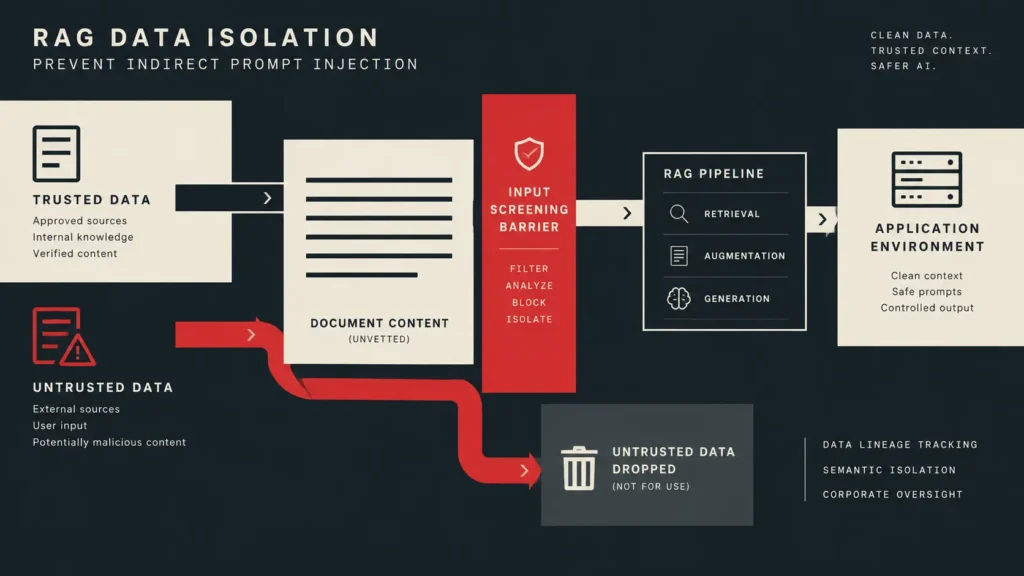
To systematically mitigate indirect prompt injection threats, system architects must insert a localized, low-latency semantic verification gateway directly ahead of the core language model window. This validation checkpoint must execute on an isolated, low-privilege classification instance that possesses zero autonomous tool execution rights and shares no persistent memory configurations with the primary application agent. Its singular operational task is to programmatically score incoming retrieved database vectors and determine whether individual text chunks are verified to enter the primary context window.
- Screen text blocks for explicit instruction-like syntax anomalies: The localized screening layer must automatically scan all incoming vector strings for imperative phrasing addressed to a generative model, system role reassignment language, and explicit text strings instructing the application to disregard prior developer parameters.
- Flag malicious token clustering patterns at the perimeter gate: The system checkpoint must evaluate token distributions to isolate high-density cluster blocks of command verbs, delimiter-mimicking punctuation sequences, and encoded or obfuscated text arrays designed to conceal malicious payloads from signature-based filters.
- Intercept systemic command semantics before context injection occurs: The classification gateway must drop any retrieved text blocks containing unauthorized requests for memory clearing, credential handling, low-level database tool invocation, or outbound data transmission, as these administrative signals have no business appearing within ordinary reference material.
- Normalize raw text fields completely before executing scoring algorithms: Systems leads must ensure the preprocessing pipeline strips zero-width spaces, collapses Unicode lookalike homoglyphs, and exposes hidden HTML elements or hidden metadata parameters, preventing adversaries from hiding payloads from the pre-filter while the primary model still reads them.
- Design the validation filter to fail closed across all pipelines: Any unverified data chunk that triggers a suspicious semantic score must be immediately quarantined, logged in a secure administrative index with its source metadata, and excluded from the context window entirely. Teams must enforce this screening lifecycle both at initial data ingestion and again at real-time retrieval, because a reference document that was clean during its initial load can be silently re-poisoned at its external source before a subsequent transaction executes.
STRATEGY 3: ENFORCING CONTENT ENCAPSULATION SYNTAX VIA STRUCTURAL XML TAG ENVELOPES
Wrapping every retrieved chunk inside a rigid, unique structural envelope ensures the master system prompt can explicitly define the parsed tokens as untrusted data. The core system directive then dictates that anything residing within these boundaries must be handled purely as inert reference material to be analyzed or quoted, completely neutralizing any embedded strings that attempt to trigger an indirect prompt injection exploit.
- Generate secure randomized identifiers for every transaction session: Infrastructure leads must generate dynamic tag names or insert randomized cryptographic tokens on a per-request basis from a secure source. Keeping these transient identifiers completely out of persistent data stores ensures an attacker cannot close an extraction envelope early, because they cannot mathematically predict its specific label.
- Sanitize retrieved text fields to neutralize structure spoofing: The preprocessing engine must systematically scrub raw string inputs to disable angle-bracket sequences and tag-like characters inside the fetched payload, preventing malicious blocks from forging a system directive lane or spoofing a closing tag.
- Attach explicit provenance attributes straight to the data envelope: Map the source identity, file creation timestamps, and defined trust tier directly to each document envelope container, providing downstream transaction loggers and security monitoring systems with a verifiable record of exactly where each block originated.
- Reinforce context boundaries utilizing a sandwich prompt layout: Build a dual-layer validation defense by restating the data-only rule immediately after the retrieved content block as well as before it. This balanced layout counters hostile payloads designed to occupy the absolute end of an attention window to overwrite preceding system parameters.
Infrastructure managers auditing platform perimeter parameters should cross-reference their designs against the official OWASP top 10 LLM vulnerability tracking matrices, which list prompt injection as the primary entry. This programmatic encapsulation serves as a strong probabilistic boundary control rather than a standalone silver bullet, meaning it must be paired with every adjacent data isolation layer across your execution path.
STRATEGY 4: RESTRICTING MULTI-TIERED CONTEXT BUDGETS AND TEXT TRUNCATION CONSTRAINTS
Every token of attacker-controlled text inside the execution window increases the system’s threat surface. Enforcing rigid context budgets shrinks this exposure window deliberately, neutralizing large-scale text strings before they can cause an architecture-tier hijack.
- Establish multi-tiered allocation ceilings across data streams: Systems leads must implement strict context constraints, defining a clear per-chunk ceiling, a per-document character cap, a fixed per-source chunk count, and a strict total percentage limit of the model attention window that retrieved data may occupy. Internal validated datasets receive a larger resource allocation, while scraped public web text and third-party file uploads receive the most restricted limits.
- Reserve a dedicated memory block for core system parameters: Secure a fixed, unalterable portion of the model context window exclusively for developer system directives. This step ensures that volumetric context flooding or repetition-based attacks lose all leverage because they cannot physically fit inside the window or push core safety logic out of the model’s effective attention layer.
- Truncate payloads strictly at semantic boundaries: Enforce truncation rules at clean sentence or paragraph edges to prevent cutoffs from generating ambiguous token fragments. DevSecOps engineers must order this preprocessing data pipeline deliberately: execute text normalization first, then apply truncation constraints, run semantic classification checks, and wrap the remaining blocks inside secure data envelopes. Truncating text early keeps the classification engine’s workload predictable and stops adversarial payloads from hiding in the tail of an oversized document file.
- Enforce identical context discipline across runtime tool outputs: Treat all downstream tool execution outputs and API responses that re-enter the model context loop as unverified data chunks, passing them through the identical truncation and isolation filters applied to external documents to prevent secondary injection cycles.
STRATEGY 5: DECOUPLING LLM AUTONOMOUS TOOLS FROM ADMINISTRATIVE EXECUTION RIGHTS
System architects must assume a semantic compromise will eventually bypass initial filters and configure backend environments to ensure a successful exploit accomplishes nothing. The ultimate blast radius of a hijacked agent is defined entirely by its provisioned system privileges rather than the structural complexity of your input screening blocks.
- Enforce strict least privilege boundaries across tool integrations: Grant each runtime task the narrowest possible scoped, short-lived access credentials, defaulting permanently to read-only permissions. Never expose raw corporate session tokens, administrative API keys, or master infrastructure secrets inside the context window; instead, isolate them within a secure cryptographic vault that the application execution layer reaches on the model’s behalf.
- Segment execution environments using default-deny network walls: Run all autonomous tool execution routines inside isolated, transient container sandboxes configured with default-deny egress policies. Restricting outbound routing to a tight allow-list of pre-vetted destination domains ensures that an injected instruction to exfiltrate enterprise records to an external adversary server hits a hard network barrier.
- Split the runtime architecture into dual-model operational roles: Build an architectural separation of concerns by assigning task processing to two distinct models. A sandboxed reader model processes unvetted document content and possesses zero external tool execution access, while a separate, privileged actor model views exclusively the sanitized, structured outputs generated by the reader—never coming into direct contact with raw, fetched text layers.
- Mandate human-in-the-loop validation for state-changing transactions: Require explicit human approval clicks before allowing the system to execute destructive or unalterable actions, such as memory deletion, production record modification, or outbound database transmissions. Start up automation scales safely only when the underlying actions are fully reversible.
STRATEGY 6: MONITORING MODEL OUTPUTS VIA EXIT-FILTER NOTIFICATION MIDDLEWARE
Inspecting input data alone is entirely insufficient to secure docker llm deployment targets or protect application logic. Once a model runtime processes a compromised block, the semantic compromise occurs internally, meaning only the resulting generated outputs reveal the breach. Output validation middleware serves as your final technical checkpoint before raw tokens reach the client user interface or execute downstream system tools.
- Parse model responses for data leakage patterns: Configure your egress filtering layers to continuously scan every response string for internal infrastructure hostnames, protected database identifiers, or structured corporate assets that must never appear inside a user-facing reply field.
- Intercept credential signatures and canary string tokens: Audit outgoing token data for recognizable API key structures, token formatting blocks, and unique cryptographic canary strings planted in your vectors, which immediately signal that the model engine has reproduced protected data from storage.
- Block unauthorized commands and invalid tool arguments: Evaluate all generated tool invocations against your strict schema validation guidelines, immediately dropping the transaction if the model attempts to pass unmapped parameters or unauthorized functions outside the current user’s session policy.
- Neutralize hidden exfiltration channels and encoded text blobs: Systematically block embedded hyperlinks, web hooks, or resource paths pointing toward non-allow-listed external destination domains, while decoding text blocks to ensure adversaries are not smuggling data out using ordinary-looking characters.
Triage teams must choose their automated response according to severity: enforce immediate token blocks, execute automated redaction routines, or escalate the alert across your operational logging channels. Attach explicit correlation identifiers to every flagged output so your incident responders can quickly trace the anomalous response back to the specific retrieved database chunk that caused it, forwarding the forensic logs straight to your central SIEM ecosystem. Executing real-time log cross-correlation and sending alerts functions as an essential defense component, because every detection serves as direct technical evidence of an actively poisoned upstream reference source.
STRATEGY 7: AUTOMATED COMPLIANCE DRIFT SWEEPS AND ADVERSARIAL PERSISTENCE TESTING CADENCES
Technical security controls inevitably decay silently across complex application life cycles. A minor model weight upgrade, a quick prompt template adjustment, or a backend data retriever optimization can accidentally drop a vital XML encapsulation parameter or loosen a classification filter threshold without generating any immediate system compilation errors.
- Execute routine, low-overhead configuration sweeps against every processing endpoint: DevSecOps teams must establish automated, recurring validation routines across all active RAG pipelines utilizing specialized, curated adversarial instruction datasets to check system boundaries under load.
- Verify encapsulation tags and classifier thresholds continuously: Ensure that transient data encapsulation tags remain strictly randomized on a per-session basis, semantic pre-filter classification parameters match intended baselines, and text truncation constraints are fully intact at the data ingestion boundary.
- Audit exit validation filters using seeded data constraints: Confirm that output verification middleware systematically intercepts planted data elements, preventing credential artifacts or private corporate tracking variables from bypassing your egress checkpoints during an active session thread.
- Gate software deployments inside CI/CD pipelines based on sweep results: Trigger these automated scanning scripts on a strict, recurring calendar schedule and immediately following every system change event—including model version bumps, prompt modifications, retriever adjustments, or the addition of a new ingestion source—completely blocking build updates if a single control test fails.
- Deploy harmless tracer canary documents directly into the vector index: Seed your vector databases with low-impact tracking files containing benign instructions to execute simple logging actions, verifying that your internal security orchestration stack throws an immediate alarm when the specific text blocks are indexed.
- Rotate your adversarial test suite regularly to match shifting threat variations: Continuously update your validation vectors with fresh structural variations, recognizing that a static testing framework only proves your application can beat last quarter’s attacks while leaving the infrastructure exposed to modern semantic exploits.
MANDATORY OPERATIONAL ANALYSIS PAPERS & RECONNAISSANCE LIMITATIONS
No single technical control can completely eliminate this structural threat. Every mitigation layer detailed across this architecture blueprint acts as a probabilistic barrier, and their true enterprise security value comes exclusively from stacking independent, decoupled failure modes so that if one security gate drops a token, adjacent controls intercept the exposure.
Reconnaissance and vulnerability assessment tooling have hard limits when tracking semantic vulnerabilities. Traditional perimeter scanners and external configuration checkers see network endpoints, open ports, and cryptographic certificates, but they physically cannot see what instruction text sits inside an active vector store or how a language model alters its behavior after reading a specific string chunk. Semantic threat structures remain entirely invisible to network security tools built exclusively for network-layer risk profiles.
Assuming an internal RAG tool or vector processing pipeline is secure simply because it lacks a public web-facing endpoint introduces a highly dangerous false sense of security across your engineering divisions. If an employee uploads an unverified vendor invoice, syncs an unmapped customer service ticket, or scrapes an untrusted internet repository into the vector index, an embedded indirect prompt injection instruction string can compromise your backend operations directly from within your local network boundary. The model will parse the rogue token instructions, hijack adjacent API connections, and pivot laterally through your cloud databases while your perimeter logging platforms report zero structural anomalies.
Systems architects must systematically treat the data ingestion path, rather than the legacy network edge, as the true infrastructure perimeter. Engineering teams must rigorously document exactly who holds the system privileges to add new content layers to each vectorized index, from which specific data sources text fields originate, and under which explicit trust tier the records are evaluated before validation loops execute.
CONCLUSION & GOVERNANCE BOUNDARY SUMMARY
Indirect prompt injection persists as a structural challenge because it directly exploits the fundamental semantic mechanics of how large language models function, rather than relying on a patchable software bug. Defending against this vector requires a code-enforced, deeply layered engineering discipline: systems architects must continuously isolate fetched text fields, enforce strict structural boundaries using randomized tags, verify token semantics through dedicated classification pre-filters, heavily constrain automated tool privileges, and systematically audit every single exit token at the egress interface.
A resilient privacy and identity safety posture operates as an active, ongoing system engineering discipline rather than a static boardroom compliance checkbox reviewed once a year and forgotten. Ingestion pipelines and agentic networks that handle unstructured data assets must be managed with continuous evaluation. Engineering teams that systematically test, measure, and tighten these contextual containment gates will successfully detect and block adversarial instruction attempts early, while those that treat perimeter defense as a finished milestone will eventually find out otherwise when a session hijack occurs.
Balancing high-velocity application scaling with rigid semantic prompt protection remains one of the ultimate engineering challenges facing modern DevSecOps architects and platform developers. We invite you to join the technical discussion in the comments section below: What specific passive scanning architectures, framework tracking layers, or automated log monitoring platforms do you currently use to audit your infrastructure perimeters against global threat indexes and block indirect prompt injection vectors? Have you successfully shifted your orchestration layers to dual-model operational roles, or are you running basic table-top mock exercises during staging builds? Drop your organizational workflows, active directory patterns, and hard-earned runtime security advice with the engineering community below!
Related: Secure Docker LLM Deployment: 5 Practical Blueprints to Shield Corporate Networks – A practical guide to hardening containerized LLM environments against misconfigurations, exposed services, and AI-specific security threats.
Block Grok AI Scraping: 4 Vital Adjustments to Shield Corporate Networks – A practical guide to blocking Grok AI scraping on X, using privacy controls, access restrictions, and defensive measures to reduce unauthorized use of brand content for AI training and data extraction.
Write Incident Response Plan: 5 Urgent Blueprints to Shield Corporate Networks – A practical five-step framework for building an incident response plan with severity-based triage, secure out-of-band communication, defined containment roles, regulatory notifications, and recurring simulation drills.
Microsoft Digital Defense Report 2025: Ultimate Summary to Shield Corporate Networks – A comprehensive summary of Microsoft’s Digital Defense Report 2025, examining the evolving threat landscape, AI-powered attacks, identity risks, cybercrime trends, and the defensive strategies organizations need to strengthen resilience.
ISO 27001 AI Controls: 5 Essential Cross-Walks to Stop Compliance Drift – A practical framework for mapping ISO 27001:2022 controls to AI infrastructure, covering asset inventories, inference logging, dataset security, regulatory alignment, and audit-ready GRC verification.
Secure LangChain Tool Execution: 6 Vital Steps to Shield Corporate Networks – Secure LangChain tool execution with strict input schemas, zero-trust isolation, pre-execution validation, and layered controls to stop prompt injection from becoming a system-level threat.
FREQUENTLY ASKED QUESTIONS (FAQ)
Q1. How can small development teams verify if a third-party Python library (like a specialized PDF text extractor) is stripping out hidden formatting that attackers use to trick RAG tokenizers?
Engineering teams must audit text-extraction pipelines to ensure they do not pass unmapped whitespace strings or hidden structural formatting codes into the prompt assembler. You must configure your extraction scripts to strictly match text inputs against an exclusive regular expression filter that keeps only alphanumeric characters, structural punctuation, and explicit sentence structures before processing token weights.
Q2. Will implementing a dual-model (Reader/Actor) architecture significantly increase operational latency or API billing costs across high-volume startup pipelines?
Yes, running dual-inference steps doubles the base token volume required to process a single data query. To lower this billing overhead, infrastructure managers should deploy a compact, highly customized open-source language model to complete the low-privilege reading and summarization steps on local compute hardware, reserving expensive frontier cloud models exclusively for the final action steps.
Q3. How do we prevent exit-filter middleware from accidentally triggering false positives that block legitimate engineering logs or code fragments during debugging sessions?
Developers must establish an encrypted hash validation or data canary check inside internal database systems. By assigning unique tracking tokens to legitimate system strings, the exit middleware can instantly verify that a code segment matching a signature pattern is safe to pass through, dropping the connection only when an unhashed credential pattern tries to slip by.
Q4. If an attacker seeds a malicious payload inside an image caption, can vision-language models (VLMs) trigger an indirect prompt injection exploit during visual RAG tasks?
Yes, multi-modal engines convert visual images and text blocks into the identical vector space inside the context window, meaning an instruction embedded within an image or alt-text field can override system parameters. To block this vector, you must isolate the text output generated by your multi-modal preprocessor, parsing it through the same XML encapsulation filters applied to standard text documents.
Q5. What is the primary operational failure organizations commit when configuring vector database access policies for autonomous agent tools?
The most common vulnerability is granting the database query service account broad write and delete privileges across the entire vector index. System leads must enforce a strict, read-only database role for all automated data retrieval tasks, ensuring that even if an execution session faces a complete semantic hijack, the model physically lacks the access rights required to corrupt or drop stored indexing tables.
DISCLAIMER
Educational Notice: This article is published on AI Security Watch strictly for technical educational and general cybersecurity awareness purposes. The configurations and research discussed are based on public threat intelligence data. This content does not constitute professional IT architecture, legal, or financial advice. Because network configurations vary, always verify settings in an isolated test environment or consult with a qualified engineer before modifying live hardware or registries. AI Security Watch contains informational links to external resources; we are not responsible for third-party site accuracy or platform content.