
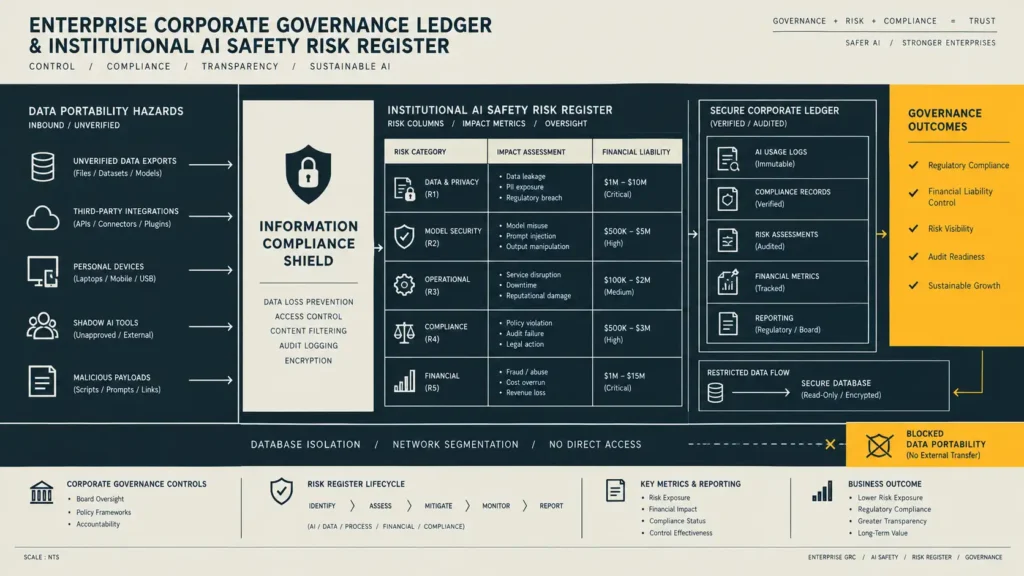
⚡ TL;DR — Key Takeaways
- Administrative access controls: Formulating a structured compliance tracking matrix secures enterprise sales pipelines—the process required to maintain a functional AI safety risk register dictates that operations teams systematically map every fine-tuning path and data touchpoint before procurement vetting loops begin.
- Vendor/client parameter validation: Restructuring default formatting schemas provides critical protection against unvetted architectural liabilities; consolidate risk severity fields, clear mitigation ownership, and live remediation status variables into a single, highly structured corporate ledger.
- Stream-optimized runtime flags: Monitoring data portability hazards protects enterprise financial assets from sudden compliance drift—compliance managers must compute precise financial blast radiuses programmatically to quantify downstream fiscal exposure long before an external procurement auditor flags the pipeline.
- Perimeter isolation validation: Shielding core enterprise application environments demands continuous operational tracking rather than point-in-time reviews—execute routine compliance drift checks across your deployment matrix, since a risk register audited only once a calendar cycle is already completely stale.
Table of Contents
Enterprise scaleups and SaaS vendors routinely lose high-value deals not because their underlying core system architecture is inherently unsafe, but because they treat model safety as an informal engineering conversation instead of a documented governance artifact. A Fortune 500 procurement officer does not evaluate “we’re careful with data” as a valid corporate claim—they evaluate it as a significant risk gap, because unmapped shadow tools and vague data portability paths read as an uninsurable liability the exact moment a due-diligence questionnaire arrives. Failing to programmatically isolate these dynamic integration paths allows automated collection scripts to scrape and index malicious string payloads, feeding them straight into model attention windows before internal teams can verify the data lineage.
That gap is entirely structural rather than technical. The engineering team may genuinely have sound data-handling practices in place; what is missing is the formal repository that lets a buyer’s security team verify those practices exist without a live interrogation of the founding engineers. Deciding to deploy an explicit, structural roadmap to construct strict validation parameters and an AI safety risk register ledger is a critical operational engineering requirement, not a nice-to-have compliance artifact reserved for later-stage companies. Enforcing these centralized response parameters is the only technical mechanism that successfully prevents asset-handling drift, stabilizes enterprise procurement loops, and stops technical risk drift before a deal quietly goes cold.
There is a profound, stomach-dropping sense of technical disbelief that hits you when you sit in a final enterprise procurement meeting with a Fortune 500 buyer and watch a multi-million dollar contract stall instantly. You listen to their risk committee ask a simple, direct question about your data lineage, and your heart sinks as your team scrambles to explain your architecture over a Zoom call without a structured ledger to back it up.
Watching a legacy security officer scratch out a major enterprise deal simply because you cannot present a structured ledger mapping out exactly where fine-tuning customer data is stored or how the application isolates model context boundaries under duress is a brutal wake-up call. It proves that microservices and high-velocity code drops mean absolutely nothing if your lean development team operates without a hard-coded crisis manual to dictate containment rights under duress.
The four core architectural modules detailed below build that governance ledger from the ground up, structured specifically to satisfy the most rigorous enterprise security audits.
THE CORE SPECIFICATIONS OF AN ENTERPRISE-GRADE GOVERNANCE LEDGER
A genuine governance ledger is not a superficial spreadsheet assembled the week before a procurement audit—it functions as a living document with four distinct architectural modules, each built to address a different question an enterprise security team will eventually ask.
MODULE 1: FORMATTING RISK COLUMNS AND STRUCTURAL THREAT CATEGORIZATION
The foundational structure of the register is its column schema, and getting this wrong completely undermines everything built on top of it. Building a functional AI safety risk register requires that each recorded row features a distinct risk identifier, a plain-language threat description, an explicit threat category (such as model vulnerability, shadow AI usage, data portability hazard, or third-party dependency risk), a severity rating based on a consistent scale, an assigned engineering owner, and an updated remediation status. Threat categorization matters as much as severity: a buyer’s security team parses these categories to verify whether an organization has actually mapped its full exposure surface or just documented the risks that were easiest to describe.
- Enforce schema consistency across all rows to guarantee auditability: A severity scale that shifts definition halfway through the document—where a “high” rating means something different in row 12 than it did in row 3—fails an audit even if every individual entry is technically accurate, because the reviewer can no longer trust the aggregate posture the register is supposed to provide.
- Establish explicit threat taxonomy definitions: Clear categorization maps data lineages cleanly, allowing your compliance groups to trace vulnerabilities down to specific operational layers.
- Assign direct engineering accountability metrics: Every identified systemic liability must map to exactly one owner to ensure technical mitigation paths are verified, validated, and clean.
MODULE 2: CALCULATING FINANCIAL BLAST RADIUSES AND LIABILITY MODELING METRICS
Severity metrics alone fail to answer the primary question a Fortune 500 buyer’s legal and finance teams actually care about: what does this risk cost if it materializes. Implementing robust financial blast radius modeling translates each cataloged threat into an estimated liability figure, constructed from a highly defensible combination of factors—including potential regulatory fine exposure under applicable frameworks, estimated customer churn if the incident became public, direct system remediation costs, and contractual penalty exposure under existing enterprise agreements.
- Establish a defensible and consistent calculation methodology: This calculation does not need to be precise to the exact dollar to be highly useful; rather, it must remain entirely methodology-driven across every row of the ledger. A blast radius figure that a compliance lead can explain and justify under direct questioning carries far more procurement weight than an apparently more accurate number that nobody can reconstruct the underlying logic behind.
- Quantify downstream cross-tenant liability exposure: Systematically modeling the true fiscal blast radius allows software vendors to map out potential asset damage boundaries, helping the team proactively adjust corporate policy parameters before a platform liability issue surfaces.
- Align risk values directly with legal compliance limits: Hardcoding these financial projections right into your corporate AI safety risk register provides clear visibility for executive leadership, turning abstract model vulnerabilities into explicit, quantifiable corporate business realities.
MODULE 3: TRACKING SHADOW AI USAGE AND UNMAPPED DATA PORTABILITY HAZARDS
Shadow AI—model access or fine-tuning workflows adopted by individual teams outside sanctioned procurement and security review—is one of the fastest-growing categories in this register, precisely because it grows invisibly. An engineering team piping customer data through an unvetted third-party inference API to solve an immediate problem creates exactly the kind of unmapped exposure that stalls a procurement review the moment a buyer’s security questionnaire asks where customer data actually travels.
- Establish a dedicated category for data portability hazards: Isolating data portability vectors into a tracked category rather than folding them into general data-handling rows is necessary because the underlying failure mode is distinct: it is not merely that data was mishandled, but that the organization cannot precisely account for every location a customer’s data has touched across fine-tuning pipelines, vector stores, and third-party model providers.
- Structure compliance tracking against recognized industry baselines: Structuring this tracking ledger against the official NIST Artificial Intelligence Risk Management Framework parameters gives compliance leads a recognized methodology to map these hazards against, rather than building an internal taxonomy from scratch that a Fortune 500 auditor has never seen and has no reason to trust on first encounter.
- Enforce continuous subnet log auditing across enterprise networks: Corporate risk officers must implement passive traffic monitoring to automatically scan, catalog, and log shadow tool usage before unvetted API data transmission paths create an uninsurable liability inside the master AI safety risk register layout.
MODULE 4: STRUCTURING MITIGATION METRICS AND CONTINUOUS COMPLIANCE DRIFT SWEEPS
A cataloged risk without a tracked mitigation status is merely a documented liability rather than a functioning governance tool. Effectively scaling an AI safety risk register requires that each recorded threat row features a clearly defined mitigation metric—a measurable indicator of remediation progress rather than a vague status entry like “in progress” that carries no verifiable context—paired with a continuous review cadence appropriate to the risk’s severity tier.
- Implement automated compliance drift sweeps to preserve ledger accuracy: A major model weight update, a new third-party pipeline integration, or a quietly adopted internal utility can instantly invalidate a previously accurate risk assessment without anyone updating the master repository to reflect the change.
- Catch tracking variances before external security reviews catch them first: Deploying a scheduled, recurring drift sweep is designed specifically to capture and resolve configuration variances before an external procurement auditor or enterprise buyer flags the discrepancy during due-diligence cycles.
- Enforce programmatic verification gates across software supply chains: Compliance managers must integrate continuous tracking scripts to continuously verify assigned mitigation thresholds, ensuring that any unrecorded change to model access points automatically triggers an executive remediation alert.
MANDATORY PROCUREMENT AUDITING PAPERS & DISCLOSURE BOUNDARIES
A resilient data privacy and safety posture operates as an active, ongoing system engineering discipline rather than a static boardroom compliance checkbox signed off once an audit cycle and forgotten. Deep metrics from modern multi-tenant environments make the operational path clear: achieving true infrastructure resilience requires corporate teams to treat column formatting schema, financial blast radius calculations, shadow tool monitoring pipelines, and continuous compliance drift sweeps as a single, code-enforced technical matrix.
Assuming your enterprise platform is clear for complex procurement loops simply because you hold a standard SOC 2 Type II attestation introduces a highly dangerous and severe false sense of security across your operational divisions. Traditional IT audits evaluate static infrastructure perimeters, physical data centers, and employee background check logs while completely missing dynamic data drift, prompt safety vectors, and non-deterministic model outcomes. If you operate without a hard-coded AI safety risk register ledger to explicitly map out fine-tuning paths and context window boundaries under duress, a single data portability hazard can stall a multi-million dollar enterprise contract, leaving your sales directors completely paralyzed while buyer security committees flag your platform as an uninsurable operational liability.
CONCLUSION & GOVERNANCE BOUNDARY SUMMARY
A resilient data privacy and corporate safety posture operates as an active, ongoing system engineering discipline rather than a static boardroom compliance checkbox reviewed once a year and forgotten. The four core architectural pillars detailed across this roadmap—column schema formatting, financial blast radius modeling, shadow AI and data portability tracking, and explicit mitigation metrics paired with automated drift sweeps—only function as a powerful governance tool when maintained continuously, rather than hastily assembled retroactively to salvage a single procurement cycle.
A genuine AI safety risk register is ultimately a major sales driver as much as a compliance artifact. It serves as the definitive technical document that lets a security-conscious buyer say yes with complete confidence, entirely eliminating the need to take an engineering team’s informal word for it. Maintaining an unyielding corporate posture requires risk officers to continuously refine their infrastructure perimeters against structural validation decay, transforming internal tracking metrics into active programmatic limits to ensure your business preserves private data access permanently.
Balancing high-velocity SaaS feature deployment with rigid corporate compliance readiness remains one of the ultimate orchestration challenges facing modern DevSecOps architects and compliance leads. We invite you to join the technical discussion in the comments section below: What specific passive scanning architectures, framework tracking layers, or automated log monitoring platforms do you currently use to audit your infrastructure perimeters against global threat indexes and manage your AI safety risk register profiles? Have you successfully shifted your vendor assessments to hardcoded metric calculations, or are you running basic quarterly dashboard reviews during staging builds? Drop your organizational workflows, active directory patterns, and hard-earned runtime security advice with the engineering community below!
Related: Indirect Prompt Injection: 7 Elite Strategies to Shield Corporate Networks – A practical guide to mitigating indirect prompt injection in RAG systems using trusted data pipelines, input sanitization, retrieval controls, and output validation to prevent malicious content from influencing AI responses.
Secure Docker LLM Deployment: 5 Practical Blueprints to Shield Corporate Networks – A practical guide to hardening containerized LLM environments against misconfigurations, exposed services, and AI-specific security threats.
Block Grok AI Scraping: 4 Vital Adjustments to Shield Corporate Networks – A practical guide to blocking Grok AI scraping on X, using privacy controls, access restrictions, and defensive measures to reduce unauthorized use of brand content for AI training and data extraction.
Write Incident Response Plan: 5 Urgent Blueprints to Shield Corporate Networks – A practical five-step framework for building an incident response plan with severity-based triage, secure out-of-band communication, defined containment roles, regulatory notifications, and recurring simulation drills.
Microsoft Digital Defense Report 2025: Ultimate Summary to Shield Corporate Networks – A comprehensive summary of Microsoft’s Digital Defense Report 2025, examining the evolving threat landscape, AI-powered attacks, identity risks, cybercrime trends, and the defensive strategies organizations need to strengthen resilience.
ISO 27001 AI Controls: 5 Essential Cross-Walks to Stop Compliance Drift – A practical framework for mapping ISO 27001:2022 controls to AI infrastructure, covering asset inventories, inference logging, dataset security, regulatory alignment, and audit-ready GRC verification.
FREQUENTLY ASKED QUESTIONS (FAQ)
Q1. How can enterprise compliance leads legally map cross-border AI data portability liabilities inside the risk register when model nodes span both EU and US sovereign subnets?
Compliance teams must hardcode dynamic geolocation tracking variables directly into the ledger’s hazard metadata columns. You must catalog the precise boundary lines of each foundational model host provider, mapping explicit risk entries for localized jurisdictional overrides—such as specific EU AI Act enforcement penalties or cross-border data transfer limitations—to prove your B2B SaaS architecture satisfies multi-regional compliance criteria.
Q2. Will integrating automatic shadow tool tracking sensors within our development CI/CD pipelines slow down standard software compilation speeds?
No, because system tracking dependencies should run exclusively as asynchronous, out-of-band compliance scanners during staging builds. By configuring passive API audit hooks to intercept traffic logs without halting execution pipelines, engineering groups can continually feed active telemetry data straight into the risk register without adding latency to development cycles.
Q3. How do we prevent our financial blast radius calculations from becoming obsolete when enterprise clients negotiate unique, highly customized indemnification caps?
Risk managers must structure the ledger’s financial liability algorithms to calculate risk exposure using a dual-tier modular parameter. The registry must cross-reference your baseline architectural exposure metrics alongside specific, client-contractual liability variables, programmatically altering the aggregate blast radius profile the exact moment a custom enterprise service level agreement goes live.
Q4. External procurement auditors frequently reject risk registers that rely on qualitative metrics like “Low, Medium, High”—what objective calculation replaces this?
Startups must replace subjective phrasing with a hardcoded, quantitative Risk Priority Number (RPN) derived from multiplying clear mathematical factors: Vulnerability Exploitability Probability (1–10) times System Structural Impact Severity (1–10). This methodology yields an auditable integer string that external security committees can mathematically verify and trace down to clear architectural limits.
Q5. What is the primary operational failure organizations commit when mapping third-party open-source model weights inside their governance ledgers?
The primary mistake is failing to record downstream supply chain dependencies, such as training data provenance and base-model weight poisoning risks. Compliance frameworks dictate that vendors map the exact lineage of any foundational model weights utilized, ensuring that upstream developer vulnerabilities or unvetted dataset vectors are completely cataloged before procurement review cycles launch.
DISCLAIMER
Educational Notice: This article is published on AI Security Watch strictly for technical educational and general cybersecurity awareness purposes. The configurations and research discussed are based on public threat intelligence data. This content does not constitute professional IT architecture, legal, or financial advice. Because network configurations vary, always verify settings in an isolated test environment or consult with a qualified engineer before modifying live hardware or registries. AI Security Watch contains informational links to external resources; we are not responsible for third-party site accuracy or platform content.
流媒体成人内容 通过选择经过验证的成人网站来安全进行。使用 可靠的色情中心 以获得私密的娱乐体验。
在哪里观看色情内容,通过探索网络上的可靠平台。研究 受保护的内容来源 以获得私密观看体验。
最新成人网站 提供创新的成人娱乐内容。发现 可靠的新网站 以获得现代化的体验。
成人材料 可在各种成人娱乐网站上获取,供娱乐用途。始终选择 安全平台 以确保安全体验。
成人内容平台 提供广泛的成人娱乐视频选择。选择 安全的成人网站 以获得保密体验。
Find out more