
⚡ TL;DR — Key Takeaways
- Administrative access controls: Establishing absolute record taxonomy schemas shields your local business networks—the initial process required to engineer a defensible data retention policy dictates that systems engineers systematically classify corporate records into strict trust tiers before any automated destruction dates can be assigned.
- Vendor/client parameter validation: Restructuring data life cycle intervals provides critical protection against unmanaged background information collection creep; enforce hardcoded structural schedules across all server storage volumes rather than relying on a loose, manual cleanup assumption that fails to alter your production security baseline.
- Stream-optimized runtime flags: Monitoring background database transactions blocks unchecked table accumulation across distributed cloud instances—deploy automated pruning pipelines to systematically eliminate legacy data pools, as manual cleanup workflows fail to scale and cannot survive employee turnover.
- Perimeter isolation validation: Shielding distributed computing instances demands continuous operational tracking under load rather than static documentation reviews—perform continuous verification audits across your storage infrastructure to ensure automated pruning scripts have not quietly ceased executing.
Table of Contents
Early-stage tech scaleups and small businesses frequently treat data accumulation as a zero-cost convenience rather than a compounding structural threat. Unmanaged legacy database tables and orphaned file shares function as a massive regulatory target and an uninsurable operational liability the exact moment a compliance audit or legal disclosure window opens. Failing to programmatically isolate these historical repositories allows stale fields to quietly build up structural exposure, introducing severe data tracking liabilities long before automated monitoring configurations can flag the non-compliant pools or drop an exposed storage endpoint.
Deciding to deploy an explicit, structural roadmap to construct strict validation parameters and an enterprise data retention policy
blueprint is a critical operational engineering requirement, not a paperwork exercise handled once and filed away. Enforcing these centralized data lifecycles is the only technical mechanism that successfully prevents asset-handling drift, stabilizes enterprise procurement loops, and stops technical risk drift before an old, forgotten dataset becomes the reason a company faces existential statutory fines. Moving past passive security assumptions allows backend teams to transform raw storage lifecycles into active, code-enforced boundaries, locking down network interfaces before an outdated data silo triggers a complete regulatory compliance failure.
There is a profound, stomach-dropping sense of technical disbelief that hits you when you conduct a quick infrastructure audit on an old, forgotten cloud storage bucket and realize your team has been sitting on a compliance landmine. You scan the root file tree and watch your heart sink as you discover unencrypted customer PII, cleartext transaction logs, and historic session hashes dating back over five years—completely orphaned from your primary access workflows but fully accessible to anyone with basic directory read privileges.
Realizing that a single perimeter breach would have triggered immediate, existential statutory fines under GDPR or HIPAA for data that the company had zero business reason to keep is a brutal wake-up call. It proves that scaling up compute nodes means absolutely nothing if your engineering division leaves legacy customer profiles rotting in unmanaged cloud silos without a code-enforced destruction routine.
The step-by-step data life cycle purging workflows detailed below provide a hardcoded operational checklist to map out these absolute data-handling boundaries systematically.
THE STEP-BY-STEP DATA LIFE CYCLE PURGING LANDSCAPE
STEP 1: CLASSIFYING CORPORATE RECORDS AND MAPPING STRICT TRUST TIERS
Every effective data retention policy begins with classification, because a destruction schedule is meaningless without first knowing what category a given record belongs to. This classification taxonomy serves as the foundational architecture that every downstream data retention policy control depends on.
- Define distinct classification tiers for every type of corporate record: Customer PII, financial transaction logs, employee records, internal communications, and system telemetry each carry entirely different legal retention requirements and distinct risk profiles if exposed. Treating them as a single, undifferentiated data pool guarantees severe over-retention across your environment.
- Map global regulatory constraints against each trust tier: A record subject to GDPR carries different minimum and maximum retention windows than one governed purely by domestic contract law. The classification tier must explicitly encode which regulatory regime applies rather than just identifying the raw format of the data.
- Assign a designated business owner to each classification tier: A data tier without an accountable owner is a tier that nobody actively maintains. Classification mapping requires a specific title or team name attached to the row rather than just a passive category label in a spreadsheet.
- Document the legal basis for retaining each data tier at all: Data retained without a clear, auditable business or legal justification is exactly the kind of record a regulator or plaintiff’s attorney will ask about first. The justification must exist in writing before the question is ever asked.
STEP 2: ESTABLISHING AUTOMATIC DATABASE PRUNING ROUTINES AND SCHEMA LIFECYCLES
Manual data cleanup does not survive organizational change. This step focuses on architecting an automated pruning pipeline that the classification scheme from Step 1 feeds directly into, ensuring systemic consistency across all operational layers.
- Assign a defined retention lifecycle to every database schema: Each table or collection must have explicit retention logic built directly into its schema design rather than retention operating as an afterthought applied inconsistently by whichever engineer happens to modify that part of the codebase.
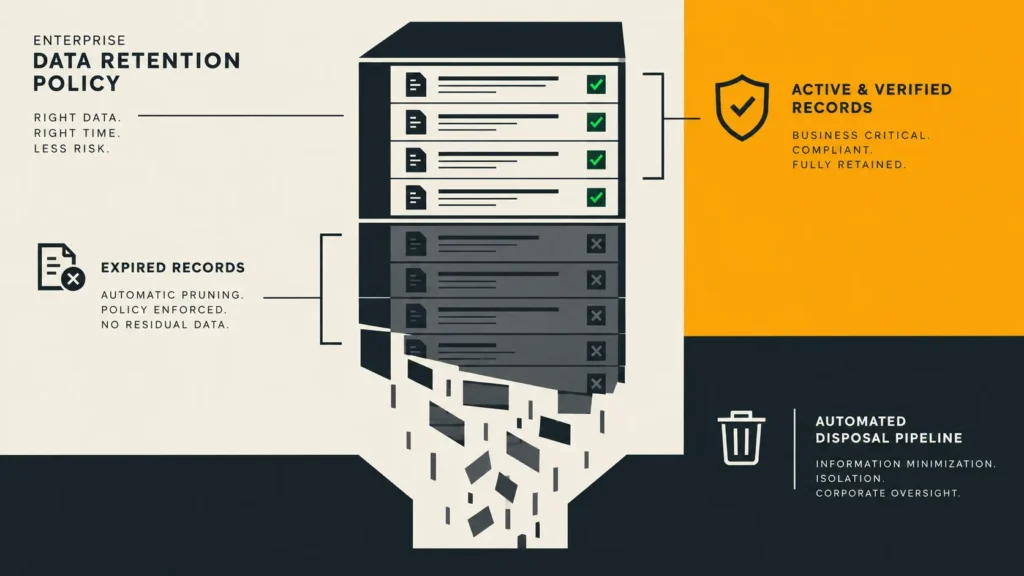
- Automate pruning execution on a fixed, recurring cadence: Scheduled, automatic removal of records that have exceeded their classified retention window completely closes the security gaps that manual cleanup inevitably leaves open as engineering headcount and priorities shift.
- Build pruning logic that respects strict legal holds: A record under an active litigation hold must be programmatically excluded from automatic pruning regardless of its classification tier’s normal schedule. The data pipeline requires an explicit override mechanism rather than just a straightforward timer thread.
- Log every automated pruning action for future audit purposes: A record that was correctly and automatically destroyed still requires a corresponding log entry proving exactly when, why, and under which specific policy that deletion occurred, providing an unyielding trail for compliance reviews.
STEP 3: HARDCODING EXPLICIT DOCUMENT DESTRUCTION LIFECYCLES AND VERIFICATION PATHS
Structured database records represent only a fraction of a corporate data footprint. This step extends identical rigor to raw files, system backups, and unstructured document storage arrays to ensure complete environment isolation.
- Hardcode destruction lifecycles at the absolute point of document creation: A document tagged with its eventual destruction date the exact millisecond it is created is far less likely to be forgotten than one relying on an engineer remembering to apply a policy retroactively.
- Extend destruction schedules to system backup and archival copies: A record deleted from primary storage but still sitting untouched in a multi-month-old backup snapshot represents exactly the same exposure window a regulator or attacker cares about. Backups must inherit the identical retention logic as the primary data they are copied from.
- Verify actual resource destruction rather than assuming scheduled execution: A destruction job that is configured to run and a destruction job that actually completed successfully are two entirely different things. Verification processes must confirm the physical completion of the task rather than assuming it based on an unverified schedule.
- Ground document destruction procedures in established federal guidance: Teams engineering this pillar should reference the official CISA data privacy and resource destruction criteria to map their sanitization standards. Grounding your procedures in these public directives guarantees your compliance workflows satisfy elite security metrics, helping you build a data retention policy framework that remains highly defensible during external audit evaluations.
STEP 4: AUTOMATED COMPLIANCE DRIFT SWEEPS AND PERSISTENCE VALIDATION CADENCES
A retention playbook that worked correctly at launch can silently stop working months later due to environment updates. This final step in the asset lifecycle catches configuration drift before an external auditor does, transforming your documentation into an active layer of structural defense.
- Run scheduled sweeps confirming pruning jobs are executing: An automated pruning pipeline that silently fails due to a permission change, schema migration, or unhandled runtime error can leave data accumulating unnoticed for months if nobody checks the system logs.
- Validate that new data sources are captured under the classification scheme: As a business adds new tools, integrations, or data types, each addition must be mapped into the existing trust tiers from Step 1. An unclassified new data source is an active policy gap by default rather than a harmless edge case.
- Reconcile actual data volumes against expected retention windows: A database table that should only ever contain roughly ninety days of records but has grown steadily for two years is a clear signal that pruning has quietly stopped functioning somewhere in the ingestion pipeline.
- Treat every drift finding as a tracked remediation item: A gap identified during a compliance sweep that is not formally logged and closed tends to resurface as exactly the same liability during your next high-stakes audit cycle.
MANDATORY REGULATORY COMPLIANCE PAPERS & JURISDICTIONAL LIMITS
Assuming your database is secure simply because you use managed cloud service providers or localized encryption introduces a dangerous false sense of security across your operational divisions. If your engineering team operates without a code-enforced destruction routine, the sheer volume of over-retained user data acts as an immediate trigger for catastrophic compliance penalties under GDPR or HIPAA the second a data subject request or an external breach hits your network surface. Storing five years of unmapped customer records simply because disk space is cheap turns your infrastructure into an absolute liability, ensuring that a single perimeter slip transforms an isolated incident into an existential regulatory event.
Jurisdictional variation compounds the retention challenge for any organization operating across international borders. A record considered fully compliant under one region’s minimum retention requirement may simultaneously violate another region’s maximum retention limit for the identical category of data—meaning your baseline system configuration can land in immediate violation depending on geographic routing parameters.
To systematically stop compliance drift, the data classification scheme engineered during your initial environment mapping must explicitly encode which specific jurisdiction’s rules govern each distinct dataset. Relying on a single global default parameter across mixed cloud environments invariably fails external audits, as it ignores the conflicting timeline mandates enforced by global data protection authorities. Software architects must hardcode geo-aware disposal schedules directly into dynamic data storage arrays to guarantee multi-tenant compliance remains fully insulated under load.
CONCLUSION & GOVERNANCE BOUNDARY SUMMARY
A resilient privacy and identity safety posture operates as an active, ongoing system engineering discipline rather than a static boardroom compliance checkbox reviewed once a year and forgotten. A data retention policy built on disciplined classification, automated database pruning routines, hardcoded document destruction lifecycles, and continuous drift validation turns regulatory obligations into core operational infrastructure, rather than a severe financial liability quietly accumulating in a forgotten storage bucket. Transitioning toward this automated data lifecycle engineering eliminates the human bottlenecks that inevitably surface during employee turnover, ensuring that stale, high-risk user records are systematically purged from your production nodes before an unexpected compliance audit or security perimeter bypass reveals an uninsurable operational exposure.
Balancing high-velocity application scaling with rigid storage minimization timelines remains one of the ultimate orchestration challenges facing modern DevSecOps architects and small business compliance leads. We invite you to join the technical discussion in the comments section below: What specific passive scanning architectures, framework tracking layers, or automated log monitoring platforms do you currently use to audit your infrastructure perimeters against global threat matrix indexes and manage your data retention policy configurations? Have you successfully shifted your database cleanup schedules to hardcoded cron triggers, or are you running basic quarterly directory reviews during staging builds? Drop your organizational workflows, active directory patterns, and hard-earned runtime security advice with the engineering community below!
Related: AI Safety Risk Register: 4 Masterful Frameworks to Stop Compliance Drift – Enterprise AI safety isn’t just about compliance—it’s about tracking risks, ownership, data exposure, and mitigation before they become deal-breakers.
Indirect Prompt Injection: 7 Elite Strategies to Shield Corporate Networks – A practical guide to mitigating indirect prompt injection in RAG systems using trusted data pipelines, input sanitization, retrieval controls, and output validation to prevent malicious content from influencing AI responses.
Secure Docker LLM Deployment: 5 Practical Blueprints to Shield Corporate Networks – A practical guide to hardening containerized LLM environments against misconfigurations, exposed services, and AI-specific security threats.
Block Grok AI Scraping: 4 Vital Adjustments to Shield Corporate Networks – A practical guide to blocking Grok AI scraping on X, using privacy controls, access restrictions, and defensive measures to reduce unauthorized use of brand content for AI training and data extraction.
Write Incident Response Plan: 5 Urgent Blueprints to Shield Corporate Networks – A practical five-step framework for building an incident response plan with severity-based triage, secure out-of-band communication, defined containment roles, regulatory notifications, and recurring simulation drills.
Microsoft Digital Defense Report 2025: Ultimate Summary to Shield Corporate Networks – A comprehensive summary of Microsoft’s Digital Defense Report 2025, examining the evolving threat landscape, AI-powered attacks, identity risks, cybercrime trends, and the defensive strategies organizations need to strengthen resilience.
FREQUENTLY ASKED QUESTIONS (FAQ)
Q1. How can small technical teams handle database retention pruning when relational tables use complex foreign key cascades that risk breaking downstream analytics?
System teams must implement a soft-deletion or data-anonymisation queue rather than raw dropping. By configuring your cron routines to clear out sensitive identifying string variables while preserving unlinked, randomized numerical metrics, you keep your aggregate business data fully auditable for analytics tools while systematically ensuring the fields are stripped of regulatory liability.
Q2. Does our data retention policy need to explicitly cover employee communication logs on third-party SaaS environments like Slack, Zoom, or Microsoft Teams?
Yes, because global data protection frameworks treat corporate communication records containing customer PII as part of your company’s broader operational audit footprint. Administrators must coordinate with corporate software vendors to align third-party administrative message retention settings with the strict timescales declared in your central policy, preventing unmanaged business text records from persisting in external cloud storage pools.
Q3. How do we legally execute document destruction loops if our B2B SaaS startup is hit with a sudden litigation hold that overlaps with our automated purging schedules?
Your engineering leads must build an explicit, high-priority “freeze” parameter inside your automated cleaning pipelines. This database flag acts as a hard programmatic override that instantly excludes target account tables or specific document directories from deletion sweeps, ensuring that automated purging processes halt for the duration of the legal holding window without corrupting adjacent database cleanup schedules.
Q4. External security auditors frequently note that backups running on immutable cloud storage blocks cannot be pruned. How do we resolve this contradiction?
Startups must implement an application-layer cryptographic erasure strategy, frequently called “crypto-shredding.” By encrypting specific customer records with unique, decoupled security keys at the row level, you can achieve immediate, absolute data disposal by simply destroying the specific key profile, leaving the corresponding backup blocks fully unreadable, unminable, and entirely compliant without altering the underlying raw disk storage blocks.
Q5. What is the primary operational failure small businesses commit when configuring object storage lifecycles for unstructured files like voice recordings or user image uploads?
The primary bottleneck is failing to apply precise object-level categorization metadata tags during initial file upload events. Failing to append precise classification headers at ingestion forces object storage lifecycle systems to evaluate the entire container using a loose, generalized timeline rule, which frequently results in the accidental over-retention of sensitive personal data or the premature deletion of critical corporate records.
DISCLAIMER
Educational Notice: This article is published on AI Security Watch strictly for technical educational and general cybersecurity awareness purposes. The configurations and research discussed are based on public threat intelligence data. This content does not constitute professional IT architecture, legal, or financial advice. Because network configurations vary, always verify settings in an isolated test environment or consult with a qualified engineer before modifying live hardware or registries. AI Security Watch contains informational links to external resources; we are not responsible for third-party site accuracy or platform content.