
⚡ TL;DR — Key Takeaways
- Administrative access controls: Assessing legal and regulatory data protection laws establishes a nation’s baseline security boundary—the global cybersecurity index 2024 highlights that data protection and breach notification statutes form the mandatory baseline that every other compliance pillar builds upon.
- Vendor/client parameter validation: Implementing operational incident response capabilities forms the true technical layer of protection, demanding that active national CIRT proliferation and standards adoption actively defend connected systems rather than relying on unenforced policy documents alone.
- Stream-optimized runtime flags: Streamlining national organizational frameworks ensures that operational focus remains high without administrative drift, defined by whether a comprehensive, national cybersecurity strategy actually exists and is actively staffed by technical personnel.
- Perimeter isolation validation: Securing cross-border digital spaces requires continuous, verified collaboration—countries must actively engage in international threat-sharing agreements and real, documented inter-agency collaboration loops rather than relying on signed paper treaties alone.
Table of Contents
The International Telecommunication Union (ITU) officially published the 5th edition of the global cybersecurity index 2024 against a challenging macro environment, with approximately 5.4 billion individuals online navigating highly aggressive ransomware campaigns targeting public utilities and critical infrastructure. The systemic business risk of unmitigated perimeter exposure has grown significantly, with the global average cost of a data breach rising to USD 4.45 million. On the regulatory landscape, European data protection authorities issued over EUR 1.9 billion in GDPR penalties throughout 2023 alone, driving the cumulative total of post-2018 data protection fines past the EUR 4.5 billion mark and emphasizing the heavy financial liabilities of institutional compliance drift.
This latest edition marks a complete structural transformation in global benchmarking methodology, abandoning traditional, static country-by-country numerical rankings in favor of a rigorous five-tier grouping model. Operational environments are now categorized from Tier 1 (Role-modelling) down through Tier 5 (Building) to establish transparent peer cohorts based on objective, verified capabilities. This strategic restructuring is designed to provide actionable pathways for developing nations to emulate successful security architectures, actively encouraging real-world technical enforcement over superficial, paper-only check-box compliance.
There is a profound, stomach-dropping sense of technical disbelief that hits you when you oversee an international enterprise security footprint and watch a host nation proudly claim top-tier compliance marks on paper. You look at the official global indexes and see them ranked alongside world-class digital economies, but when you run a routine infrastructure audit on your local branch office in that region, you are forced to confront absolute chaos.
Your threat hunting tools continuously flag unpatched, internet-exposed core networking ports, default administrative passwords on critical infrastructure, and completely unmonitored subnets. It is a massive wake-up call to realize that laws passed in a capital city do absolutely nothing to shield your physical data centers if the jurisdiction completely lacks real-world engineering enforcement and localized regulatory accountability.
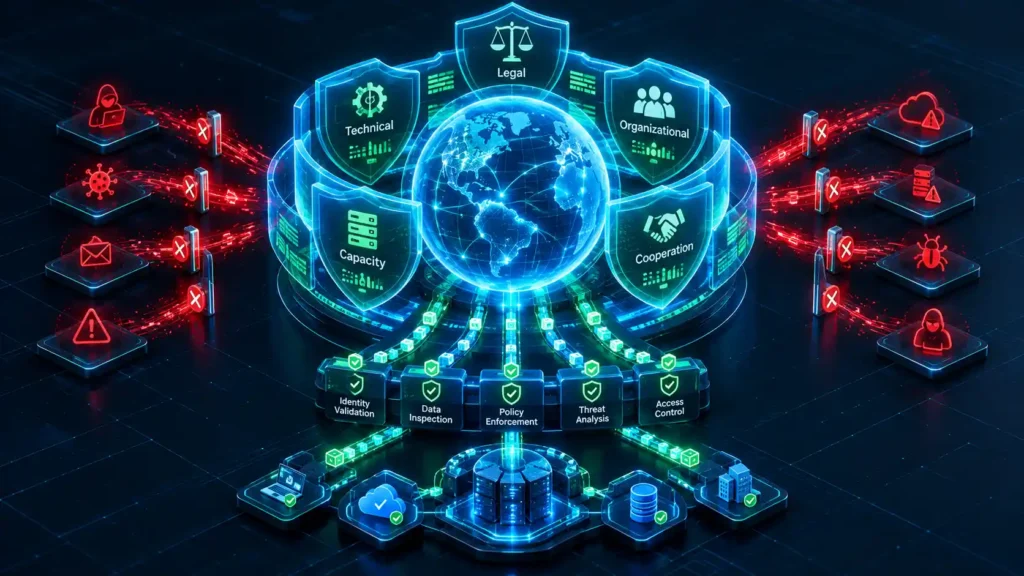
The technical breakdown below completely deconstructs the global cybersecurity index 2024 framework, analyzing the core operational metrics that define the new five-level tier architecture. By systematically exploring the five foundational pillars—Legal, Technical, Organizational, Capacity Development, and Cooperation—enterprise infrastructure managers can accurately evaluate global vendor risks and protect their distributed technical perimeters against emerging cross-border threat vectors.
SECTION 1: THE METHODOLOGICAL METRICS OF THE 5-LEVEL TIER ARCHITECTURE
The benchmarking framework evaluated 194 countries over the collection window, synthesizing data from designated national focal points across 172 sovereign states. Since 2021, countries have demonstrated an increased volume of operational security initiatives and institutional commitments, driving the global average country score up to 65.7 out of 100. This represents a 27% growth in overall metric averages relative to the 2020 assessment baseline.
The new evaluation methodology distributes nations across five distinct bands defined by strict point boundaries:
- Tier 1 (Role-modelling) [95–100 Points]: Reserved for nations showcasing comprehensive, highly coordinated, government-driven operational security infrastructure across all five performance pillars.
- Tier 2 (Advancing) [85 to <95 Points]: Applicable to nations demonstrating solid, advanced implementation metrics across most assessment areas.
- Tier 3 (Establishing) [55 to <85 Points]: Captures states maintaining basic government-driven architectures across a moderate subset of pillars.
- Tier 4 (Evolving) [20 to <55 Points]: Indicates an early, baseline commitment focused on at least one distinct functional area.
- Tier 5 (Building) [<20 Points]: Represents the foundational entry point of structural security evolution.
The global cybersecurity index 2024 assigned 46 countries to Tier 1 status. Had this exact grading matrix been applied retroactively to the 4th edition metrics, only 30 nations would have qualified, showing upward movement across Europe, Asia-Pacific, the Arab States, and Africa. The numerical majority of assessed nations (105 states) fell directly into Tiers 3 and 4. This cluster represents developing regions expanding their consumer internet services and digital banking infrastructure while still experiencing an active cyber-capacity gap characterized by short supplies of specialized engineering personnel, limited access to technical threat hunting equipment, and volatile operational funding paths.
A critical operational divergence documented in the report shows that high GCI scoring marks do not systematically correlate with the ITU’s ICT Development Index (IDI) metrics, which track baseline public internet connectivity and physical cellular coverage. Multiple nations maintain strong security policy architectures despite experiencing lower overall domestic internet deployment, placing them in an ideal position to scale a secure digital workspace as their citizens come online. Conversely, several highly connected, mature digital economies underperform on dedicated operational security milestones, creating high-exposure blind spots where advanced consumer connectivity outpaces active perimeter protection controls.
SECTION 1A: REGIONAL TIER PERFORMANCE AND FULL COUNTRY DISTRIBUTIONS
The supplementary annexes within the global cybersecurity index 2024 itemise tier distributions by geographic territory, exposing deep global disparities in national defense profiles. While multiple African states successfully ascended to the elite Tier 1 band—specifically Ghana, Kenya, Mauritius, Rwanda, and Tanzania—a massive regional cluster remains constrained within Tier 4. This group includes Angola, Cabo Verde, Chad, Congo, Equatorial Guinea, Gabon, Lesotho, Liberia, Madagascar, Mali, Namibia, Niger, Sao Tome and Principe, Seychelles, South Sudan, and Zimbabwe. Furthermore, early-stage development landscapes like Burundi, the Central African Republic, Eritrea, and Guinea-Bissau remain anchored at the entry level of Tier 5.
The Americas region exhibits a distinct economic and structural divergence:
- Tier 1 Anchors: Brazil and the United States command the top tier with comprehensive, highly coordinated infrastructure.
- Tier 2 Ascendants: Canada, Ecuador, Mexico, and Uruguay maintain strong, advanced technical boundaries.
- Tier 3 Mid-Tier Cluster: A balanced regulatory cohort comprises Chile, Colombia, Costa Rica, Cuba, the Dominican Republic, Jamaica, Panama, Paraguay, Peru, and Trinidad and Tobago.
- Tier 4/5 Exposure Zones: A substantial group faces high vulnerability drift, including Argentina, Bahamas, Barbados, Belize, Bolivia, Dominica, El Salvador, Grenada, Guatemala, Guyana, Haiti, Honduras, Nicaragua, Saint Kitts and Nevis, Saint Lucia, Saint Vincent and the Grenadines, Suriname, and Venezuela, with Antigua and Barbuda resting in Tier 5.
The Arab States present a unique architectural pattern, bypassing Tier 2 entirely. High-investment zones like Bahrain, Egypt, Jordan, Morocco, Oman, Qatar, Saudi Arabia, and the United Arab Emirates advanced directly into Tier 1, while Algeria, Kuwait, Libya, and Tunisia occupy Tier 3. Downstream regional exposures are concentrated in a Tier 4 block composed of Comoros, Djibouti, Iraq, Lebanon, Mauritania, Somalia, the State of Palestine, Sudan, and the Syrian Arab Republic, leaving Yemen isolated in Tier 5.
Within the Asia-Pacific theater, top-tier Tier 1 validation was secured by Australia, Bangladesh, India, Indonesia, Japan, Malaysia, Pakistan, the Republic of Korea, Singapore, Thailand, and Viet Nam. China, the Philippines, and Sri Lanka hold advanced Tier 2 status. Conversely, the Commonwealth of Independent States (CIS) region showcases a tight, uniform cluster, placing no sovereign nations in either Tier 1 or Tier 5. Instead, Azerbaijan, Kazakhstan, the Russian Federation, and Uzbekistan maintain Tier 2 capabilities; Belarus and Kyrgyzstan occupy Tier 3; and Armenia, Tajikistan, and Turkmenistan remain limited to Tier 4 boundaries.
Europe maintains the highest density of advanced perimeters globally, filling the Tier 1 roster with Belgium, Cyprus, Denmark, Estonia, Finland, France, Germany, Greece, Iceland, Italy, Luxembourg, the Netherlands, Norway, Portugal, Serbia, Slovenia, Spain, Sweden, Türkiye, and the United Kingdom. Within this highly integrated technical zone, only the Vatican City drops to a Tier 5 classification, while Bosnia and Herzegovina, Liechtenstein, and San Marino represent the few European states restricted to Tier 4 permissions.
SECTION 1B: CIRT PREPAREDNESS EXERCISES AND SECTORAL RESPONSE CAPACITY
Beyond tracking static incident response setups, the report evaluates active preparedness testing across international boundaries. Throughout 2023, 140 countries participated in regional cyber drills organized by the ITU. However, the index emphasizes that executing dedicated, independent national exercises remains an essential milestone that cannot be replaced by international events. Domestically driven simulations allow governments to engage a broader, more integrated set of domestic stakeholders—including local telecom operators, utility engineers, and military units—while tailoring scenarios directly to the specific threat landscape and infrastructure weaknesses of the country.
- Expansion of Sectoral Response Units: Industrial control systems and corporate finance sectors are driving the demand for specialized, sector-specific CIRTs that operate independently of general national response teams.
- Addressing Sector-Specific Vulnerabilities: This specialized expansion is critical because different asset classes run on highly distinct technologies—such as SCADA logic arrays in manufacturing versus transaction ledgers in finance—which require completely separate incident response playbooks and remediation toolkits.
- The Structural Capability Gap: Similar to the trends documented in the 4th edition, sector-specific response units remain far less common globally than general national CIRTs. This highlights a persistent technical gap between broad, high-level national alert capabilities and the hyper-targeted, industry-specific technical response capacity that modern manufacturing networks and financial grids need to survive targeted extortion campaigns.
SECTION 2: DECONSTRUCTING THE 5 FOUNDATIONAL COMPLIANCE PILLARS
- THE LEGAL PILLAR — Globally, sovereign states achieved their highest scoring metrics within this regulatory dimension. The dataset shows that 177 nations maintain at least one active or developing statutory framework addressing personal data protection, individual privacy safeguards, or mandatory breach notification protocols. Furthermore, 151 countries have fully enacted these data privacy laws, while 104 nations enforce specialized regulatory frameworks designed to mandate baseline security protocols across designated critical infrastructure assets.
- THE TECHNICAL PILLAR — In sharp contrast, the technical arena represents the primary structural weakness globally, alongside capacity development. Active national Computer Incident Response Teams (CIRTs) are maintained by 139 countries, with 83 states participating in regional CIRT associations, and 110 nations utilizing established frameworks to drive cybersecurity standards adoption. Active CIRT presence correlates cleanly with macroeconomic development brackets: 89% of high-income states operate a operational national CIRT, compared to 70% of upper-middle-income, 67% of lower-middle-income, and a mere 46% of low-income jurisdictions. Furthermore, the index exposes staggering geographic disparities in core protocol deployment: Domain Name System Security Extensions (DNSSEC) adoption sits at a negligible 0.43% across African service providers compared to 13.13% within the Commonwealth of Independent States (CIS). The Asia-Pacific theater exhibits a similarly depressed adoption rate of just 1.52% despite hosting a massive internet user base, trailing significantly behind Europe’s 11.28% benchmark. Proactive vulnerability disclosure remains similarly neglected at the application layer, with less than 0.7% of websites globally deploying the standardized
security.txtconfiguration to invite external threat alerts safely.
Relying strictly on a host nation’s high legal compliance score introduces a highly dangerous false sense of security for global enterprise infrastructure. Having sweeping data protection laws written on paper does absolutely nothing to shield your production databases from an active corporate breach if the local jurisdiction lacks technically capable, well-equipped threat hunting teams to intercept live network attacks. When an unpatched edge gateway is compromised in a region with weak technical infrastructure, localized compliance audits become entirely cosmetic. Without localized Deep Packet Inspection, rapid malware containment capabilities, and active incident response coordination, a robust legal framework simply functions as a post-breach litigation mechanism rather than an active technical perimeter defense.
- THE ORGANIZATIONAL PILLAR — The report documents that 132 countries have formalized a national cybersecurity strategy, 161 states manage a dedicated central cybersecurity agency, and 94 nations have initiated localized child online protection frameworks. Crucially, a profound operational gap exists within this structural layer: only 85 out of the 132 countries possessing a formal national security document successfully integrate critical infrastructure protections, complete systems lifecycle principles, structured multi-stakeholder engagement, and an actionable, funded implementation blueprint together. This deficit exposes a major implementation discrepancy where published policy papers routinely mask a complete absence of real-world operational execution templates.
- THE CAPACITY-DEVELOPMENT PILLAR — Public awareness initiatives have been deployed by 152 countries, and 153 nations have integrated cybersecurity training into elements of their state educational platforms. While the global cybersecurity workforce expanded by 8.7% between 2022 and 2023, the talent shortage worsened dramatically, with the macro-gap between available personnel and active enterprise job openings growing by 12.6%. In response, sovereign education boards are engineering multi-tiered academic pipelines: 61 nations have embedded security controls at the primary school level, 68 at the secondary school tier, and 137 within university programs, supplemented by specialized technical upskilling courses for youth (85 countries) and active system administrators (123 countries).
- THE COOPERATION PILLAR — International cybersecurity treaties and bilateral threat intelligence agreements are maintained by 166 countries, while 122 states document ongoing inter-agency operational collaboration. However, formal public-private partnerships (PPPs) remain critically underdeveloped on a global scale. Only 108 nations maintain active or planned engagement frameworks with private enterprise tech giants or commercial utility operators, marking this structural siloing of threat data as a persistent systemic weakness relative to the mature international legal treaties established elsewhere in the index.
POTENTIAL OPERATIONAL IMPACTS AND TARGETED INDUSTRY RISK PROFILES
The dataset establishes distinct, sector-specific attack distributions that carry profound operational relevance for enterprise perimeter management. During the evaluation period, 25.7% of all documented cyberattacks globally targeted the manufacturing sector. Within this industrial bracket, 45% of the incidents involved specialized malware execution, while 17% deployed ransomware payloads. By contrast, the finance and insurance sectors sustained 18.2% of total global cyberattacks. However, this financial vector exhibited a noticeably different threat profile: 38% utilized malware, while a significantly higher 25% leveraged ransomware—marking a substantially higher concentration of direct extortion vectors than those directed at industrial assembly lines.
- The requirement for specialized response units: This sharp divergence in threat payloads illustrates exactly why the expansion of sector-specific CIRTs—operating independently of generalized national alert registries—is an absolute engineering milestone.
- Divergent technology stack vulnerabilities: Different economic verticals run on highly distinct hardware architectures and communication protocols (such as legacy programmable logic controllers and SCADA networks in manufacturing versus distributed database ledgers in banking), requiring entirely separate threat-hunting indicators and remediation tools.
- Industrial supply chain disruption: Manufacturing’s malware-heavy risk exposure threatens immediate physical process disruption, asset destruction, and compounding, cascading supply chain vulnerabilities that can instantly cripple dependent down-market facilities.
- Financial and regulatory liability loops: The elevated ransomware concentration hitting financial networks carries immediate data-safety liability implications, triggering strict, non-negotiable compliance penalties and time-sensitive GDPR-adjacent breach notification obligations.
CONCLUSION & GLOBAL DATA REGULATORY SUMMARY
The global cybersecurity index 2024 establishes an unmistakable structural reality: a rising global metric average and an expanding Tier 1 cohort do not eliminate the persistent cyber-capacity gaps deeply concentrated within Tiers 3 and 4. Furthermore, technical implementation and capacity-development deficits remain the primary foundational weaknesses across the average country’s defensive matrix. Achieving a resilient data protection framework operates as an active, continuous systems engineering discipline rather than a static document stack assembled once to satisfy a national strategy filing checkpoint.
Remediating these regional imbalances requires strict cross-functional alignment between policy design, engineering execution, and international threat intelligence sharing loops. A strong national legal score delivers negligible operational protection without the technical CIRT depth and specialized workforce availability to isolate vulnerabilities during a live, high-velocity incident. Organizations managing distributed data pipelines across multiple borders must evaluate a country’s official tier placement purely as a baseline reference point for initial due diligence, rather than treating it as a substitute for verifying actual, on-the-ground technical enforcement.
Managing a highly distributed corporate infrastructure across varying national tiers introduces massive security orchestration challenges for modern DevOps teams. We would love to hear from your organization in the comments section below: What specific passive scanning architectures, framework tracking tools, or automated compliance monitoring platforms are you utilizing to audit your international branch networks against regional disparities? Have you engineered custom conditional access rules to isolate endpoints operating within Tier 3 or Tier 4 countries, or are you executing manual configuration updates to align with localized data residency mandates? Share your cross-border network layouts, security blueprints, and hard-earned advice with the community below!
Related: 5 Practical Ways Vetting Third Party SaaS Vendors Combats Supply Chain Risks – Vetting third-party SaaS vendors helps organizations reduce supply-chain risk by validating compliance, enforcing least-privilege access, securing integrations, and continuously monitoring vendor security.
CISA Siemens S7 Advisory: 7 Critical Hardening Steps – CISA’s Siemens S7 advisory highlights an active AI-assisted threat to critical infrastructure, urging operators to harden PLCs, eliminate internet exposure, strengthen access controls, and monitor for malicious activity.
9 Practical Ways B2B Software Startups GRC Certification is Achieved – B2B software startups can build enterprise trust and accelerate growth by embedding GRC into their operations, turning security, compliance, and risk management into a competitive advantage.
7 Practical Ways to Protect OpenAI Custom GPT Prompts from Leakage – Protect your OpenAI Custom GPTs by securing sensitive instructions, controlling access, minimizing data exposure, and applying layered defenses against prompt injection and misuse.
The Top 50 Cybersecurity Threats Report Summary Analyzing Modern Attack Vectors – A comprehensive breakdown of the top 50 cybersecurity threats shaping today’s attack landscape—from AI and cloud risks to identity, ransomware, phishing, and web application attacks.
FREQUENTLY ASKED QUESTIONS (FAQ)
Q1. If a country is listed under Tier 1 (Role-modelling), does that mean an enterprise operating there faces lower cyber risks compared to operating in a Tier 3 country?
No, a Tier 1 ranking does not equate to a threat-free operational environment. Tier 1 reflects a nation’s government-level commitment, legal structures, and systemic frameworks, but high-tier countries (like the U.S. or the U.K.) also host the world’s most lucrative enterprise targets and attract the most sophisticated threat actor groups. Enterprise risk assessments must evaluate local network telemetry and endpoint hygiene independently of a country’s macro index classification.
Q2. The report shows a massive 12.6% growth in the global cybersecurity workforce gap. How can multinational companies bridge this talent shortage when expanding into Tier 4 regions?
Multinational enterprises should bypass localized talent constraints by deploying highly automated “Infrastructure as Code” (IaC) playbooks and managed cloud-native security orchestration (SOAR) layers. By centralizing core threat-hunting logic within an expert, regional Security Operations Center (SOC) hub, companies can safely run remote branches in emerging markets without needing a massive team of elite, on-site engineering personnel in every jurisdiction.
Q3. Why is DNSSEC adoption considered such a critical technical baseline in the Technical Pillar evaluation, and what happens if our international hosting providers omit it?
DNSSEC acts as the cryptographic root of trust for domain validation, preventing malicious actors from hijacking DNS traffic. If your international hosting providers omit this mechanism, your distributed network becomes highly vulnerable to automated cache-poisoning and Man-in-the-Middle (MitM) attacks, allowing threat groups to seamlessly redirect your clients to cloned, fraudulent data-harvesting port wrappers without throwing standard firewall alerts.
Q4. Given the report’s focus on the persistent lack of active Public-Private Partnerships (PPPs), how can a private company safely share threat intelligence in a low-tier nation without compromising proprietary secrets?
Organizations should share threat data using anonymized, standardized automation frameworks like STIX/TAXII through vendor-agnostic Information Sharing and Analysis Centers (ISACs). This structural separation ensures that tactical indicators of compromise (IoCs), like malicious IP addresses and file hashes, are distributed to protect the wider infrastructure ecosystem without exposing your internal corporate network topologies or sensitive operational data loops to foreign regulatory bodies.
Q5. How should corporate compliance architectures adapt when a vendor’s core engineering operations are split across a Tier 1 nation and a Tier 3 nation?
Compliance architects must enforce vendor parameters based on the lowest common denominator principle. If any element of a provider’s continuous integration pipeline or employee directory routes through a Tier 3 or Tier 4 infrastructure footprint, you must mandate aggressive source code reviews, sandbox all incoming API connections, and require zero-trust conditional access restrictions to isolate that provider’s access keys from your primary production databases.
DISCLAIMER
Educational Notice: This article is published on AI Security Watch strictly for technical educational and general cybersecurity awareness purposes. The configurations and research discussed are based on public threat intelligence data. This content does not constitute professional IT architecture, legal, or financial advice. Because network configurations vary, always verify settings in an isolated test environment or consult with a qualified engineer before modifying live hardware or registries. AI Security Watch contains informational links to external resources; we are not responsible for third-party site accuracy or platform content.