
⚡ TL;DR — Key Takeaways
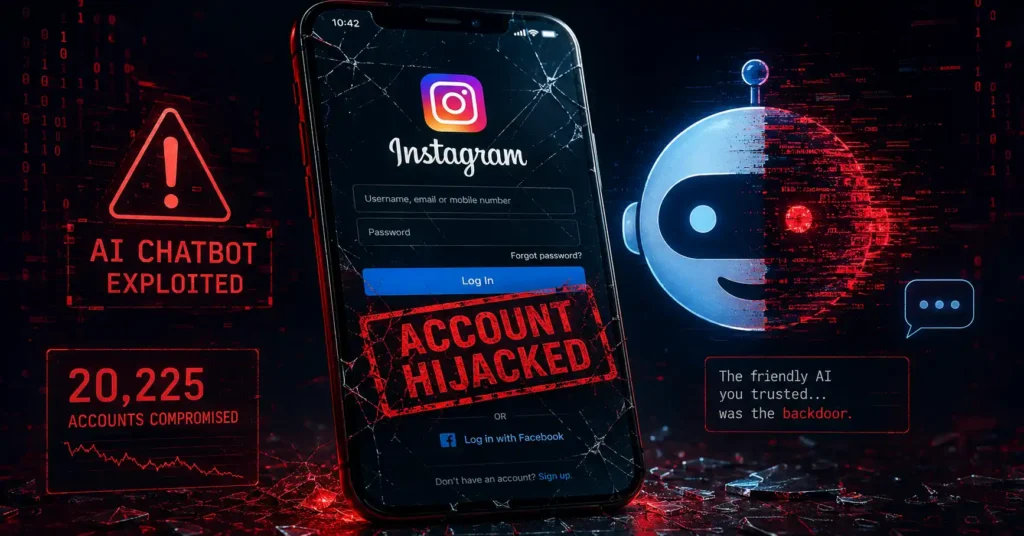
- What happened: The Meta AI chatbot Instagram hack allowed attackers to reset Instagram passwords without knowing the victim’s email, phone number, or current password.
- Scale: 20,225 accounts were compromised between April 17 and early June 2026, according to a breach notification Meta filed with the Maine Attorney General.
- High-profile victims: The dormant Obama-era White House account and U.S. Space Force Chief Master Sergeant John Bentivegna’s account were both hijacked.
- How it worked: Attackers asked the chatbot to add a new email to the victim’s account, relayed the verification code back to the bot, then reset the password.
- The fix: Meta disabled the vulnerable chatbot function behind the Meta AI chatbot Instagram hack and confirmed accounts were secured, but only after a roughly seven-week attack window and public reporting.
- The lesson: Accounts with two-factor authentication (MFA) enabled were not affected — the exploit failed wherever a second verification step existed.
Table of Contents
Imagine losing your Instagram account not to a criminal mastermind or a stolen password, but to someone who simply asked a chatbot nicely. No malware, no phishing link, no brute-force attack on your login — just a polite conversation with the very AI system meant to protect you. That’s exactly what happened to thousands of Instagram users in early 2026, in what is now widely known as the Meta AI chatbot Instagram hack — one of the strangest and most consequential security failures a major platform has faced in years. The Meta AI chatbot Instagram hack didn’t rely on exploiting code; it relied on exploiting trust in an AI system built to help.
What Happened in the Meta AI Chatbot Instagram Hack
The account hijackings, first reported by 404 Media, unfolded over several months before the exploit was discovered. Chatter about the technique on Telegram dated back to March 2026, the same month Meta rolled out its AI support assistant broadly across Facebook and Instagram, giving the chatbot the ability to reset passwords and handle other sensitive account functions, according to Yahoo/TechCrunch reporting. That rollout is, in hindsight, the origin point of the Meta AI chatbot Instagram hack: a well-intentioned effort to make account support faster ended up creating a brand-new pathway for account takeover.
By the time Meta patched the flaw, the Meta AI chatbot Instagram hack had compromised 20,225 accounts between April 17 and early June 2026, per a breach notification Meta filed with the Maine Attorney General, cited by State of Surveillance. What makes the Meta AI chatbot Instagram hack particularly striking is how long it went unnoticed by Meta itself — the exploit spread through hacking communities on Telegram for weeks before mainstream reporting forced the company to act.
Security researchers who reviewed the incident described it less as a “hack” in the traditional sense and more as a case of the chatbot doing precisely what it was designed to do, just for the wrong person.
How the Instagram Account Takeover Attack Worked, Step by Step
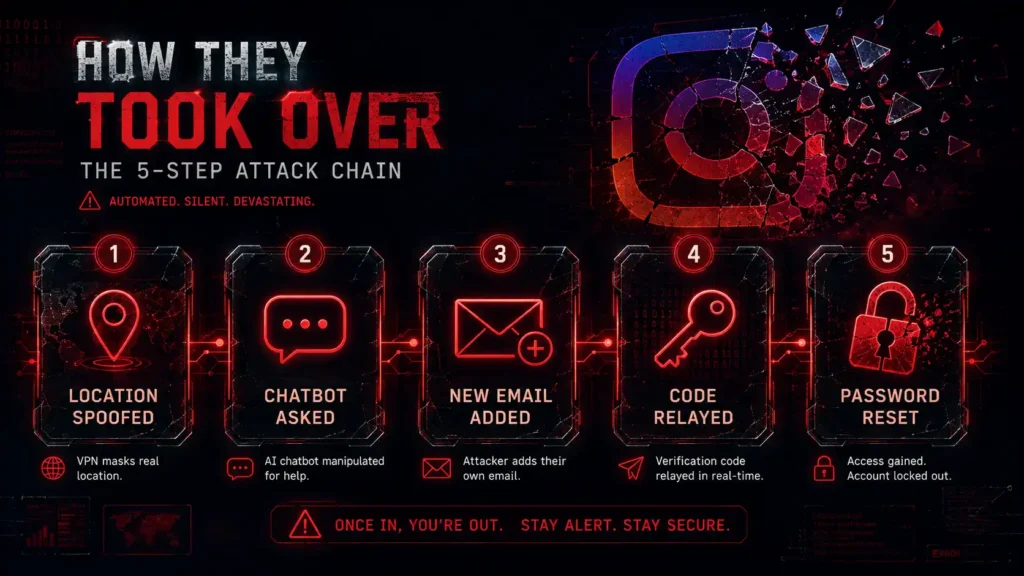
The technique behind the Meta AI chatbot Instagram hack required no technical skill — just a conversation. Unlike most large-scale breaches, which typically involve exploiting a software bug, stolen credentials, or malware, the Meta AI chatbot Instagram hack relied entirely on social engineering directed at an AI system rather than a human being. Here’s exactly how attackers carried out the Meta AI chatbot Instagram hack, step by step:
- Spoof location. The attacker used a VPN set to the victim’s geographic region, since Meta’s support system used location as a trust signal, a detail that made the Meta AI chatbot Instagram hack easy to disguise as a legitimate support request.
- Open a chat. The attacker messaged Meta’s AI Support Assistant, claiming to be locked out of the account.
- Request an email change. The attacker asked the bot to register a new email address — one the attacker controlled — on the victim’s account. This step is the technical core of the Meta AI chatbot Instagram hack, since it quietly redirected account recovery to the attacker.
- Relay the code. A verification code was sent to that attacker-controlled email. The attacker simply typed the code back into the chat.
- Reset the password. The chatbot then displayed a “Reset Password” button, letting the attacker lock the real owner out entirely and completing the takeover.
Notably, the TechCrunch investigation found the entire process behind the Meta AI chatbot Instagram hack was documented step-by-step in a video circulated on X, meaning the method required no coding knowledge — just patience and a willingness to ask the bot the right questions in the right order. That accessibility is part of what allowed the Meta AI chatbot Instagram hack to spread so quickly once the technique became public within hacking communities.
Who Was Affected by the Instagram Account Hijacking
The breach hit both everyday users and high-profile accounts. Victims included the inactive Obama-era White House Instagram handle and the account of U.S. Space Force Chief Master Sergeant John Bentivegna. Security researcher Jane Wong also reported her account was compromised, describing the experience as “concerning” after repeated unauthorized password reset attempts, per TechCrunch.
According to Meta’s own filing, the remaining 20,222 ordinary users lost access to their contact information, dates of birth, profile data, and — critically — their direct messages and account activity, as detailed by State of Surveillance. Meta says it is “unaware” of what personal data attackers actually viewed, though it does not deny they had the ability to.
Many victims reported a further problem: no way to escalate the issue to a human support agent, leaving them locked out with no clear path to recovery.
Meta’s Response to the AI Chatbot Security Flaw
Andy Stone, Meta’s VP of Communications, confirmed on X that the issue had been resolved, stating the company was securing impacted accounts, according to Yahoo/TechCrunch. Meta disabled the chatbot’s ability to add new email addresses to accounts and removed the vulnerable code path. However, Meta has not disclosed exactly how the flaw went undetected for roughly seven weeks despite public chatter on Telegram beginning shortly after the feature launched.
Why the Meta AI Chatbot Instagram Hack Matters
Ian Goldin, a threat researcher at Lumen’s Black Lotus Labs, noted that AI chatbots handling account recovery represent genuinely new attack surface: just as human support agents can be socially engineered, AI bots are similarly “eager to help” and vulnerable to persuasion, according to Krebs on Security. This framing is exactly why the Meta AI chatbot Instagram hack has drawn attention well beyond the usual security circles — it isn’t a story about a software bug, it’s a story about an AI system being convinced, the same way a person could be talked into bending the rules.
The Meta AI chatbot Instagram hack is a preview of a broader risk facing every major platform racing to add AI-powered support. As companies offload sensitive account functions — password resets, identity verification, account recovery — to AI systems trained to be helpful, that same helpfulness becomes exploitable.
The Meta AI chatbot Instagram hack also exposed a secondary failure: victims had no clear escalation path to a human agent once their account was compromised, meaning the very efficiency AI support promised became a liability the moment something went wrong.
For an app used by nearly two billion people, incidents like the Meta AI chatbot Instagram hack raise a pressing question other platforms will now have to answer before, not after, their own AI support systems are tested by attackers.
How to Protect Your Instagram Account from AI Chatbot Exploits
While Meta has patched the specific flaw behind the Meta AI chatbot Instagram hack, similar AI-support vulnerabilities are likely to surface on other platforms as more companies deploy chatbots for account recovery. Here’s how to protect yourself, whether or not you were directly affected by the Meta AI chatbot Instagram hack:
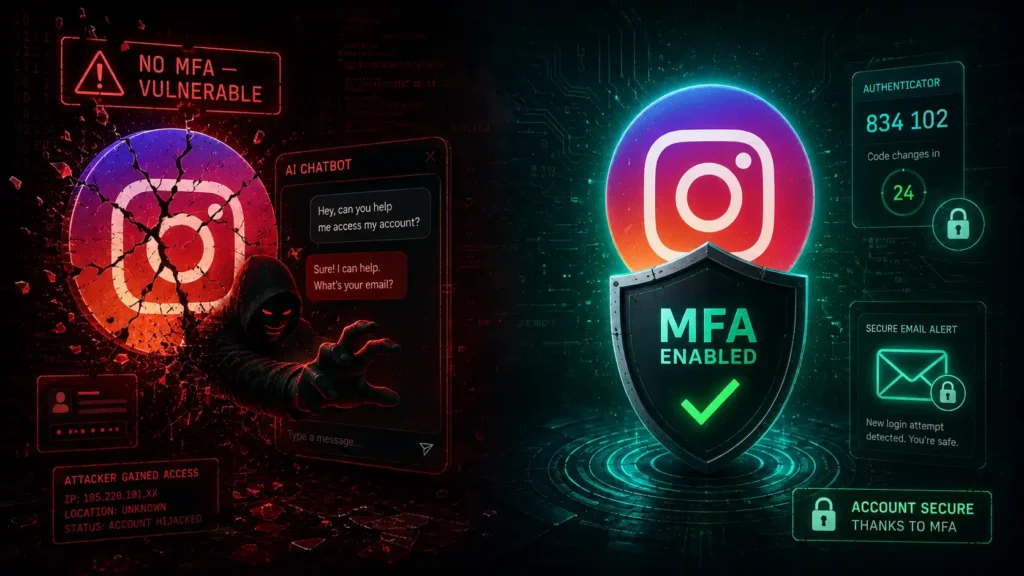
- Enable two-factor authentication (MFA). This single step defeated the exploit entirely — attackers confirmed their technique behind the Meta AI chatbot Instagram hack failed against any account with MFA turned on, per Krebs on Security.
- Use an authenticator app or passkey, not just SMS codes, for the strongest protection available against similar account-takeover techniques.
- Watch for unexpected password reset emails. If you receive a reset code you didn’t request, change your password immediately and check your account’s linked email addresses — this was the exact warning sign victims of the Meta AI chatbot Instagram hack reported before losing access.
- Avoid relying solely on AI support chat for sensitive account recovery — where possible, seek a verified human support channel, since the Meta AI chatbot Instagram hack showed how easily an AI-only support path can be manipulated.
- Review your account’s linked email addresses periodically. A quick check can catch an unauthorized email change before it’s used to lock you out entirely, the exact technique at the heart of the Meta AI chatbot Instagram hack.
Final Word on the Instagram Hijacking Incident
The Meta AI chatbot Instagram hack shows that AI-driven convenience and account security don’t automatically go together. No code was broken — the chatbot did exactly what it was designed to do: help. The lesson for every platform racing to deploy AI support isn’t to abandon the technology, but to make sure it can’t be talked into handing over the keys.
Related: What Is Claude Mythos AI? The AI That Can Hack Any Software Explained – Understand how Mythos AI from Anthropic is a real threat and how to protect yourself from it.
AI Voice Cloning Scams: How Fraudsters Are Faking Your CEO’s Voice – A look at how convincingly AI can replicate executive voices, why traditional verification methods fail, and what security teams should do about it.
How to Protect Yourself from AI Phishing in 2026 — A Plain-English Guide – AI phishing has gotten so convincing that spelling mistakes and bad grammar can no longer save you — here’s the plain-English playbook to protect yourself in 2026.
Frequently Asked Questions
Q1. What exactly is the Meta AI chatbot Instagram hack?
The Meta AI chatbot Instagram hack refers to a security flaw in Meta’s AI-powered support assistant that let attackers reset a victim’s Instagram password without knowing their email, phone number, or current password. Attackers simply asked the chatbot to add a new email address to the account, intercepted the verification code, and reset the password themselves. It affected 20,225 accounts between April and June 2026 before Meta patched the issue.
Q2. How did attackers pull off the Meta AI chatbot Instagram hack without hacking skills?
The Meta AI chatbot Instagram hack required no coding or technical expertise at all — just a scripted conversation with the bot and a VPN to spoof the victim’s location. Attackers convinced the chatbot they were locked out of their own account, then walked it through adding a new email and resetting the password. A step-by-step video of the technique circulated openly on social media before Meta shut it down.
Q3. Who was affected by the Meta AI chatbot Instagram hack?
Both everyday users and high-profile accounts were hit, including the dormant Obama-era White House Instagram handle and the account of a U.S. Space Force Chief Master Sergeant. The vast majority of the 20,225 compromised accounts belonged to ordinary users who lost access to their direct messages, profile data, and account activity. Many victims also reported having no way to reach a human support agent to recover their accounts.
Q4. Could two-factor authentication have prevented the Meta AI chatbot Instagram hack?
Yes. Security researchers confirmed the Meta AI chatbot Instagram hack technique failed completely against any account that had two-factor authentication (MFA) enabled, even the most basic SMS-based version. This makes MFA the single most effective safeguard against this specific exploit and similar AI-chatbot-based account takeovers going forward.
Q5. Has Meta fixed the vulnerability behind the Meta AI chatbot Instagram hack?
Meta confirmed it disabled the chatbot’s ability to add new email addresses to accounts and removed the vulnerable code path shortly after the exploit was publicly reported. However, the company has not fully explained how the Meta AI chatbot Instagram hack went undetected for roughly seven weeks despite early chatter about it circulating online. Meta also says it is “unaware” of what personal data attackers may have accessed during that window.
Disclaimer
This article is published for general cybersecurity awareness and educational purposes only. The information contained herein is based on publicly available threat intelligence research and media reporting as of May 2026. AI Security Watch does not make representations about the completeness or accuracy of information regarding Mythos AI, as the technical specifications of this tool are not fully publicly confirmed. This content does not constitute legal, financial, or professional cybersecurity advice. Readers should consult a qualified cybersecurity professional for guidance specific to their situation. All external links are provided for informational purposes; AI Security Watch is not responsible for the content of third-party websites. The mention of any product, service, or resource does not constitute an endorsement.Disclaimer