
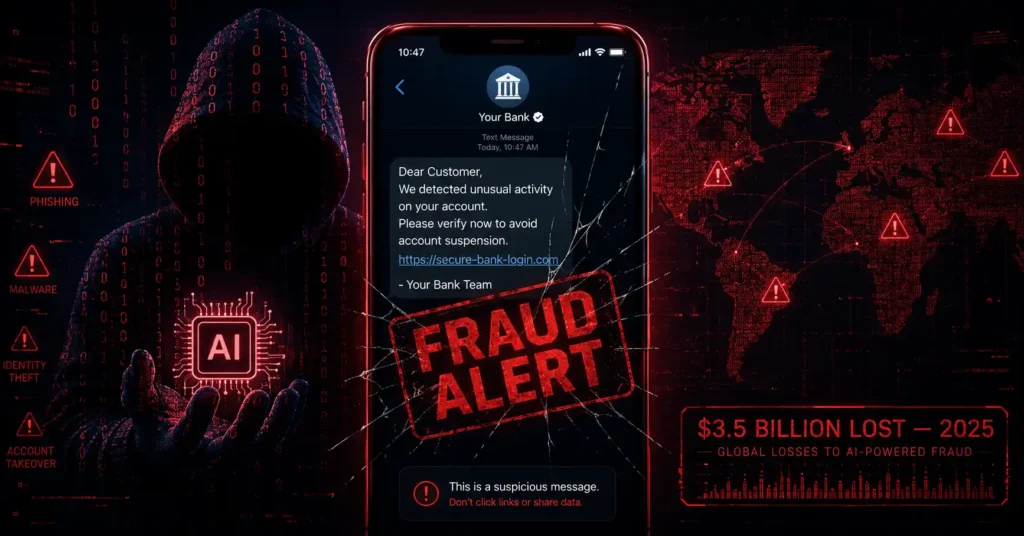
⚡ TL;DR — Key Takeaways
- What’s new: AI phishing attacks jumped 14-fold in a single month (Nov–Dec 2025) and now make up around 40% of all phishing in 2026.
- The cost: Americans reported losing $3.5 billion to imposter scams in 2025 alone from AI phishing, with a median loss of $700 per victim.
- Why it’s harder to spot: AI phishing emails and texts no longer have typos or awkward phrasing — they’re personalized, fluent, and often reference real details about you.
- New attack types: Voice cloning, AI-written texts (smishing), and fake QR codes are now common alongside classic email phishing.
- The fix: A handful of simple habits — slowing down, verifying independently, and locking down your accounts — stop almost all AI phishing attempts, no technical skill required.
Table of Contents
If a scam email used to make you laugh — bad grammar, a “Nigerian prince,” a logo that looked slightly off — that’s not what you’re up against anymore. Scammers now use the same AI tools you might use to write an email or edit a photo, except they’re using them to impersonate your bank, your boss, or even your own family member’s voice. This guide breaks down what AI phishing actually looks like in 2026 and exactly what you can do to protect yourself, in plain English.
What Is AI Phishing?
AI phishing is any scam where artificial intelligence is used to make a fraudulent message, call, or website more convincing. Instead of a scammer manually writing a clumsy email, generative AI tools now draft flawless messages in seconds, mimic a company’s tone, or even clone a real person’s voice from a few seconds of audio. AI-assisted attacks surged from just 4% of reported phishing in November 2025 to 56% in December — a 14-fold jump in a single month, according to Hoxhunt’s 2026 Phishing Trends Report. That means this threat isn’t a rare edge case anymore — it’s quickly becoming the default.
Why AI Phishing Is So Convincing
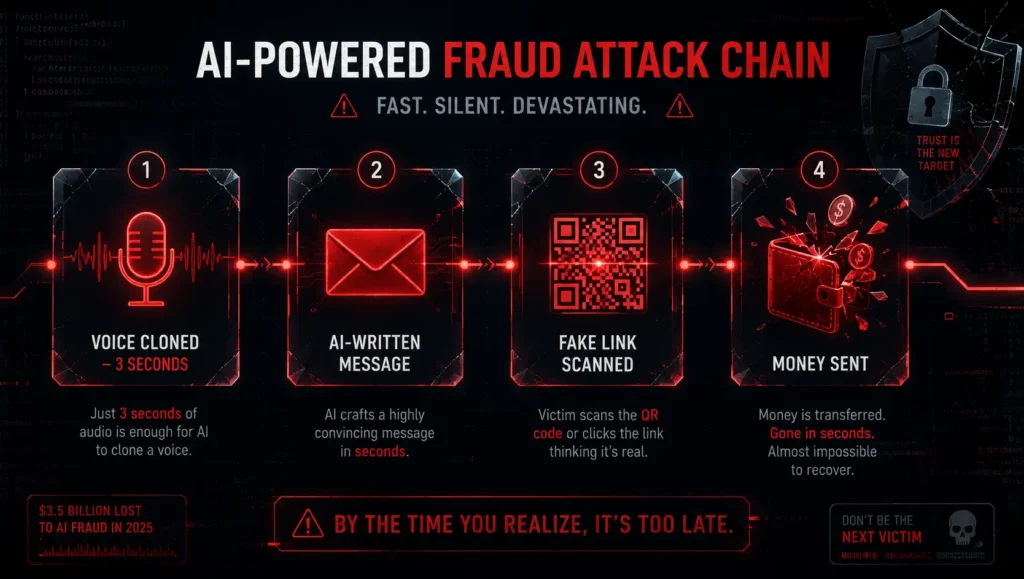
Traditional phishing relied on volume — send enough bad emails, and a few people will click. AI phishing relies on quality. Tools can now generate phishing emails with click-through rates more than four times higher than manually written ones, according to Vectra AI. Scammers use AI to:
- Personalize messages with real details scraped from social media or data breaches
- Clone a voice from as little as three seconds of audio, according to StationX
- Generate realistic fake websites, QR codes, and text messages (smishing) that mimic banks, delivery services, or government agencies
- Write in perfect, fluent English (or any language) with zero spelling errors
This is why the financial damage is climbing so fast. Americans reported losing $3.5 billion to imposter scams in 2025, with total fraud losses across all categories reaching a record $15.9 billion, according to the FTC. The median individual loss was $700, though some victims lost over $1 million.
The Most Common Scam Tactics Right Now
AI phishing doesn’t look like one single scam — it’s a toolkit that criminals apply across several different attack styles, all built to exploit trust and urgency. Here are the tactics showing up most often in 2026:
- Fake bank security alerts. A text or call claims suspicious activity on your account and urges you to “protect” your money by moving it — often to an account controlled by the scammer. This remains the single costliest form of AI phishing, since victims believe they’re acting to save their own funds.
- Voice cloning calls. A call sounds exactly like a family member in distress, asking for emergency money, or an executive requesting an urgent wire transfer. Because the voice itself is the disguise, this branch of AI phishing is especially effective against people who trust their own ears over anything else.
- Toll and delivery texts (smishing). Fake messages about unpaid tolls or missed deliveries push you to click a link and enter payment details. These AI phishing texts are mass-produced and personalized with real names or addresses, making them look far more legitimate than the generic spam of a few years ago.
- QR code scams. A malicious QR code on a poster, parking meter, or email redirects to a fake login page designed to harvest your username and password. Because QR codes hide the actual destination URL, this tactic is quickly becoming a favorite entry point for AI phishing campaigns.
- Social media impersonation. Nearly 30% of people who lost money to scams in 2025 said the interaction began on social media, with losses there reaching $2.1 billion, per Bitdefender’s coverage of FTC data. Fake profiles, AI-generated photos, and cloned voice notes are used to build a relationship before the AI phishing pitch — a loan request, a fake investment, or a “prize” that requires an upfront fee.
- Fake job and hiring scams. Scammers pose as recruiters using AI-written job offers and AI chatbot “interviewers” to collect personal information or bank details under the promise of employment, a fast-growing branch of AI phishing that targets job seekers directly.
- Government and IRS impersonation. AI-generated calls and texts mimic official government agencies, warning of unpaid fines or legal action to pressure immediate payment — a category of AI phishing that grew sharply in reported losses over the past year.
How to Protect Yourself from AI Phishing
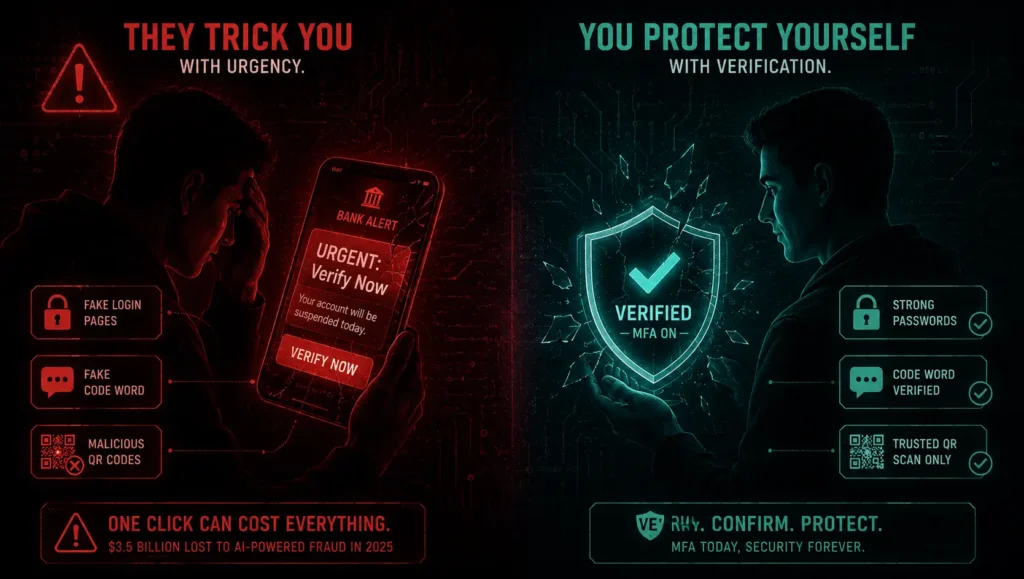
Protecting yourself from AI phishing doesn’t require technical expertise — it requires a handful of consistent habits that work regardless of how convincing the scam looks. Because AI phishing depends on catching you off guard, slowing down and verifying is often the entire defense you need. Here’s a fuller breakdown of what actually works:
- Slow down before you act. Every AI phishing message is designed to create urgency — a frozen account, a missed payment, a family emergency. Scammers count on panic overriding judgment. Pause, breathe, and give yourself time to verify before clicking, calling back, or sending money.
- Verify independently, never through the message itself. If you get a call or text claiming to be your bank, hang up and call the number on the back of your card. Never use a phone number or link provided in the suspicious message — that’s exactly how AI phishing traps work, since the entire scam depends on you trusting the channel it arrived through.
- Set a family code word. IIf a “relative” calls sounding distressed and asking for money, a pre-agreed code word confirms it’s really them. Voice clones used in AI phishing can copy tone, accent, and emotion, but they can’t guess a secret only your family knows.
- Don’t scan unknown QR codes. Treat QR codes in public places, parking meters, or unsolicited emails the same way you’d treat a suspicious link — don’t tap it. If you must pay a toll or fee, go directly to the official website or app instead.
- Enable multi-factor authentication (MFA) everywhere. MFA won’t stop every AI phishing attempt, especially voice-based scams, but it remains one of the strongest, easiest defenses against account takeover if your password is ever stolen through a fake login page.
- Limit what you share publicly. Voice clips, birthdays, family names, and daily routines posted online become raw material scammers can feed into AI tools to make an AI phishing attempt more personal and convincing.
- Pause before wiring or transferring money. No legitimate bank, government agency, or employer will ever pressure you to move money immediately over the phone. Treat any such request, however official it sounds, as a likely AI phishing attempt until verified.
- Keep software and spam filters updated. Many AI phishing emails still get flagged by modern spam filters and browser warnings — keeping these tools current adds a layer of automated protection behind your own judgment.
- Talk to older or vulnerable family members. Older adults are disproportionately targeted by AI phishing scams involving fake grandchildren, bank alerts, or government fines. A short conversation about verifying before sending money can prevent a devastating loss.
- Report it. If you spot or fall for a scam like this, report it at ReportFraud.ftc.gov — it helps regulators track and shut down these schemes faster.
The Bottom Line
AI phishing is more convincing than anything scammers have used before, but the defense against it hasn’t actually changed — it’s just more important than ever. Slow down, verify independently, and treat urgency as a warning sign rather than a reason to act fast. These simple habits stop the vast majority of AI phishing attempts, no matter how polished the message looks.
Related: The 5 Worst Data Breaches of 2026 — And What AI Could Have Prevented – the McDonald’s McHire incident sits alongside 2025’s most damaging breaches, all sharing one common thread: basic security gaps that AI-powered tools were built to catch.
What Is Claude Mythos AI? The AI That Can Hack Any Software Explained – Understand how Mythos AI from Anthropic is a real threat and how to protect yourself from it.
AI Voice Cloning Scams: How Fraudsters Are Faking Your CEO’s Voice – A look at how convincingly AI can replicate executive voices, why traditional verification methods fail, and what security teams should do about it.
Frequently Asked Questions
Q1. What exactly makes AI phishing different from regular phishing?
AI phishing uses generative AI to write flawless, personalized messages or clone a real voice, instead of relying on generic, typo-filled templates. This makes the scam far more convincing and much harder to catch by eye. It’s why click-through rates on AI-generated phishing emails run over four times higher than traditional ones.
Q2. Can AI phishing really clone someone’s voice from a short clip?
Yes. Scammers need as little as three seconds of audio — pulled from a video, voicemail, or social media post — to generate a convincing voice clone. That clone can then be used in a call impersonating a family member, boss, or bank representative to pressure you into sending money quickly.
Q3. How do I know if a text or email is AI phishing and not a real message?
Don’t judge by writing quality alone, since AI phishing messages are often flawless. Instead, check whether the message creates urgency, asks you to click a link or call a number it provides, or requests money or personal details — then verify independently through a number or site you already trust.
Q4. Does multi-factor authentication (MFA) stop AI phishing attacks?
MFA won’t block every AI phishing attempt, especially voice-based scams, but it remains one of the most effective defenses against account takeover from stolen passwords or fake login pages. Pairing MFA with independent verification habits closes most of the gaps AI phishing exploits.
Q5. Who is most at risk from AI phishing scams?
Anyone can be targeted, but older adults and people active on social media are especially vulnerable, since nearly 30% of 2025 scam losses started on social platforms. Younger, tech-savvy users are also increasingly falling for AI phishing because familiarity with AI tools can create false confidence in spotting fakes.
Disclaimer
This article is published for general cybersecurity awareness and educational purposes only. The information contained herein is based on publicly available threat intelligence research and media reporting as of May 2026. AI Security Watch does not make representations about the completeness or accuracy of information regarding Mythos AI, as the technical specifications of this tool are not fully publicly confirmed. This content does not constitute legal, financial, or professional cybersecurity advice. Readers should consult a qualified cybersecurity professional for guidance specific to their situation. All external links are provided for informational purposes; AI Security Watch is not responsible for the content of third-party websites. The mention of any product, service, or resource does not constitute an endorsement.Disclaimer