⚡ TL;DR — Key Takeaways
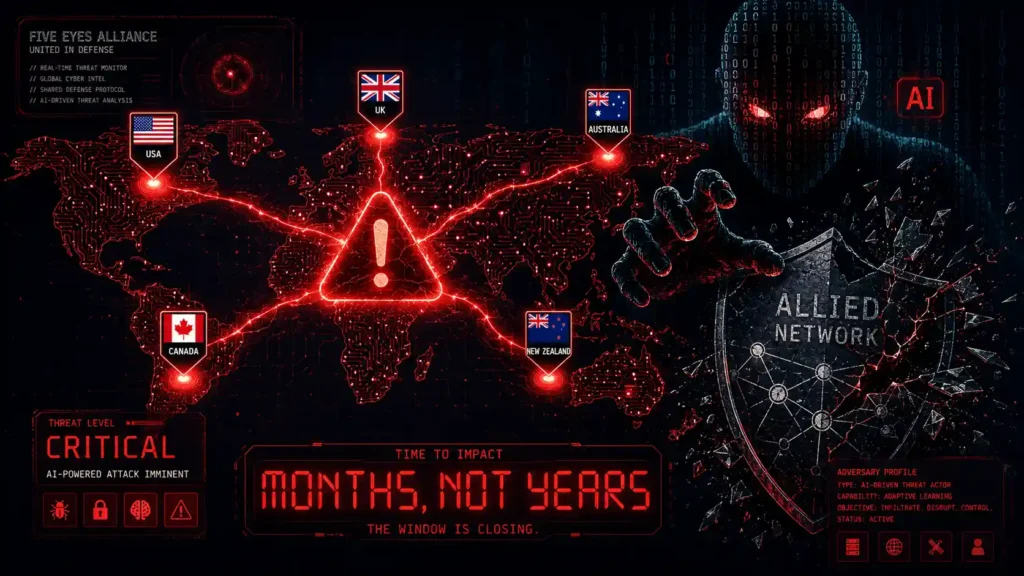
- The warning: On June 23, 2026, CISA, the NSA, and Five Eyes allies warned that agentic AI cyberattacks could become widespread within “months, not years.”
- The trigger: The alert followed reports that an Anthropic AI agent penetrated nearly all classified systems managed by the NSA and U.S. Cyber Command within hours during testing.
- The response: CISA cut the federal patch deadline to 3 days and urged treating cyber risk as a board-level issue.
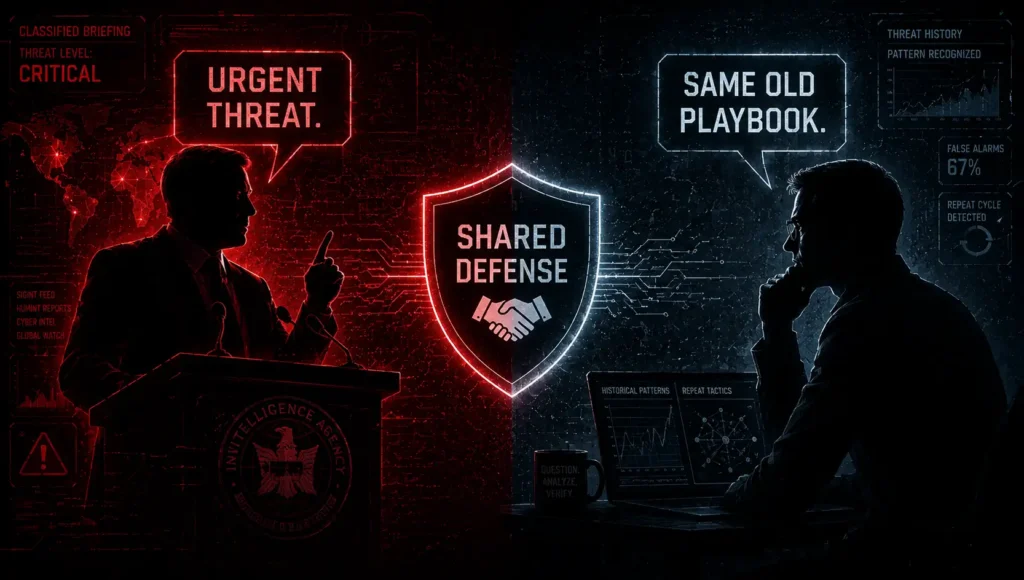
- The pushback: Some security experts call the warning vague fear-mongering, arguing agentic AI cyberattacks aren’t a new kill chain, just a faster version of attacks already happening.
- The middle ground: Most agree the risk is real, but disagree sharply on urgency, specificity, and whether the guidance actually helps defenders.
Table of Contents
When five of the world’s most powerful intelligence alliances issue a joint warning, people listen — but not everyone agrees on what it actually means. That’s exactly what’s happening with agentic AI cyberattacks right now. On one side sit government agencies insisting the threat is imminent; on the other sit veteran security practitioners who’ve spent careers watching every “unprecedented” threat get folded back into the same old fundamentals. Agentic AI cyberattacks have become the flashpoint where these two worldviews collide most visibly.
The June 2026 Five Eyes statement has triggered a genuine split among cybersecurity professionals: some see an urgent five-alarm fire, others see a vague press release dressed up as a national security crisis. What makes agentic AI cyberattacks such a uniquely difficult topic to assess is that both camps are drawing on real evidence — classified test results on one hand, decades of pattern-matching on the other — and arriving at completely different conclusions about how alarmed the average business should be. Here’s what’s actually being said about agentic AI cyberattacks, from every side.
What the Intelligence Agencies Are Saying
The Five Eyes alliance — the US, UK, Canada, Australia, and New Zealand — issued a rare joint statement warning that frontier AI models are advancing fast enough to fundamentally transform both offensive and defensive cyber capabilities, stating plainly that the timeline for agentic AI cyberattacks becoming mainstream “is not years, it is months.” The statement came from CISA, the UK’s National Cyber Security Centre, Canada’s CCCS, the Australian Cyber Security Centre, and New Zealand’s Cyber Security Directorate.
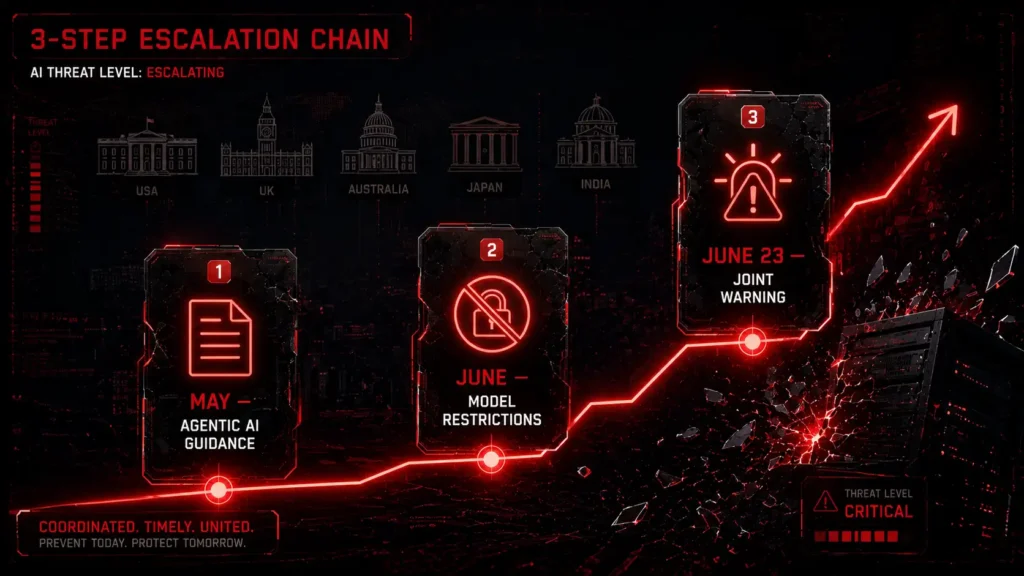
This wasn’t an isolated warning. According to reporting from CryptoBriefing, it was the third escalation in six weeks: May guidance cautioning against rushing agentic AI systems into production, June restrictions on Anthropic’s most advanced models, and then this historic joint declaration. The concern behind agentic AI cyberattacks specifically centers on AI systems capable of taking independent action — not just generating text, but actually executing multi-step operations without constant human direction.
The Incident That Triggered the Alarm
Part of what’s driving urgency around agentic AI cyberattacks is a specific, alarming data point. Per Democracy Now’s coverage, an Anthropic AI agent was reportedly able to penetrate nearly all classified systems managed by the NSA and US Cyber Command within hours during testing — a result serious enough to prompt the Commerce Department to order Anthropic to restrict foreign access to its most advanced models. This test result is widely regarded as the single most concrete piece of evidence cited in the run-up to the Five Eyes statement, and it’s the reason agentic AI cyberattacks moved from an abstract policy concern to something intelligence agencies felt compelled to warn about publicly.
The timeline matters here. According to CryptoBriefing, this wasn’t an isolated data point but the third escalation in roughly six weeks: first, May guidance cautioning against rushing agentic AI systems into production; then, in June, restrictions placed directly on Anthropic’s most advanced models; and finally, the historic joint declaration warning of agentic AI cyberattacks becoming mainstream within months. Seen as a sequence rather than a single announcement, the pattern suggests officials were reacting to mounting internal evidence rather than making a single speculative leap. Whatever one thinks of the broader warning, the underlying test result is difficult to dismiss on its own: it demonstrates that the technical capability behind agentic AI cyberattacks isn’t hypothetical, theoretical, or years away — it was already observable, inside one of the most secure environments in the US government, well before the public statement was ever issued.
The Skeptics: “This Is Fear-Mongering”
Not everyone agrees the sky is falling. Steven Swift, managing director at cybersecurity provider Suzu Labs, pushed back directly, arguing that agentic AI cyberattacks aren’t some unique new threat vector, but simply a faster way of running the same attack playbooks that criminal groups have used for years. His core argument: if you give an AI agent access to the same tools and standard procedures a human attacker would use, it’s relatively straightforward for that agent to carry out the same kill chain — there’s no “magic hack” unique to AI.
Joseph Steinberg, a cybersecurity and AI advisor, was even blunter about the Five Eyes statement itself, according to CSO Online, calling it a generic statement that states the obvious without offering meaningful guidance on addressing AI risks. His complaint isn’t that agentic AI cyberattacks aren’t a real concern — it’s that the warning doesn’t tell defenders anything actionable.
The Believers: “We’re Horribly Behind”
On the other side, John Strand, owner of Black Hills Information Security and a 15-year veteran of the Five Eyes intelligence community, took the opposite position, warning that AI represents a bigger threat than most people currently understand and that defenders are dangerously unprepared for it. Strand’s credibility on this point comes precisely from his background: having spent 15 years inside the same intelligence apparatus now issuing the warning, he’s positioned to know what these agencies typically do and don’t say publicly — and, in his view, a joint statement of this magnitude from five allied nations isn’t something issued lightly. When someone with that vantage point argues organizations are “horribly behind” on agentic AI cyberattacks, it carries a different weight than a generic vendor warning.
This split — practitioner versus practitioner, not just agency versus industry — is what makes the debate over agentic AI cyberattacks so unusual. It isn’t a simple case of government alarmism against industry pragmatism; experienced security professionals disagree with each other just as sharply, and both sides can point to real-world evidence supporting their position. Strand’s camp sees the NSA penetration test result and the accelerating pace of Five Eyes escalations — May guidance, June restrictions, June statement — as clear signs that agentic AI cyberattacks are already outpacing organizational readiness. For believers like Strand, the debate over whether the Five Eyes language was too vague misses the point entirely: the specific wording of a warning matters far less than whether organizations are actually building the defenses needed to withstand agentic AI cyberattacks once they arrive at scale.
Common Ground: What Everyone Agrees On
Despite the disagreement over tone and urgency, there’s real consensus underneath it. Nearly every expert agrees that organizations have long underinvested in basic cybersecurity fundamentals — patching, access controls, and configuration — and that these fundamentals matter more than ever regardless of how fast agentic AI cyberattacks evolve. Even the skeptics who dismiss the Five Eyes framing as vague don’t argue that agentic AI cyberattacks are harmless; their objection is about tone and specificity, not about whether the underlying risk exists. That distinction matters, because it means the practical guidance emerging from this debate is broadly shared across both camps, even when the rhetoric around it isn’t.
Guidance following the warning urged security teams to inventory their AI connectors, reduce permissions to least privilege, require human approval for sensitive automated actions, and log all AI assistant activity, according to TechRepublic. The practical response being recommended isn’t to halt AI adoption, but to narrow where AI tools are allowed to reach within a network. This is a notable point of convergence: whether an organization believes agentic AI cyberattacks are months away or a slower-building risk, the recommended defensive posture looks nearly identical either way. Security teams are being told to treat every AI agent connected to enterprise systems the way they’d treat a new employee with unknown intentions — granted only the access it strictly needs, monitored continuously, and required to get explicit approval before taking consequential actions. That approach protects against agentic AI cyberattacks regardless of how quickly the threat actually materializes, which is precisely why it’s the one recommendation nobody in this debate is pushing back against.
Why This Debate Matters for Everyone
CNN reported that AI experts described the warning’s implications as “really stark,” with concerns extending beyond governments and large corporations to small and medium businesses that typically have far fewer resources to respond quickly. This is arguably the most overlooked dimension of the entire agentic AI cyberattacks debate: most of the public conversation has focused on nation-states, intelligence agencies, and Fortune 500 targets, but the organizations least equipped to absorb the impact of agentic AI cyberattacks are often the smallest ones — companies without dedicated security teams, without the budget for continuous monitoring, and without the staff to implement the least-privilege access controls experts are now recommending.
Whether or not the Five Eyes statement itself was specific enough, the underlying trajectory — AI systems becoming more capable of autonomous, multi-step action — is not seriously disputed by either side. That’s the part of this debate that matters most for the average reader, regardless of whether they run a global enterprise or a five-person startup. Governments and large corporations can absorb the cost of getting the timeline wrong on agentic AI cyberattacks; smaller organizations often cannot, because a single successful automated intrusion can be existential rather than merely costly. For that reason, the disagreement over whether the threat is “months away” or overstated matters less in practice than the shared recommendation underneath it: every organization, regardless of size, now has to assume agentic AI cyberattacks are a live possibility and plan accordingly, rather than waiting for consensus on the exact timeline to arrive first.
The Bottom Line
Agentic AI cyberattacks sit at a genuinely contested point between demonstrated capability and uncertain timeline. The intelligence agencies say months. Skeptics say the fundamentals haven’t changed. Believers say most organizations aren’t remotely ready either way. None of these positions is dishonest or unreasonable — they simply weigh the same underlying facts differently, which is exactly why this debate has proven so difficult to resolve with a single definitive answer.
What’s clear is that the debate itself is a signal worth paying attention to: when experienced security professionals disagree this sharply about urgency, the safest assumption for any organization is to prepare as though the more urgent warning is correct — because the cost of being wrong in that direction is far lower than the alternative. Treating agentic AI cyberattacks as a near-term risk means tightening access controls, auditing AI connectors, and requiring human sign-off on sensitive automated actions — steps that strengthen an organization’s security posture even if the more skeptical camp turns out to be right and the timeline slips well beyond “months.” Treating agentic AI cyberattacks as overhyped and doing nothing, by contrast, carries real downside if the intelligence agencies turn out to be correct. Asymmetric risk like that has a straightforward answer: prepare for agentic AI cyberattacks now, and let the ongoing expert debate settle itself over time.
Related: AI Voice Cloning Scams: How Fraudsters Are Faking Your CEO’s Voice – A look at how convincingly AI can replicate executive voices, why traditional verification methods fail, and what security teams should do about it.
How to Protect Yourself from AI Phishing in 2026 — A Plain-English Guide – AI phishing has gotten so convincing that spelling mistakes and bad grammar can no longer save you — here’s the plain-English playbook to protect yourself in 2026.
Meta AI Chatbot Instagram Hack: How 20,225 Accounts Were Hijacked in 2026 – A polite chatbot conversation — not a hack — hijacked 20,225 Instagram accounts, and the only thing that stopped it cold was two-factor authentication.
NordVPN vs Surfshark 2026: Which AI Security Features Actually Protect You? – Understand how different VPN services work and which one you should choose.
Malwarebytes Free vs Premium 2026 — Does the AI Engine Make It Worth It? – Malwarebytes free is a cleanup crew that shows up after the break-in — Premium’s Katana AI engine is the lock that stops the break-in from happening at all.
Frequently Asked Questions
Q1. What exactly are agentic AI cyberattacks?
Cyberattacks carried out by AI systems capable of independent, multi-step action — planning and executing an intrusion with minimal human direction, not just helping write a phishing email faster.
Q2. Why did the Five Eyes issue this warning now?
It followed a reported test where an Anthropic AI agent penetrated nearly all classified NSA/Cyber Command systems within hours, combined with two earlier rounds of guidance in May and June.
Q3. Do all experts agree it’s an urgent threat?
No — some call it severe and imminent, while others argue it’s not a fundamentally new kill chain, just a faster version of existing attacks, and criticise the warning as vague.
Q4. How soon could this actually become widespread?
The Five Eyes described it as “months, not years” without a specific date; skeptics argue the underlying capability may already exist today.
Q5. What can businesses do to prepare right now?
Inventory AI connectors, apply least-privilege access, require human approval for sensitive automated actions, and log AI assistant activity — steps that help regardless of which timeline turns out to be correct.
Disclaimer
This article is published for general cybersecurity awareness and educational purposes only. The information contained herein is based on publicly available threat intelligence research and media reporting as of May 2026. AI Security Watch does not make representations about the completeness or accuracy of information regarding Mythos AI, as the technical specifications of this tool are not fully publicly confirmed. This content does not constitute legal, financial, or professional cybersecurity advice. Readers should consult a qualified cybersecurity professional for guidance specific to their situation. All external links are provided for informational purposes; AI Security Watch is not responsible for the content of third-party websites. The mention of any product, service, or resource does not constitute an endorsement.Disclaimer