
⚡ TL;DR — Key Takeaways
- What it is: Machine learning threat detection uses AI to collect, correlate, and act on cyber threat data automatically, instead of relying on manual analysis alone.
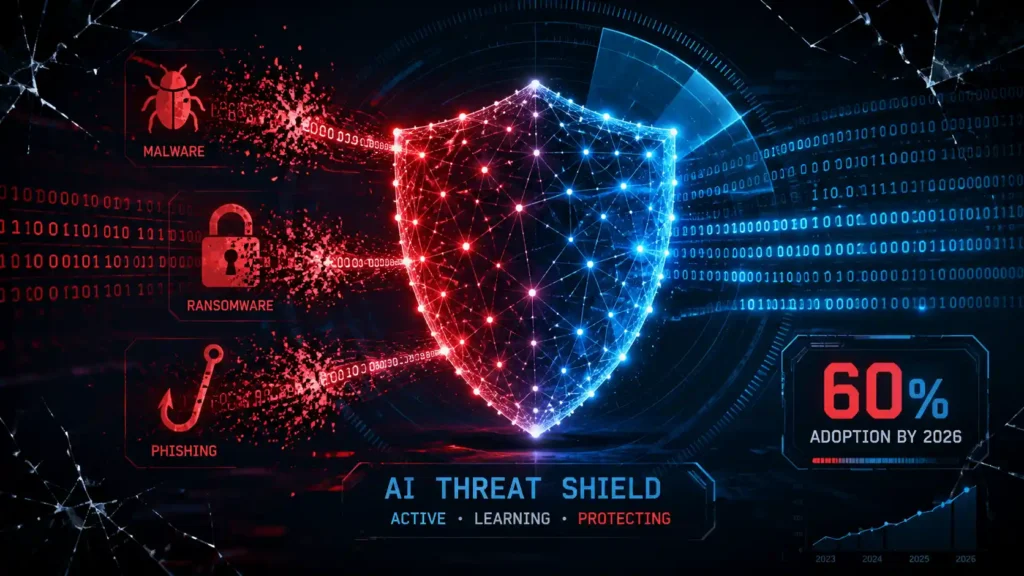
- Why it’s growing fast: Over 60% of organizations will rely on AI-augmented cybersecurity platforms in 2026, up from under 20% in 2023.
- The dual-use problem: The same AI capabilities strengthening defense are also lowering the barrier for attackers — one campaign used a Claude AI model to automate 80-90% of tactical attack operations.
- Biggest current threat: 50% of security professionals now cite hyper-personalized, AI-driven phishing as the top threat facing their organization.
- The catch: Basic security gaps, not exotic new attacks, remain the most common way organizations get breached — machine learning threat detection just helps close those gaps faster.
Table of Contents
Every major story we’ve covered on this site — voice cloning scams, AI phishing, the Meta AI chatbot Instagram hack — is really the same underlying story wearing a different mask. Behind each one sits the same discipline working quietly in the background: machine learning threat detection. It’s the reason security teams caught some of these attacks at all, and the reason attackers are now moving faster than traditional defenses can keep up with. If you’ve read any of our coverage on these incidents, you’ve already seen machine learning threat detection in action — just not always by that name.
This guide explains what machine learning threat detection actually means, why it’s become central to cybersecurity in 2026, and how it connects to the real-world attacks reshaping the threat landscape right now. Understanding machine learning threat detection isn’t just useful background — it’s the lens that makes sense of nearly every other story on this site, from a single hijacked Instagram account to a five-nation government warning about the future of cyberwarfare.
What Is Machine Learning Threat Detection?
Machine learning threat detection refers to the use of artificial intelligence — including machine learning, deep learning, and natural language processing — to collect, correlate, and act on cybersecurity threat data faster and more accurately than manual analysis allows.
Traditional threat intelligence relied heavily on signature-based detection and human analysts manually reviewing security data, an approach that often fell short against zero-day attacks and fast-moving threats, according to Cyber Intel Insights. This approach was built specifically to close that gap, replacing slow, manual review cycles with systems that can process threat data continuously and at a scale no human analyst team could match alone.
This approach changes things by correlating information across multiple networks, geographic regions, industry sectors, and data sources simultaneously — something security teams previously struggled to do when analyzing incidents in isolation, per SentinelOne.
Unlike static detection tools, it continuously adapts by learning from new data, allowing it to recognize previously unknown attack methods rather than only catching threats that match an existing signature.
This adaptive quality is what distinguishes it from earlier generations of security tooling: instead of waiting for a human analyst to identify a new threat pattern and manually update detection rules, these systems can surface emerging patterns on their own, often flagging suspicious activity long before it would have been documented and catalogued through traditional means.
Why Machine Learning Threat Detection Matters More in 2026
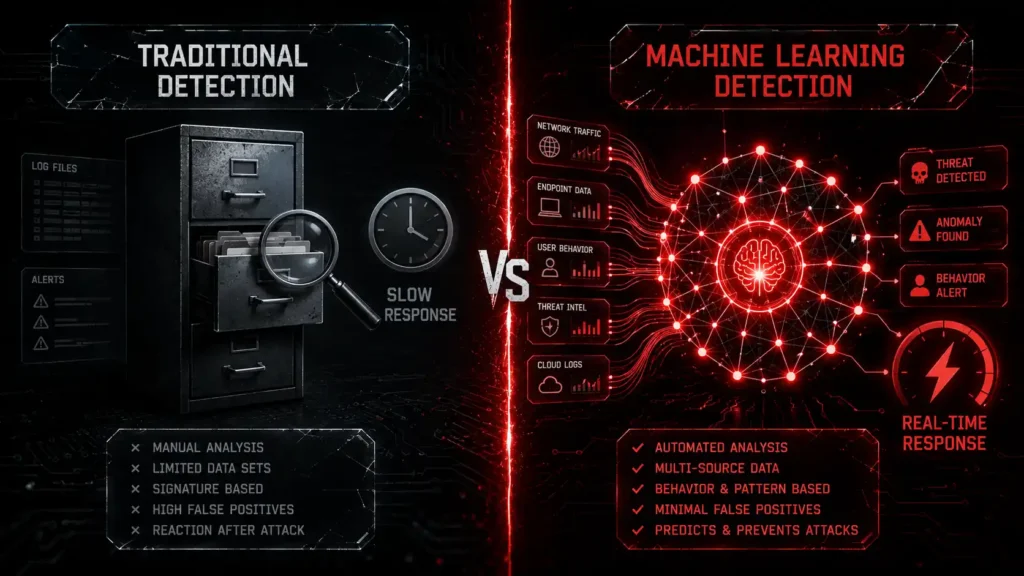
Adoption has moved from early-adopter territory to a baseline requirement. Gartner predicts that in 2026, over 60% of organizations will rely on cybersecurity platforms with AI-augmented automation — a massive leap from less than 20% in 2023, according to Fortinet.
This shift reflects a simple reality: attacks now move at machine speed, and human-only analysis can no longer keep pace. What used to be a competitive advantage for early adopters has become table stakes; organizations without it are no longer just behind the curve, they’re operating with a structural disadvantage against attackers who already assume AI-speed defenses on the other side.
Good detection platforms support security teams by identifying suspicious network behavior, unusual login attempts, and abnormal traffic from IoT devices or endpoints in real time, rather than discovering compromise only after the damage is done.
This real-time approach is the core difference from older threat intelligence models, which mainly focused on collecting and distributing information after the fact. The shift matters because the cost of a delayed response has grown sharply: a breach detected in real time by this kind of tooling can often be contained before data exfiltration occurs, while the same breach caught days later through manual review may already involve significant financial and reputational damage.
That gap — hours or days versus weeks — is precisely why this capability has moved from a nice-to-have to a baseline operational requirement across nearly every industry by 2026.
The Dual-Use Problem: AI Helps Attackers Too
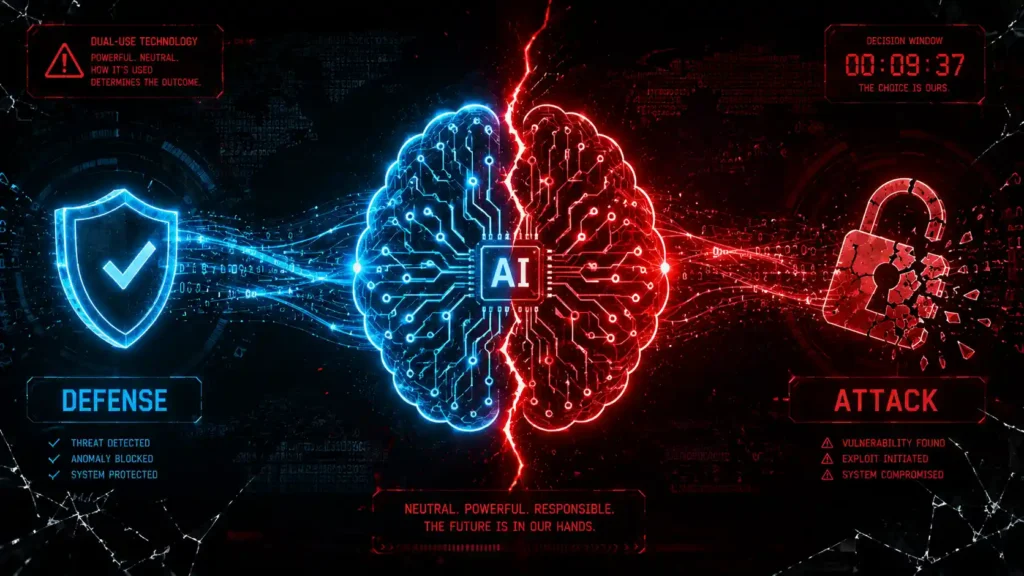
Here’s the uncomfortable part: the same underlying technology cuts both ways. As the CIO 2026 Threat Detection Report puts it, AI is helping lower the barrier of entry to conduct cyberattacks even as it strengthens defenses. Nation-state actors from Iran, China, and North Korea have leveraged large language models and Model Context Protocol servers as force multipliers — in one campaign, a Claude AI model was used to automate 80-90% of tactical operations.
This mirrors what we covered in our piece on agentic AI cyberattacks: this isn’t just a defensive concept anymore, it’s a contested space where both sides are racing to apply the same underlying capabilities faster than the other. Google’s Threat Intelligence Team has also observed cybercriminals leveraging AI-enabled malware that can generate scripts, alter code to avoid detection, and create malicious functions on-demand once deployed, according to Cyber Defense Magazine.
The Threats Driving This Field in 2026
Several attack categories dominate current reporting:
- Hyper-personalized phishing. AI has changed social engineering by building attacks on behavioral data, mimicking individual writing styles, and increasingly pairing with deepfake voice and video. 50% of security professionals now cite this as the top threat facing their organization, according to Cynet — a pattern directly reflected in our own coverage of AI phishing scams.
- Deepfake fraud. One industry survey found 85% of organizations experienced at least one deepfake-related incident in the past year, according to DeepStrike — closely mirroring the voice-cloning CEO fraud cases we’ve covered.
- AI-enabled malware. Malicious software is increasingly capable of disguising its activity, altering behavior to bypass antivirus tools, and even analyzing a target network’s defenses in real time to avoid detection.
- Exploited security fundamentals. Perhaps most importantly, IBM’s 2026 X-Force Threat Intelligence Index found a 44% increase in attacks beginning with exploitation of public-facing applications, largely driven by missing authentication controls, according to IBM Newsroom. AI accelerates how fast these basic gaps get found and closed — but attackers use the same acceleration to find them first.
How Organizations Use It to Defend
AI-powered cybersecurity strengthens endpoints, networks, and cloud security through phishing detection, behavioral analytics, vulnerability management, and authentication controls, reducing manual effort and human error while improving response times, per Fortinet.
Effective adoption requires high-quality data, continuous model updates, human oversight, and integration across the full security stack — not simply installing a tool and expecting it to work in isolation.
Organizations that treat it as a plug-and-play product rather than an ongoing discipline tend to see diminishing returns, since the models powering these platforms are only as effective as the data feeding them and the analysts overseeing their output.
Notably, most experts frame current AI threats less as a revolution and more as an evolution in speed and automation, rather than an entirely new category of attack.
That framing matters for how organizations should approach this technology: it isn’t a replacement for foundational security hygiene, but an accelerant layered on top of it. The human role doesn’t disappear — it shifts from reacting to individual alerts toward shaping and overseeing the systems that respond automatically.
In practice, this means security teams spend less time triaging low-level alerts one by one and more time tuning detection models, validating AI-driven decisions, and investigating the more complex, high-confidence threats it surfaces.
The organizations getting the most value from it in 2026 are the ones that pair it with strong fundamentals, rather than treating it as a substitute for them.
The Bottom Line
Machine learning threat detection has moved from a specialized capability to a near-universal expectation for any organization serious about cybersecurity in 2026. It offers real, measurable advantages — faster detection, broader correlation, and adaptive learning that static tools can’t match — but it’s not a silver bullet. The same capabilities empowering defenders are actively being used by attackers, and basic security gaps remain the most common entry point for real-world breaches. Understanding it isn’t optional anymore; it’s the foundation for understanding nearly every other threat we cover on this site.
Related: Meta AI Chatbot Instagram Hack: How 20,225 Accounts Were Hijacked in 2026 – A polite chatbot conversation — not a hack — hijacked 20,225 Instagram accounts, and the only thing that stopped it cold was two-factor authentication.
NordVPN vs Surfshark 2026: Which AI Security Features Actually Protect You? – Understand how different VPN services work and which one you should choose.
Malwarebytes Free vs Premium 2026 — Does the AI Engine Make It Worth It? – Malwarebytes free is a cleanup crew that shows up after the break-in — Premium’s Katana AI engine is the lock that stops the break-in from happening at all
Frequently Asked Questions
Q1. What is machine learning threat detection in simple terms?
It’s the use of AI to automatically collect, correlate, and act on cybersecurity threat data faster than manual analysis alone. It helps security teams spot and respond to attacks in real time instead of after the damage is done.
Q2. How is it different from traditional threat intelligence?
Traditional methods relied on signature-based detection and manual review, which often missed zero-day attacks. This approach continuously learns from new data, letting it recognize previously unknown attack patterns.
Q3. Can this technology be used by attackers too?
Yes — the same underlying technology is dual-use. Nation-state actors and cybercriminals have used AI tools like large language models to automate reconnaissance, phishing, and malware development.
Q4. Do organizations still need human analysts with this in place?
Absolutely. Human oversight remains essential for tuning models, validating decisions, and investigating complex threats — AI shifts the human role rather than replacing it.
Q5. Is this only for large enterprises?
No. While large enterprises adopted it first, over 60% of all organizations are expected to rely on AI-augmented security platforms in 2026, making it increasingly standard across businesses of every size.
Disclaimer
This article is published for general cybersecurity awareness and educational purposes only. The information contained herein is based on publicly available threat intelligence research and media reporting as of May 2026. AI Security Watch does not make representations about the completeness or accuracy of information regarding Mythos AI, as the technical specifications of this tool are not fully publicly confirmed. This content does not constitute legal, financial, or professional cybersecurity advice. Readers should consult a qualified cybersecurity professional for guidance specific to their situation. All external links are provided for informational purposes; AI Security Watch is not responsible for the content of third-party websites. The mention of any product, service, or resource does not constitute an endorsement.Disclaimer