
⚡ TL;DR — Key Takeaways
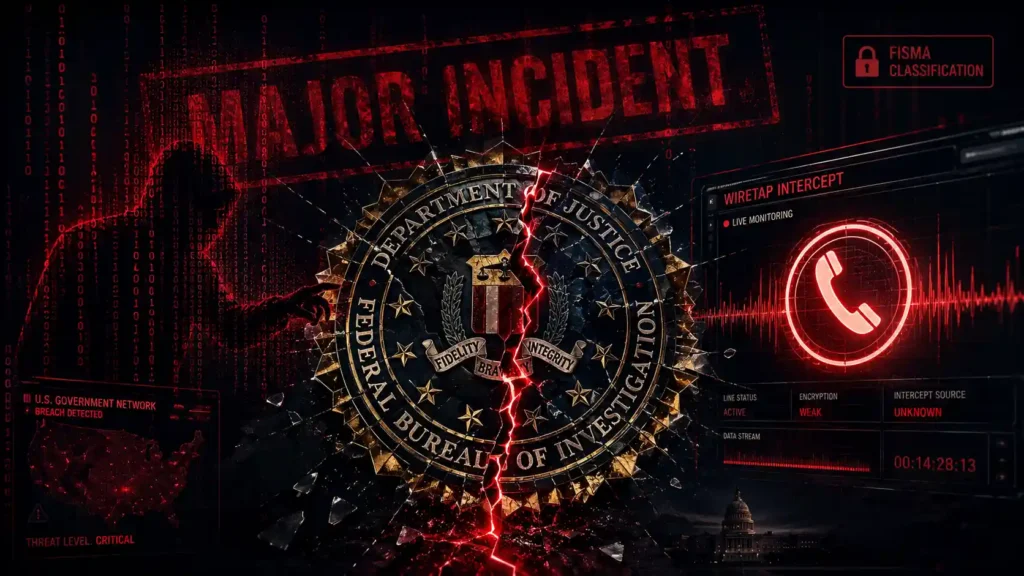
- What happened: The FBI data breach 2026 involved suspected Chinese state-sponsored hackers breaching DCS-3000 (“Red Hook”), an FBI system managing court-authorized wiretap surveillance.
- Discovery: FBI analysts first flagged abnormal log activity on February 17, 2026, after the intrusion had already been underway.
- Official classification: By April 1, 2026, the FBI formally declared it a “major incident” under FISMA — the highest federal breach severity designation.
- What was exposed: Pen register and trap-and-trace metadata (who a surveillance target called, who called them, and what websites they visited) plus personally identifiable information on investigation subjects.
- The suspected culprit: Investigators are focused on Salt Typhoon, a China-linked group previously responsible for breaching all three major US cellular carriers.
- The bigger picture: This was one of three separate FBI cyber incidents in March 2026 alone, alongside a compromise of Director Kash Patel’s personal email and an exposed 2023 hack tied to Epstein investigation files.
Table of Contents
When the agency responsible for investigating cybercrime becomes the victim of one, the story writes itself. That’s exactly what happened with the FBI data breach 2026 — a Chinese-linked intrusion into one of the bureau’s own surveillance systems, disclosed to Congress this spring and serious enough to trigger the federal government’s highest breach classification. It’s the kind of irony that’s hard to overstate: the same agency Americans rely on to investigate ransomware gangs, nation-state hackers, and cybercriminal networks spent months this year quietly managing a breach of its own.
What makes the FBI data breach 2026 especially notable isn’t just who was targeted, but what was inside the system attackers reached. This wasn’t a leaked employee spreadsheet or a phishing-compromised email account — it was direct access to infrastructure the bureau uses to manage active surveillance on criminal and national security targets. That distinction is a large part of why the FBI data breach 2026 escalated so quickly from an internal security matter into a formal, congressionally-reported national security incident.
What Actually Got Breached
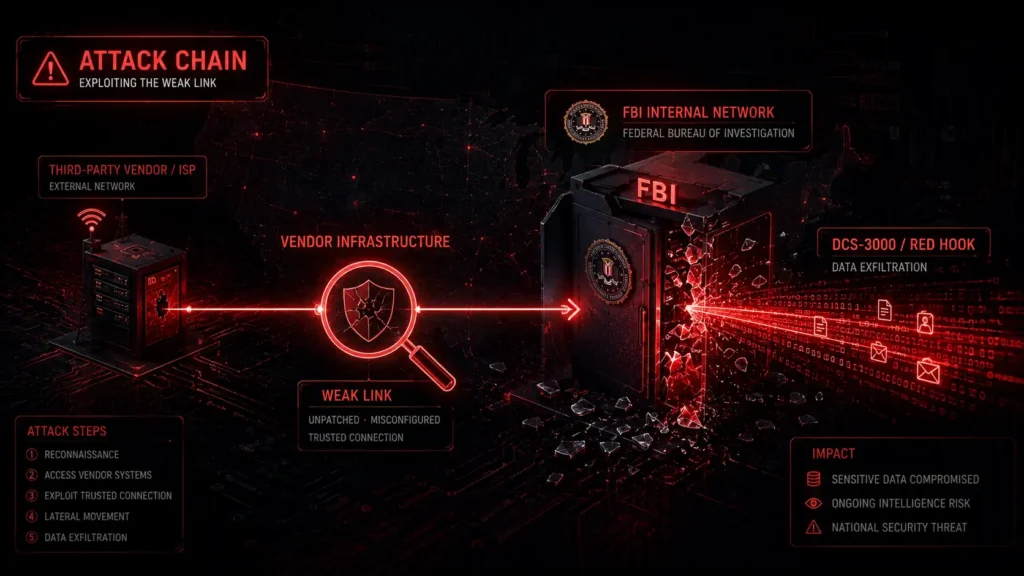
The system at the center of this incident is an unclassified component of the bureau’s Digital Collection System Network, specifically DCS-3000, known internally as “Red Hook,” according to HSToday. This system manages court-authorized wiretaps and foreign intelligence surveillance requests — infrastructure most Americans don’t even know exists, let alone one built specifically to track criminal and national security targets.
FBI analysts first detected abnormal log activity on February 17, 2026, and launched an investigation, per CPO Magazine. The compromised system held data from pen register and trap-and-trace surveillance tools — technology that tracks which phone numbers a target calls, which numbers call them, and which websites they visit, according to iHeart. While these tools don’t capture the actual content of calls or messages, the metadata itself reveals something arguably more sensitive: exactly who the FBI is watching, right now, in active investigations.
How the FBI Data Breach 2026 Was Discovered and Escalated
The FBI alerted Congress in early March 2026, and by April 1, Politico reported the bureau had formally classified the intrusion as a “major incident” under the Federal Information Security Modernization Act. Under FISMA, that designation only applies when a breach involves compromised personally identifiable information or presents acute risk to national security — meaning the FBI concluded both conditions had been met, according to IBTimes UK.
That classification isn’t symbolic. It legally requires notifying Congress within seven days and places the FBI data breach 2026 among the most consequential cyberattacks ever directed at US law enforcement, per ComplexDiscovery. Notably, the White House, DHS, and NSA all joined the investigation — a level of interagency response typically reserved for incidents agencies consider far from routine.
Who’s Behind the FBI Data Breach 2026
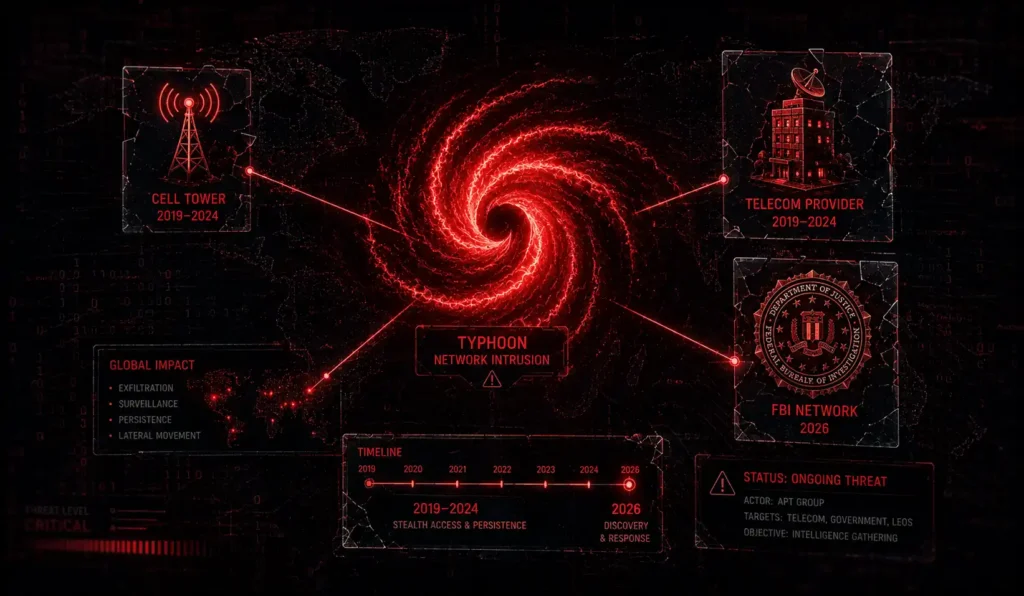
No hacking group has been officially named, but investigators have focused heavily on Salt Typhoon, a threat actor linked to China’s Ministry of State Security. Salt Typhoon previously breached all three major US cellular providers and dozens of telecom companies worldwide between 2019 and 2024, in what’s considered one of the largest intelligence compromises in American history, according to AOL/NBC News.
That earlier campaign successfully obtained phone records from millions of Americans and, notably, also stole FBI wiretap data — making the FBI data breach 2026 look less like an isolated event and more like a continuation of the same long-running espionage effort.
If Salt Typhoon is ultimately confirmed as the group behind the FBI data breach 2026, it would mean the same actors who spent years quietly embedded inside America’s telecommunications backbone have now returned to strike an even more sensitive target: the agency responsible for investigating them in the first place.
China has publicly denied any involvement in Salt Typhoon’s activities, and officials familiar with the matter noted that the group’s hacking has continued largely unchecked despite the intense scrutiny that followed its 2024 exposure.
That persistence is itself part of the story — the FBI data breach 2026 arrives at a moment when the US government’s own attribution and public naming of Salt Typhoon’s earlier campaign apparently did little to deter further operations, raising uncomfortable questions about whether current countermeasures are actually working.
Not an Isolated Incident
The FBI data breach 2026 didn’t happen in a vacuum. According to CPO Magazine, the bureau faced three separate cyber incidents in March 2026 alone: the DCSNet breach itself, a compromise of FBI Director Kash Patel’s personal email claimed by an Iran-linked group, and a fresh disclosure that a 2023 hack of the bureau’s New York field office had exposed files connected to the Jeffrey Epstein investigation.
Multiple adversaries, different attack vectors, one agency, in a single month — a pattern security experts describe as far outside the profile of a routine breach.
Viewed together, these three incidents reframe the FBI data breach 2026 as less of a one-off failure and more of a symptom of a much broader security strain across the bureau’s entire digital footprint.
It’s one thing for a single system to be compromised by a sophisticated, well-resourced nation-state actor; it’s another for that same agency to simultaneously be dealing with an email compromise attributed to a completely different foreign group and the resurfacing of an older, previously undisclosed breach tied to one of the most sensitive investigations in recent memory.
The clustering of the FBI data breach 2026 alongside these other incidents suggests that whatever internal security gaps allowed one adversary in may not be isolated to a single system or a single point of failure, which is precisely why the interagency response — pulling in the White House, DHS, and NSA — went well beyond what a single, contained intrusion would typically warrant.
Why This Matters Beyond Washington
The FBI data breach 2026 underscores something we’ve written about repeatedly on this site: even the organizations built specifically to defend against cyber threats aren’t immune to them. Surveillance metadata might not sound as dramatic as stolen passwords or financial data, but knowing who a government is actively investigating is exactly the kind of intelligence a rival nation-state would pay dearly to obtain — and in this case, appears to have obtained largely for free, through a vendor’s weaker defenses rather than the FBI’s own systems.
That distinction matters enormously: the FBI data breach 2026 wasn’t the result of a sophisticated zero-day exploit against a hardened target, it was the result of a trusted third party being the weaker link in an otherwise well-defended chain.
This pattern is becoming a recurring theme across nearly every major intrusion we’ve covered, not just the FBI data breach 2026. Attackers increasingly bypass an organization’s own defenses entirely and instead target the vendors, contractors, and service providers that already have trusted access — a strategy that’s proven repeatedly more efficient than attacking a hardened target head-on.
For an agency as security-conscious as the FBI, the fact that a commercial ISP’s vendor infrastructure became the entry point is a sobering reminder that an organization’s cybersecurity posture is only ever as strong as its least-secured partner. The FBI data breach 2026 is unlikely to be the last major incident that traces back to this exact weakness, given how consistently it keeps showing up across government and industry alike.
The Bottom Line
The FBI data breach 2026 is a reminder that supply-chain vulnerabilities — not just direct attacks — remain one of the most effective paths into even the most sensitive government networks. As Chinese state-linked groups like Salt Typhoon continue operating with apparent impunity years after their initial exposure, the incident raises uncomfortable questions about how well-defended America’s most sensitive investigative infrastructure actually is, and how many similar intrusions may still be unfolding undetected.
Related: Norton Genie AI Scam Detector: Does It Actually Stop Scams in 2026? – Read the major features of the Norton Genie AI Scam Detector and understand its benefits in your daily life.
The Ultimate Guide to Machine Learning Threat Detection in 2026 – Machine learning threat detection catches attacks in real time instead of after the damage is done — but the same technology is arming attackers just as fast as it’s arming defenders.
McDonald’s Data Breach 2026: 64 Million Job Applicants’ Data Exposed Through AI Chatbot – Read major data breach in McDonald’s McHire Software.
The 5 Worst Data Breaches of 2026 — And What AI Could Have Prevented – Check for the worst 5 data breaches of 2026
Frequently Asked Questions (FAQ)
Q1. What exactly was compromised?
DCS-3000 (“Red Hook”), the FBI’s wiretap surveillance system. Exposed data included pen register/trap-and-trace metadata plus PII on investigation subjects.
Q2. Who is believed to be behind it?
No group officially named, but investigators are focused on Salt Typhoon, a China-linked group tied to China’s Ministry of State Security.
Q3. How did attackers gain access?
Via a commercial ISP’s vendor infrastructure — a supply-chain attack rather than a direct breach of FBI systems.
Q4. Why was it classified as a “major incident”?
Under FISMA, the classification requires compromised PII or acute national security risk. The FBI concluded both conditions were met.
Q5. Was it an isolated event?
No — one of three separate FBI cyber incidents in March 2026 alone.
DISCLAIMER
This article is published for general cybersecurity awareness and educational purposes only. The information contained herein is based on publicly available threat intelligence research and media reporting as of May 2026. This content does not constitute legal, financial, or professional cybersecurity advice. Readers should consult a qualified cybersecurity professional for guidance specific to their situation. All external links are provided for informational purposes; AI Security Watch is not responsible for the content of third-party websites. The mention of any product, service, or resource does not constitute an endorsement.Disclaimer