
⚡ TL;DR — Key Takeaways
- The market: AI security spending estimates range from $25.5B to $44.2B in 2026 depending on methodology, with every major analyst firm projecting double-digit growth through 2034.
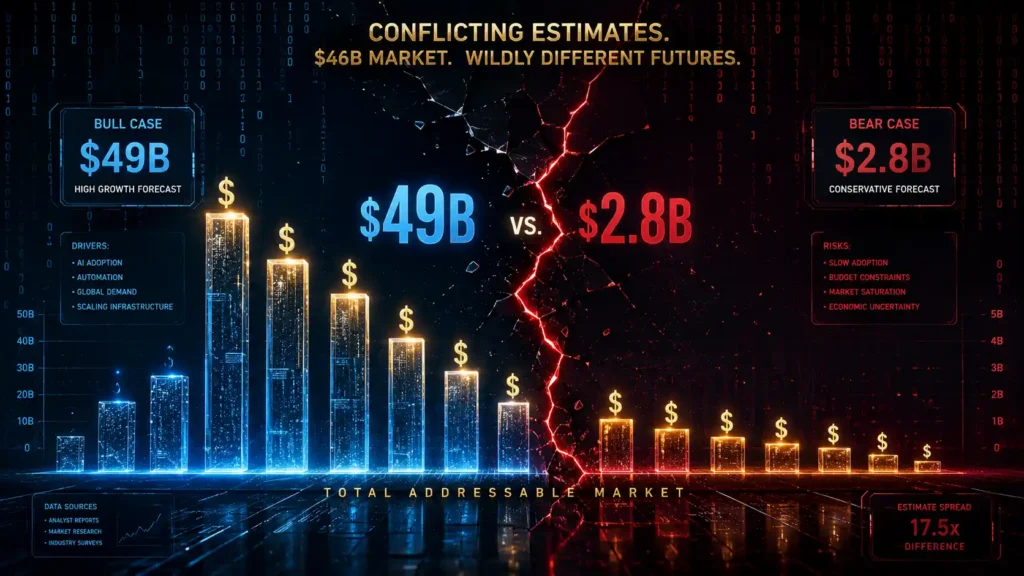
- The spending gap: Enterprises are investing roughly 17 times more in AI-powered defense tools than in securing the AI systems those tools actually run on.
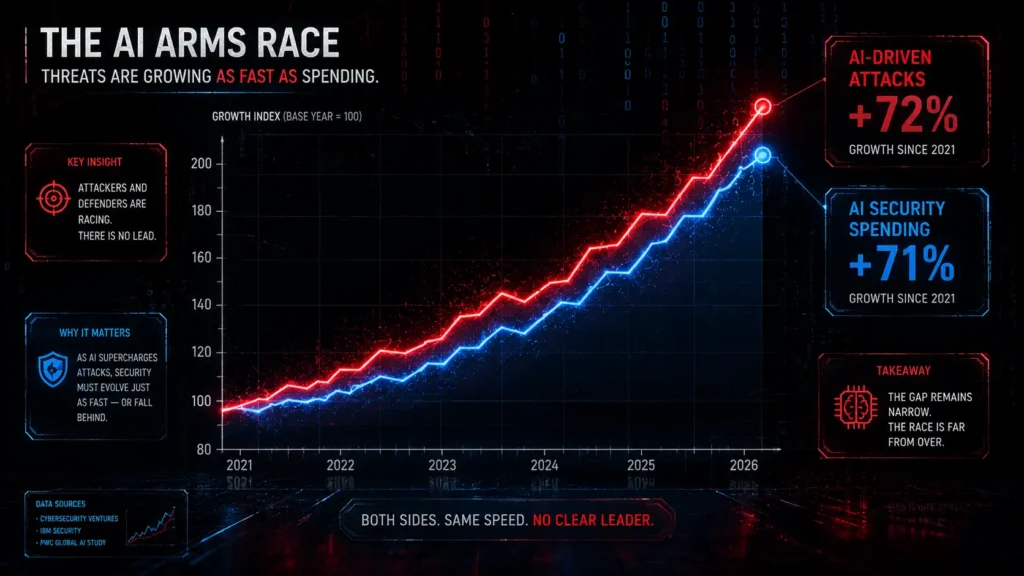
- The attack surge: AI-driven attacks are up 72% year-over-year, and 82.6% of phishing attempts now use AI in some form.
- The payoff: Organizations using AI and automation in security save $1.9 million per breach and detect incidents 51 days faster than those that don’t.
- The commitment: 89% of organizations plan to increase AI security spending in 2026, by an average of 47% over 2025 levels.
Table of Contents
Every AI security report published this year tells a version of the same story with slightly different numbers attached. That’s not a flaw in the data — it’s the data itself telling you something. When five separate analyst firms can’t agree on whether the AI security market is worth $25 billion or $44 billion, it means the category is moving faster than anyone can measure it accurately.
This kind of disagreement almost never happens in mature software markets. Nobody debates the size of the CRM market by a factor of nearly two; the category is old enough that analysts have converged on a shared definition of what counts.
AI security hasn’t reached that point yet, and the spread between estimates is itself a useful signal about how early-stage and fast-moving this space still is. Below is a consolidated, sourced snapshot of where AI security actually stands in 2026, built specifically so other researchers, writers, and analysts can cite it directly rather than re-running the same fragmented research from scratch.
The Data, by the Numbers
| Metric | Figure | Source |
| AI in cybersecurity market (2026) | $25.53B → $50.83B by 2031 | Markets and Markets |
| AI in cybersecurity market (alt. estimate) | $44.24B → $213.17B by 2034 | Fortune Business Insights |
| Total AI security market (incl. governance/testing) | $4.8B (2025) → $34.2B by 2032 | Market.us |
| Agentic AI security market | $1.65B (2026) → $13.52B by 2032 | Markets and Markets |
| Global security spending (all categories) | $308B in 2026 | IDC |
| AI-amplified defense spending vs. securing-AI spending | $49B vs. $2.8B (17x gap) | Gartner 4Q25 |
| AI-driven attack growth | +72% year-over-year | AI Business Weekly |
| Phishing attempts using AI | 82.6% | AI Business Weekly |
| Orgs planning to increase AI security spend in 2026 | 89%, +47% avg increase | Market.us / IBM |
| Breach cost reduction with AI + automation | $1.9M saved, 51 days faster detection | Fortune Business Insights |
The Market Everyone Is Racing to Size
No two market research firms agree on exactly how big this market is right now, and that’s worth sitting with. MarketsandMarkets puts the core AI-in-cybersecurity figure at $25.53 billion in 2026, growing to $50.83 billion by 2031. Fortune Business Insights, using a broader definition, puts 2026 at $44.24 billion, ballooning to $213.17 billion by 2034. Market.us tracks a narrower slice — AI security governance, monitoring, and testing tools specifically — at $4.8 billion in 2025, projected to hit $34.2 billion by 2032 at a 32.4% compound annual growth rate.
The disagreement isn’t sloppy research; it reflects a category still being defined in real time. What every firm agrees on is direction: fast, sustained, double-digit-to-triple-digit growth, with no analyst projecting a slowdown before the next decade.
The Gap Nobody’s Talking About Enough
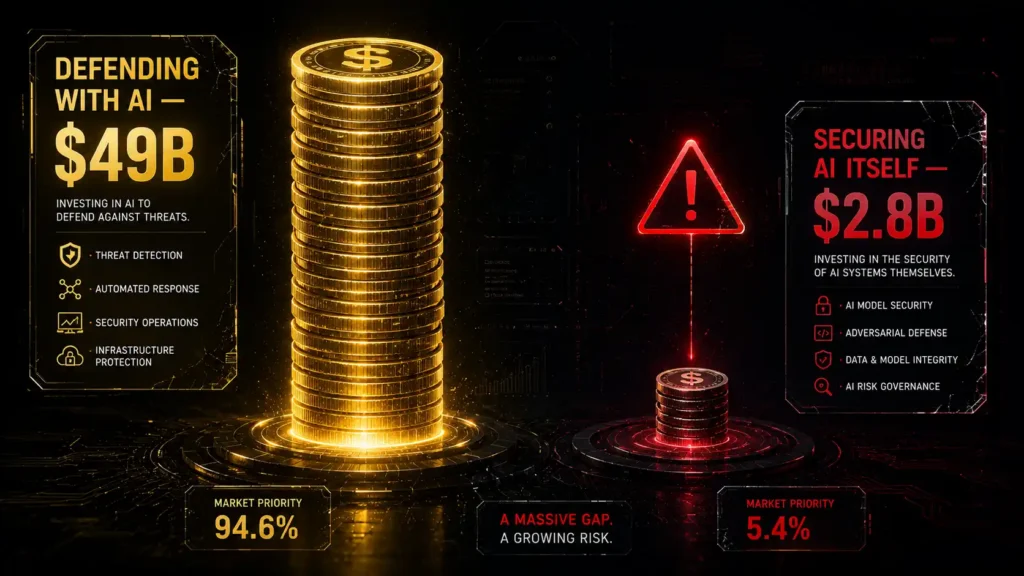
Here’s the single most important number buried in this year’s data: Gartner’s 4Q25 forecast split the market into two distinct segments for the first time ever — AI-amplified security (using AI to defend everything else) at $49 billion, versus securing AI itself (protecting the models, training data, and agent workflows) at just $2.8 billion. That’s a 17-to-1 spending imbalance.
In plain terms, enterprises are pouring money into AI-powered detection and defense tools far faster than they’re investing in making sure those same AI systems can’t be manipulated, poisoned, or turned against them.
Forrester’s 2026 predictions go further, forecasting that an agentic AI deployment will cause a publicly disclosed breach this year severe enough to result in employee dismissals — not as a single point of failure, but as a cascade. Given the spending gap, that prediction doesn’t look like a stretch.
The Attack Side Is Scaling Just as Fast
Defensive spending is racing to keep up with an attack landscape growing at a comparable pace. AI-driven attacks climbed 72% year-over-year, and 82.6% of phishing attempts now incorporate AI in some form, according to compiled 2026 data from AIBusinessWeekly. Average breach costs now sit at $4.88 million globally — a number that makes the $1.9 million savings organizations see from deploying AI and automation in their security stack look less like a nice-to-have and more like a direct offset against a rapidly rising baseline cost.
Why Organizations Are Doubling Down Anyway
Despite the uncertainty in exact market size, enterprise appetite isn’t slowing down. 89% of organizations plan to increase spending on this category in 2026, with the average planned increase sitting at 47% over 2025 levels, according to Market.us and IBM’s report on the topic. That’s not incremental budgeting — it’s a near-universal signal that security leaders view current AI-related exposure as outpacing what last year’s budget was built to handle.
Global security spending overall is projected to hit $308 billion in 2026, growing to $430 billion by 2029, per IDC — with AI-driven platforms cited as the single largest driver of that growth. Cloud security remains the fastest-growing subsegment at 28.8% growth, reflecting how tightly this investment is now bound to broader cloud infrastructure spending.
The Bottom Line
AI security in 2026 is a market growing faster than the industry’s ability to measure it consistently, defending against attacks growing at a nearly identical pace, and structurally underinvesting in the one place — securing AI itself — that could prevent the next major AI-driven breach before it happens. The organizations winning this fight aren’t the ones spending the most on AI security broadly; they’re the ones closing the 17-to-1 gap between defending with AI and defending the AI itself, before Forrester’s prediction of a headline-making agentic AI breach turns out to be about them.
Related: DHS HSIN Breach: Hackers Sat Inside World Cup Security for 5 Weeks – Hackers breached DHS’s Homeland Security Information Network at the worst possible time, exposing how one overlooked system can put major events like the FIFA World Cup at greater cyber risk.
Norton Genie AI Scam Detector: Does It Actually Stop Scams in 2026? – Read the major features of the Norton Genie AI Scam Detector and understand its benefits in your daily life.
AI Cyberattacks: How One AI Found 555 Flaws Attackers Wanted First – One AI uncovered 555 software vulnerabilities before attackers could exploit them—showing how AI is becoming one of cybersecurity’s most powerful defenders.
AI Predator Warning: 7 Signs Your Child’s Chatbot Isn’t Safe – Learn the subtle warning signs of unhealthy AI chatbot interactions—and discover practical ways parents can keep children safe through awareness, open conversations, and smart digital habits.
Claude AI Went From $1B to $30B in Two Years. Its Security Story Is Just as Wild. – Claude went from $1 billion to $30 billion in two years by being brilliant at finding security flaws — the same brilliance a nation-state group used to jailbreak it for a live espionage campaign.
AI Browser Agents: Why One Is 90% More Vulnerable to Phishing – Every major AI browser shares the same unfixable flaw, and one of them is 90% more vulnerable to phishing than the browser you’re using right now.
Frequently Asked Questions (FAQ)
Q1. How big is the AI security market in 2026, really?
Estimates vary significantly by methodology — MarketsandMarkets puts it at $25.53 billion, while Fortune Business Insights estimates $44.24 billion using a broader definition. The disagreement itself reflects how early-stage and fast-moving this category still is.
Q2. What is the 17-to-1 AI security spending gap?
It refers to Gartner’s finding that enterprises spend roughly $49 billion on AI-powered defense tools but only $2.8 billion securing the AI systems those tools rely on — a significant imbalance that leaves AI models and agent workflows comparatively underprotected.
Q3. How much are AI-driven cyberattacks actually growing?
AI-driven attacks are up 72% year-over-year, and 82.6% of phishing attempts now incorporate AI in some form, according to 2026 industry data.
Q4. Does using AI in security actually reduce breach costs?
Yes — organizations using AI and automation in their security stack save an average of $1.9 million per breach and detect incidents 51 days faster than those that don’t, according to Fortune Business Insights.
Q5. Are companies planning to keep increasing AI security spending?
Yes — 89% of organizations plan to increase AI security spending in 2026, with the average planned increase sitting at 47% over 2025 levels.
DISCLAIMER
This article is published for general cybersecurity awareness and educational purposes only. The information contained herein is based on publicly available threat intelligence research and media reporting as of July 2026. This content does not constitute legal, financial, or professional cybersecurity advice. Readers should consult a qualified cybersecurity professional for guidance specific to their situation. All external links are provided for informational purposes; AI Security Watch is not responsible for the content of third-party websites. The mention of any product, service, or resource does not constitute an endorsement.Disclaimer