
⚡ TL;DR — Key Takeaways
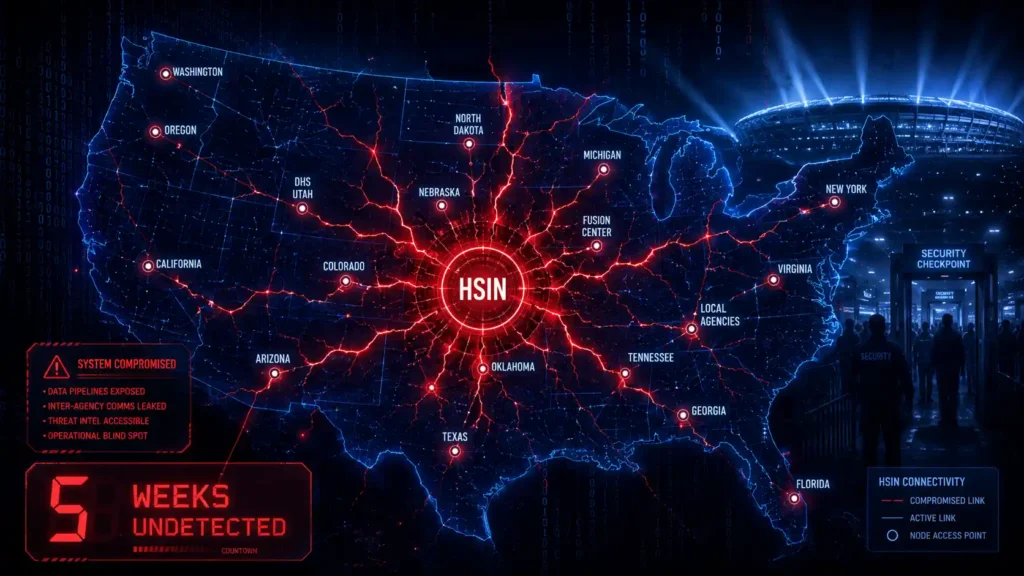
- What happened: Unknown hackers breached DHS HSIN, the federal government’s primary sensitive-but-unclassified information-sharing platform, and went undetected for roughly 4-5 weeks.
- The timing: The DHS HSIN intrusion occurred during active security coordination for the 2026 FIFA World Cup, hosted across 11 US cities through the July 19 final.
- The scope: HSIN spans more than 35 topic-specific portals used by federal, state, local, tribal, international, and private-sector partners.
- The pattern: This is the third major US federal breach disclosed in 2026 alone, following a CISA contractor credential exposure and a separate FBI wiretap system compromise.
- The response: Senate Intelligence Committee Vice Chair Mark Warner has formally demanded a DOJ investigation, calling the exposed data a direct national security risk.
Table of Contents
For roughly five weeks this summer, unknown hackers had a working set of keys to one of the most operationally sensitive networks in the US government — and nobody noticed. DHS HSIN, the platform federal, state, and local agencies rely on to coordinate everything from World Cup security to plane-crash emergency response, sat quietly breached while officials had no idea.
When DHS finally confirmed the intrusion on July 1, 2026, it became the third major federal cybersecurity failure disclosed in 2026 alone — and arguably the one with the worst possible timing. Here’s what actually happened inside DHS HSIN, why the exposure window matters more than the breach itself, and what it reveals about the state of federal cyber defense heading into one of the most-watched events ever hosted on American soil.
DHS HSIN Breach by the Numbers
| Metric | Figure |
| Intrusion window | Late May – early June 2026 |
| Public disclosure date | July 1, 2026 |
| Time undetected | ~4-5 weeks |
| HSIN topic-specific portals | 35+ |
| World Cup host cities affected | 11 (US) + Canada + Mexico |
| Tournament final | July 19, 2026, MetLife Stadium |
| Federal breaches disclosed in 2026 (this cluster alone) | 3 |
Inside the DHS HSIN Intrusion
DHS HSIN — the Homeland Security Information Network — isn’t a document archive. It’s the operational backbone of domestic security coordination in the United States: a live environment where federal agencies, all 50 states, tribal and territorial governments, international partners, and private critical-infrastructure operators exchange threat feeds, coordinate event security, and maintain a shared operational picture during emergencies.
Understanding what DHS HSIN actually does day-to-day is essential to understanding why this breach matters as much as it does — this isn’t a system that quietly stores old case files, it’s one that’s actively in use, in real time, by the people responsible for keeping large-scale public events and emergency responses running safely.
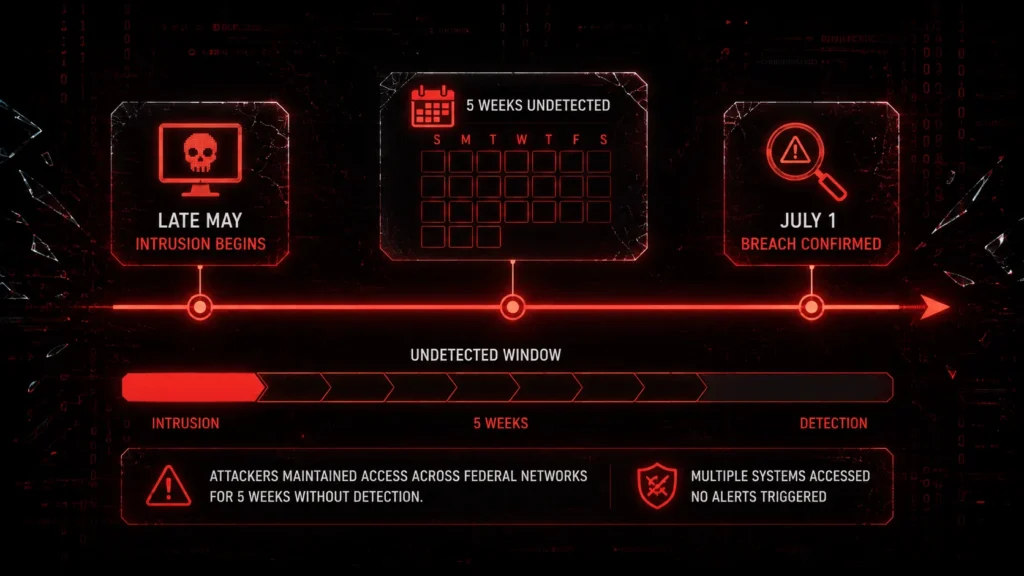
DHS confirmed on July 1, 2026 that attackers breached HSIN servers along with an associated SharePoint-based collaboration environment, according to TechTimes. The intrusion is believed to have started in late May or early June — meaning whoever got in had persistent access to the DHS HSIN environment for roughly a month before the government even knew it was happening, per Technology.org.
A month of unnoticed access inside DHS HSIN is a meaningfully long dwell time by any standard: enough time to map the network’s structure, identify which of the platform’s 35+ portals held the most valuable coordination data, and potentially stage further access before detection tools or human analysts ever flagged the intrusion.
Why the World Cup Timing Makes This Worse
DHS HSIN isn’t just any internal system. Sen. Mark Warner specifically noted that HSIN is actively supporting security coordination for the 2026 FIFA World Cup and the America250 celebrations, according to Inc.. The tournament runs across 11 US host cities alongside Canada and Mexico, with the final at MetLife Stadium on July 19 — meaning the exposure window overlapped directly with live security planning for one of the most-watched international events ever held on US soil.
This isn’t DHS HSIN’s first high-stakes deployment either. The same platform coordinated the emergency response to the January 2025 midair collision between an American Airlines regional jet and a US Army Black Hawk helicopter near Washington, DC, which killed 67 people, according to Technology.org. A platform this operationally critical sitting exposed for weeks is a materially different risk category than a typical corporate breach.
DHS has stated that classified networks were not affected and that it has isolated the impacted systems, but as of this writing, the agency has not disclosed whether attackers actually exfiltrated data, according to GBlock. That’s an important distinction reporters and researchers should keep tracking: “breached” and “confirmed data theft” are not the same claim, and DHS has only confirmed the former so far.
Three Breaches, One Pattern
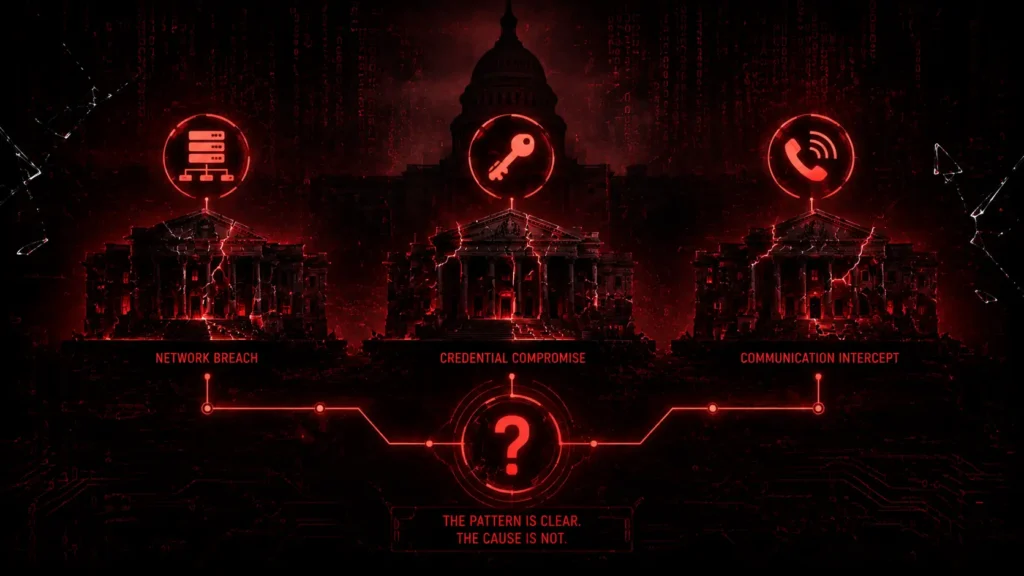
This isn’t an isolated incident, either. According to TheCyberSecGuru, a CISA contractor separately exposed a trove of passwords and cloud access keys to the open internet in May 2026 — weeks before this intrusion began.
The FBI, meanwhile, was forced to formally declare a “major cyber incident” earlier this year after a suspected China-linked breach of a surveillance system likely exposed phone numbers of active wiretap targets, a story we covered in depth separately. Layer this breach on top of that timeline and a pattern starts to look less like coincidence and more like a structural resourcing problem across the federal cybersecurity apparatus.
That framing matters because DHS and its cybersecurity arm, CISA, have both absorbed significant staffing reductions over roughly the same window these incidents occurred, per TheCyberSecGuru. Nobody has published exact staffing numbers tied specifically to HSIN’s security team, but the broader trend across federal cybersecurity staffing raises a legitimate question: is an agency running leaner actually able to keep pace with an attack surface this large?
Congress Demands Answers
Sen. Warner’s statement, published by his office on July 1, didn’t mince words: “The information in HSIN, while not classified, is highly sensitive, and its exposure risks national security,” he said, per Nextgov/FCW. Warner explicitly called on DHS and DOJ to jointly investigate who breached DHS HSIN, what was accessed, and ensure all HSIN partners receive timely information and mitigation tools.
As Vice Chair of the Senate Intelligence Committee, Warner’s involvement pushes the DHS HSIN breach beyond a routine cybersecurity disclosure and into the territory of active congressional oversight, with real potential for hearings, subpoenaed testimony, or a public investigative report depending on what the DOJ inquiry turns up.
The House Homeland Security Committee has separately requested its own briefing on the incident, meaning DHS is now facing scrutiny from both chambers of Congress simultaneously over the same DHS HSIN breach. That kind of dual-chamber interest rarely fades quietly; it typically produces a public paper trail — briefing memos, committee statements, possibly a formal report — that will make it far harder for DHS to characterize this incident as fully resolved without independent confirmation of exactly what happened inside DHS HSIN and who was responsible.
The Bottom Line
The DHS HSIN breach is a case study in why “sensitive but unclassified” is a dangerously misleading label. The data inside DHS HSIN was never meant to be classified, but it’s exactly the kind of operational, coordination-level information that matters most in the moments it’s actually being used — during a live World Cup security operation, or during a fatal midair collision response.
A platform sitting breached for a month, during the exact window it mattered most, isn’t a minor administrative failure. It’s a preview of what happens when critical coordination infrastructure gets treated as routine IT rather than as the load-bearing wall it actually is.
The uncomfortable truth about DHS HSIN is that its lack of a classified label likely made it an easier, more attractive target in the first place. Classified networks get the tightest budgets, the most rigorous audits, and the most senior security staff; unclassified-but-sensitive systems like DHS HSIN often sit one tier down in funding priority, even when the operational stakes they carry are comparable.
Until that funding and oversight gap closes, DHS HSIN and systems like it will keep occupying the exact blind spot attackers are best positioned to exploit — technically not classified, practically indispensable, and consistently under-resourced relative to the risk they carry.
Related: Norton Genie AI Scam Detector: Does It Actually Stop Scams in 2026? – Read the major features of the Norton Genie AI Scam Detector and understand its benefits in your daily life.
AI Cyberattacks: How One AI Found 555 Flaws Attackers Wanted First – One AI uncovered 555 software vulnerabilities before attackers could exploit them—showing how AI is becoming one of cybersecurity’s most powerful defenders.
AI Predator Warning: 7 Signs Your Child’s Chatbot Isn’t Safe – Learn the subtle warning signs of unhealthy AI chatbot interactions—and discover practical ways parents can keep children safe through awareness, open conversations, and smart digital habits.
Claude AI Went From $1B to $30B in Two Years. Its Security Story Is Just as Wild. – Claude went from $1 billion to $30 billion in two years by being brilliant at finding security flaws — the same brilliance a nation-state group used to jailbreak it for a live espionage campaign.
AI Browser Agents: Why One Is 90% More Vulnerable to Phishing – Every major AI browser shares the same unfixable flaw, and one of them is 90% more vulnerable to phishing than the browser you’re using right now.
Frequently Asked Questions (FAQ)
Q1. What is DHS HSIN, and why does it matter?
A live platform for federal/state/local/tribal/international security coordination — not a document archive, actively used during real events and emergencies.
Q2. How long were attackers inside before detection?
Roughly 4-5 weeks — intrusion started late May/early June 2026, confirmed by DHS on July 1.
Q3. Was classified information exposed?
DHS says classified networks weren’t affected, but hasn’t confirmed whether data was actually exfiltrated from the unclassified systems.
Q4. Is this connected to other federal breaches?
Yes — part of a pattern with a May 2026 CISA contractor exposure and an earlier FBI wiretap system breach.
Q5. What is Congress doing about it?
Sen. Mark Warner has called for a joint DHS/DOJ investigation; the House Homeland Security Committee has requested its own briefing.
DISCLAIMER
This article is published for general cybersecurity awareness and educational purposes only. The information contained herein is based on publicly available threat intelligence research and media reporting as of July 2026. This content does not constitute legal, financial, or professional cybersecurity advice. Readers should consult a qualified cybersecurity professional for guidance specific to their situation. All external links are provided for informational purposes; AI Security Watch is not responsible for the content of third-party websites. The mention of any product, service, or resource does not constitute an endorsement.Disclaimer