
⚡ TL;DR — Key Takeaways
- Dissecting the Creeper Worm means going back to 1971, decades before the internet or organized malware existed, to examine the first program that moved itself across a computer network without human intervention.
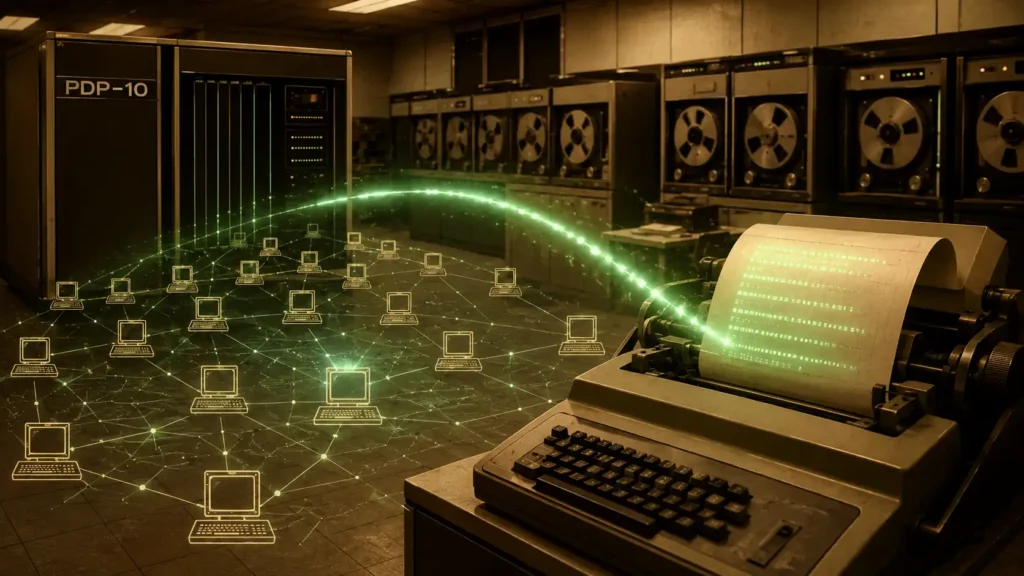
- The self-replicating mechanics: Creeper used the ARPANET’s Resource Sharing Executive protocol to copy itself to a remote PDP-10 mainframe, execute there, and delete its own footprint on the original host.
- The legendary terminal output: Infected Teletype terminals displayed the now-iconic message, “I’m the creeper, catch me if you can!”, marking the first documented instance of a program announcing itself to a human operator.
- The birth of antivirus: Ray Tomlinson, the BBN engineer who later gave email the “@” symbol, wrote a program called Reaper, the world’s first piece of defensive software, specifically to hunt down and remove Creeper from the network.
Table of Contents
In 1971, Bob Thomas, an engineer at Bolt, Beranek and Newman (BBN) in Cambridge, Massachusetts, wrote a program called Creeper as an experiment in whether code could move itself between computers on a network (source: Wikipedia, “Creeper and Reaper”).
The network it moved across was the ARPANET, the U.S. government-funded research network that would eventually evolve into the modern internet, and at the time it connected fewer than two dozen machines across American universities and research labs (source: Missed History, “The First Computer Virus in 1971”). One detailed technical retrospective on the program’s history notes that the original Creeper experiment was tested across at most 28 computers connected to the ARPANET running the TENEX operating system (source: SANS Internet Storm Center, “50 years of malware? Not really.”).
Dissecting the Creeper Worm matters for modern security thinking precisely because it wasn’t built with malice. Thomas wasn’t trying to steal data or extort anyone; he was testing a genuinely novel idea, that a piece of running software could relocate itself across a network perimeter entirely on its own, without a human physically copying a file from one machine to another.
That idea, harmless as it was in 1971, is the direct conceptual ancestor of every self-propagating threat that followed. Understanding how Creeper worked, and how BBN’s engineers responded to it, offers a clean, low-noise case study for foundational network security concepts that still apply to interconnected systems today.
I find it absolutely fascinating that the very first hack in human history was born as a completely harmless research experiment, not an act of crime, geopolitical espionage, or cyber warfare. Bob Thomas wasn’t looking to lock down databases or extract bank accounts; he was simply a curious engineer testing a brand-new boundaries-pushing concept. It is an amazing reminder that the entire field of cybersecurity was triggered not by malice, but by the natural human drive to see how far code could travel across a connected environment.
This case study walks through four forensic steps: the host environment Creeper operated in, the mechanics of how it moved between machines, the payload it displayed to human operators, and the countermeasure BBN built to eliminate it.
Step 1: Mapping the Host Environment and Port Intrusions
Creeper’s entire existence was tied to a specific piece of 1970s computing infrastructure: the Digital Equipment Corporation (DEC) PDP-10 mainframe, running an operating system called TENEX (source: History of Information, “The Creeper Worm, the First Computer Virus”). TENEX itself was developed at BBN, the same organization Thomas worked for, meaning he had deep, first-hand familiarity with the operating system’s internal mechanics before he ever wrote Creeper.
These PDP-10 machines were large, room-filling mainframes, a far cry from the personal devices connected to today’s networks, and each one represented a single node on the fledgling ARPANET. The network itself relied on simple packet-routing address tables rather than anything resembling a modern firewall or intrusion detection system, meaning there was effectively no gatekeeping layer standing between one trusted research machine and the next.
This absence of any real perimeter defense is what allowed Creeper’s experiment to work at all. A modern network segments and inspects traffic between hosts by default; ARPANET in 1971 was built entirely on implicit trust between a small, cooperative research community, and Creeper exploited that openness not through any flaw, but simply because nothing was there to stop it.
Step 2: Isolating the Self-Replicating REXEC Mechanism
Creeper’s propagation method was built on a BBN research project called RSEXEC, short for Resource Sharing Executive, an experimental concept exploring whether a running program could “jump” between machines to reach one with available computing resources or needed data. Creeper was, in effect, the demonstration program that came out of that broader research effort.
The mechanism worked in a specific, deliberate sequence. Creeper would locate another TENEX system reachable over the ARPANET, establish a connection to it, and transmit a copy of its own compiled program along with any data it needed to continue running.
Once the copy was confirmed running on the new remote machine, the original Creeper process terminated itself on the host it had just left. This is a critical technical distinction that separates Creeper from later, more aggressive malware: it relocated rather than multiplied, meaning at any given moment there was only ever one active instance of Creeper running somewhere on the network, not an exponentially growing swarm.
Ray Tomlinson later wrote an enhanced version of Creeper that did replicate rather than simply move, spreading copies without deleting the original, which is part of what ultimately prompted the countermeasure covered in Forensic Step 4 (source: Corewar, “Creeper and Reaper, the History of the First Computer Worm”).
Step 3: Deconstructing the Screen Payload Display
Every time Creeper successfully relocated to a new machine, it triggered a specific, human-visible behavior: a message printed directly onto the connected Teletype terminal. The text read, in the plain capital-letter style of the era’s hardware, “I’M THE CREEPER: CATCH ME IF YOU CAN” (source: Computer Timeline, “Bob Thomas”).
This single design choice marks a genuine first in computing history: a program deliberately announcing its own presence to a human operator, rather than operating silently in the background. Nothing about Creeper’s payload was destructive; it didn’t delete files, exfiltrate data, or damage the host system in any way, making the message closer to a digital calling card than a threat.
When you look at the stark capital letters of that 1971 Teletype output, it is impossible not to see the structural ancestry of modern ransomware screens. Today’s hostile extortion notes, blinking red on compromised corporate workstations, are the direct, aggressive descendants of Creeper’s polite warning. We have essentially moved from an era of playful digital tag among a circle of 23 trusted scientists to a highly weaponized global extortion landscape where the exact same notification design patterns are used to demand multi-million dollar payouts.
That said, the underlying pattern, a program that makes its intrusion visible and taunts the operator who discovers it, is one that persists directly into modern threat behavior. Where Creeper’s message was closer to a playful research footnote, that same on-screen notification concept reappears today in vastly more hostile form, demanding payment rather than simply announcing a successful game of network tag.
Step 4: Reconstructing the Reaper Counter-Measure
Creeper’s spread, and Tomlinson’s more aggressive replicating version of it, prompted the first documented network-wide security response in computing history. Tomlinson, already a known figure at BBN for his work adapting email to work across ARPANET, built a program called Reaper specifically to counter it.
Reaper was designed to move across the same ARPANET nodes Creeper had been using, searching the active memory of each TENEX system it reached for a running Creeper process. When it located one, Reaper terminated it, then continued its own journey to the next node on the network, repeating the search-and-remove cycle system by system (source: SmarterMSP, “The Creeper and the Reaper make cybersecurity history”).
This makes Reaper, by most historical accounts, the first piece of software built explicitly for the purpose of finding and removing another unwanted program from a network, the conceptual root of every antivirus and endpoint detection tool built since. The fact that this earliest security response was itself a self-propagating program, using the same mobility mechanism as the threat it was built to remove, is a detail worth sitting with; the first cybersecurity tool in history worked by fighting fire with fire.
Conclusion
Dissecting the Creeper Worm reveals a set of governance and risk management lessons that remain directly relevant more than fifty years later. An open, trust-based network perimeter allowed an experimental, non-malicious program to move freely between systems with no resistance, and the eventual fix required building dedicated software specifically to hunt it down.
Modern interconnected cloud networks operate at a scale Bob Thomas and Ray Tomlinson could never have imagined, but the core lesson holds unchanged: code can move across network boundaries on its own, and any environment built on implicit trust between connected systems is one incident away from needing its own version of Reaper. Studying where that pattern began is still one of the clearest ways to understand where modern network defense strategy comes from.
Securing our digital perimeters requires understanding the long-term historical context of network trust boundaries. What specific historical cyber incidents or real-world security case studies do you find most valuable when analysing modern risk management? Do you lean towards evaluating early mainframe anomalies like the Morris Worm, studying industrialised infrastructure exploits like Stuxnet, or focusing entirely on modern cloud-native supply chain compromises? Drop a comment in the box below and let me know your thoughts—lets share our case studies and dissect history together!
Related: Implementing Rate Limiting for OpenAI API Endpoints Via 7 Rigid Tiers to Stop Billing Attacks – A seven-tier, code-level guide for Node.js developers on implementing rate limiting for OpenAI API endpoints to stop Denial of Wallet attacks, layering in-memory limits, Redis-backed token buckets, cost-based throttling, and edge-layer Cloudflare/Nginx defenses.
Prevent API Key Leakage When Building Local AI Applications Via 5 Rigid Rules to Eliminate Risk – Protect your local AI applications from accidental API key leaks with simple, practical security controls that keep secrets out of code, logs, and public repositories.
Blocking AI Data Scraping on Shopify Stores Via 5 Proven Steps to Stop Theft – Learn how to block AI data scraping on Shopify stores, protect valuable product content, and control unwanted automated access to your online store.
Open-Source LLM Guardrails to Secure Your Custom Chatbots Using 3 Powerful Security Frameworks to Stop Hack Risks – Explore open-source LLM guardrails that help protect custom chatbots from prompt injection, unsafe outputs, data leaks, and other AI security threats.
Frequently Asked Questions (FAQ)
Q1. Was Creeper actually illegal, or was writing self-replicating code allowed at the time?
There were no laws against it at all, since computer-specific crime legislation like the U.S. Computer Fraud and Abuse Act didn’t exist until 1986, fifteen years after Creeper. In 1971, ARPANET was a small, cooperative research community where sharing and modifying code, even experimental self-moving programs, was standard practice rather than a violation of anything.
Q2. Is Creeper technically classified as a virus or a worm by modern security definitions?
Historians and security researchers actually disagree on this. Since the original version relocated rather than replicated (it deleted itself from the prior host), some argue it doesn’t meet the modern technical definition of either a virus or a worm, both of which typically require self-copying; it’s more accurately described as a “mobile program,” with the “worm” and “virus” labels applied retroactively by later writers.
Q3. Did Creeper or Reaper cause any lasting damage to the ARPANET or the machines involved?
No, neither program caused any destructive impact. Creeper didn’t delete files, corrupt data, or degrade system performance beyond the negligible resources needed to run and display its message, and Reaper’s entire function was cleanup, not further disruption.
Q4. What happened to Bob Thomas and Ray Tomlinson after this experiment; did their careers involve more security work?
Ray Tomlinson went on to become far more widely known for a separate, unrelated achievement: implementing the first networked email system and introducing the “@” symbol for addressing messages between machines. Thomas continued his broader research work at BBN, with Creeper remaining a footnote experiment rather than the centerpiece of his career.
Q5. How did people find out about Creeper and Reaper, given there was no internet or media coverage in 1971 to report on it?
Knowledge of the experiment spread primarily through internal BBN documentation, direct accounts from Ray Tomlinson decades later, and academic retrospectives written well after the fact once computer security became a recognized field. Much of what’s documented today relies on secondhand recollection and later technical write-ups rather than contemporaneous 1971 press coverage, since nothing like tech journalism covering software existed yet.
DISCLAIMER
Educational Notice: This article is published on AI Security Watch strictly for technical educational and general cybersecurity awareness purposes. The configurations and research discussed are based on public threat intelligence data. This content does not constitute professional IT architecture, legal, or financial advice. Because network configurations vary, always verify settings in an isolated test environment or consult with a qualified engineer before modifying live hardware or registries. AI Security Watch contains informational links to external resources; we are not responsible for third-party site accuracy or platform content.