
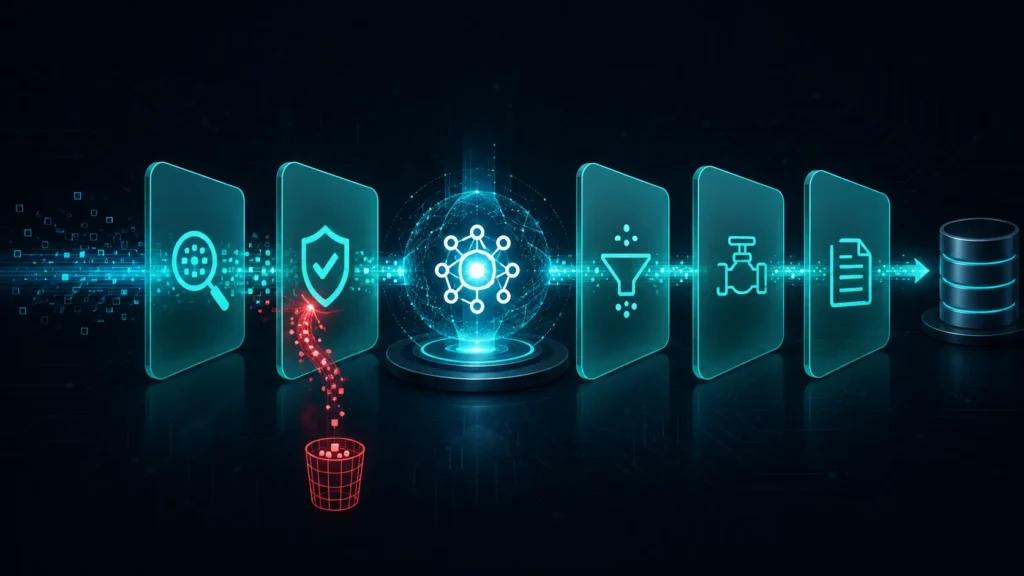
⚡ TL;DR — Key Takeaways
- Intercepting Boundary Injections: Configuring open source guardrails like Meta’s LlamaFirewall intercepts prompt injections at the input layer before a malicious instruction ever reaches your agent’s core reasoning process.
- Auditing Intent Realignment: Context-aware intent validation gates, powered by LlamaFirewall’s Agent Alignment Checks, inspect an agent’s internal chain-of-thought pathways to catch goal misalignment triggered by indirect injection strings.
- Masking Data Exfiltration Paths: Deploying strict output sanitization rules automatically masks internal system tokens, proprietary database keys, and private consumer records before any generated text block can leave your API gateway.
- Trapping Multi-Turn Exploits: Implementing real-time token rate limiting and session drift tracking restricts resource abuse anomalies while catching multi-turn configuration manipulation attempts on the fly.
Table of Contents
Deploying autonomous AI agents with direct access to internal databases, executive APIs, and customer file trees creates a massive application security exploit window if left unmonitored. An agent capable of reading email, executing code, and calling internal APIs on a user’s behalf inherits every privilege it is granted. A single crafted input can potentially redirect that privilege toward an attacker’s goal instead of the user’s intended path.
Traditional perimeter firewalls are completely blind to semantic vulnerabilities like prompt injection or indirect jailbreaks, since these attacks arrive as ordinary-looking text rather than malformed packets or known malware signatures. This is exactly why implementing programmatic open source guardrails at the application layer is mandatory: something needs to inspect token streams for semantic intent before they ever reach the backend model, since network-layer security tools have no visibility into what a sentence is actually asking the model to do.
There is a shocking, stomach-dropping realization that hits your engineering team when you watch an internal LLM agent easily trick itself into dropping an entire production database table or emailing private payroll spreadsheets to an unverified public account. The intruder did not exploit a traditional buffer overflow or a broken authorization token—they simply typed a clever, multi-layered sentence into a standard web text box. Realizing that a basic string of English text can completely override your core infrastructure instructions and turn your own automation agent into an insider threat changes your entire approach to API security. It forces you to accept that foundational models cannot protect themselves from creative manipulation.
This implementation manual covers five strategic controls engineered using Meta’s LlamaFirewall framework, a robust toolset for establishing open source guardrails: input validation scanning, context-aware intent filtering, output sanitization, rate limiting with session drift rejection, and immutable audit logging.
CONTROL 1: INTEGRATING DYNAMIC INPUT VALIDATION LAYER SCHEMAS
The first line of defense is inspecting every input string before it reaches your agent’s core reasoning layer. LlamaFirewall’s PromptGuard 2 classifier serves exactly this role. It is available as a lightweight jailbreak and injection detection engine in two configurations: an 86-million-parameter model tuned for maximum detection precision, and a 22-million-parameter variant optimized for low-latency edge deployment where response time is critical.
- Categorize Incoming Payloads: Configure this input scanning layer to intercept three distinct categories of malicious payload: toxic or policy-violating content, adversarial prompts specifically engineered to manipulate model behavior, and hidden system override scripts embedded within otherwise ordinary-looking text.
- Route All External Data Streams: Route every incoming user message, and critically, every piece of untrusted external content an agent ingests—including scraped web pages, inbound emails, and uploaded documents—through this scanning layer before it ever reaches the agent’s execution logic.
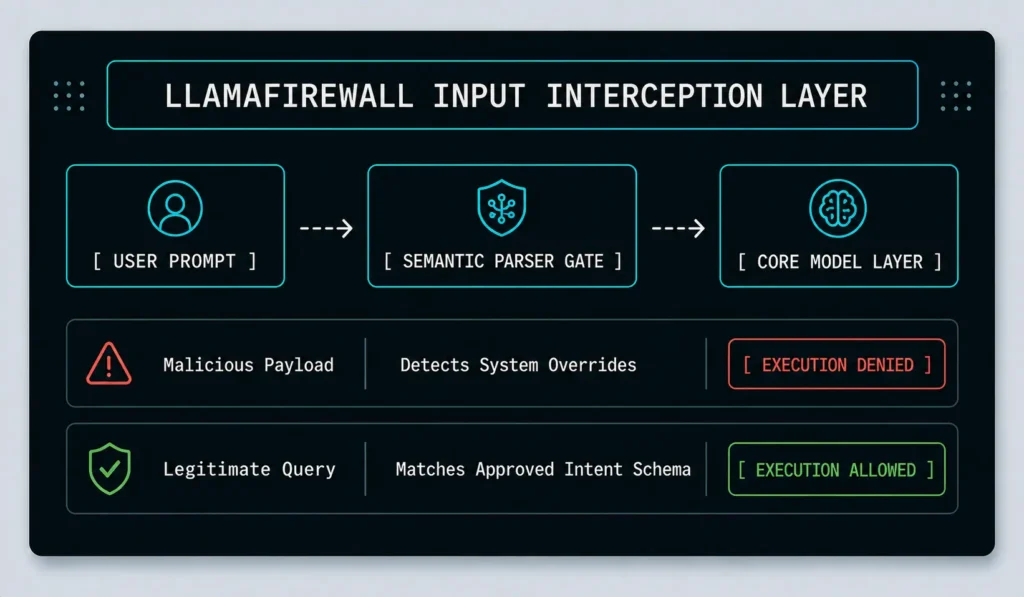
Relying solely on a model’s system prompt instructions to “ignore malicious inputs” or “stay aligned with safety parameters” is a failed defensive architecture. System instructions are easily overridden by advanced indirect injection vectors. If an attacker embeds a hidden command inside a third-party webpage that your agent reads, the model’s contextual processing treats that instruction as part of its live context window, frequently blinding it to its original guidelines. Hard, application-layer open source guardrails must intercept the payload before it ever reaches the model’s context array.
This distinction matters architecturally: PromptGuard 2 catches direct injection attempts typed straight into a chat interface. However, indirect injection—malicious instructions hidden inside a webpage or document that the agent reads autonomously later—demands the exact same scanning discipline applied to every external data source the agent touches, rather than protecting only the user-facing text input field.
CONTROL 2: ENFORCING CONTEXT-AWARE INTENT FILTERING AND SYSTOKEN ISOLATION
Input scanning catches known malicious patterns, but sophisticated attacks can still slip through as benign-looking requests. These inputs only become dangerous once the autonomous agent begins acting on them. LlamaFirewall addresses this specific gap with Agent Alignment Checks, functioning as a chain-of-thought auditor that inspects the agent’s internal reasoning process—rather than just its raw text inputs—for signs of structural manipulation or goal misalignment.
- Audit Internal Reasoning Pathways: Configure this layer to mediate between raw user queries and agent execution nodes. This architecture passes prompt payloads through semantic validation pipelines that verify whether the agent’s planned actions remain completely aligned with the user’s original stated goal.
- Prevent Token Extraction Loops: This semantic enforcement step prevents system prompts from being overwritten or extracted via social engineering tricks. The evaluation occurs at the reasoning level, completely replacing surface-level, pattern-matching regex filters on raw text inputs.
This category of defense maps directly onto risks formally documented in the OWASP Top 10 for Large Language Model Applications, particularly prompt injection and excessive agency. Both vectors require this exact class of intent-level validation rather than relying on surface-level input filtering alone. Independent evaluation benchmarks confirm that implementing these layered open source guardrails drops attack success rates from a high 17.6% down to just 1.7%, delivering an ironclad improvement over baseline model safety tuning.
CONTROL 3: CONFIGURING OUTPUT SANITIZATION ERRORS AND PII MASKING
Implementing open source guardrails on the input side is insufficient if the autonomous agent’s generated responses leak sensitive data. Output-side inspection functions as a distinct control layer, scanning what the model is about to output before it ever reaches the end user or downstream integrated systems.
Scan for Key Exposure Categories: Configure output inspection scripts to systematically scan the LLM’s generated token strings for four specific leakage categories:
- Exposed database keys, access tokens, or system credentials.
- Internal system architecture strings or file paths that could aid further network intrusions.
- Private consumer records (PII) that the agent shouldn’t be surfacing to that specific user group.
- Fragments of internal prompt logic or system instructions that reveal how your processing framework is structured.
Enforce Hard-Block Gateway Triggers: Apply this scanning as a mandatory gateway step positioned after response generation but before payload delivery. This architecture ensures that no output reaches a user or downstream API call without passing this validation check first. Treat any flagged output as a hard block rather than a soft warning, since an exposed customer record or a leaked credential cannot be un-sent once delivered.
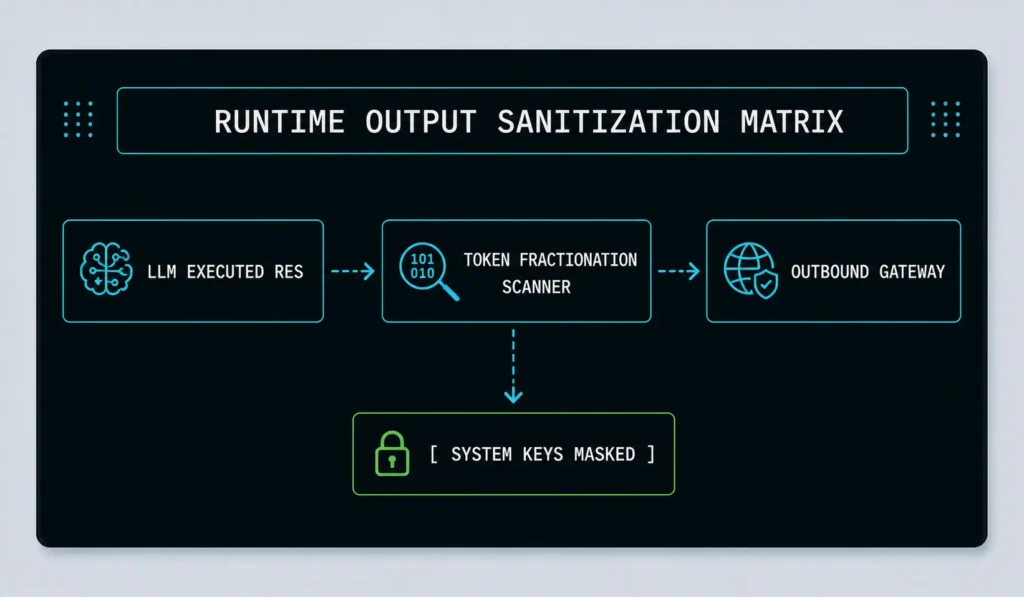
Each of these checks handles a different computational failure mode. An agent asked an innocent-seeming question might genuinely fail to realize that a piece of its active context window contains a raw credential it shouldn’t repeat back, making automated application-layer filtering mandatory.
CONTROL 4: DEPLOYING REAL-TIME TOKEN RATE LIMITING AND SESSION DRIFT REJECTION
Beyond content-level risks, autonomous AI agents introduce a resource-based attack surface. An attacker can attempt to exhaust your operational token budget, degrade system performance for legitimate users, or probe for weaknesses through sustained, high-volume interaction. This control explicitly addresses the multi-turn manipulation and brute-force dimension that single-message input scanning alone fails to cover.
- Track Multi-Turn Interactivity: Track conversational session data across multiple turns rather than analyzing individual messages in isolation, as sophisticated semantic manipulation attempts often build toward a jailbreak gradually across a sequence of seemingly innocent exchanges.
- Terminate Anomalous Sessions: Configure automated thresholds that terminate access tokens the moment anomalous query volumes, unusual request patterns, or system manipulation strings manifest within a session, rather than waiting for a single dramatic red flag.
Session drift detection specifically watches for a conversation gradually moving away from its original stated purpose—an early warning signal distinct from any single message triggering an outright block. Pairing rate limiting with this drift detection closes both the resource-exhaustion and the slow-burn manipulation attack paths simultaneously.
CONTROL 5: IMPLEMENTING IMMUTABLE AUDIT LOGGING AND ANOMALY ALERTS
Every control covered so far operates in real time, but a complete security posture also requires a durable, reviewable record of what actually happened. This final control transforms your guardrail deployment from a reactive filter into an auditable, DevSecOps-compliant system.
- Establish Centralized Logging Arrays: Output every input-output pairing safely into a centralized, read-only logging aggregation point. This tracking captures what was asked, what the agent attempted, and what your guardrail layers flagged or blocked at each stage.
- Enforce Administrative Log Sanitization: This logging pipeline must exclude unmasked consumer data or internal cryptographic secrets from the stored record itself. Apply the same output sanitization principles from Control 3 to your own internal logs, not just to user-facing responses.
- Deploy Aggregated Anomaly Alerts: Configure real-time anomaly alerts against this log stream, flagging patterns like repeated injection attempts from a single session, unusual spikes in blocked requests, or output-sanitization triggers clustering around a specific agent capability.
This configuration gives your security team the forensic visibility needed to investigate an incident after the fact, and the early-warning signal needed to catch a sustained attack campaign before it succeeds through sheer persistence.
CONCLUSION & INTERFACE ISOLATION SUMMARY
Securing autonomous AI agents requires an active, runtime interception strategy rather than assuming foundational models have baked-in safety parameters sufficient on their own. Implementing open source guardrails like LlamaFirewall exists precisely because model-level safety training, however well-intentioned, was never designed to withstand the sustained, adversarial pressure a production agent with real API access and file system permissions will eventually face.
Deploying all five controls together—input validation scanning, context-aware intent filtering, output sanitization, rate limiting with drift detection, and immutable audit logging—closes the gap between what a model was trained to refuse and what a determined attacker can actually get it to do in practice. Treat this layered defense as mandatory production infrastructure for any agent with elevated privileges, rather than an optional hardening pass reserved for after your first security incident.
Hardening production agents requires balancing strict perimeter safety with real-world system performance. What specific open source guardrails configurations, latency overhead constraints, or token parsing limits does your engineering team manage while protecting your custom AI agents? Do you find that prompt-layer classification or output sanitization scripts inject the most latency into your inference loops? Drop a comment below and share your experience—let’s share our deployment roadmaps and help each other build bulletproof AI architectures!
Related: Combating Threat Actor RMM Usage via 5 Rigid Infrastructure Group Policies – A practical five-layer defense strategy to stop threat actors from abusing legitimate RMM tools for stealthy access, persistence, and lateral movement across enterprise environments.
Building an ISMS Framework in 5 Strategic Steps to Pass External Audits – Building an ISMS framework gives organizations a structured way to identify information-security risks, implement effective controls, and continuously improve their security posture.
Neutralizing Corporate Identity Theft Exposures Via 6 Proven Controls – Neutralize corporate identity theft by combining credit protection, domain takedowns, email authentication, registry monitoring, brand alerts, and payment verification into one layered defense.
Stopping Email Tracking Pixels Via 5 Rigid Rules to Prevent Spy Attacks – Stop invisible email surveillance by blocking tracking pixels, stripping telemetry links, and hardening your inbox with layered privacy controls.
FREQUENTLY ASKED QUESTIONS (FAQ)
Q1. Does LlamaFirewall only work with Meta’s own Llama models, or can it protect agents built on other LLMs like GPT-4 or Claude?
LlamaFirewall is entirely model-agnostic by design. Because it operates as an external, programmatic software layer inspecting API traffic rather than modifying a specific model’s internal weights, it can protect any artificial intelligence system. You can seamlessly integrate it with open-source models or closed-source commercial APIs like OpenAI’s GPT-4 or Anthropic’s Claude, as long as your application architecture lets you intercept token streams at the input and output gateways.
Q2. How much latency does adding these five guardrail controls actually introduce to an agent’s response time?
The exact processing overhead depends on which specific modules you enable and how you configure your inference pipelines. To minimize impact, LlamaFirewall provides a highly optimized 22-million-parameter PromptGuard 2 variant specifically built for low-latency, edge-deployed applications where user response time is critical. Because deeper chain-of-thought auditing via Agent Alignment Checks is computationally intensive, many enterprise engineering teams run lightweight input/output scanning on every standard transaction, while reserving deep alignment checks exclusively for high-privilege actions like executing database writes or triggering outbound email relays.
Q3. Can these guardrails be bypassed if an attacker specifically studies how PromptGuard 2 or Agent Alignment Checks work, since it’s open source?
While open-source transparency allows adversaries to download the code and analyze its detection logic locally, the framework’s multi-layered defense strategy specifically accounts for this risk. No security posture should rely on obscurity. Even if a sophisticated attacker crafts an input string that slips past the pattern-based input scanning tier, the independent reasoning-level alignment check and strict output sanitization layers serve as automated backstops, making complete perimeter compromise exceptionally difficult.
Q4. Do I need to run all five controls, or can I start with just one or two if I’m building a smaller, lower-risk agent?
If you are deploying a low-privilege, read-only agent that simply answers basic questions from a public knowledge base, starting with basic input validation and hard-block output sanitization is an acceptable baseline. However, if your agent possesses write privileges, API execution rights, or access to private customer repositories, implementing all five controls is non-negotiable. The higher an automated agent’s privilege tier, the more critical each independent defensive layer becomes to contain potential data exfiltration campaigns.
Q5. Is LlamaFirewall actively maintained, or is this a research project that’s since been abandoned?
LlamaFirewall is actively maintained as a production-grade safety framework. According to official development tracking repositories, Meta leverages this exact architecture internally across its own commercial production lines rather than treating it as a static academic research artifact. Meta’s ongoing roadmap includes scaling the software to support multimodal agent inputs (like image and audio parsing) and continuously optimizing the latency profiles of their reasoning auditors, ensuring long-term utility for enterprise security architectures.
DISCLAIMER
Educational Notice: This article is published on AI Security Watch strictly for technical educational and general cybersecurity awareness purposes. The configurations and research discussed are based on public threat intelligence data. This content does not constitute professional IT architecture, legal, or financial advice. Because network configurations vary, always verify settings in an isolated test environment or consult with a qualified engineer before modifying live hardware or registries. AI Security Watch contains informational links to external resources; we are not responsible for third-party site accuracy or platform content.
The dawn of AI is here and thriving more than most people know.
Yeah its alot