

⚡ TL;DR — Key Takeaways
- Systematizing Corporate Posture: Successfully building an ISMS framework converts fragmented, ad-hoc data habits into a centrally documented, structured architecture that enterprise procurement buyers can independently verify rather than taking your data safety claims on faith.
- Bounding Information Repositories: Defining organizational asset perimeters guarantees that every private datastore, cloud code repository, and physical workspace boundary falls under a clearly scoped, legally defensible protective umbrella.
- Executing Quantifiable Assessment: Conducting formalized asset risk triage replaces gut-feeling infrastructure priorities with a repeatable, highly structured risk treatment methodology backed by a formal Statement of Applicability.
- Operationalizing Daily Enforcement: Deploying baseline security controls alongside continuous internal audit validation mechanics transforms static policy documents into living, evidence-backed proof of continuous runtime governance.
Table of Contents
Early-stage scaleups and technology companies routinely hit a sharp commercial ceiling when enterprise buyers demand verifiable proof of structural information security before executing major vendor contracts. A promising business deal stalls indefinitely the exact millisecond a prospective customer’s procurement team asks for architectural compliance documentation that simply does not exist yet. When this bottleneck manifests, no amount of verbal engineering reassurance can close the governance gap.
Building an ISMS framework serves as the foundational data architecture that shifts an engineering organization away from unverified, ad-hoc data handling habits into an audit-ready, internationally certified security posture. This process does not function as a marketing exercise; it represents a core structural commitment to documenting, enforcing, and continuously proving that your organization systematically isolates and protects the digital assets it handles.
There is a painful, sobering realization that hits many software founders during their first major enterprise security review. They confidently state that their application is hosted on an AWS or Google Cloud architecture that is already SOC 2 and ISO 27001 certified, completely conflating infrastructure security with organizational data governance. Cloud vendors protect the physical hypervisors; they do not write your internal employee background check policies, access control logs, or incident response playbooks. Founders routinely freeze when an enterprise procurement officer asks to see the startup’s own documented Information Security Management System, realizing that a secure cloud host does not mean your corporate business operations are compliant.
This module details five strategic operational steps to clear your path toward compliance: defining your asset boundary perimeter, executing formalized risk triage, deploying administrative controls and core policy standards, operationalizing continuous monitoring, and running internal audit validation drills before your official certification review.
STEP 1: DEFINING THE ORGANIZATIONAL APPLICABILITY AND ASSET BOUNDARY PERIMETER
Every information security management system implementation begins with a precise, deliberate answer to a single core question: what exactly is being protected? Skipping this step or defining your scope too vaguely creates an unstable compliance foundation riddled with invisible gaps. These visibility blind spots inevitably surface later, usually during the worst possible moment—an active third-party external audit.
- Isolate Every Production Repository: Identify and catalog every single data store your organization operates. This inventory must span primary production databases, offsite backup archives, cold storage vaults, and any auxiliary analytics or logging pipelines that interact with sensitive client information.
- Map Software & Infrastructure trees: Document your cloud code repositories explicitly, including all private package registries, internal deployment tooling, and infrastructure-as-code (IaC) configuration templates that could expose underlying architectural details if compromised.
- Establish Hardware & Identity Perimeters: Extend this architecture mapping to physical hardware boundaries, local office networks, endpoint employee devices, and on-premises development equipment, alongside a clear definition of which distinct user groups (employees, temporary contractors, and automated third-party integrations) fall under the ISMS’s protective shield.
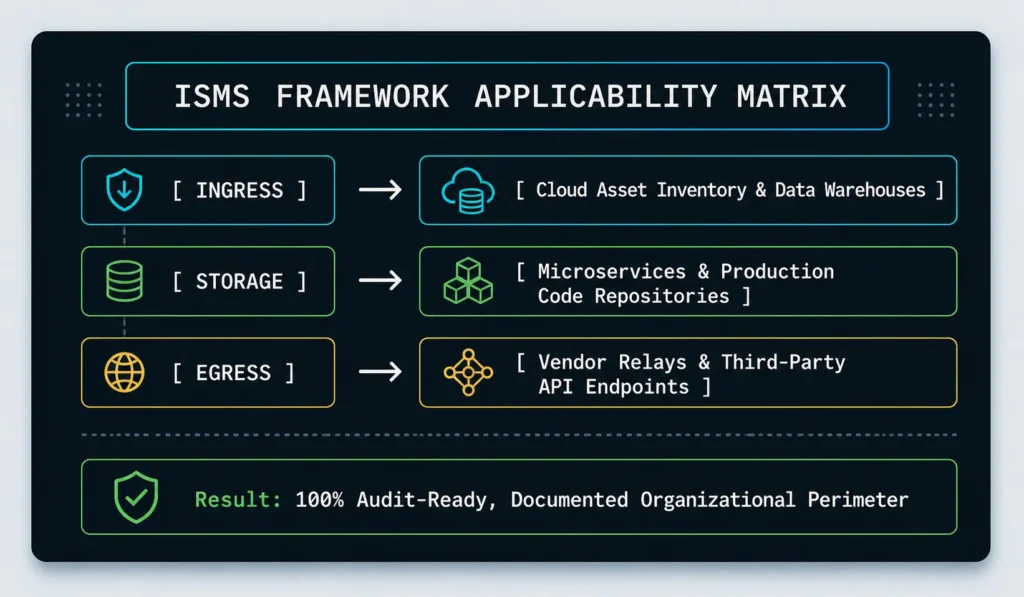
The explicit operational goal of this initial step is ensuring that no orphan environment—such as a forgotten staging server, an unmonitored tracking plugin, or an overlooked contractor credentials profile—sits outside your defined boundary where nobody is held directly accountable for its security posture.
STEP 2: EXECUTING FORMALIZED ASSET RISK TRIAGE AND MATRIX IMPACT ANALYSIS
With your boundary defined, the next step converts that asset inventory into a structured risk management exercise. This is where building an ISMS framework shifts from passive documentation into genuine, prioritized risk decision-making.
Inventory every corporate data asset identified in Step 1, then assign each one a probability rating and an impact rating, capturing both how likely a given threat is to materialize and how severely it would affect the business if it did. Multiplying these two figures produces a combined risk score, giving you an objective basis for prioritization rather than relying on which risk feels most urgent on a given day.
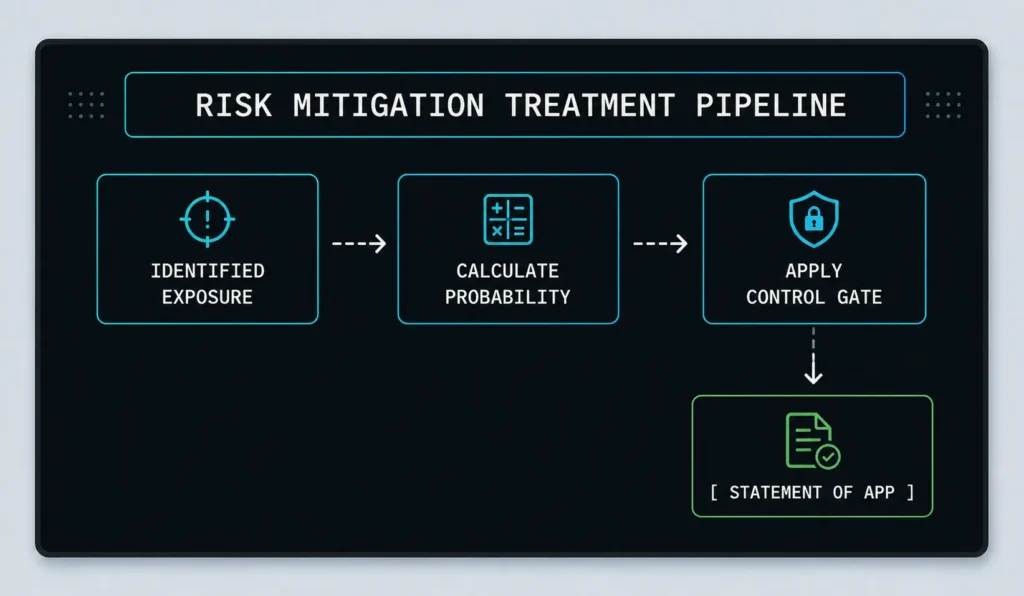
A critical pitfall during initial setup is attempting to treat every single business asset with identical maximum security priority. Classifying your public marketing blog with the same extreme confidentiality constraints as your primary production database creates immediate operational bottlenecks. If every minor tool requires multi-sig key validation and manual code reviews, your development velocity will collapse under unmaintainable audit friction. You must classify assets into distinct tiers so your security resources are concentrated where the actual systemic exposures live.
Draft a formal Statement of Applicability (SoA), the mandatory document logging which specific controls from your chosen framework apply to your organization, which do not, and the documented justification for each decision. This becomes the central reference auditors return to repeatedly, since it directly connects your abstract risk assessment to the concrete controls you have actually committed to implementing across your environment.
STEP 3: DEPLOYING ADMINISTRATIVE SECURITY CONTROLS AND CORE POLICY STANDARDS
Risk assessment identifies what needs protecting; this step creates the enforceable rules that actually protect it. Administrative controls translate your Statement of Applicability from a planning document into operational reality.
- Generate an Acceptable Use Policy (AUP): Define what employees can and cannot do on company infrastructure, covering password complexity standards, device usage, and remote connectivity requirements in language every employee can genuinely understand and follow.
- Build Access Management Logs: Document who has access to which systems and why, paired with a defined review cadence confirming that access still matches current roles.
- Draft an Incident Response Map: Outline a clear, sequenced plan for what happens the moment a security incident is detected, including escalation paths and named responsible parties.
Round out your core documentation with a security awareness operational protocol, defining how and how often employees receive security training, since a policy nobody has been trained on carries far less audit credibility than one paired with documented awareness efforts. Review the International Organization for Standardization’s official compliance directory directly for authoritative reference material when structuring these core documents against internationally recognized asset classification and control standards.
STEP 4: OPERATIONALIZING CONTINUOUS THREAT LOGGING AND PERIMETER MONITORING
Written policies satisfy your entry documentation requirements, but third-party auditors specifically look for hard evidence that those parameters are actually being followed day-to-day. This phase is what transforms static files into a living, continuously verifiable system.
- Implement Real-Time Monitoring Infrastructure: Deploy live monitoring tools across the specific boundaries defined in Step 1. Your tracking must capture login events, configuration alterations, and privilege anomalies as they happen rather than attempting to reconstruct events retroactively after a compromise occurs.
- Establish Centralized Audit Logging: Ensure that every significant engineering action across your protected environment generates a timestamped, tamper-resistant record available for subsequent validation.
- Consolidate Evidence via Metric Dashboards: Build a unified security metrics dashboard that pulls this data stream into a single, reviewable layout. This gives your operational team, and eventually your external certification auditor, transparent visibility into whether your controls are functioning as documented on an ongoing basis.
This continuous evidence trail is precisely what separates a genuinely operating data framework from a policy binder that exists purely for show.
STEP 5: INITIALIZING INTERNAL AUDIT DRILLS AND THE MANAGEMENT REVIEW LOOP
Before any external certification body reviews your infrastructure, your own organization needs to validate that the framework actually works. This final step functions as the mandatory operational rehearsal that catches system gaps before they turn into formal non-conformities during the official assessment that determines your certification outcome.
- Conduct Independent Internal Audit Simulations: Have someone who is not directly responsible for the control being tested walk through your documented processes exactly as an external auditor would.
- Document Non-Conformity Discoveries Explicitly: Log the specific gap, its operational severity, and the corrective actions taken. Demonstrating a proactive internal process for catching and fixing your own gaps provides highly valuable audit evidence.
- Execute Structured Management Review Sessions: Require organizational leadership to formally evaluate the ISMS’s performance, analyze security incident data or internal audit logs, and approve resource allocation for continued infrastructure hardening.
This governance loop closes the gap between daily operational reality and executive accountability, ensuring the framework steadily tightens over time rather than stagnating after its initial build.
CONCLUSION & CURRICULUM CLASSROOM SUMMARY
Building an ISMS framework across all five strategic steps—boundary definition, risk triage, administrative controls, continuous monitoring, and internal audit validation—gives an organization the structural credibility that enterprise procurement teams and certification bodies both require. Each phase builds directly on the one before it, and skipping any single step leaves your entire compliance framework resting on an unstable foundation.
A successful information security system functions as a stateful, repeatable execution pipeline, rather than a passive, point-in-time document configuration check completed once and shelved. Organizations that treat these five steps as an ongoing operational discipline—revisited and strengthened continuously rather than assembled in a panic right before a single audit deadline—are the ones that pass external certification cleanly and maintain it seamlessly through every subsequent review cycle.
Transitioning from decentralized startup habits to a structured compliance perimeter brings unique operational challenges. What specific compliance hurdles, policy documentation friction points, or automated internal audit tooling arrays (such as Vanta, Drata, or self-hosted evidence collectors) does your team leverage while scaling your corporate ISMS perimeters? Do you find that assigning asset ownership or writing your statement of applicability creates the most internal friction? Drop a comment below and share your experience—let’s share our governance roadmaps and help each other clear our next external audit gates!
Related: Neutralizing Corporate Identity Theft Exposures Via 6 Proven Controls – Neutralize corporate identity theft by combining credit protection, domain takedowns, email authentication, registry monitoring, brand alerts, and payment verification into one layered defense.
Stopping Email Tracking Pixels Via 5 Rigid Rules to Prevent Spy Attacks – Stop invisible email surveillance by blocking tracking pixels, stripping telemetry links, and hardening your inbox with layered privacy controls.
Conducting a HIPAA Assessment Via 4 Rigid Control Measures – A rigorous HIPAA assessment turns healthcare data protection into a continuous process of mapping PHI, enforcing access controls, validating encryption, and managing third-party risk.
Understanding ISO 27001 Foundations Using 6 Practical Rules – ISO 27001 turns information security into a practical, repeatable governance system—helping organizations protect critical assets, manage risk, and build lasting trust through six foundational rules.
FREQUENTLY ASKED QUESTIONS (FAQ)
Q1. Is building an ISMS framework specifically tied to ISO 27001, or does it apply to other security frameworks too?
While the concept of an Information Security Management System (ISMS) formally originates from and is most strictly codified by the ISO 27001 standard, its foundational architecture is framework-agnostic. The exact same five-step methodology—spanning perimeter scoping, risk matrix triage, administrative control deployment, continuous monitoring, and internal audit validation—applies universally across alternative regulatory frameworks like SOC 2, HIPAA, or the NIST Cybersecurity Framework (CSF). Building an ISMS establishes the underlying security discipline and data governance habits, which seamlessly adapt to whatever specific certification matrix your enterprise procurement buyers demand.
Q2. How long does it typically take a small engineering team to complete all five steps before pursuing formal certification?
The operational timeline varies depending on your current headcount and existing infrastructure maturity, but most lean engineering teams spend three to six months building out Steps 1 through 4 before they are genuinely prepared for the mock internal audit drills outlined in Step 5. Attempting to rush this timeline to meet a sudden sales or enterprise procurement deadline usually results in a set of policy documents that look complete on paper but do not reflect daily runtime reality—a compliance gap that certified external inspectors are specifically trained to uncover during field reviews.
Q3. Do we need a dedicated compliance hire to execute this five-step process, or can existing engineering leadership own it?
A full-time compliance hire is not a strict prerequisite, particularly for early-stage startups and lean teams. This implementation process is commonly owned by an existing engineering manager, Chief Technology Officer (CTO), or operations director who can allocate focused blocks of time to architecture mapping and policy drafting. As your organization scales and your data ecosystem grows more complex, bringing on dedicated Governance, Risk, and Compliance (GRC) personnel becomes a natural transition, but it is entirely possible to clear your initial certification gates using your current leadership structure.
Q4. What is the actual operational difference between the internal audit in Step 5 and the official external certification audit that follows it?
The internal audit functions as a self-directed or third-party assigned dress rehearsal engineered to catch system flaws before they can impact your brand, whereas the external certification audit is conducted by an accredited third-party body whose findings directly dictate whether you receive your official certificate. A rigorous internal audit process should uncover and resolve almost all non-conformities before the official inspector arrives on-site. Ultimately, a clean external certification review is a direct reflection of how seriously your team treated the internal rehearsal phase.
Q5. If our Statement of Applicability changes significantly after certification, does that invalidate our existing ISMS certification?
No, but it does mandate immediate documented revisions. Accredited certification bodies fully expect an operational ISMS to evolve dynamically as your company’s data assets, threat environments, and administrative controls shift over time. Any major modifications must be logged in an updated Statement of Applicability (SoA) and backed by clear evidence trails inside your continuous monitoring dashboards. This ongoing tracking requirement is precisely why Step 5’s management review loop operates as a permanent business routine rather than a one-time pre-certification task, keeping your compliance documentation accurate instead of frozen at your initial audit snapshot.
DISCLAIMER
Educational Notice: This article is published on AI Security Watch strictly for technical educational and general cybersecurity awareness purposes. The configurations and research discussed are based on public threat intelligence data. This content does not constitute professional IT architecture, legal, or financial advice. Because network configurations vary, always verify settings in an isolated test environment or consult with a qualified engineer before modifying live hardware or registries. AI Security Watch contains informational links to external resources; we are not responsible for third-party site accuracy or platform content.