⚡ TL;DR — Key Takeaways
- Administrative access controls: Establishing rigorous procurement verification gates forms your primary defensive layer—vetting third party saas vendors must actively begin before any service contracts are signed, ensuring you lock down exactly what operational access a provider receives before they can interface with your architecture.
- Vendor/client parameter validation: Every system integration point requires strict architectural boundary validation checks; treating external data connections as trusted pathways allows unvalidated webhook parameters and overly broad OAuth token grants to function as silent entry points into your core environment.
- Stream-optimized runtime flags: Deploying programmatic, continuous security tracking metrics yields vastly superior protection compared to relying on a basic, one-time procurement approval—tracking vendor risk must operate as an active workflow because an external platform’s risk profile changes dynamically after onboarding.
- Perimeter isolation validation: Securing structural system integrity demands proactive, rigorous containment validation; you must explicitly test your infrastructure’s ability to isolate or cut off a connected vendor instantly, because if you cannot sever an integration fast during an emergency, you do not truly control the risk.
Table of Contents
Unstructured external software adoption operates completely outside your direct network view by default, prioritizing short-term department convenience over centralized architectural governance. Fast-moving engineering and corporate teams routinely sign up for new external utilities, immediately connect them to primary production environments using live tokens, and quickly move on to other tasks without ever mapping out the exact data privileges or systemic visibility granted.
This loose onboarding habit functions adequately during early-stage scaling, but it introduces an immediate, critical infrastructure liability the exact moment one of those connected platforms experiences a security incident. Your core system databases become highly vulnerable to lateral supply chain data leaks because threat actors do not need to attack your perimeter directly; they simply exploit the weakest link in your ecosystem by breaching a trusted partner that holds your unmonitored API connection keys.
Deciding to deploy a structured framework for vetting third party saas vendors is a mandatory, revenue-critical engineering requirement rather than a bureaucratic procurement formality. Operating without rigorous software vetting controls allows unmapped data pipelines, hidden application backdoors, and vendor-side configurations to drift silently across your technical landscape. These external vulnerabilities inevitably grant unauthorized network execution pathways to remote threat actors, exposing your entire corporate network to catastrophic exploitation if a connected service is compromised.
There is a profound, stomach-dropping sense of technical disbelief that hits you when you conduct a routine infrastructure access review and discover that a low-tier marketing analytics utility your team onboarded months ago holds standing read/write permissions to your primary client production databases. You expect typical software utilities to sit within tight operational cages or read-only sandboxes, but instead, you see a basic vendor account operating completely unmonitored with global system keys. It is a massive wake-up call to realize that default SaaS integration prompts do not protect your data boundary; unvetted tools are actively functioning as hidden backdoors into your system, turning a simple procurement mistake into the single greatest threat to your organization’s perimeter security.
The five production-grade practices detailed below transform vendor assessment from a superficial onboarding checkbox into a repeatable, code-enforced security control loop. By methodically working through artifact screening, access scoping boundaries, webhook parameter insulation, and incident containment testing, you can guarantee that your vetting third party saas vendors workflow actively isolates your internal runtime from public exploitation.
STEP 1: PARSING COMPLIANCE ARTIFACTS AND CRITICAL SOC 2 AUDIT RED FLAGS
Compliance documentation establishes the foundational review tier during your procurement lifecycle, but it only functions as a viable shield if your security team knows how to analyze the text past a superficial, surface-level pass/fail summary. Relying blindly on marketing badges or basic compliance certificates introduces immediate risk into your core operational pipeline.
- Request the full SOC 2 Type II report, not just the cover letter: A vendor asserting compliance metrics without immediately producing the underlying, full-text documentation is a primary indicator of systemic risk—the complete report houses the actual testing observations, exceptions, and multi-month performance data that truly matter.
- Check for a qualified opinion from the external auditor: Carefully parse the auditor’s formal declaration page to sweep for a qualified opinion, which explicitly signals that one or more internal control metrics failed to meet security expectations during the historical testing window; this major red flag is easily overlooked if you only skim the executive summary.
- Isolate missing Complementary User Entity Controls (CUECs): Audit the CUEC definitions to identify exactly what configurations your organization is legally and technically responsible for maintaining on your end—if your vetting third party saas vendors workflow glosses over these parameters, you risk inheriting massive security responsibilities without your engineering team’s knowledge.
- Identify carved-out infrastructure subsystems: Scrutinize the report’s scoping boundaries to determine if specific cloud architectures, data centers, or ancillary microservices were carved out or completely excluded from the assessment; you must explicitly verify that the exact software modules your business integrates are the specific components that underwent formal evaluation.
STEP 2: ENFORCING DATA SHIELDING BOUNDARIES VIA THE PRINCIPLE OF LEAST PRIVILEGE
Once an external provider clears the initial documentation review stage, the next step is making sure their technical access permissions precisely mirror the absolute minimum requirements of their operational role. Granting expansive default access to external services is a primary driver of enterprise breaches, requiring teams to build tight containment loops around all inbound connection paths.
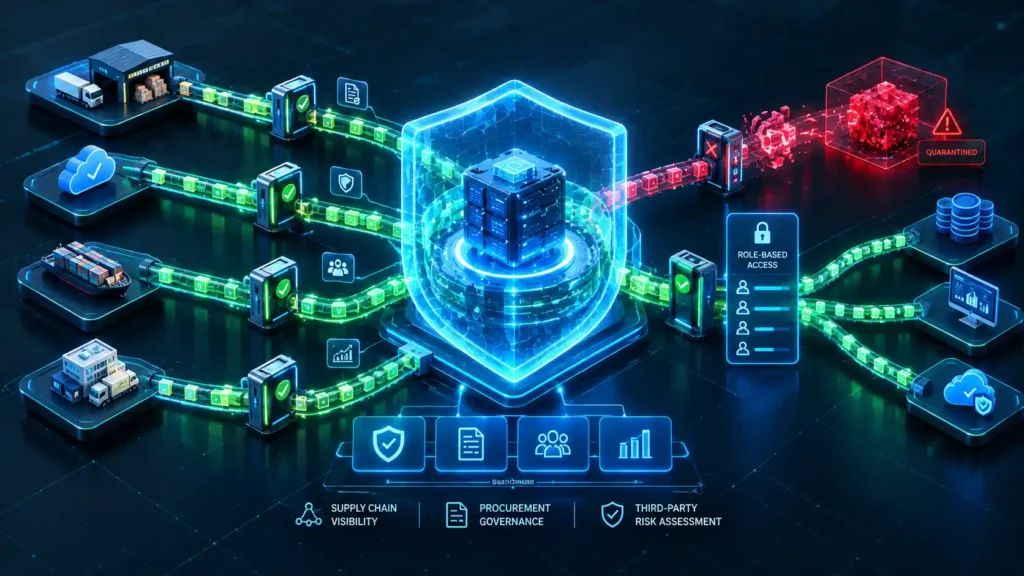
- Restrict vendor app identities using RBAC: Ensure that all programmatic vendor integrations execute tasks under a highly restricted role scoped exclusively to their specific software functions, completely replacing the lazy practice of granting a broad administrative identity just to bypass initial permission blocks.
- Use sandboxed API access tokens: Provision tokens issued to external integrations with strict cryptographic limitations that scope them to specific, isolated endpoints and narrow data payloads; this design ensures you drastically limit the blast radius if that token is ever leaked or exfiltrated from the vendor’s database.
- Apply explicit tenant scoping: In multi-tenant environments, you must hardcode explicit workspace isolation boundaries so that an external integration can only interact with the precise data rows it is meant to serve, completely blocking the tool from querying or traversing your full production environment by default.
- Ground your access architecture in established guidance: Engineering teams constructing these access containment layers should systematically align their permission maps with the official NIST cyber supply chain risk management guidelines. This authoritative reference alignment guarantees that your vendor integration checkpoints mirror the exact structural controls that enterprise security procurement reviews use to measure supply chain safety.
STEP 3: ASSESSING SYSTEM INTEGRATION INTERFACES AND WEBHOOK EXPOSURES
Operational integration nodes—rather than a provider’s core application dashboard—frequently function as the hidden, primary exposure surface within your network topology. Because these connection interfaces directly bridge external codebases with your protected internal environment, leaving them unmonitored introduces immediate script and data injection vectors.
- Treat unmonitored webhooks as an active risk surface: External webhooks that do not undergo rigorous cryptographic validation on the receiving end present a severe vulnerability; threat actors can exploit these unshielded endpoints to push malicious payload scripts laterally into your workspace while masquerading as legitimate vendor telemetry.
- Audit OAuth token grants regularly: Systematically review authorized integrations to verify that tokens granted during initial onboarding have not retained overly permissive access profiles; regular validation cycles catch and prune excessive permissions that should be scaled back to safe operational limits.
- Enforce validation boundaries on all incoming webhook parameters: Every single external webhook request must be parsed against a strict, predefined data schema and cryptographically verified for origin authenticity before processing, completely replacing the practice of trusting an inbound data packet simply because it arrived on the expected URL endpoint.
Accepting overly permissive, broad OAuth scopes—such as granting “read/write access to all user repositories” or “global directory visibility”—during a hurried SaaS software trial introduces a devastating threat vector into your infrastructure. When internal teams click through setup prompts without auditing permission boundaries, a single security incident at that external vendor instantly transforms their platform into a live launchpad for lateral corporate extortion. Attackers will leverage those valid, pre-authenticated tokens to bypass your firewall perimeters completely undetected, downloading proprietary files and executing extortion payloads directly from a trusted administrative account.
STEP 4: ESTABLISHING FORMAL EXIT STRATEGIES AND HARDENED DATA PURGE TELEMETRY
Managing how a business relationship terminates is just as critical to network safety as the initial onboarding verification, yet this lifecycle phase remains the exact step most corporate procurement routines skip entirely. Leaving your long-term data footprints unmonitored on a decommissioned vendor’s servers leaves your organization highly vulnerable to secondary data exposure long after you stop using the software.
- Address vendor lock-in before signing, not after: Service contracts must explicitly dictate the precise mechanisms and data formats required to export your information, ensuring that migrating to an alternative platform later is never blocked by a technical limitation or a contractual dead end.
- Require verified data deletion, not a vague promise: Ensure your legal and technical frameworks explicitly obligate the provider to permanently wipe all stored corporate data blocks upon contract termination, completely moving away from loose, ambiguous agreements stating that data “will be handled appropriately.”
- Demand cryptographic proof of destruction: Mandate the delivery of a formal, signed attestation or a verified cryptographic receipt confirming that your proprietary records have been permanently expunged from the vendor’s storage disks; this active documentation provides definitive evidence you can present to your own infrastructure auditors rather than relying blindly on the vendor’s word alone.
STEP 5: RUNNING ADVERSARIAL INTEGRATION DRIFT TESTS AS THE FINAL LAYER OF VETTING THIRD PARTY SAAS VENDORS
The final validation phase confirms that all the programmatic gates, documentation checks, and access limits established during the prior deployment steps actually function as intended when a crisis strikes—not just on a static paper contract. Relying strictly on initial screening parameters without executing active runtime validation creates a false sense of security across your operational pipeline.
- Review automated API traffic logs regularly: Aggregated network log files must be systematically parsed to evaluate whether an external tool’s real-time behavioral patterns mirror its approved functional footprint, allowing security analysts to catch anomalies and unauthorized directory queries before they mature into live data breaches.
- Run simulated token revocations: Execute routine, unannounced access token termination drills within a controlled sandboxed environment to verify that your infrastructure can successfully sever an external provider’s data access in seconds, rather than discovering a broken administrative path in the middle of an active security crisis.
- Conduct vendor breach tabletop exercises: Structure collaborative, hypothetical third-party compromise simulations across your response teams to expose hidden operational gaps and coordination blind spots within your business continuity plans before an actual vendor breach forces you to improvise under pressure.
- Confirm isolation does not disrupt core operations: Engineer your platform integrations with distinct structural boundaries so that completely cutting off a compromised vendor clean cuts the localized threat vector instantly without triggering unexpected cascading failures or taking down adjacent internal networks that happen to share identical backend services.
CONCLUSION & COMPLIANCE BOUNDARY SUMMARY
A resilient infrastructure privacy posture operates as an active, ongoing system engineering discipline rather than a static stack of template configurations reviewed once during onboarding and forgotten. Anchoring your broader supply chain security framework on continuous access telemetry, granular credential isolation, and disciplined network boundaries actively shields your architecture from the catastrophic financial and operational drain a single compromised external vendor can cause.
Successfully vetting third party saas vendors means treating every single digital integration as a standing network risk to be perpetually monitored, rather than a one-time procurement approval to be filed away in an administrative directory. The five production-grade practices outlined above transform that assessment workflow into core, code-enforced infrastructure that your team maintains continuously, completely moving away from a superficial compliance formality that is revisited only after a third-party breach has already compromised your data.
Scaling vendor security architecture while keeping up with the rapid tooling demands of a growing business is an active, evolving challenge for security teams. We would love to hear from you in the comments section below regarding your specific implementation choices: Which specialized third-party risk management (TPRM) platforms, automated data scanners, or API telemetry tracking tools are you using to audit vendor integrations across your corporate subnets? Have you successfully automated your token revocation workflows to trigger instantly during a third-party security incident, or are you running manual architectural reviews during procurement cycles? Share your vendor screening setups, custom API permission blueprints, and hard-earned advice with the community below!
Related: CISA Siemens S7 Advisory: 7 Critical Hardening Steps – CISA’s Siemens S7 advisory highlights an active AI-assisted threat to critical infrastructure, urging operators to harden PLCs, eliminate internet exposure, strengthen access controls, and monitor for malicious activity.
9 Practical Ways B2B Software Startups GRC Certification is Achieved – B2B software startups can build enterprise trust and accelerate growth by embedding GRC into their operations, turning security, compliance, and risk management into a competitive advantage.
7 Practical Ways to Protect OpenAI Custom GPT Prompts from Leakage – Protect your OpenAI Custom GPTs by securing sensitive instructions, controlling access, minimizing data exposure, and applying layered defenses against prompt injection and misuse.
5 Simple Steps to Secure Ollama Nginx Proxy Gateways Instantly – Secure Ollama behind Nginx with authentication, streaming-aware proxy controls, and perimeter validation to prevent unauthorized access, GPU resource abuse, and exposed AI model endpoints.
The Top 50 Cybersecurity Threats Report Summary Analyzing Modern Attack Vectors – A comprehensive breakdown of the top 50 cybersecurity threats shaping today’s attack landscape—from AI and cloud risks to identity, ransomware, phishing, and web application attacks.
FREQUENTLY ASKED QUESTIONS (FAQ)
Q1. What structural fallback plan should a security team deploy if a vital SaaS tool flatly refuses to share their complete SOC 2 Type II report due to broad corporate non-disclosure policies?
When an upstream platform blocks direct visibility into their SOC 2 documentation, you must demand an alternative security package comprising their comprehensive ISO/IEC 27001 certificate paired with an unabridged Statement of Applicability (SoA). Supplement this document review by legally binding the provider to a customized Cloud Security Alliance Consensus Assessments Initiative Questionnaire (CAIQ) or a standardized SIG core matrix within your primary Master Services Agreement (MSA).
Q2. How can an enterprise practically enforce automated data vetting protocols against “Shadow IT” SaaS tools introduced by independent departments using corporate credit cards?
Organizations should combat decentralized software adoption by programmatically cross-referencing real-time identity management console events with automated accounting tools. Hooking your cloud single sign-on (SSO) engine into financial ledger monitors allows security infrastructure to flag and isolate unvetted platform access profiles the moment an unmapped commercial transaction or unauthorized OAuth workflow attempts to register.
Q3. Can we rely on an external vendor’s upstream cloud infrastructure provider’s SOC 2 compliance (such as AWS or Azure) as proof of the vendor’s own security posture?
No, and assuming a cloud hosting provider’s audited perimeter covers the vendor’s application layer is a fatal architectural oversight. A cloud data center’s report validates physical server parameters, virtualization layers, and storage arrays; it completely omits testing the vendor’s bespoke application code logic, tenant data separation controls, or internal access onboarding hygiene.
Q4. What technical middle-layer controls can we build if an essential third-party integration natively demands global, unrestricted API keys to function?
If a legacy software provider cannot support sandboxed, low-privilege tokens, you must route all inbound and outbound transactions through a dedicated internal API proxy gateway. This microservice layer actively intercepts all external system calls, forces incoming payloads through explicit data filtering rules, and restricts the tool’s functional system vision strictly to specified client database rows rather than exposing your full production directory.
Q5. Beyond annual document validation cycles, what automated indicators of compromise (IoCs) should we track to catch active compliance drift across active SaaS connections?
Security operations centers should deploy passive network logging architectures to evaluate runtime behavior deviations across connected external endpoints. Programmatic monitors must generate immediate remediation alerts if a vendor’s API account attempts unusual data block exfiltration volumes, initiates connection sessions during non-standard hours, or queries system directories completely unrelated to its defined operational scope.
DISCLAIMER
Educational Notice: This article is published on AI Security Watch strictly for technical educational and general cybersecurity awareness purposes. The configurations and research discussed are based on public threat intelligence data. This content does not constitute professional IT architecture, legal, or financial advice. Because network configurations vary, always verify settings in an isolated test environment or consult with a qualified engineer before modifying live hardware or registries. AI Security Watch contains informational links to external resources; we are not responsible for third-party site accuracy or platform content.