
⚡ TL;DR — Key Takeaways
- Identifying Shifting Vectors: Combating modern AI cyberattacks 2026 threats requires moving away from passive security filters and deploying continuous, multi-layered verification controls to mitigate hyper-personalized, machine-driven data intrusions.
- Neutralizing Impersonation Phishing: Halting advanced identity deception—including AI-generated phishing loops and deepfake voice or video fraud—demands the immediate enforcement of protocol-level domain authentication (SPF, DKIM, and DMARC) paired with out-of-band verbal confirmation checkpoints for all corporate financial requests.
- Slowing Autonomous Ransomware: Defending networks against autonomous agentic campaigns and double-extortion ransomware pipelines requires establishing segmented infrastructure layouts alongside immutable, air-gapped backups to protect high-value database arrays from silent exfiltration.
- Isolating Polymorphic Payloads: Stopping stealthy software supply chain interventions and adaptive polymorphic malware lines requires migrating away from traditional signature-based antivirus scanners and implementing behavior-based endpoint protection (EDR) to intercept self-altering code strings in real time.
Table of Contents
It is a typical Monday morning shift when your finance director receives an urgent request from the CEO ordering an immediate wire transfer to a vendor account. The formatting is flawless, the organizational tone matches perfectly, and the corporate authorization code looks entirely valid. Your team processes the invoice immediately—only to discover an hour later that the real executive never sent the message and your enterprise capital is permanently gone.
This catastrophic scenario represents the exact type of sophisticated AI cyberattacks 2026 patterns hitting corporate infrastructure networks daily. According to verified CISA threat intelligence records, automated artificial intelligence has completely transformed corporate threat landscapes by giving adversaries the ability to personalize intrusions at an infinite scale. Modern variants of these AI cyberattacks 2026 threats do not rely on clumsy, generic methods; instead, they actively scan your perimeter and adapt their behavioral code footprints the exact millisecond your infrastructure defenses push back.
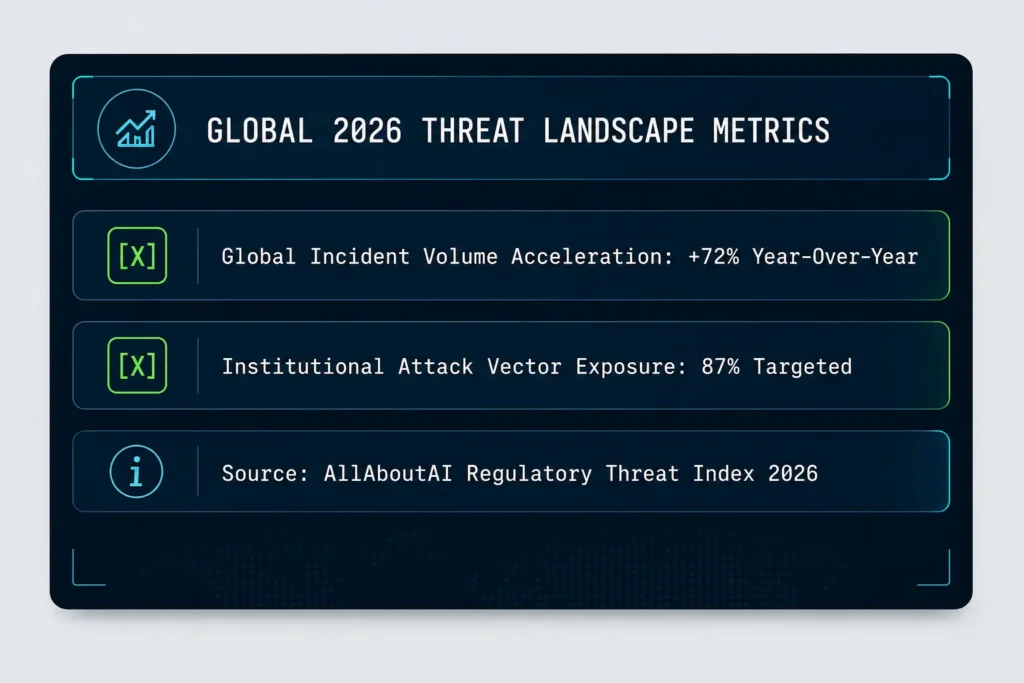
72% Year-over-year increase in AI cyberattacks globally. 87% of organisations were targeted by an AI-powered cyberattack in the past year. Source: AllAboutAI — AI Cyberattack Statistics 2026
HOW AI CYBERATTACKS 2026 AUTOMATE PHISHING CAMPAIGNS AT SCALE
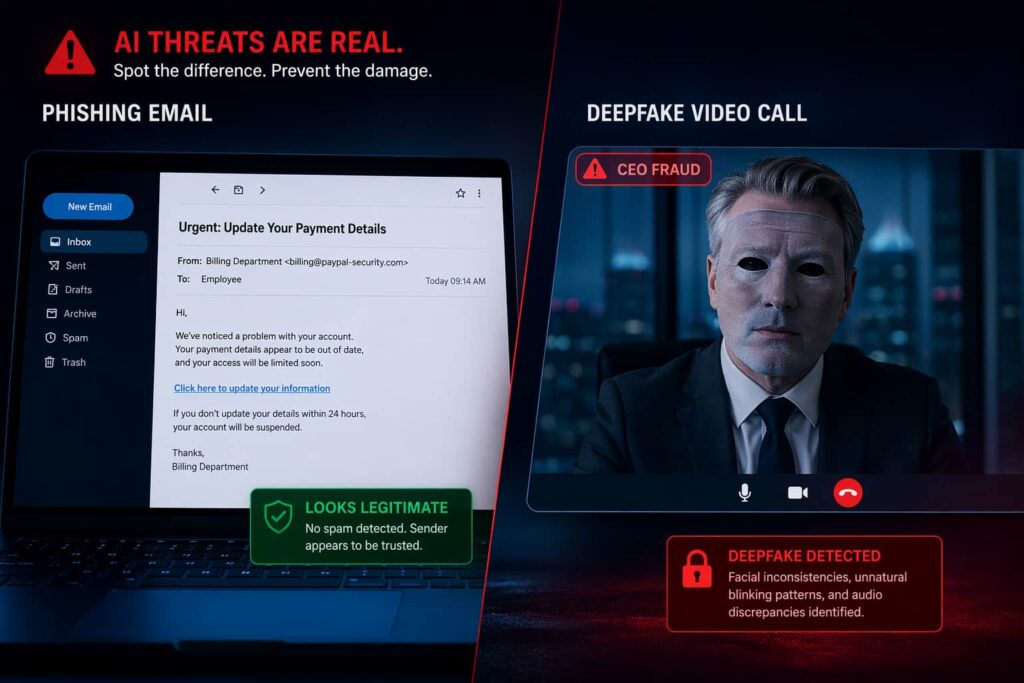
Traditional phishing emails were historically simple to isolate. Broken grammar, generic greetings, and obvious foreign phrasing allowed basic signature filters to drop malicious payloads easily. Advanced machine learning models have completely eliminated every single one of those traditional indicators.
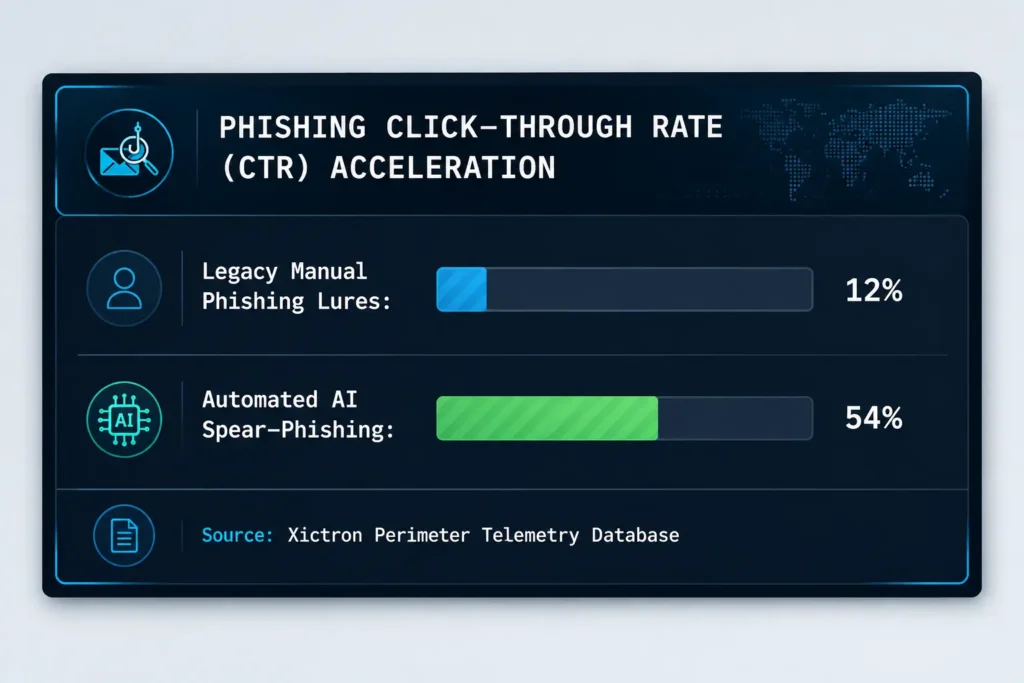
According to enterprise threat intelligence logs mapped by Xictron Perimeter Telemetry Analytics, AI-generated phishing scripts now achieve a staggering 54% click-through rate, completely eclipsing the 12% baseline held by manual human operators. Peer-reviewed security research from Harvard confirms that up to 60% of message recipients fall victim to these automated lures—including highly security-aware enterprise professionals.
These tailored AI cyberattacks 2026 vectors arrive grammatically flawless, emotionally targeted to exploit urgency, and contextually grounded. The underlying software pipelines dynamically scrape open-source intelligence (OSINT) repositories, company web trees, and professional social networks to reference real corporate projects, named internal colleagues, and active vendor relationships. While no human adversary could coordinate thousands of customized spear-phishing messages per hour, automated language pipelines execute this at zero marginal cost.
Administrative Hardening Protocols
- Deploy AI-Driven Phishing Rehearsals: Discontinue the use of outdated, static template simulations. Train internal teams against dynamic, multi-stage language models that actively mimic real-world executive impersonation scripts.
- Enforce Protocol-Level Border Controls: Implement strict cryptographic authentication frameworks across your domain perimeters. Mandate hard-reject Sender Policy Framework (SPF) rules, rotatable DomainKeys Identified Mail (DKIM) signing keys, and a global
p=rejectDomain-based Message Authentication, Reporting, and Conformance (DMARC) infrastructure configuration.
- Establish Out-of-Band Validation Mandates: Implement a rigid corporate rule requiring formal verbal confirmation over a secondary, pre-verified channel for any external accounting request or routing modification—completely ignoring contact paths supplied in the inbound message body itself.
FINANCIAL IMPERSONATION VIA DEEPFAKE VOICE AND VIDEO VISHING
In 2024, multinational engineering firm Arup lost $25.6 million during a single deepfake video conference when a finance employee joined what appeared to be a legitimate corporate call with company executives. Every participating manager on that screen was an AI-generated deepfake clone. According to telemetry indicators, a target’s vocal frequency can now be perfectly cloned using just three seconds of captured audio data, leaving a meager 0.1% of the public capable of reliably identifying synthetic media under pressure.
These advanced AI cyberattacks 2026 configurations exploit the most fundamental business trust signals: a familiar face, a verified voice, and established executive authority. The FBI’s IC3 data logs show a major 37% rise in AI-assisted business email compromise variants, with hundreds of high-value cases involving cloned executive vocal patterns engineered to bypass standard internal authorization loops.
Administrative Hardening Protocols
- Institute a Pre-Established Corporate Codeword System: Mandate a secure, offline voice-verification phrase loop that executives must provide before any high-value accounting operations or data exports are authorized.
- Enforce Multi-Channel Transfer Rules: Explicitly forbid the execution of high-value financial transfers based solely on a video call session, voice message script, or singular communication channel.
- Deploy Synthetic Media Detection Software: Integrate real-time deepfake and media anomaly analysis tools at the local network gateway to inspect inbound video communications for computational artifacts.
DISSECTING AI CYBERATTACKS: AUTOMATED RANSOMWARE PIPELINES
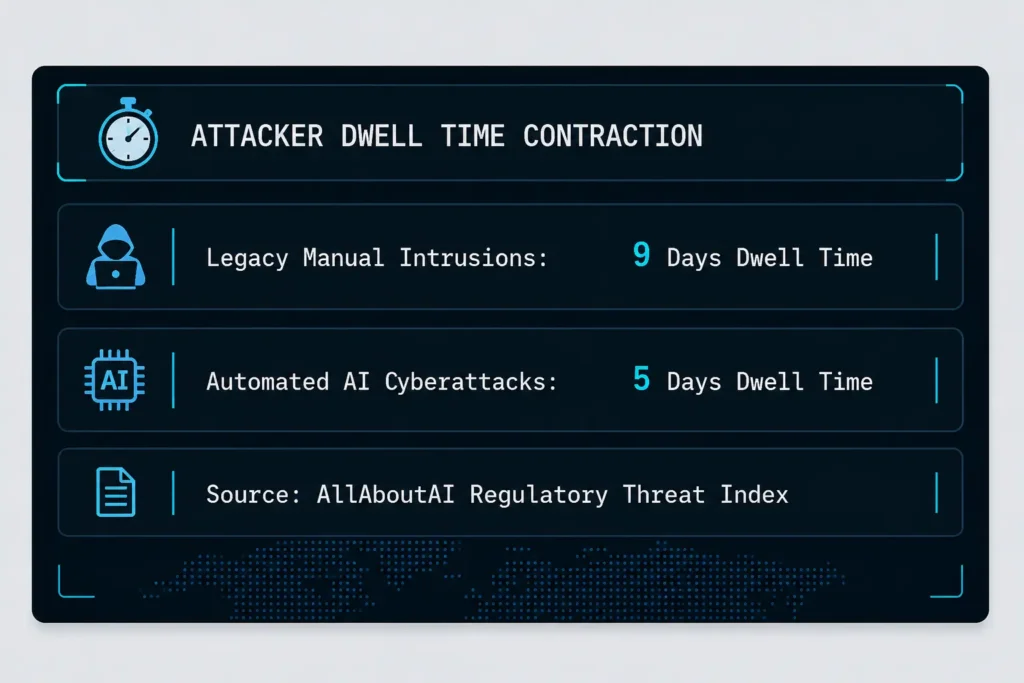
Ransomware delivery vectors are a legacy threat, but machine-learning-accelerated payloads operate on an entirely different scale of destruction. According to the AllAboutAI Regulatory Threat Index, automated artificial intelligence has slashed the median attacker dwell time from nine days down to just five days. This means your operations team now has less than half the baseline window to detect a network intrusion before full data locking triggers.
Modern ransomware variants associated with AI cyberattacks 2026 threats do not simply encrypt file structures; they execute rapid, silent double-extortion data exfiltration routines first. Traditional offline backups no longer provide comprehensive isolation. The automated payload systematically crawls, packages, and extracts high-value database schemas out of your perimeter before an administrative alert ever registers on your security dashboard. Average extortion settlement demands have subsequently climbed past the $1.13 million threshold.
Administrative Hardening Protocols
- Deploy Immutable Storage Nodes: Implement true Write-Once-Read-Many (WORM) cloud environments or air-gapped offline storage architecture that ransomware configurations cannot reach or modify.
- Migrate to Behavioral Endpoint Security: Transition completely away from static signature-matching antivirus tools and deploy behavior-based Endpoint Detection and Response (EDR) agents to kill unauthorized bulk encryption processes instantly.
- Enforce Zero-Trust Microsegmentation: Logically isolate your corporate network zones so that an intrusion inside an auxiliary testing environment cannot migrate laterally to your primary production servers.
GUARDING INFRASTRUCTURE AGAINST FULLY AUTONOMOUS AGENTIC INTRUSIONS
Autonomous agentic execution represents the newest and most structurally dangerous frontier of modern corporate exploitation. According to data logs compiled by Barracuda Networks, agentic artificial intelligence functions as a self-directed digital partner that can plan, execute, observe, adapt, and maintain persistence across a target environment completely independent of human guidance. This is no longer a tool designed to assist a malicious coder; the agent is the coder.
Enterprise security firms have documented fully autonomous, AI-orchestrated infrastructure campaigns where automated frameworks handled 80% to 90% of the active operational pipeline—executing automated reconnaissance, mapping network vulnerabilities, handling privilege escalation, and conducting data exfiltration with zero human interaction. These specialized AI cyberattacks 2026 runs operate around the clock, scale infinitely, and cost adversaries almost nothing to maintain. A criminal group that once required a team of highly paid security engineers can now deploy hundreds of simultaneous, automated network probes for the nominal cost of a cloud computing subscription.
Administrative Hardening Protocols
- Deploy AI-Powered Behavioral Analysis: Combating automated agentic probes requires implementing machine-learning detection engines on your own perimeter. Only automated analytics can flag machine-speed exploits in real time.
- Lock Down Your Internal Identity Perimeter: Establish a strict, global Zero-Trust infrastructure layout where every microservice connection, API access token, and user session is continuously validated regardless of its apparent origin source.
- Run Automated Penetration Testing: Deploy continuous, machine-driven testing protocols across your public IP footprint to locate perimeter misconfigurations before an external agent does.
NEUTRALIZING AI CYBERATTACKS: AUTOMATED BUSINESS EMAIL COMPROMISE
Business Email Compromise (BEC) powered by automated machine learning has rapidly ascended as one of the most financially devastating categories of AI cyberattacks 2026 trends targeting global operations. Traditional BEC required a threat actor to manually monitor an executive’s vocabulary and wait weeks for a payment window. Modern algorithms eliminate this bottleneck by processing your company’s historic email logs, linguistic habits, and internal hierarchies to autonomously generate fraudulent payment demands that perfectly mimic your internal staff.
Small and medium enterprises (SMEs) are disproportionately targeted by these targeted AI cyberattacks 2026 anomalies. Because early-stage operations are incredibly cheap for machine-learning engines to scan, and typically deploy fewer out-of-band banking verification rules than large enterprises, scammers treat these networks as high-yield targets with minimal entry friction.
Administrative Hardening Protocols
- Establish a Two-Person Approval Rule: Mandate a dual-signature authorization policy for any outbound payment or sensitive data transfer that climbs above a set corporate financial threshold.
- Use Behavioral Email Security Infrastructure: Integrate security gateways that analyze communication behavioral patterns and anomaly logs rather than searching for text keyword lists or known bad sender domains.
- Conduct Specialized Finance Sector Training: Run continuous, high-frequency fraud triage workshops specifically for accounting, billing, and administrative personnel, as they represent the primary target for modern business email compromise.
HOW AI CYBERATTACKS INTERCEPT VULNERABLE THIRD-PARTY SUPPLY CHAINS
Your localized network infrastructure might feature exceptional defensive parameters, but your external suppliers, cloud software vendors, and third-party utility integrations frequently do not. Modern supply chain AI cyberattacks 2026 models actively weaponize this exact visibility gap. Adversaries exploit the systemic trust you place in downstream vendor connections to slide past your perimeter firewalls completely unnoticed.
Rather than auditing individual targets manually, specialized automation tools scan thousands of interconnected supplier databases simultaneously. The exact millisecond a vulnerability is found in a low-security vendor backend, it is weaponized as a permanent backdoor into every enterprise network linked to that supplier. This means your private database configurations and customer PII are fully exposed through a third-party pipeline you trusted blindly.
Administrative Hardening Protocols
- Execute Regular Third-Party Compliance Audits: Mandate annual security posture reviews and formal GRC compliance documentation for every vendor allowed to interact with your internal network strings.
- Enforce the Principle of Least Privilege Globally: Strictly limit partner and contractor access parameters to the precise directories and databases required to satisfy their immediate contract rules.
- Monitor Inter-Infrastructure Telemetry: Deploy boundary traffic analysis tools to continuously monitor third-party API configurations and data pathways for anomalous query patterns or unusual volume spikes.
DEPLOYING BEHAVIORAL ISOLATION AGAINST ADAPTIVE POLYMORPHIC MALWARE
Polymorphic malicious software is arguably the most patient and dangerous class of AI cyberattacks 2026 vectors operating across enterprise servers today. Once compiled and deployed into a targeted infrastructure node, the malware does not execute an immediate file encrypt or file deletion cycle. Instead, it enters a silent reconnaissance phase, spending weeks observing your security maintenance patterns, identifying your thinnest defensive layers, and inventorying your high-value database tables.
Standard, legacy anti-virus programs built purely around matching known static signatures cannot intercept these modern AI cyberattacks 2026 payloads. Because the malware features embedded cryptographic code structures that alter its file hash and structure every few minutes, its file footprint is constantly changing. By the time the final intrusion trigger fires, the payload knows your server access paths better than your own administrators do, locking down files before your incident response team can pull up an active network log dashboard.
Administrative Hardening Protocols
- Deploy Behavior-Based Endpoint Detection: Replace all traditional signature-reliant security software with advanced EDR/XDR suites that automatically flag and block anomalous background processes.
- Implement Continuous Network Baseline Monitoring: Run permanent cloud logging routines to map normal traffic volumes, ensuring that small, trickling data exfiltration lines can be trapped before bulk exfiltration triggers.
- Conduct Quarterly Threat Hunting Drills: Require your internal security team or an external advisory partner to proactively hunt through server memory states and system caches for dormant malware payloads.
THE COMMON THREAD EVERY BUSINESS MUST UNDERSTAND
Every single one of these seven AI cyberattacks 2026 vectors shares a core foundational characteristic: they prioritize exploiting systemic human trust loops over cracking complex technical firewalls. The phishing email reads perfectly. The deepfake audio sounds authentic. The vendor connection appears trusted. The adaptive malware profile presents as an inactive background script.
This core shift is precisely what makes automated threats fundamentally distinct from legacy hacking methodologies. Your operations team can write software patches for code vulnerabilities, but you cannot download a patch for human trust. Data indicators from enterprise risk reports prove that automated attacks have become completely localized, multilingual, grammatically flawless, and emotionally tailored—driving a massive spike in operational compromise success rates worldwide.
In this new landscape, verified identity has officially become your baseline structural firewall. The real-world consequence of failing to harden this perimeter is absolute: up to 60% of small and medium businesses that suffer an uncontained network data breach collapse into permanent bankruptcy within six months of the event.
5 THINGS YOUR BUSINESS CAN DO THIS WEEK
To protect your enterprise infrastructure and insulate your team against evolving AI cyberattacks 2026 patterns, execute these five tactical controls across your environment immediately:
- Enforce Multi-Factor Authentication (MFA) Universally: Mandate strict, hardware-token or app-based multi-factor verification across every system, administrative account, and staff profile to block automated credential attacks.
- Deploy Protocol-Level Email Authentication Records: Configure hard-reject SPF lines, robust DKIM verification keys, and a mandatory global DMARC
p=rejectrule to permanently block domain spoofing vectors. - Initiate Realistic, AI-Mapped Phishing Rehearsals: Discontinue static training modules and train personnel using modern generative language templates that mimic real-world spear-phishing scripts.
- Codify a Rigid Out-of-Band Financial Protocol: Require a direct, verbal confirmation check over a secondary pre-verified communication line for any payment request or wire modification before capital is moved.
- Audit Your Downstream Vendor Ecosystem: Directly audit the GRC posture of your principal third-party suppliers, ensuring that their internal data perimeters match your own organizational risk limits.
THE VERDICT
The corporate entities that successfully survive the machine-learning threat era will not be the ones that operate the largest abstract cybersecurity budgets. The winners will be the organizations that recognized the shifting threat landscape early, retrained their internal personnel to reject passive trust, and installed rigid, out-of-band verification controls before an active crisis forced them to.
Artificial intelligence has not simply made security threats more frequent; it has rendered them completely believable, hyper-targeted, and more structurally damaging than any legacy exploit model that came before. These seven distinct attack frameworks are not future projections; they are live, active operations hitting corporate environments right now in 2026. The baseline question is no longer whether your network will be targeted by automated AI cyberattacks 2026 runs—the live data proves that an intercept attempt is virtually certain. The only question that matters is whether your infrastructure will be ready when that handshake triggers.
Related reading:
How AI Threat Detection Is Redefining Cybersecurity in 2026 — learn how AI-powered defences are fighting back against the attacks described above.
Proton VPN AI Security Review 2026: Is It Worth It? – learn about how Proton VPN is fighting AI threats.
Microsoft Defender AI Features 2026: The Hidden Tools Already on Your PC – learn the AI features in Microsoft Defender and how it protects you from attacks.
Dangerous AI Threat Intelligence: Why Every Business Needs It in 2026 – AI threat intelligence to keep businesses safe.
Frequently Asked Questions
Q1. What is an AI cyberattack and how is it different from a traditional cyberattack?
An AI cyberattack uses artificial intelligence to automate, personalise, and accelerate malicious activity — from generating convincing phishing emails to running fully autonomous intrusions with no human attacker involved. Traditional cyberattacks required skilled hackers to manually craft each attack. AI removes that bottleneck entirely, allowing criminals to launch thousands of highly targeted attacks simultaneously at a fraction of the cost. The result is attacks that are faster, harder to detect, and far more convincing than anything seen before.
Q2. Are small businesses really at risk from AI cyberattacks, or is this mainly a large enterprise problem?
Small businesses are disproportionately at risk. According to cybersecurity data, 62% of small businesses faced AI-driven attacks in 2025, and 60% of those that suffer a significant cyberattack go out of business within six months. AI has actually made small businesses a more attractive target — they hold valuable data but typically have fewer security controls than large enterprises, making them easier to breach for a higher return on effort.
Q3. Which of the 7 AI cyberattacks is the most dangerous for businesses right now?
For most businesses, AI-generated phishing and deepfake CEO fraud cause the most immediate financial damage because they exploit human trust rather than technical vulnerabilities — and no firewall stops an employee from transferring money to a convincing fake. However, adaptive AI malware is arguably the most dangerous long-term threat because it sits undetected inside your systems for weeks, learning your operations before striking at the worst possible moment.
Q4. What is the single most important thing a business can do today to defend against AI cyberattacks?
Enable multi-factor authentication across every account and system without exception. MFA stops the vast majority of credential-based AI cyberattacks before they reach your data — it is the highest-impact, lowest-cost security measure available to any business, regardless of size or budget. Pair it with a verbal confirmation rule for any financial request received digitally, and you have addressed the two most com
DISCLAIMER
Educational Notice: This article is published on AI Security Watch strictly for technical educational and general cybersecurity awareness purposes. The configurations and research discussed are based on public threat intelligence data. This content does not constitute professional IT architecture, legal, or financial advice. Because network configurations vary, always verify settings in an isolated test environment or consult with a qualified engineer before modifying live hardware or registries. AI Security Watch contains informational links to external resources; we are not responsible for third-party site accuracy or platform content.
The details in aisecuritywatch.com are useful to compare with a practical reference. I prefer keeping game information organized by mechanics, updates, and player questions, so I saved this Steal An Egg HQ as a reference for readers who want to check the topic further.
I found the observation “Administrative Hardening Protocols Deploy AI-Driven Phishing Rehearsals: Discontinue the use of outdated, static template simulations.” especially useful. What usually causes this to work differently in practice? Disclosure: I work on
this game reference , an independent Geometry Dash Lite site.