
⚡ TL;DR — Key Takeaways
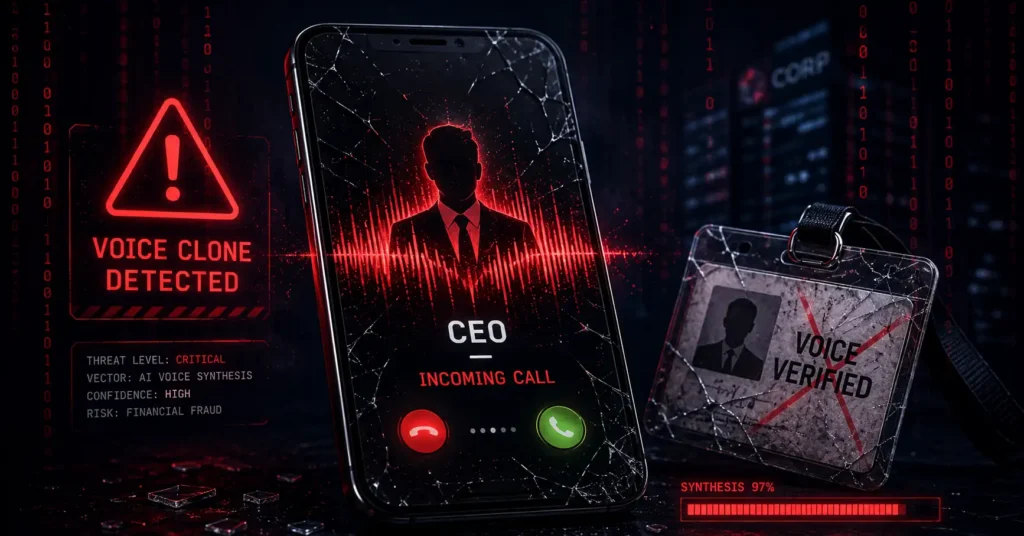
- What’s happening: Fraudsters clone a CEO or CFO’s voice from as little as 3 seconds of public audio, then call finance teams demanding urgent wire transfers. That’s how AI voice cloning scams work.
- Scale of the threat: AI-powered fraud attempts surged 1,210% in 2025, and voice cloning is now ranked among the top enterprise attack vectors.
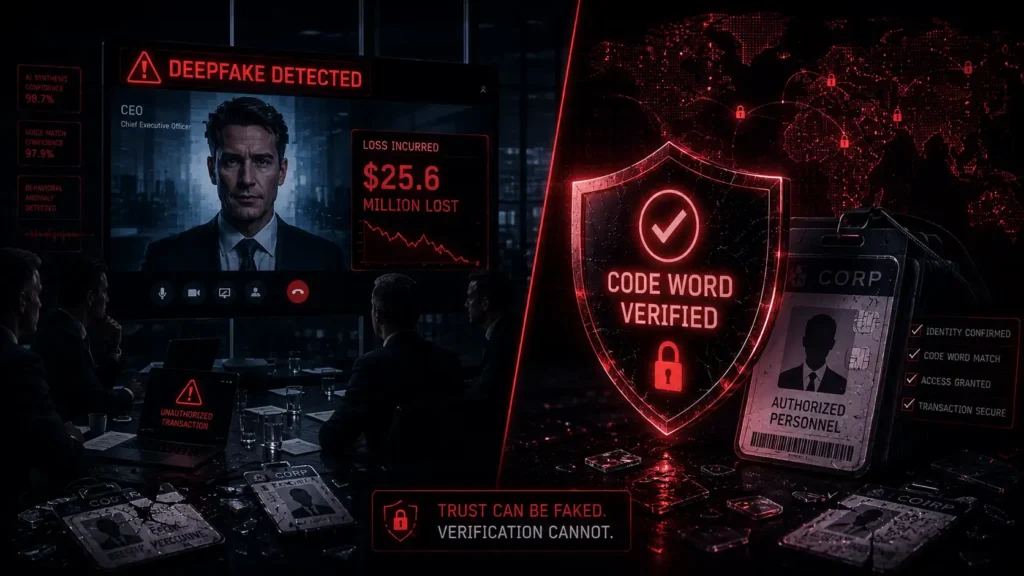
- Real losses: A Hong Kong firm lost $25.6 million after a deepfaked video call; a UK energy company lost €220,000 to a single cloned-voice call.
- Why it works: Voice clones have crossed the “indistinguishable threshold” — human ears can no longer reliably tell them apart from the real thing.
- Who’s exposed: Any organization whose executives appear in earnings calls, podcasts, or webinars — that public audio is free training data for attackers.
- The fix: Out-of-band verification (a callback or a pre-agreed code word) is the one control voice clones can’t bypass, since it isn’t based on how someone sounds.
Table of Contents
Picture this: your CFO gets a call from the “CEO,” sounding stressed, asking for an urgent wire transfer before a deal collapses. The voice is right down to the pauses and breathing. Except the CEO never called. This is the new face of corporate fraud, and AI voice cloning scams are now among the fastest-growing threats to businesses worldwide.
What Is This Fraud, Exactly?
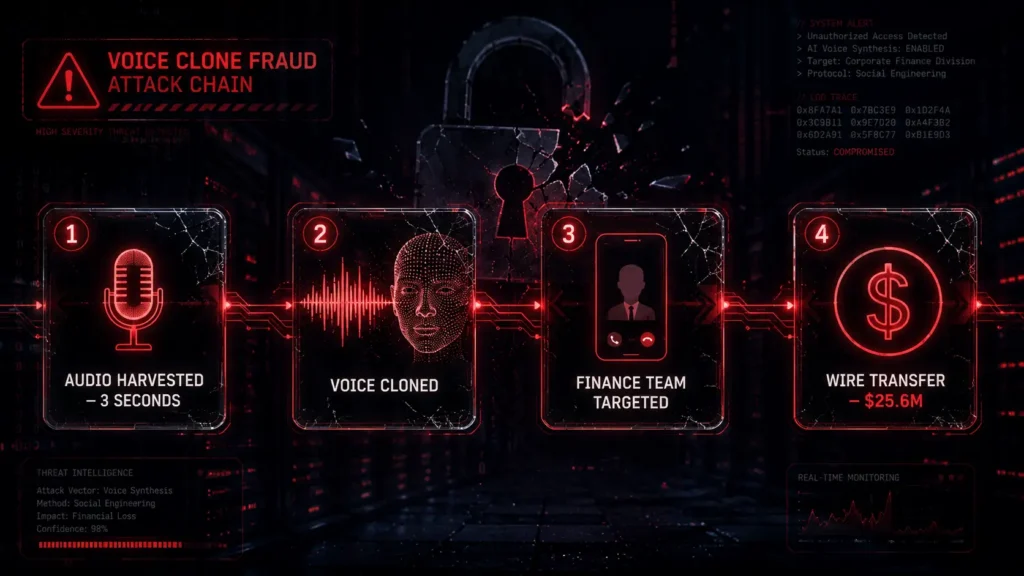
It uses machine learning models trained on short audio clips to recreate a real person’s voice with startling accuracy. Attackers scrape audio from earnings calls, podcasts, conference keynotes, and social media, then feed it into voice-cloning tools to generate synthetic speech that sounds exactly like the target. According to research cited by Vectra AI, just three seconds of audio is enough to build a working voice clone with roughly 85% accuracy — and every public appearance an executive has ever made becomes potential training data.
Unlike older phishing attempts riddled with typos and generic greetings, this fraud achieves human-quality output at machine speed, making detection far harder for even trained employees.
Why CEO Voice Fraud Is Exploding
The scale of this threat is no longer theoretical. AI-powered fraud attempts surged 1,210% in 2025, with voice cloning ranked among the top enterprise attack vectors, per the Vectra AI report. Deepfake-enabled vishing (voice phishing) attacks jumped over 1,600% in Q1 2025 compared to Q4 2024 in the US alone, and voice phishing overall surged 442% during the same period, according to data compiled by SQ Magazine.
The financial toll is climbing just as fast. The FBI’s Internet Crime Report found that AI-enabled business email compromise involving voice cloning generated $3.046 billion in losses in 2025 alone, as reported by Adaptive Security. Deloitte’s Center for Financial Services projects that AI fraud losses in the US could reach $40 billion annually by 2027, according to CybelAngel.
Real-World Cases of AI Voice Cloning Scams
These aren’t hypothetical risks — they’ve already cost real companies real money:
- Hong Kong, 2024: A finance employee at a multinational firm authorized 15 transactions totaling $25.6 million after joining a video call where every “colleague,” including the deepfaked CFO, was AI-generated. The employee initially suspected phishing but was convinced by the realistic voice and synchronized facial movements, per CybelAngel’s account of the incident.
- UK, 2023: An energy company lost €220,000 after a cloned executive voice convinced staff to authorize a fraudulent wire transfer, documented by State of Surveillance.
- US-wide: The FBI logged more than 22,000 AI-related fraud complaints with losses exceeding $893 million in its most recent Internet Crime Report, and congressional researchers estimate fewer than 5% of victims ever report their losses — meaning the real number is likely far higher, per CybelAngel.
How the Fraud Actually Works
AI voice cloning scams typically follow a predictable playbook:
- Reconnaissance — Attackers research the organization’s structure, identify the CEO or CFO, and locate public audio: interviews, webinars, and investor calls.
- Cloning — Using freely available AI tools, they generate a synthetic voice model. The 2026 International AI Safety Report notes these tools are free, require no technical skill, and can be used completely anonymously.
- Targeting — The attacker identifies an employee likely to comply with executive authority, often in finance or accounts payable.
- The Call — A cloned voice message or live “conversation” creates urgency, usually requesting a wire transfer outside normal business hours to avoid in-person checks.
- Cash-out — Funds move quickly through intermediary accounts before the fraud is discovered.
Attackers now combine channels — a spoofed email followed by a cloned voicemail or a deepfake video call — to build credibility across multiple touchpoints, a technique researchers call “Business Identity Compromise.”
The Underground Economy Behind It
What makes this threat so dangerous is accessibility. Dark web marketplaces now offer “Fraud-as-a-Service” subscriptions for under $50 a month, letting low-skill criminals input a phone number and a short video URL to generate a working clone, according to Unbox Future. No coding, no expensive hardware — just a subscription and a script.
How to Protect Your Organisation
Defending against AI voice cloning scams doesn’t require exotic technology — it requires rethinking how your organization verifies identity over the phone. Because AI voice cloning scams exploit trust in a familiar voice rather than a technical vulnerability, the strongest defenses are procedural, not just technical. Here’s how finance and security teams can build real resilience against AI voice cloning scams:
- Verify through a second channel. Never approve a wire transfer based on a voice call alone, no matter how convincing it sounds. This single habit neutralizes most AI voice cloning scams because attackers rely on the target acting on the call itself. Call the person back on a number you already have on file — never one the caller provides.
- Establish a code word. Internal teams should agree on a verification phrase for high-value requests, set in person and never shared digitally. Because AI voice cloning scams can replicate a voice but not a secret only your team knows, a code word remains one of the most effective, low-cost defenses available.
- Slow down urgency. Urgency is the core psychological lever behind almost every AI voice cloning scam. Legitimate requests can wait ten minutes for confirmation; any pressure to act instantly, skip protocol, or keep the request confidential is a red flag.
- Limit public audio exposure. Audit what executive interviews, webinars, podcast appearances, and earnings calls are publicly accessible. Every public recording is potential raw material for AI voice cloning scams, so reducing an executive’s audio footprint directly reduces attack surface.
- Set dual-authorization thresholds. Require two independent approvals, through two separate communication channels, for any transfer above a defined dollar amount. This structural control stops AI voice cloning scams even when one employee is successfully deceived, since a single compromised call can no longer move money alone.
- Train finance teams specifically. Generic security awareness training rarely addresses AI voice cloning scams directly. Role-based training focused on executive impersonation scenarios reduces susceptibility significantly; multi-factor authentication alone cuts voice fraud risk by over 70% in enterprise settings, per SQ Magazine.
- Monitor for early warning signs. Watch for unusual call patterns, requests made exclusively outside business hours, or instructions to bypass normal approval workflows — all common markers of AI voice cloning scams in progress.
Despite the scale of the problem, only 29% of consumers say they fully understand the risks behind AI voice cloning scams, per the same SQ Magazine data. That awareness gap is exactly what fraudsters are counting on — and it’s precisely why building layered, procedural defenses against AI voice cloning scams matters more than relying on any single piece of detection technology.
Conclusion
AI voice cloning scams have moved from science-fiction curiosity to boardroom reality in just a few years. As synthetic voices become indistinguishable from the real thing, the only reliable defense against AI voice cloning scams isn’t better ears — it’s better verification protocols. Treat every urgent voice request, no matter how convincing, as unverified until confirmed through a separate, trusted channel.
Related: Dangerous AI Threat Intelligence: Why Every Business Needs It in 2026 – understand the AI threat intelligence layer that could have caught the McHire credential flaw before it became a 64-million-record exposure.
The 5 Worst Data Breaches of 2026 — And What AI Could Have Prevented – the McDonald’s McHire incident sits alongside 2025’s most damaging breaches, all sharing one common thread: basic security gaps that AI-powered tools were built to catch.
What Is Claude Mythos AI? The AI That Can Hack Any Software Explained – Understand how Mythos AI from Anthropic is a real threat and how to protect yourself from it.
Frequently Asked Questions
Q1. How much audio does a scammer need to clone someone’s voice?
As little as three seconds. A short clip — from a podcast, interview, or even a voicemail greeting — is enough to build a clone with roughly 85% accuracy.
Q2. Can people actually tell the difference between a cloned voice and a real one?
Not reliably anymore. Voice cloning has crossed the “indistinguishable threshold,” meaning even trained listeners can no longer consistently spot a synthetic voice on a phone call.
Q3. Why do scammers target finance teams specifically with a fake CEO’s voice?
Finance and accounts payable staff are trained to respond quickly to executive requests. Attackers exploit that trust and time pressure, often calling outside business hours to avoid in-person verification.
Q4. Is AI voice cloning fraud actually widespread, or just a few isolated cases?
Widespread and growing fast — AI-powered fraud attempts surged 1,210% in 2025, and AI-enabled BEC involving voice cloning generated $3.046 billion in losses that year alone.
Q5. What’s the single most effective way to stop an AI voice cloning scam?
Verify through a separate, pre-established channel every time — a callback to a known number, or an internal code word agreed upon in person and never shared digitally.
Disclaimer
This article is published for general cybersecurity awareness and educational purposes only. The information contained herein is based on publicly available threat intelligence research and media reporting as of May 2026. AI Security Watch does not make representations about the completeness or accuracy of information regarding Mythos AI, as the technical specifications of this tool are not fully publicly confirmed. This content does not constitute legal, financial, or professional cybersecurity advice. Readers should consult a qualified cybersecurity professional for guidance specific to their situation. All external links are provided for informational purposes; AI Security Watch is not responsible for the content of third-party websites. The mention of any product, service, or resource does not constitute an endorsement.Disclaimer