
⚡ TL;DR — Key Takeaways
- Administrative access controls: Establishing absolute endpoint visibility serves as the non-negotiable foundation of your compliance posture—achieving an authentic nist framework alignment dictates that a small team must implement automated discovery mechanisms to catalog every active asset, as complete visibility is the prerequisite for implementing any downstream protection rule.
- Vendor/client parameter validation: Restructuring identity perimeters provides vital insulation against lateral credential-harvesting campaigns; enforcing strict just-in-time access constraints and deploying phishing-resistant multi-factor authentication (MFA) parameters permanently close the visibility gaps that routinely undo otherwise solid governance frameworks.
- Stream-optimized runtime flags: Transitioning fragmented audit trails into a unified telemetry ecosystem avoids organizational drift across distributed architectures; routing core transactional event logs through centralized pipelines turns scattered microservice anomalies into a single, highly detectable signal.
- Perimeter isolation validation: Securing enterprise networks during a live breach demands active, code-enforced isolation routines rather than passive administration—an emergency response playbook that is not aggressively practiced is simply a text document, meaning routine simulation drills are the only mechanism that makes perimeter containment fast.
Table of Contents
Operating a distributed business infrastructure with unmapped data policies is a severe corporate and financial liability. Small-to-mid market entities are especially vulnerable to catastrophic compliance penalties and sudden vendor exclusions from high-value enterprise pipelines the moment a third-party audit surfaces a security gap that nobody was tracking. Failing to mathematically define and enforce data protection boundaries means that an organization is essentially flying blind, letting configuration drift gradually degrade the host perimeter until a regulatory inspector or automated scanning network flags the system’s underlying technical vulnerabilities.
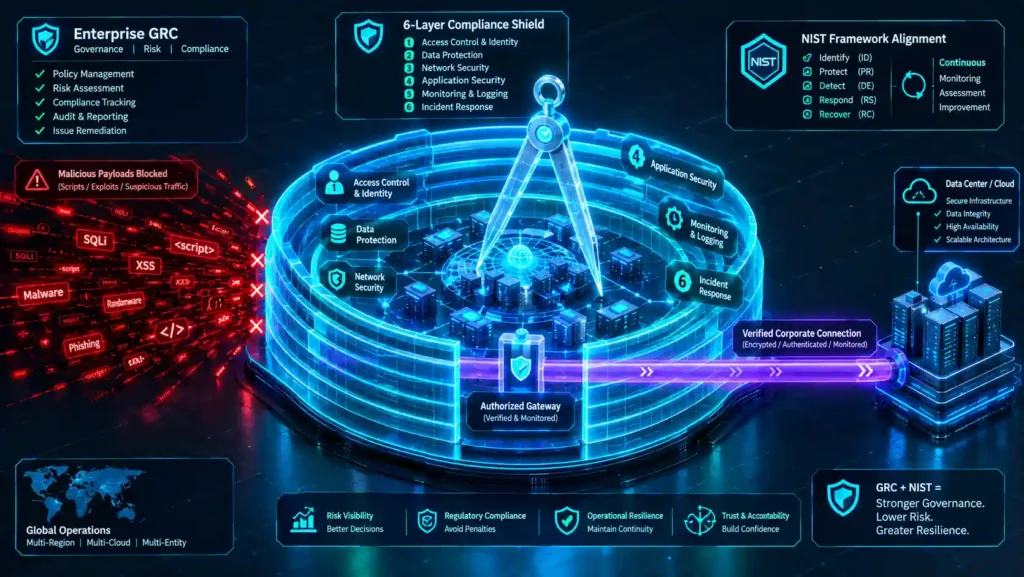
Deciding to deploy an explicit, structural roadmap to enforce your nist framework alignment controls is a mandatory, core network engineering requirement rather than a superficial paperwork exercise. Implementing a multi-layered compliance architecture is the only defensive strategy that successfully prevents data-handling stagnation, stabilizes critical vendor audits, and stops technical risk drift before it compounds into a public data breach or a non-negotiable statutory fine. Moving past static, check-box policy templates allows small IT divisions to turn governance into an active engineering shield, protecting both corporate capital assets and upstream consumer identities from systemic exposure.
There is a profound, stomach-dropping sense of technical disbelief that hits you when you sit in a high-stakes third-party vendor review meeting and realize that a core software supplier has completely mismanaged their production access tokens. You ask for their perimeter isolation logs and watch their leadership team casually pull out a generic, dust-covered compliance document from two years ago, genuinely assuming that static paperwork is sufficient to protect shared cloud environments from lateral supply-chain exploits.
Realizing that an entire enterprise application tier is trusting its downstream data integrity to an organization that treats access governance as an administrative memory exercise rather than a live infrastructure battle is a brutal wake-up call. It highlights the terrifying reality that your partners’ paper compliance means absolutely nothing if their front-line configurations introduce open backdoors straight into your private subnets.
The six roadmap pillars detailed below map directly onto the NIST Cybersecurity Framework’s foundational core functions—Identify, Protect, Detect, Respond, and Recover—plus the critical governance overlay required to bind these technical controls into a sustainable, ongoing security posture rather than a one-time configuration project.
PILLAR 1: ASSET INVENTORY DISCOVERY AND HARDENED IDENTITY SCHEMAS
The “Identify” function serves as the structural foundation upon which every downstream control in a comprehensive nist framework alignment program depends. In infrastructure engineering, it is an absolute mathematical rule that you cannot protect, detect threats against, or reliably recover any resource whose existence is not explicitly cataloged. Small teams must begin by eliminating baseline guessing games and establishing complete, verifiable visibility over their entire digital footprint.
- Establish an immutable, centralized tracking registry: Every single connected endpoint across the architecture—whether a physical hardware asset, an ephemeral cloud container subnet, or a distributed data repository—must be programmatically integrated into a single, authoritative asset inventory. Moving completely away from fragmented departmental spreadsheets or tribal documentation prevents visibility gaps from forming across your perimeter.
- Classify architecture assets by explicit risk tiers and data sensitivity: Not every computing node introduces the same degree of corporate financial liability. An environment processing regulated customer data requires an entirely separate, hardened classification tier than an internal document wiki server, and this specific classification tracking metric must directly dictate every subsequent access control and logging rule you apply.
- Systematically eliminate unmonitored shadow IT infrastructure: Rogue applications and unsanctioned systems provisioned outside formal change-management processes operate as a premier entry point for modern threat networks. Small operational divisions must deploy regular, automated discovery scans to actively hunt down hidden endpoints and unmapped cloud buckets that managed to bypass your primary technology procurement workflows.
- Treat your asset inventory as a live, continuously updated database: An inventory written on paper that is accurate only on the day it is verified will degrade into complete fiction within a matter of fiscal quarters. To prevent dangerous configuration drift, discovery automation routines must execute continuously on a rolling loop rather than being treated as a casual, annual compliance audit exercise.
Small, resource-constrained operational divisions planning out this structural layer do not need to decipher the full, complex text of the master framework. The official NIST Cybersecurity Framework 2.0 Small Business Quick-Start Guide is engineered for entities deploying an initial governance footprint from the ground up, providing a direct, simplified pathway to execute this primary hardware and data mapping layer before administrators begin stacking on subsequent technical perimeters.
PILLAR 2: ISOLATING PRIVILEGED INTERFACES VIA PHISHING-RESISTANT MFA
The “Protect” function is the exact junction where a lean team’s infrastructure architecture either stands firm under pressure or quietly becomes the primary reason an intrusion spreads laterally across the enterprise. It is the core defensive layer that nist framework alignment audits scrutinize first, as unhardened entry points instantly invalidate all adjacent detective controls.
- Enforce strict just-in-time access controls: Standing administrative privileges represent a massive, constant corporate liability even when completely dormant. Access to high-value production databases, code repositories, and network configuration panels must be programmatically restricted to short, defined windows tied to specific maintenance tickets, then automatically revoked by the system.
- Lock down administrative execution environments: High-privilege tasks—such as infrastructure changes, master credential resets, and policy modifications—must only execute within isolated, monitored bastion environments. Moving completely away from allowing administrators to perform structural changes from whatever unvetted local device they happen to be using that day prevents credential harvesting at the workstation level.
- Deploy machine certificate pinning to stop lateral access loops: Certificate pinning binds trusted, encrypted connections strictly to specific, verified machine identities. Implementing this cryptographic validation gate ensures that even if an attacker manages to capture a valid administrative username and password, they cannot pivot or move laterally across the internal environment from an unauthorized external machine.
- Require phishing-resistant MFA specifically, rather than basic multi-factor methods: Legacy SMS-based passcodes or push-notification prompts are highly vulnerable to interception, SIM-swapping, and high-frequency alert fatigue attacks. Enforcing hardware-backed WebAuthn parameters, such as physical security keys, effectively closes this authentication gap for any user profile maintaining administrative privileges.
PILLAR 3: ENFORCING CONTINUOUS DETECTIVE RADARS AND LOG CONSOLIDATION METRICS
The “Detect” function is the critical junction where scattered, low-level technical signals across a distributed cloud environment are either programmatically correlated into an actionable alerts matrix or remain completely invisible until long after a breach has finalized. For lean operations teams, building an unshakeable detective radar means moving past siloed dashboards and consolidating event streams into a single, high-fidelity monitoring pipeline that targets the core focus keyword parameters of your nist framework alignment roadmap.
- Establish centralized, stream-optimized logging pipelines: Isolated anomalies occurring across separate, distributed microservices are completely meaningless when evaluated in a vacuum. Small teams must route all endpoint authorization events and firewall logs into a single, centralized aggregation repository, turning individually unremarkable network variations into a highly visible, recognizable attack pattern.
- Standardize log schemas and retention metrics across all system services: Inconsistent log formatting across disparate backend components makes cross-interface correlation exceptionally slow, manual, and error-prone. Standardizing exactly which identity variables are captured and setting explicit, immutable storage retention windows is an absolute technical prerequisite to running any meaningful detection capability.
- Ground your detection architecture in established national guidelines: Engineering teams constructing this high-throughput log aggregation layer should align their technical formatting directly with the official NIST infrastructure protection blueprints. This authoritative baseline reference defines the exact data monitoring expectations, threat-hunting metrics, and validation layers that modern compliance frameworks and independent third-party audits are ultimately measured against.
- Tune alerting thresholds continuously to eliminate alert fatigue without dropping true signals: A detection engine that floods a small team’s inbox with continuous, low-priority transactional chatter trains your engineers to ignore infrastructure alerts entirely. Alerting thresholds require continuous manual tuning based on what is directly actionable, ensuring that high-risk perimeter variations instantly trigger emergency pages while benign anomalies are silently indexed.
PILLAR 4: AUTOMATING HTTP 429 ISOLATION AND INCIDENT RESPOND PLAYBOOKS
The “Respond” function is frequently the weakest link for lean engineering teams—not because your underlying host-level technical controls are missing, but because cross-functional orchestration under intense pressure was never systematically rehearsed. When an active indicator of compromise fires at your network edge, a lack of automated isolation scripts turns a localized container breach into an enterprise-wide extortion event. Achieving full nist framework alignment requires moving past manual intervention and hardcoding atomic containment loops directly into your perimeter routers.
- Structure clear playbook switches for immediate network isolation: The exact millisecond a perimeter breach indicator fires across your subnets, front-line engineers require a predefined, completely unambiguous set of programmatic steps to isolate the affected network segment. Eliminating internal confusion over who holds administrative authority to cut network interfaces is a critical requirement to freeze attacker lateral movement.
- Enforce automated token revocation loops at the absolute moment of detection: Any cryptographic credential, application API key, or active user session token associated with an anomalous traffic pattern must be programmatically revoked by your authentication gateways. Automating this revocation loop blocks threat actors from capitalizing on harvested session states while your response team is still conducting initial forensic analysis.
- Rate-limit and shield exposed application interfaces during active incidents: Implement aggressive, edge-level throttling mechanisms that return clean HTTP 429 status payloads when traffic volumes deviate from established baselines. Hardcoding these defensive boundaries at your custom network edge buys your team crucial forensic mitigation time without risking downstream resource exhaustion or exposing master upstream microservices to brute-force credential stuffing.
- Define rigid escalation paths before an incident initializes, never during one: Every response playbook must maintain an explicit, pre-authorized notification architecture that defines who gets alerted, in what chronological order, and at what specific severity threshold. Eliminating communication ambiguity during an active intrusion prevents operational chaos and guarantees that response leadership can coordinate with legal and executive divisions smoothly.
Assuming a development network segment or an internal testing container is completely safe simply because it sits inside a private cloud environment introduces a highly dangerous false sense of security across your engineering division. If a single developer API key or master database credential is exposed via an unencrypted local repository or an open Git history, external threat actors can manipulate that trusted internal link to map out system dependencies entirely undetected. Once inside, they can use that unmonitored development route as a direct lateral pipeline to bypass your surface-level firewall perimeters, staging data-exfiltration sweeps against production-tier environments while completely flying beneath your standard GRC radar.
PILLAR 5: VALIDATING FAIL-SECURE DISASTER RECOVERY VIA DISCIPLINED DRILLS
The “Recover” function only delivers operational security if your recovery pipelines have been aggressively tested under conditions that actually resemble a real infrastructure compromise. Validating backup integrity solely on a text document or a static compliance sheet introduces severe risk. Achieving a proper, code-enforced nist framework alignment requires small engineering teams to shift away from paper-based assumptions and programmatically prove their disaster recovery capabilities under stress.
- Run automated, offline mock backup restoration sequences: A data backup archive that has never undergone a full, bare-metal test-restoration operates purely as an unverified assumption rather than an active security control. Small teams must enforce regular, scheduled data restoration drills inside isolated staging subnets to programmatically confirm your code can reconstruct databases before a real crisis strikes.
- Confirm that initialization scripts never leak internal encryption keys or master credentials: The technical recovery process itself must be architected with strict credential isolation boundaries. Reconstructing your system infrastructure states and spinning up fresh cloud containers must never expose the root private keys or administrative certificates that protect that exact same environment, preventing post-breach credential harvesting.
- Time your recovery drills aggressively against a defined Recovery Time Objective (RTO): Knowing that your infrastructure can theoretically be rebuilt from scratch is not the same as knowing it can occur within a business-acceptable operational window. Every restoration drill must be measured, timed, and logged against your stated corporate RTO metrics to ensure your team can normalize business operations before downtime inflicts catastrophic financial loss.
- Maintain at least one primary recovery path completely offline and air-gapped: Any backup strategy that depends entirely on network-connected, hot cloud storage can be fully compromised or deleted alongside the primary servers it is meant to restore. Maintaining an isolated, completely air-gapped cold storage recovery path is the only technical safeguard that guarantees survival when your primary cloud infrastructure is fully compromised.
PILLAR 6: THE GOVERNANCE OVERLAY — CONTINUOUS EXPOSURE MANAGEMENT AND AUDIT READINESS
Technical execution across the first five operational functions only transitions into sustainable compliance when an overarching governance layer tightly binds them together over time. The ultimate metric of a lasting nist framework alignment roadmap is its ability to withstand employee turnover, rapid software development velocity, and continuous infrastructure changes without degrading your baseline posture into an unmonitored liability.
- Run continuous, automated configuration audits rather than point-in-time reviews: Cloud environments drift constantly as software engineering teams push rapid application modifications under intense deadline pressures. Deploying continuous configuration monitoring engines catches unauthorized access overrides and unpatched policy changes the exact millisecond they manifest, rather than relying on an annual compliance review that is already months out of date.
- Maintain active, dynamic vendor tracking metrics across all partner APIs: Every single third-party provider, external vendor, or outsourced technology contractor with access to your internal environments or customer datasets must maintain an active, continuously updated risk profile. Moving completely away from one-time security assessments completed during onboarding ensures that an external partner’s security degradation does not introduce an unmapped lateral supply-chain exploit into your networks.
- Document framework control ownership explicitly within a single accountability directory: Every technical safeguard mapped across the five functional pillars requires a named, accountable internal owner. Compliance controls that operate without clear, individualized engineering ownership are the exact parameters that quietly stop being maintained, creating silent vulnerability windows that independent auditors routinely flag during review loops.
- Treat audit readiness as a continuous operational state rather than a pre-audit scramble: An organization that can programmatically produce clean, verifiable evidence of its control effectiveness at any given second has achieved a truly defensible security posture. Shifting to an automated, continuous evidence-collection baseline completely eliminates the chaotic, error-prone scramble that typically occurs right before a scheduled regulatory evaluation, allowing your lean team to focus entirely on front-line technical defense.
CONCLUSION & GOVERNANCE BOUNDARY SUMMARY
A resilient privacy and network safety posture operates as an active, ongoing system engineering discipline rather than a static stack of boardroom compliance templates reviewed once a year. Achieving an authentic nist framework alignment—built deliberately on continuous asset discovery, disciplined access controls, centralized detection radars, rehearsed response playbooks, validated recovery architectures, and an active governance overlay—turns compliance into a piece of functional operational infrastructure rather than a recurring audit fire drill.
Anchoring your security program on automated token telemetry, credential isolation, and disciplined network blocks actively shields your compute cluster from the kind of catastrophic resource drain and regulatory fallout that inevitably follows an unmanaged compliance gap.
Balancing rapid feature deployment velocity with rigid, continuous GRC framework alignment remains one of the most complex orchestration challenges facing modern DevOps and compliance teams. We invite you to join the technical discussion in the comments section below: What specific passive network scanning architectures, automated framework tracking tools, or continuous third-party vendor monitoring platforms are you utilizing to audit your enterprise supply chains against global benchmark indexes?
Have you successfully automated your API token revocation playbooks to isolate external partner drift instantly, or are you running manual configuration updates inside your policy files during procurement loops? Share your network layouts, identity access blueprints, and hard-earned advice with the engineering community below!
Related: Check Point Cyber Security Report 2026: Crucial Tactics to Shield Networks – A strategic look at Check Point’s 2026 cybersecurity outlook, revealing how AI-driven threats, evolving attack vectors, and unified security are reshaping enterprise cyber defense.
OpenAI API Rate Limit: 5 Crucial Middleware Steps to Stop Billing Attacks – A practical guide to implementing OpenAI API rate limiting in Node.js, using middleware and distributed controls to prevent abuse, runaway costs, and AI service disruption.
IBM Cost of a Data Breach 2026: 7 Crucial Metrics to Stop Loss Exposure – IBM’s 2026 breach-cost analysis reveals how AI-driven security, faster containment, and stronger controls can significantly reduce the financial impact of data breaches.
Linux UFW Firewall WireGuard: 5 Crucial Steps to Secure Tunnels – A practical guide to securing Linux servers with UFW firewall rules and WireGuard VPN, combining controlled access, encrypted connectivity, and stronger host-level protection.
Global Cybersecurity Outlook 2026: Crucial Tactics to Defeat Systemic Threats – A deep dive into the 2026 global cybersecurity landscape, revealing how AI, supply-chain dependencies, geopolitical risk, and boardroom gaps are reshaping enterprise cyber resilience.
5 Crucial Steps to Harden Adobe AI Content Privacy Settings Now – A practical five-step strategy to harden Adobe AI content privacy settings, control telemetry, protect sensitive creative assets, and prevent unauthorized AI data analysis.
FREQUENTLY ASKED QUESTIONS (FAQ)
Q1. How can small teams maintain a defensible NIST alignment while using ephemeral serverless infrastructure or dynamic cloud containers that live for only a few minutes?
Dynamic microservices require a complete shift away from manual monitoring to event-driven security configuration auditing. Lean infrastructure teams should utilize cloud-native infrastructure-as-code (IaC) linting and configuration-tracking agents that automatically hook into deployment pipelines—programmatically validating that every ephemeral container inherits inherited permission blocks, strict service-to-service cryptographic variables, and automated log hooks before it ever registers in a live production environment.
Q2. The “Protect” function mandates certificate pinning to halt lateral movement, but what happens when a pinned machine certificate naturally expires, and how do we prevent an internal service outage?
To safeguard your operations from catastrophic authentication lockouts during expiration cycles, you must deploy an automated Certificate Lifecycle Management (CLM) utility that works out-of-band. The tracking utility must programmatically renew machine certificates, push renewed public key hashes to your validation middleware, and cycle the internal credentials on a rolling loop—ensuring your zero-trust machine validation gates authenticate workloads without requiring a manual system reboot that causes downtime.
Q3. The roadmap highlights a major flaw in relying on static multi-factor authentication (MFA) parameters like SMS. What is the explicit technical barrier preventing small teams from rolling out hardware keys universally?
The secondary hurdle is typically logistic rather than infrastructure-based—specifically, managing enrollment drift across remote workers and handling emergency token recovery paths when hardware elements are physically lost. To bridge this operational gap without downgrading your security posture, lean divisions should implement a hybrid FIDO2 authentication workflow—mandating hardware keys for high-privilege administrators while allowing verified workers to use platform-native biometric parameters (like Windows Hello or Touch ID) backed by local TPM chips to preserve phishing resistance.
Q4. When an active Incident Response playbook triggers a token revocation loop to isolate a compromised service, how do we prevent cascading backend failures across adjacent, benign dependent APIs?
This is the exact reason why your orchestration playbooks cannot run broad, global account terminations. Your backend middleware architecture must leverage granular, scope-specific API token frameworks; when an anomaly is isolated, your automated response scripts must surgically revoke only the explicit, downstream authorization token flagged by the detective log matrix, allowing adjacent microservice blocks to continue processing unaffected traffic strings safely.
Q5. Independent GRC auditors frequently ask small teams for historical evidence of threat intelligence sharing under the NIST guidelines. How do we fulfill this metric without a dedicated intelligence cell?
Lean teams can completely satisfy this metric by programmatically linking their gateway firewalls to open-source, automated threat intelligence sharing feeds (such as STIX/TAXII or regional ISAC portals). By setting up your network perimeter to automatically import real-world malicious IP indicators and simultaneously export sanitized, non-proprietary log drops of dropped edge attacks to trusted security databases, you programmatically establish an active threat intelligence coordination loop that satisfies compliance requirements automatically.
DISCLAIMER
Educational Notice: This article is published on AI Security Watch strictly for technical educational and general cybersecurity awareness purposes. The configurations and research discussed are based on public threat intelligence data. This content does not constitute professional IT architecture, legal, or financial advice. Because network configurations vary, always verify settings in an isolated test environment or consult with a qualified engineer before modifying live hardware or registries. AI Security Watch contains informational links to external resources; we are not responsible for third-party site accuracy or platform content.