⚡ TL;DR — Key Takeaways
- Administrative access controls: Aligning corporate leadership with engineering realities defines your structural defense layout—the global cybersecurity outlook 2026 establishes that boardroom engagement levels dictate overall security health, noting that 30% of high-resilience enterprises enforce personal liability for board directors during data breaches, compared to a mere 9% among low-resilience environments.
- Vendor/client parameter validation: Restructuring programmatic procurement gateways provides vital insulation against external infrastructure drift—76% of mature, high-resilience corporations mandate direct security division involvement during all technology purchasing processes, whereas only 53% of resource-constrained peers enforce similar validation milestones.
- Stream-optimized runtime flags: Executing deep ecosystem evaluation loops helps contain hidden technical dependencies before they cross your network boundary—74% of highly resilient enterprises actively audit the structural security maturity of their suppliers, compared to just 48% of organization profiles operating with insufficient protections.
- Perimeter isolation validation: Transitioning industrial control infrastructure away from legacy, unmonitored isolation states requires dedicated, code-driven validation metrics—currently, only 32% of enterprise environments utilizing Operational Technology (OT) actively monitor their physical automation networks with specialized, OT-aware security tools.
Table of Contents
The World Economic Forum’s global cybersecurity outlook 2026 outlines an unstable, metamorphic threat landscape where digital disruptions bypass localized firewalls and cross geographic borders at scale. This systemic threat environment is driven by a dangerous combination of rapid artificial intelligence advancement and deep geopolitical fragmentation. The underlying data regarding the primary engine of this change is undeniable: an overwhelming 94% of surveyed technology leaders anticipate that AI will be the absolute fastest-accelerating driver of change across both offensive and defensive operations over the coming year. As adversarial groups leverage automated machine learning scripts to lower extraction costs, enterprise perimeters find themselves under continuous, automated probing.
At the same time, a widening priority divide between boardroom risk perception and front-line engineering execution creates a major vulnerability vector across enterprise infrastructures. The report explicitly quantifies this internal friction: ransomware attacks remain the absolute leading operational concern for Chief Information Security Officers (CISOs), reflecting the catastrophic downtime a successful encryption event inflicts on integrated IT and Operational Technology (OT) cell environments. Conversely, Chief Executive Officers (CEOs) have completely shifted their focus toward the immediate bottom-line financial impacts of cyber-enabled fraud and third-party data leaks, creating a dangerous structural misalignment in how corporate resources and defense budgets are allocated.
There is a profound, stomach-turning sense of technical disbelief that hits you when you sit in an executive boardroom briefing and watch the C-suite confidently sign off on a perfect compliance checklist. The executives congratulate themselves on paper metrics and check off administrative regulatory boxes, completely detached from reality.
Meanwhile, down in the trenches, your front-line security engineers are actively burning the midnight oil to fight back live lateral movement and credential-stuffing sweeps inside secondary third-party vendor APIs. These are unmonitored external access points that the boardroom didn’t even know were connected to primary client databases. It is a massive wake-up call to realize that high-level executive optimism means absolutely nothing if your engineering division is improvising defenses behind closed doors because the C-suite treats cyber risk as a static insurance policy rather than a live infrastructure battle.
The technical breakdown below completely deconstructs the World Economic Forum’s global cybersecurity outlook 2026 text payload. By diving into real-world macroeconomic threat statistics, exploring high-stakes industrial breach case studies, and deploying the report’s official seven-layer Cyber Resilience Compass framework, compliance architects and systems administrators can successfully insulate their networks from cascading transnational exploitation.
SECTION 1: TECHNICAL DECONSTRUCTION OF THE 2026 WEF TELEMETRY
The AI Threat Axis
The data demonstrates a massive shift in corporate governance, with the proportion of companies enforcing formalized pre-deployment evaluation processes for machine learning tools nearly doubling from 37% in 2025 up to 64% in 2026. This rapid adaptation is an immediate structural reaction to an accelerating threat vector: 87% of technology leaders classify AI-specific vulnerabilities as the single fastest-growing cyber risk category, outstripping standard high-velocity exposures like cyber-enabled fraud (77%) and supply chain compromises (65%).
On the defensive front line, 77% of organizations have integrated automated machine learning scripts directly into their Security Operations Centers (SOCs), heavily prioritizing automated email phishing detection (52%), real-time anomaly response pipelines (46%), and internal user behavioral monitoring (40%).
However, system trust and engineering skills deficits remain a severe bottleneck across modern corporate architectures. A definitive 54% of infrastructure architects state that an absolute shortage of internal technical knowledge functions as the primary hurdle preventing secure AI implementation, while the critical requirement for human validation checkpoints (41%) and general risk ambiguity (39%) severely slow down deployment timelines. Furthermore, only a minor 40% of enterprises execute continuous, rolling security reviews on active algorithms, leaving roughly one-third of global platforms completely devoid of any technical AI evaluation framework.
The Geopolitical & Public Sector Vulnerability Layer
Transnational conflict structures have officially solidified into the primary macro factor guiding enterprise perimeter protection, with 64% of global companies actively accounting for state-sponsored espionage and infrastructure sabotage inside their baseline risk-mitigation strategies. This exposure is felt most severely at the high end of the market, where a massive 91% of hyperscale corporations have completely rewritten their security strategies to withstand cross-border geopolitical volatility.
Concurrently, public trust in centralized state protection boundaries is rapidly breaking down. The index documents that 31% of operators report an absolute lack of confidence in their nation’s ability to defend or respond to critical infrastructure attacks—a measurable degradation from the 26% margin recorded the previous year.
Geographic confidence metrics exhibit extreme regional splits, with the Middle East and North Africa logging an exceptional 84% preparedness confidence rating, contrasted against a record-low 13% confidence floor across Latin America and the Caribbean. Crucially, the public sector itself operates under severe structural strain; a alarming 23% of government agencies and international public bodies report insufficient cyber-resilience capabilities, doubling the 11% failure baseline recorded across the private sector.
The Changing Architecture of Cybercrime
Digital extortion loops are penetrating personal and professional networks at historic rates. The report’s telemetry reveals that 73% of global enterprise users were personally hit by cyber-enabled fraud loops during the past 12 months, driven by a heavy volume of advanced phishing or smishing attacks (62%), invoice and procurement payment fraud (37%), and malicious identity theft (32%).
This widespread exposure explains the profound strategic divide currently fracturing corporate boardrooms. As documented by the WEF survey registries, CEOs have entirely shifted their primary concerns away from traditional network encryption toward financial fraud and server-side data leaks. CISOs, conversely, remain hyper-focused on ransomware and supply chain resilience because these specific vectors inflict immediate, physical downtime on active IT systems and production-floor automation cells.
SECTION 2: THE ECONOMIC FALLOUT OF SUPPLY CHAIN DISRUPTION & LAW ENFORCEMENT HIT LOOPS
The real-world financial devastation of modern cyber warfare is highlighted by a major case study in the report. In August 2025, Jaguar Land Rover—the United Kingdom’s largest automotive manufacturer—was hit by a catastrophic cyberattack that completely froze production lines across its global operations for five consecutive weeks. The radial blast radius of this single event impacted more than 5,000 downstream suppliers. It forced the corporation to absorb £196 million ($260 million) in direct, cyber-related remediation costs alongside a devastating 25% plunge in quarterly revenues down to £4.9 billion ($6.5 billion).
The macroeconomic shock wave extended far beyond the corporate perimeter, inflicting a massive £1.9 billion ($2.5 billion) loss on the wider UK economy. The supply chain network was stabilized only when the British government stepped in to issue an emergency £1.5 billion ($2 billion) loan guarantee. The World Economic Forum utilizes this systemic failure to demonstrate how tightly interlinked modern industrial ecosystems have become. A single technical fault or target compromise at one node can instantly cascade across entire industries, proving that public-private capital coordination is now a non-negotiable requirement for managing systemic national risk.
To counter this weaponized threat landscape, global public-private coalitions executed a series of high-velocity, international law enforcement takedowns throughout 2025:
- Operation Serengeti 2.0: Coordinated directly by INTERPOL across 18 African nations and the United Kingdom, this targeted counter-offensive disrupted sophisticated business email compromise (BEC) and ransomware rings. The operation resulted in 1,209 arrests and the successful recovery of $97.4 million in stolen assets, accelerated by threat telemetry pulled from the WEF-hosted Cybercrime Atlas.
- Operation Secure: INTERPOL led a 26-country coalition alongside private-sector threat intelligence firms to systematically dismantle specialized infostealer malware delivery paths. The joint operation knocked down 20,000 malicious IP addresses and domains, seized 41 command-and-control (C2) servers, and put 32 key threat actors in tracking registries.
- Operation Endgame: Orchestrated by Europol and Eurojust, this transnational sweep successfully shattered extensive botnet and dropper malware distribution infrastructures. The technical disruption effectively cleaned hundreds of thousands of infected corporate endpoints and compromised home computers while reclaiming several million stolen credential logs.
- Lumma Infostealer Disruption: A high-impact joint partnership between Europol and Microsoft severely crippled the operations of the dominant Lumma malware ecosystem. The aggressive engineering push disabled command paths running across 394,000 compromised machines while seizing more than 1,300 malicious domains in a single operational window.
SECTION 3: THE 7 COMPASS ARCHITECTURES FOR ENTERPRISE RESILIENCE
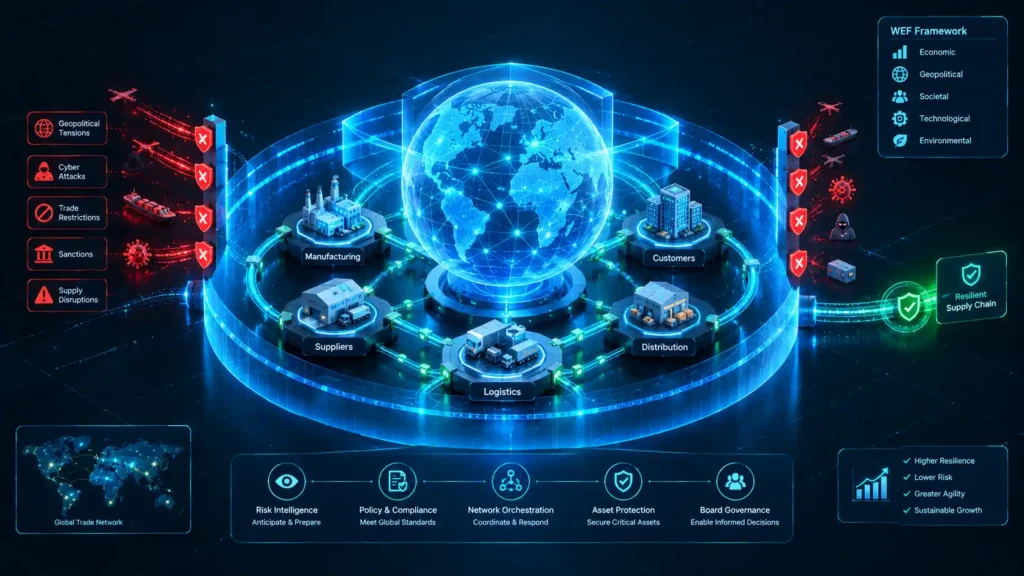
The report’s proprietary Cyber Resilience Compass framework categorizes field-tested security practices into seven interrelated operational dimensions. The underlying data exposes a profound, systemic gap between high-resilience enterprises and resource-constrained organizations across every single metric:
- Category 1 — Leadership: Executive governance serves as the foundation for technical resilience. In high-resilience organizations, 30% enforce personal corporate liability for board members during data breaches, contrasting sharply with a minor 9% baseline among unhardened firms. Within mature environments, 99% document consistent board engagement, with 52% of executive directors receiving structured threat updates and 45% maintaining a clearly defined risk oversight role.
- Category 2 — Governance, Risk and Compliance: Regulatory metrics function as an operational stabilizer rather than an administrative burden—79% of highly resilient corporations hold a positive view regarding the real-world effectiveness of cyber regulations, compared to 62% among under-resourced peers.
- Category 3 — People and Culture: Bridging the internal engineering talent gap is a primary marker of network safety—78% of high-resilience organizations possess the precise technical skill sets required to achieve their security objectives, a staggering contrast to the mere 15% personnel capability floor recorded across insufficiently resilient firms.
- Category 4 — Business Processes (Procurement Integration): True security begins before contracts are signed—76% of high-resilience organizations integrate their security function directly into the vendor procurement pipeline, compared to 53% in lower-tier companies. Routinely reviewing the official World Economic Forum global risk parameters provides an essential, authoritative benchmark to align your internal procurement gates with global validation standards.
Assuming a third-party vendor is entirely secure simply because they display a shiny SOC 2 compliance badge or a generic audit certificate introduces a catastrophic vulnerability into your network edge. A massive, paper-based compliance score means absolutely nothing to your system’s integrity if you grant that provider a standing, unrestricted API key. If their active database connection allows unvetted data schemas or unvalidated inputs to bypass your firewalls, threat actors can weaponize that trusted partner account to push malicious script payloads straight into your core compute clusters—turning their superficial audit checkmark into a direct launchpad for enterprise-wide extortion.
- Category 5 — Technical Systems (AI Security Assurance): Machine learning deployments require continuous validation—83% of highly resilient firms execute comprehensive security assessments on AI tools before deployment, while only 39% of low-resilience teams enforce a similar validation gate, marking this as one of the widest operational discrepancies in the framework.
- Category 6 — Crisis Management (Joint Simulations): Recovery playbooks cannot be verified in a vacuum—44% of high-resilience enterprises actively run simulated cyber incidents and joint recovery drills alongside their ecosystem partners, whereas only 16% of low-resilience operations practice cross-organizational exercises.
- Category 7 — Ecosystem Engagement (Supplier Maturity and Mapping): Securing the boundary means continuously evaluating external dependencies—74% of mature organizations audit the structural security maturity of their suppliers, compared to 48% among insufficiently protected operations. Concurrently, 48% execute detailed ecosystem mapping to identify hidden operational exposure nodes across their partner networks.
The Operational Technology (OT) & Legacy Governance Deficit
Beyond the core metrics of the Compass framework, the report’s dedicated OT data highlights a dangerous, unmonitored exposure window caused by the rapid convergence of IT and industrial systems. Among corporations running active industrial environments, only 16% report OT security issues directly to their executive boards, and a mere 20% maintain a dedicated, specialized OT security team. Furthermore, only 32% actively monitor their physical automated assets with specific, OT-aware security tools, and in just 36% of cases is the CISO legally responsible for both IT and OT security spaces. This massive visibility gap leaves critical manufacturing lines vulnerable, an exposure compounded by the fact that 31% of operators identify legacy systems as their primary barrier to achieving cyber resilience.
SECTION 4: REGULATORY FRAGMENTATION AND THE BOARDROOM ENGAGEMENT GAP
Global sentiment regarding the impact of technology mandates remains highly favorable across sovereign boundaries, with 74% of all evaluated participants viewing cyber-related regulations positively. Threat hunting directors state that these legal frameworks help CISOs successfully elevate security awareness to the board of directors (58%) and drive measurable, tangible improvements in overall security posture (55%).
Regionally, however, the data exposes an inverted paradox where the most mature, high-resource digital landscapes report the lowest confidence in regulatory efficacy:
- Emerging Market Optimism: The Middle East and North Africa lead the global index with an exceptional 81% positive sentiment rating.
- Developed Market Fatigue: Europe and North America—the two regions maintaining the most highly developed, rigorous data safety frameworks—drop to the lowest positive sentiment margins at 70% and 71% respectively.
The global cybersecurity outlook 2026 attributes this specific geographic friction to the complex administrative burdens and severe cross-border compliance fragmentation that advanced frameworks introduce. Global compliance architectures create significant operational bottlenecks, led by extreme difficulties in mandating third-party vendor compliance (18%) and parsing conflicting regulatory application rules across multi-tenant business units (17%).
This regulatory complexity directly compounds a widening divide in corporate leadership alignment. While an unshakeable 99% of high-resilience organizations maintain consistent board-level engagement across their identity perimeters, under-resourced and vulnerable operations exhibit severe leadership gaps across every single measured dimension. This systemic executive disconnect reinforces the identical, high-exposure Leadership-category failure—typified by the stark 30% versus 9% personal liability gap—documented within the Cyber Resilience Compass registries above.
SECTION 5: SUPPLY CHAIN CONCENTRATION RISK AND THE CLOUD DEPENDENCY PROBLEM
Beyond the baseline operational maturity of individual third-party suppliers, the data highlights a major structural concern across the global economy: the systemic vulnerability created by an extreme reliance on a tiny pool of critical digital service providers, legally classified as infrastructure concentration risk. The global cybersecurity outlook 2026 documents that cloud technologies rank as the second most significant tech vertical expected to impact corporate cybersecurity (61%), trailing only behind artificial intelligence and machine learning layers (94%). This massive percentage reflects how deeply embedded a hand-selected number of cloud hosting nodes have become across the global industrial ecosystem, effectively functioning as single-point-of-failure vectors for modern enterprise architectures.
This concentration risk moved from a theoretical threat model to a highly disruptive reality during late 2025 via a series of cascading provider-level infrastructure collapses:
- The AWS DNS Incident (October 2025): A catastrophic administrative misconfiguration inside a core Domain Name System (DNS) layer operated by Amazon Web Services instantly paralyzed thousands of organizations worldwide.
- The Microsoft Azure Outage (October 2025): A global cloud platform crash completely froze enterprise application services within the exact same month.
- The Cloudflare Outage (November 2025): A massive network routing disruption severed thousands of prominent digital platforms and public web portals.
The World Economic Forum is careful to clarify that these specific high-impact incidents were caused by core operational misconfigurations rather than malicious external cyber breaches. However, the report frames them as critical warnings illustrating how a single provider-level fault can instantly trigger broad downstream economic damage across tightly interconnected networks—perfectly mirroring the cascading risk patterns demonstrated by direct cyberattacks like the Jaguar Land Rover breach.
A separate, high-stakes crisis-management case study within the report emphasizes this exact dependency lesson. Following a sophisticated, targeted network cyberattack on Japanese beverage giant Asahi in October 2025, the corporation’s primary enterprise resource planning (ERP) systems and essential IT services were brought down entirely. This forced on-site manufacturing and logistics personnel to completely abandon their digital frameworks and revert to manual pen-and-paper workarounds simply to execute basic inventory tracking and complete safety-critical checks on automated industrial control data.
On broader global supply chain practices, the report’s large-sample analytics show that while 66% of organizations now enforce supplier security maturity assessments and 65% successfully involve their security function inside technology procurement loops, severe blind spots persist in cross-organizational collaboration. A minor 38% actively share real-time threat intelligence with ecosystem partners, and a record-low 27% run joint incident response simulations alongside their vendors—exposing a massive crisis-management execution gap that the WEF Cyber Resilience Compass framework identifies as the single greatest separator between resilient enterprises and vulnerable operations.
SECTION 6: THE PERSISTENT DRIVERS OF GLOBAL CYBER INEQUITY
The research dedicates an entire section to deconstructing the systemic issue of cyber inequity, defined as the heavily uneven distribution of digital capacity across global industries and geographic regions due to structural disparities in talent, financial budgets, and baseline technology systems. This capacity gap is not contained within isolated networks; it introduces a severe security boundary failure across interconnected economic supply chains. Baseline confidence in organizational resilience varies drastically by geographic market, with the Middle East and North Africa leading the index (where 40% of operators report capabilities exceeding minimum requirements), while Sub-Saharan Africa registers the lowest baseline—with a minor 8% reporting exceeding capabilities and 32% absorbing an insufficient resilience posture.
Sovereign enterprise size directly compounds these regional imbalances. Low-revenue, small-scale organizations are mathematically twice as likely to operate with insufficient security perimeters compared to hyperscale corporations. Economic sector classification dictates exposure in an identical fashion: Non-Governmental Organizations (NGOs) report a staggering 37% insufficient resilience level, outstripping the 23% deficit recorded across the public sector and dwarfing the stable 11% baseline found within private enterprise structures, proving that public-interest networks operate under severe systemic strain.
Transnational engineering skills shortages perfectly trace these exact equity fault lines:
- High-Exposure Talent Gaps: A definitive 65% of organizations across Latin America and the Caribbean, alongside 63% within Sub-Saharan Africa, flatly lack the specialized personnel and technical skill sets required to achieve their security milestones.
- Developed Market Baselines: By contrast, skills deficits hover between a more manageable 43% and 48% across South Asia, Europe, East Asia-Pacific, the Middle East, and North America.
To combat this vulnerability, 34% of mature enterprises now provide structured, formalized cybersecurity guidance to under-resourced downstream suppliers, while an additional 31% offer temporary, ad hoc administrative assistance. The index links these private-sector mentoring workflows directly to prominent public-interest initiatives like the CyberPeace Builders and Common Good Cyber coalitions, which work to close the capability gap at scale.
Crucially, the report issues a stark warning that rapid artificial intelligence innovation risks widening this global data divide. The telemetry reveals that 54% of all technology operators identify an absolute shortage of specialized skills as the primary barrier preventing safe AI implementation. Because advanced machine learning capabilities are embedded into software product upgrades faster than resource-constrained organizations can securely govern them, well-funded corporations report significantly accelerated AI adoption curves. Meanwhile, smaller companies, municipal governments, and NGOs lag behind, creating a high-exposure digital landscape where advanced connectivity completely outpaces front-line Technical Pillar defenses.
CONCLUSION & GLOBAL IDENTITY SUMMARY
A resilient privacy and safety posture operates as an active, ongoing system engineering discipline rather than a static stack of boardroom templates signed off once a year. The empirical data within the global cybersecurity outlook 2026 makes this reality unmistakable: every single Cyber Resilience Compass performance category exposes a deep, systemic execution gap between enterprises that operationalize technical defense routines continuously and those that treat them as a superficial compliance checkbox.
The report’s official closing statement delivers a transparent macro warning, asserting that cyber risk has permanently evolved beyond a backroom technical function into a core strategic, economic, and societal concern that demands immediate, coordinated action across disparate sectors and national borders. It concludes on a note of measured optimism, underscoring that organizations that actively embed resilience protocols directly into their leadership agendas, aggressively manage emerging machine learning and supplier vulnerabilities, and proactively collaborate with their wider digital ecosystems are structurally positioned to withstand severe operational shocks and rapidly adapt to global uncertainty.
Closing these structural protection gaps requires a genuine, code-enforced alignment that tightly connects high-level policy design, front-line engineering execution, and international threat intelligence sharing loops. The devastating financial fallout of the Jaguar Land Rover supply chain collapse—combined with the massive systemic vulnerabilities exposed by the late-2025 AWS, Azure, and Cloudflare infrastructure outages—demonstrates that a single provider-level configuration fault or targeted edge compromise can cascade into billions of dollars in national economic damage.
This occurs completely irrespective of how well-fortified an individual organization’s specific boundaries appear on a paper balance sheet. Compliance architects and technology officers must treat every single Compass domain as a standing, active engineering discipline to be audited continuously, completely moving away from treating threat intelligence as a static report to be filed away until the next corporate review cycle.
Balancing macro executive risk oversight with real-time, front-line technical defense remains one of the most complex orchestration challenges facing modern DevOps and compliance teams. We invite you to join the technical discussion in the comments section below: What specific passive network scanning architectures, automated framework tracking tools, or continuous third-party vendor monitoring platforms are you utilizing to audit your enterprise supply chains against global benchmark indexes? Have you successfully automated your API token revocation playbooks to isolate external supplier drift instantly, or are you executing manual configuration updates during procurement cycles? Share your network layouts, identity access blueprints, and hard-earned advice with the engineering community below!
Related: 5 Crucial Steps to Harden Adobe AI Content Privacy Settings Now – A practical five-step strategy to harden Adobe AI content privacy settings, control telemetry, protect sensitive creative assets, and prevent unauthorized AI data analysis.
5 Critical Pillars of the Global Cybersecurity Index 2024 Revealed – The Global Cybersecurity Index 2024 reveals how legal, technical, organizational, capacity-building, and international cooperation shape national cyber resilience—and where critical security gaps still remain.
5 Practical Ways Vetting Third Party SaaS Vendors Combats Supply Chain Risks – Vetting third-party SaaS vendors helps organizations reduce supply-chain risk by validating compliance, enforcing least-privilege access, securing integrations, and continuously monitoring vendor security.
CISA Siemens S7 Advisory: 7 Critical Hardening Steps – CISA’s Siemens S7 advisory highlights an active AI-assisted threat to critical infrastructure, urging operators to harden PLCs, eliminate internet exposure, strengthen access controls, and monitor for malicious activity.
FREQUENTLY ASKED QUESTIONS (FAQ)
Q1. The GCO 2026 highlights a massive divergence where CEOs prioritize cyber-enabled fraud while CISOs remain focused on ransomware. How can a security team bridge this priority divide to secure infrastructure funding?
To resolve this internal friction, security teams must translate operational technical threats into direct business impact metrics. Instead of presenting raw vulnerability counts or server patch backlogs, CISOs should present data models detailing how a perimeter gateway compromise or ransomware lock triggers immediate revenue stagnation, regulatory data liabilities, and cascading supply chain downtime.
Q2. According to the report, 87% of leaders view AI vulnerabilities as the fastest-growing cyber risk. What concrete engineering steps can we take to protect our internal datasets from generative AI leaks?
Organizations must implement robust data egress filtering and API input sanitization across all corporate LLM pathways. Deploy automated data loss prevention (DLP) gateways to actively scan user prompts for sensitive proprietary source code or customer metrics, enforce rigid tenant isolation boundaries on all fine-tuning repositories, and disable out-of-the-box vendor data collection configurations.
Q3. The WEF data shows that public sector organizations report double the rate of insufficient cyber resilience (23%) compared to the private sector (11%). Why does this public sector vulnerability exist?
Public sector and international institutions are heavily constrained by legacy procurement regulations, complex bureaucratic funding approval paths, and a severe shortage of competitive security engineering talent. These resource constraints slow down modern patch management pipelines, leaving critical public infrastructure running on outdated code arrays that threat actors target via automated internet-wide scanning services.
Q4. How does the concept of “Cyber Sovereignty” mentioned in the report impact multi-national enterprises using centralized hyperscale cloud architectures?
Cyber sovereignty forces a shift away from global data aggregation toward regionally isolated or sovereign cloud subnets. Multinational firms must re-engineer their infrastructure to ensure that sensitive customer information and proprietary operational data are stored, processed, and cryptographically managed within the explicit legal boundaries of the local host nation, preventing unauthorized extraterritorial data access during cross-border conflicts.
Q5. The report notes that only 16% of companies report OT security issues to their boards, exposing a massive governance gap. What is the infrastructure risk of leaving the CISO disconnected from the OT cell?
When the CISO is excluded from OT cell oversight, the corporate perimeter lacks a unified visibility layer over converged IT/OT networks. This allows threat actors to compromise an unmonitored IT endpoint—like an office workstation—and move laterally straight into core industrial logic networks, rewriting programmable controller code undetected because plant floor operations are entirely siloed from centralized security logging networks.
DISCLAIMER
Educational Notice: This article is published on AI Security Watch strictly for technical educational and general cybersecurity awareness purposes. The configurations and research discussed are based on public threat intelligence data. This content does not constitute professional IT architecture, legal, or financial advice. Because network configurations vary, always verify settings in an isolated test environment or consult with a qualified engineer before modifying live hardware or registries. AI Security Watch contains informational links to external resources; we are not responsible for third-party site accuracy or platform content.