
⚡ TL;DR — Key Takeaways
- Administrative access controls: Establishing absolute endpoint gateway constraints protects your underlying infrastructure—to block credential stuffing effectively, your middleware layers must cleanly identify and authenticate every client profile at the network edge before a single login attempt ever reaches your core application logic.
- Vendor/client parameter validation: Restructuring incoming entry parameters provides vital protection against advanced proxy-rotation vectors—combine network-level IP behavior analytics with ja3/ja4 TLS fingerprinting and device metadata parsing, as no single data signal catches a determined bot on its own.
- Stream-optimized runtime flags: Transitioning configuration profiles into locked, system-managed states prevents memory misalignment across service nodes—rate-limit incoming candidate traffic at the edge using a rolling sliding window model, completely avoiding fixed clock resets that automated scripts can easily time around.
- Perimeter isolation validation: Shielding downstream enterprise computing systems demands active verification testing under load—enforce strict boundary filters to return clean, fast rejection responses for excessive traffic, ensuring a high-velocity script flood never reaches your primary database connection pool.
Table of Contents
Exposed HR platforms, procurement endpoints, and candidate intake systems have permanently evolved beyond basic, backroom business utility forms. In the current threat landscape, these public-facing interfaces have become prime target zones and high-velocity launch bases for automated script networks, distributed credential reuse loops, and synthetic candidate profile floods that systematically treat your intake infrastructure as free computing resources to manipulate and abuse. Operating an exposed internet gateway without restricting submission profiles means an automated attacker can scale server resource usage infinitely, converting unmonitored form fields into entry points for large-scale systemic exploitation before your security alerts ever trigger an internal event flag.
Deciding to deploy an explicit, structural roadmap to manage your endpoint validation parameters and block credential stuffing vectors is a critical, revenue-critical operational engineering requirement rather than a secondary optimization pass. Enforcing strict, code-driven perimeter constraints is the only technical mechanism that successfully prevents platform-level resource exhaustion, preserves backend database infrastructure integrity, and protects the internal identity registries tied to every candidate and employee account.
Without deep, interface-specific filtering layers, public application routes remain highly exposed, leaving your processing engines completely vulnerable to automated token exhaustion scripts that can paralyze your database connection pools.
There is a profound, stomach-dropping sense of technical disbelief that hits you when you log into your infrastructure dashboard on a Monday morning only to discover that your recruitment interface completely locked up the application layer over the weekend. You look at the database telemetry and realize that because the form route lacked an explicit middleware edge filter, an automated script network spent 48 hours spamming millions of stolen username and passcode combinations straight into your authentication logic.
Watching a simple hiring portal configuration oversight rack up massive emergency forensic consulting fees, crash downstream microservices, and corrupt your candidate database with thousands of synthetic scrap files is a brutal wake-up call. It proves that a single unthrottled form endpoint can instantly compromise an organization’s structural stability.
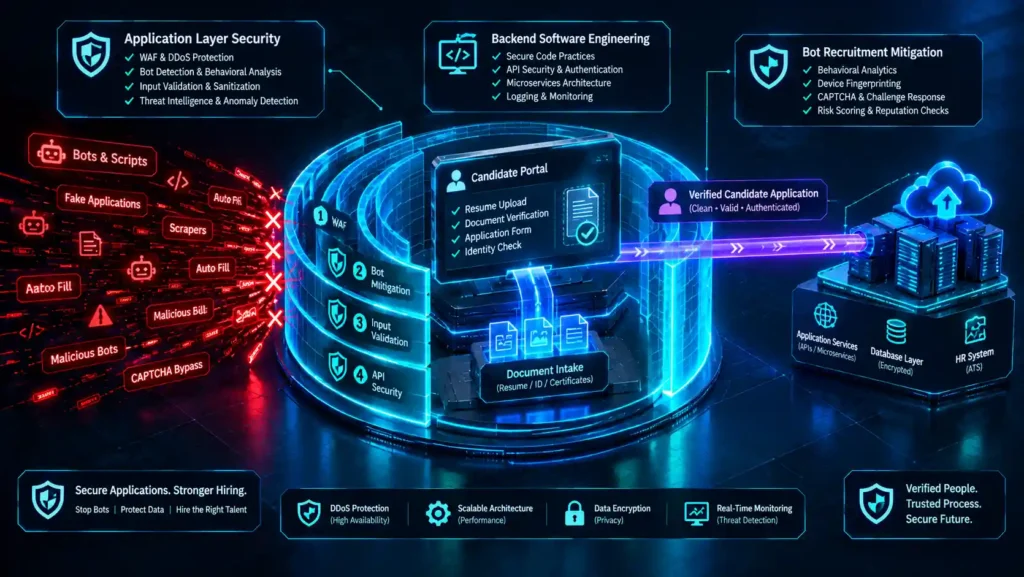
The four coordinated implementation steps detailed below construct that technical defense from the external network edge inward, culminating in the automated, fail-secure response barriers required to ensure a flood of malicious web traffic never impacts your core backend systems.
STEP 1: MULTI-FACTOR TELEMETRY IDENTIFICATION AND EDGE PARAMETER PARSING
Any defensive strategy engineered to block credential stuffing must systematically establish the true identity of the inbound request before allowing a single login phase or submission attempt to reach core authentication logic. Relying on superficial parameters creates immediate security gaps that automated scanning arrays manipulate at will.
- Implement multi-tiered connection tracking logic: Relying strictly on a single network-layer signal, such as a raw IP address, is incredibly fragile. Modern credential-stuffing toolkits are built specifically to cycle through extensive residential proxy networks, allowing automated scripts to present a fresh IP footprint on every consecutive request loop.
- Layer in JA3 and JA4 TLS fingerprinting parameters: These specialized cryptographic markers analyze the precise technical characteristics of how a client negotiates its initial TLS handshake. Because handshake parameters are exceptionally difficult for an automated framework to spoof compared to a standard, text-based user-agent header string, botnets frequently expose themselves by broadcasting distinct, highly recognizable TLS fingerprints across their entire distributed node pool.
- Add deep client device metadata analysis as a third verification layer: Evaluating client-side behavioral signals—such as screen resolution inconsistencies, missing browser web APIs, non-standard font arrays, and unnatural, millisecond-precise timing between interactive form inputs—instantly flags scripted, non-human traffic profiles when parsed alongside your network telemetry data.
- Treat incoming client identification as a cumulative risk score: Avoid managing perimeter identity verification as a simple binary pass-or-fail rule. The objective of an advanced edge-filtering architecture is to build a composite risk-scoring matrix, ensuring that an automated attacker who successfully manipulates or bypasses one tracking layer is still intercepted and dropped by the adjacent verification filters.
STEP 2: DYNAMIC RATE LIMITING STRATEGIES AND SLIDING WINDOW SHIELDING
The mathematical algorithm underpinning your rate-limiting framework directly determines whether automated script networks can exploit predictable window resets to slip massive volumes of login attempts through undetected. Selecting an outdated traffic model leaves public interfaces exposed to systematic boundary manipulation.
- Understand why fixed-window counters fail against credential stuffing: A basic fixed-window approach resets its internal integer count at a defined clock boundary, such as the top of every minute. This layout introduces a severe scheduling vulnerability; an automated toolkit can burst through its maximum allowed authentication limits in the final seconds of an active window, and immediately burst through it again in the opening seconds of the next, effectively doubling the intended threshold in seconds.
- Deploy a rolling sliding window counter at the application edge instead: A sliding window model continuously evaluates inbound transaction velocity over a dynamic, rolling time period rather than matching a fixed clock boundary. This programmatic adjustment effectively closes the edge-of-window burst exploit that credential stuffing scripts are specifically tuned to time around.
- Consider token bucket logic for legitimate burst tolerance: Token bucket algorithms allocate a fixed capacity of transaction tokens that programmatically refill at a steady, predefined rate. Each inbound payload consumes a single token from the pool, and requests are rejected the exact millisecond the bucket hits empty—this approach smooths out bursty traffic while still tolerating brief, legitimate user spikes, which is highly effective for recruitment portals facing genuine traffic surges around application deadlines.
- Scale limits dynamically based on composite risk scores: Move away from enforcing a single, uniform threshold across your entire enterprise base. A client connection flagged as higher risk by your multi-factor telemetry layers must automatically face a tighter, highly restrictive rate limit, rather than allowing every client to share an identical threshold regardless of structural behavior.
STEP 3: LOG CONSOLIDATION METRICS AND TELEMETRY VERIFICATION DRIFTS
Scattered operational signals across distributed web services are far less useful than the exact same metrics correlated into a single, coherent picture of attacker behavior. To block credential stuffing loops before they compromise core backend structures, your logging pipelines must actively bridge the visibility gaps between disconnected web endpoints.
- Route all form entry attempts through centralized logging pipelines: Failed login attempts, candidate application submissions, and password reset requests frequently execute across completely separate web services. Without a centralized logging pipeline, a highly distributed credential stuffing campaign spread across those distinct microservices can easily look like isolated, harmless noise rather than a coordinated threat actor attack footprint.
- Cross-correlate edge anomalies across services in near real time: A data pattern that appears completely unremarkable inside an isolated database log—such as a handful of failed authentication loops here or a minor spike in file uploads there—frequently reveals a clear, malicious attack signature the moment it is cross-correlated against the identical source IPs, TLS fingerprints, and strict transaction timing windows.
- Ground your logging architecture in established enterprise best practices: Engineering teams constructing this high-throughput correlation layer should align their technical parameters directly with the official OWASP automated threat prevention blueprints. This institutional standard catalogs the exact detection signals, defensive header structures, and monitoring approaches that security directors rely on to distinguish coordinated stuffing campaigns from ordinary login traffic.
- Watch closely for telemetry verification drift over time: Automated threat networks rapidly adapt their tooling, proxy matrices, and rotational velocities the exact second their initial penetration runs get throttled. Your logging architecture requires continuous manual tracking reviews to guarantee the specific telemetry signals used to detect and block credential stuffing active workloads still match current attacker behavior rather than relying on last quarter’s legacy signature tactics.
STEP 4: AUTOMATED INTERFACE ISOLATION AND FAIL-SECURE RESPONSE BARRIERS
The final layer of your security stack determines exactly what happens the instant an inbound request crosses your defined risk thresholds, and how cleanly your system degrades under sustained volumetric pressure. Designing vulnerable error interfaces or leaky exception paths can inadvertently give threat actors the precise telemetry data they need to optimize their automated evasion strategies.
- Return clean HTTP 429 status responses for excessive traffic: A properly structured HTTP 429 “Too Many Requests” payload must terminate the transaction immediately at your network edge, well before it can ever reach your core application logic or primary database layer. Blocking the transaction early is the exact technical mechanism that actively protects infrastructure integrity and database availability, rather than simply relying on client-side compliance.
- Isolate flagged traffic blocks without disrupting legitimate applicants: A strategy designed to block credential stuffing that operates with overly aggressive, blunt thresholds risks locking out authentic job candidates or vendors during a high-volume hiring surge. Your isolation middleware should escalate dynamically—gradually transitioning from low-latency friction challenges to temporary, time-bound session blocks rather than an immediate hard stop for every borderline telemetry signal.
- Design the fail-secure state to degrade gracefully under maximum load: If your rate-limiting framework or third-party identification cluster itself becomes temporarily unavailable or crashes under a massive distributed denial-of-wallet (DoW) flood, your routing system must default to a conservative, highly protective posture. The backend must explicitly reject unverified traffic streams during a telemetry outage rather than silently opening a backdoor that allows all automated traffic through unchecked.
Assuming a public-facing form endpoint or candidate login panel is completely secure simply because it sits behind a standard, off-the-shelf CAPTCHA challenge introduces a highly dangerous false sense of security across your operational divisions. Modern automated script frameworks and initial access brokers routinely pass pre-solved tokens, leverage low-cost human solver farms via API integrations, or rotate residential proxy subnets cleanly to simulate authentic user paths. If you rely on a single, superficial interactive barrier as your standalone security shield, threat actors can bypass basic filters completely undetected—quietly executing large-scale credential stuffing runs that compromise user accounts while your administrative teams remain entirely unaware of the ongoing intrusion.
CONCLUSION & GOVERNANCE BOUNDARY SUMMARY
A resilient privacy and application safety posture operates as an active, ongoing system engineering discipline rather than a static boardroom compliance checkbox reviewed once and forgotten. A strategy built to block credential stuffing—combining layered client identification, sliding window rate limiting, centralized log correlation, and disciplined fail-secure response barriers—actively shields your hiring portal from the kind of catastrophic financial and operational drain a single unthrottled endpoint can cause.
Anchoring the perimeter on automated token telemetry, credential isolation, and disciplined network blocks turns what starts as a single exposed application form into infrastructure your team can trust under real, sustained attack conditions.
Balancing rapid user acquisition and recruitment onboarding with rigid, continuous endpoint verification remains one of the most complex orchestration challenges facing modern DevOps and identity access teams. We invite you to join the technical discussion in the comments section below: What specific web application firewalls, proxy layers, or automated log correlation tools do you deploy to monitor your Node.js application perimeters against candidate-portal abuse? Have you successfully shifted your form endpoints to dynamic sliding window rate limiters, or are you running basic fixed-window middleware validation checks during staging builds? Drop your architectural layouts, custom endpoint protection patterns, and hard-earned advice with the engineering community below!
Related: NIST Framework Alignment: 6 Crucial Rules to Stop Compliance Drift – A practical NIST-aligned GRC roadmap for turning compliance into continuous security governance through asset visibility, strong access controls, detection, response, recovery, and audit readiness.
Check Point Cyber Security Report 2026: Crucial Tactics to Shield Networks – A strategic look at Check Point’s 2026 cybersecurity outlook, revealing how AI-driven threats, evolving attack vectors, and unified security are reshaping enterprise cyber defense.
OpenAI API Rate Limit: 5 Crucial Middleware Steps to Stop Billing Attacks – A practical guide to implementing OpenAI API rate limiting in Node.js, using middleware and distributed controls to prevent abuse, runaway costs, and AI service disruption.
IBM Cost of a Data Breach 2026: 7 Crucial Metrics to Stop Loss Exposure – IBM’s 2026 breach-cost analysis reveals how AI-driven security, faster containment, and stronger controls can significantly reduce the financial impact of data breaches.
Linux UFW Firewall WireGuard: 5 Crucial Steps to Secure Tunnels – A practical guide to securing Linux servers with UFW firewall rules and WireGuard VPN, combining controlled access, encrypted connectivity, and stronger host-level protection.
Global Cybersecurity Outlook 2026: Crucial Tactics to Defeat Systemic Threats – A deep dive into the 2026 global cybersecurity landscape, revealing how AI, supply-chain dependencies, geopolitical risk, and boardroom gaps are reshaping enterprise cyber resilience.
FREQUENTLY ASKED QUESTIONS (FAQ)
Q1. If an attacker utilizes automated headless browser frameworks like Puppeteer or Playwright that simulate authentic user interactions, how does our edge middleware block them?
While headless browsers can simulate standard typing cadence and click movements, they consistently fail at the underlying cryptographic and protocol layers. Your middleware isolates these automated pipelines by analyzing advanced browser telemetry variables—specifically evaluating JA3/JA4 TLS handshake fingerprints and hunting for missing web platform APIs or canvas rendering mismatches that expose automated runtime execution nodes regardless of how cleanly they simulate surface human behavior.
Q2. Will running comprehensive multi-tiered telemetry parsing and log correlation on every application submission slow down our user login speeds or add noticeable latency?
No, provided your edge validation layer is anchored on high-performance caching nodes. By using asynchronous, non-blocking check routines and storing active transaction metrics within an in-memory data cluster (like Redis), connection parameters are evaluated and scored in single-digit milliseconds, allowing your perimeters to drop bot traffic at near-wire speeds without introducing perceptible lag to legitimate, human applicants.
Q3. What is the primary technical danger of utilizing a basic captcha challenge as our sole line of defense against recruitment portal automation?
Relying strictly on an interactive capture puzzle introduces a dangerous point of failure because modern threat networks can easily bypass them using low-cost programmatic solver APIs or automated token-passing services. Furthermore, relying entirely on heavy visual puzzles degrades user accessibility, driving up candidate drop-off metrics during hiring surges while failing to stop sophisticated botnets that treat pre-solved verification tokens as simple passcodes to slide past your defenses.
Q4. How can small operational teams implement centralized log correlation across multiple third-party candidate submission systems without high data ingestion costs?
Small business IT teams must configure strict event filtering protocols straight at their application routing boundaries. Instead of ingesting high-volume, unparsed transactional log noise, route all system traffic streams through a centralized gateway filter that drops standard success parameters and indexes only high-risk telemetry—specifically logging failed login iterations, sudden profile updates, and anomalous user-agent variations to preserve storage capital.
Q5. If our automated sliding window limiter triggers a false-positive block on a legitimate applicant connecting from a shared corporate office network, how do we resolve the lockout?
To prevent blunt, permanent lockouts across shared public IP structures (like a university or corporate office network), your rate-limiting framework should never deploy a permanent hard block based on a single signal. When a volume threshold is crossed, your edge middleware must dynamically scale the response—initially introducing a soft friction challenge or temporary, five-minute session cooldown window, allowing the client interface to safely regenerate its access permissions without cutting off an entire shared regional gateway.
DISCLAIMER
Educational Notice: This article is published on AI Security Watch strictly for technical educational and general cybersecurity awareness purposes. The configurations and research discussed are based on public threat intelligence data. This content does not constitute professional IT architecture, legal, or financial advice. Because network configurations vary, always verify settings in an isolated test environment or consult with a qualified engineer before modifying live hardware or registries. AI Security Watch contains informational links to external resources; we are not responsible for third-party site accuracy or platform content.