
⚡ TL;DR — Key Takeaways
- Administrative access controls: Establishing absolute model intake boundaries protects your underlying systems—attaining secure langchain tool execution routines dictates that development teams treat every model-generated functional argument as hostile until proven otherwise, forcing strict validation checks before granting agents native filesystem or data hooks.
- Vendor/client parameter validation: Restructuring incoming argument parameters provides critical insulation against semantic prompt overrides; implement rigid gateway access controls to ensure no autonomous tool call ever reaches a high-privilege execution slot unvalidated.
- Stream-optimized runtime flags: Monitoring dynamic orchestrator pipelines eliminates loose input variables across your application tier; validate request parameters using hardcoded data schemas rather than allowing unsafe, loose string passing to define functional execution arguments.
- Perimeter isolation validation: Shielding core infrastructure nodes demands active runtime containment boundaries rather than passive post-incident alerts—set up low-latency validation flags using lightweight intent-inspection filters to catch anomalies before an action fires, and execute perimeter containment insulation by containerizing the local runtime environment to isolate the blast radius when upstream validation layers fail anyway.
Table of Contents
Building autonomous applications with Python AI orchestrators like LangChain makes it deceptively simple to wire a large language model straight to real enterprise tools—such as database writes, internal administrative APIs, and local file system nodes—in just a handful of configuration lines. However, this ease of implementation routinely creates a dangerous, false sense of safety across internal software development teams.
Engineers frequently lower their operational guard, treating model-generated function arguments as safe, verified application parameters the moment the orchestration framework accepts them, simply because the code compiles cleanly and executes without returning a runtime error. The core technical risk remains completely unaddressed: an unvalidated argument string generated dynamically by a model functions as an unvetted payload, fully capable of abusing native application permissions long before traditional perimeter firewalls can detect the breach.
That foundational assumption operates as the actual systemic vulnerability across modern AI architectures. A function argument produced dynamically by an LLM is never developer-authored, pre-validated data—it is an unpredictable text string generated by the model in response to whatever context variables reached its processing window, explicitly including malicious strings that an external adversary may have planted inside data inputs. Passing that raw output string directly into a high-privilege tool execution slot treats an completely untrusted model output as if it were a trusted, sanitized developer input.
Deciding to deploy an explicit, structural roadmap to manage validation parameters and enforce a state of secure langchain tool execution is a mandatory, core operational engineering requirement rather than a secondary hardening pass reserved only for high-security deployments. Skipping this protective layer directly invites code-level application compromise, allows lateral privilege escalations through connected tools, and accelerates technical risk drift that compounds exponentially with every new custom utility registered to an autonomous agent’s toolkit.
There is a profound, stomach-dropping sense of technical disbelief that hits you when you conduct a routine cloud sandbox audit and realize that your autonomous execution boundaries have completely disintegrated. You check the integration logs and watch your heart sink as you discover that a simple, natural-language prompt-injection payload had successfully overridden an agent’s hardcoded system instructions.
The adversarial input seamlessly tricked the core LLM into invoking a native file-deletion tool, causing the model to wipe an entire production testing storage bucket without triggering a single system validation failure or raising an infrastructure error flag. Watching a natural-language text string manipulate a high-privilege native application tool into destroying persistent data arrays—while your logging pipelines reported absolute transactional success—is a brutal wake-up call. It proves that local sandboxing and standard network-layer rules mean absolutely nothing if your orchestration layer blindly trusts model outputs as safe execution parameters by default.
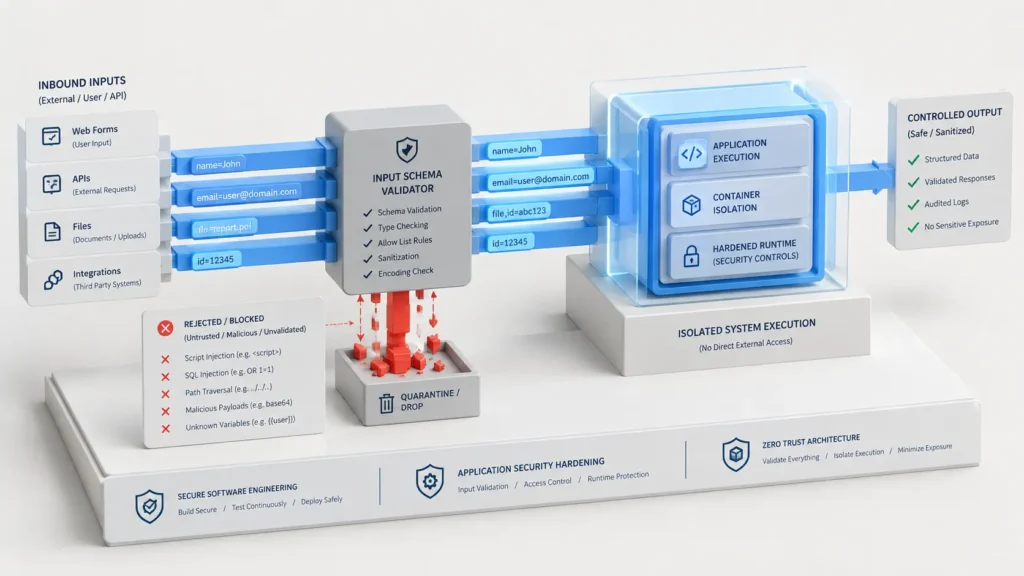
The six coordinated technical step blueprints detailed below construct that protective tier from the intake schema to the final containerized runtime boundary, ensuring your automated agents remain structurally isolated from injection-based manipulation vectors.
STEP 1: ENFORCED PYDANTIC COMPLIANCE AND HARD DATA SCHEMAS
The primary architectural boundary must reside entirely at the custom tool’s intake edge, intercepting the transactional data footprint before an argument payload can enter the execution function body. Custom tools engineered to accept loosely parsed text variables—such as accepting a free-form string and relying on internal regex logic to parse parameters—leave that processing workflow highly vulnerable to semantic manipulation, precisely because the untrusted model itself controls the exact formatting of the text being parsed.
- Hardcode explicit schema blueprints for every functional argument: Development divisions must enforce rigid structural compliance rules by binding every registered tool directly to an immutable data definition framework. This technical guardrail ensures that the underlying orchestration platform programmatically validates field presence, parameter types, and overall payload structure before the tool function can trigger execution on the host machine.
- Enforce a non-negotiable strict-rejection posture at the ingestion gateway: If an autonomous agent generates an input payload that deviates from your expected structural blueprint—such as inserting unmapped fields, a malformed type, or an unexpected nested block—the transaction must be dropped at the boundary edge immediately. Reject any best-effort typing coercion or programmatic formatting cleanups; a system utility that attempts to fix malformed input strings into a usable format inadvertently reintroduces the exact semantic ambiguity that data schemas are explicitly deployed to eliminate.
STEP 2: STRICT PARAMETER TYPING AND CASTING PRIMITIVES
Schema enforcement alone fails to close the security gap if every target parameter inside that validation structure is typed as a generic, unrestricted string. A free-form string field serves as a direct, unmonitored backdoor for command injection exploits [2.5] because it accepts any raw text the model happens to generate—including malicious syntax shaped specifically to exploit whatever downstream database or filesystem function eventually consumes it.
- Enforce rigid, field-level data typing constraints: System developers must replace open-ended string arguments with highly restrictive primitive variables. Enforce strict integers where an input must be numeric, explicit booleans where a parameter is binary, and tight, regex-constrained string formats where text inputs are genuinely unavoidable. Each of these hard primitives significantly narrows what the model is programmatically capable of passing through, completely independent of whether the model’s underlying intent was malicious or simply imprecise.
- Validate input parameters against clean operational criteria at the edge: Input values must undergo strict verification checks at the ingestion perimeter before they can reach downstream backend functions. Rather than trying to sanitize unsafe data strings after the fact, your execution context layer must reject the complete transaction outright if it fails to match the expected blueprint shape. Implement highly restrictive validation parameters, as a regular expression that is too permissive defeats the engineering purpose just as thoroughly as providing no regex mapping at all.
STEP 3: LOGICAL TOOL-ROUTING GATEWAYS AND ISOLATED RUNTIME RUNBOOKS
Even when implementing rigid validation schemas and strict primitive typing, a highly sophisticated semantic manipulation attempt can still occasionally bypass front-line validation layers. For this reason, your application security architecture must operate under a zero-trust model, ensuring that host-level boundary configurations force every custom tool execution sequence to run within a heavily containerized, transient runtime environment rather than directly on the parent orchestrating host server.
- Abstract agent environments via secure virtual sandboxes: Autonomous application spaces must be completely decoupled from the underlying host operating system using locked execution sandboxes. This structural isolation ensures that a high-privilege tool invocation—even one triggered by a successfully overridden model orchestrator—possesses zero programmatic pathways to reach outside its designated execution context boundaries, successfully containing the blast radius before the exploit can touch your core cloud infrastructure.
- Enforce transient runtime configurations to eliminate persistent footholds: Your tool-routing gateways must deploy short-lived, transient containers that tear down and rebuild automatically after every single execution cycle. Forcing this lifecycle constraints prevents a compromised script from accumulating persistent backdoors, reverse shells, or malicious file buffers, completely closing off an exploitation class that depends on the execution environment surviving past a single transactional tool call.
STEP 4: PRE-EXECUTION MODEL VALIDATION DRILLS AND INTENT INSPECTION
While automated schema checks catch structurally malformed inputs, they remain completely blind to syntactically perfect parameters wrapped in malicious semantic intent. To insulate your backend nodes from this subtle exploit vector, development teams must deploy a distinct dual-model routing validation loop, leveraging a secondary, lightweight inspection model to evaluate a proposed functional instruction block completely before that action is finalized.
- Map model-generated functional arguments against rigid safety filters: The secondary classification engine operates with a highly narrow scope—parsing generated functional parameters specifically to expose hidden natural language overrides or prompt manipulation strategies that pass schema checks but violate system boundaries. This inspection model must have zero direct access to system tools or external APIs, keeping its validation logic isolated from the same semantic exploit surface as the primary autonomous agent.
- Enforce pre-execution blocking to guarantee zero state side effects: Because this intent evaluation executes natively before the tool receives the payload rather than after it processes, a blocked request never reaches your application code. The primary orchestrator’s state database isn’t modified, and zero side effects occur across your environment, completely neutralizing a prompt-injection compromise regardless of how convincingly the initial user input manipulated the primary large language model.
STEP 5: CRYPTOGRAPHIC TRUST ARRAYS AND DIGITAL COMPONENT VERIFICATION
The preceding architectural steps are built entirely on the baseline assumption that the executable tool modules themselves are legitimate. Implementing cryptographic trust arrays protects this exact operational space by enforcing rigid tool integrity controls, ensuring that only verified, digitally signed code blocks can be registered into the autonomous agent’s active directory layout. This turns security into a proactive check against software supply chain contamination rather than a reactive monitoring tool targeting live runtime parameters.
- Enforce digital signature verification at the tool registration layer: Without an active cryptographic verification mechanism, a malicious library injection or a silent runtime tool-swap attempt can quietly introduce a rogue code pathway straight into a live execution loop. From the orchestrator’s perspective, this compromised script looks exactly like a legitimate, natively registered capability. Mandating automated signature checks at initialization closes this vulnerability window long before the orchestrator can call the compromised tool component.
- Align component verification with elite application security blueprints: Engineering teams building these validation systems must ground their verification logic in established, community-vetted frameworks rather than attempting to construct custom tracking mechanisms from scratch. Compliance managers should cross-reference their architecture straight against the official OWASP application-layer injection protection blueprints to gain vital operational context for their audits. Reviewing these industry-standard registries allows technical directors to map supply-chain dependencies and excessive agency hazards as independent threat surfaces distinct from prompt injection itself, helping them evaluate where tool registration integrity sits within the broader microservice parameter scope.
STEP 6: POST-EXECUTION REDACTION ROUTINES AND TELEMETRY LEAK SHIELDS
The final boundary checkpoint sits directly at the tool’s execution exit point rather than its entry point. Even when implementing resilient input validation layers, sandboxed environment execution, and verified code block integrity, a tool’s dynamic return value can still contain highly sensitive data that must never be allowed to reach the user-facing chat loop interface.
- Deploy isolated error-masking and result-filtering layers: Your application architecture must comprehensively evaluate every single tool return payload before forwarding the text variables back into the active conversation lifecycle. If a tool execution yields raw system metadata, server directory trees, or sensitive database credentials as part of its output—whether generated through a code bug, a misconfigured container tool, or a successful upstream semantic manipulation loop—the string payload must be redacted instantly at this exit perimeter layer before it can reach the model’s next attention window or pass to the end user.
- Enforce exit-side controls independently of input defenses: This post-execution filtration loop must operate as a completely standalone, independent architectural guardrail. It functions under an explicit assume-compromise posture, presupposing that input-side filters may have already failed for a given execution turn, and focuses its task entirely on ensuring that an intermediate compromise cannot propagate outward as a catastrophic data leak.
Assuming an AI agent or automated orchestration framework is completely insulated simply because it runs behind a standard network-layer enterprise firewall introduces a highly dangerous false sense of security across your operational divisions. Traditional network firewalls excel at blocking unauthorized external connection profiles and dropping unvetted port traffic loops, but they remain completely blind when an adversary uses natural language shifts to manipulate your systems. If a prompt-injection payload successfully overrides your system prompt, the adversary manipulates your high-privilege native tools entirely from within the trusted network boundary—forcing your backend applications to execute destructive commands or exfiltrate databases while your perimeter filters report zero structural anomalies.
CONCLUSION & GOVERNANCE BOUNDARY SUMMARY
A resilient privacy and orchestrator safety posture operates as an active, ongoing system engineering discipline rather than a static boardroom compliance checkbox reviewed once and filed away. Every new tool registered to an agent, every foundational model version upgrade, and every advanced prompt manipulation technique discovered in the wild changes the baseline threats that the validation architecture must defend against. Maintaining an unyielding governance posture requires engineering groups to continuously refine their application perimeters against structural decay.
Anchoring the gateway layout on automated token telemetry, strict credential isolation, and disciplined network blocks actively shields your compute cluster and enterprise databases from catastrophic financial and operational drain. This approach mitigates the severe corporate threats that invariably launch with a single manipulated tool invocation and culminate in a wiped production index or a leaked system credential.
None of these core validation layers functions as a standalone, absolute security guarantee. Rather, schema enforcement, strict primitive typing, sandboxed runtime execution, pre-execution intent inspection, cryptographic tool integrity verification, and post-execution output redaction collectively form a highly robust, multi-layered defensive matrix required to secure langchain tool execution tracks. This defense-in-depth model ensures that each autonomous control gate catches the parameter variations that the preceding layer missed, completely abandoning the dangerous assumption that any single administrative control is sufficient on its own.
Balancing rapid development velocity with rigid parameter protection remains one of the ultimate challenges facing modern agentic AI engineering. We want to hear from you in the comments section below: What specific passive scanning architectures, framework tracking layers, or automated log monitoring platforms do you deploy to audit your infrastructure perimeters against global indexes and secure langchain tool execution tracks within your Python stacks? Have you encountered unexpected latency overheads when routing tool arguments through secondary token-parsing utilities, or are you managing transient runtime environments through automated Docker orchestration tools? Share your structural layouts, custom data validation schemas, and hard-earned runtime security advice with the engineering community below!
Related: Secure Open WebUI Nginx: 7 Crucial Steps to Shield Corporate Networks – A practical seven-step guide to securing Open WebUI on Debian with Nginx reverse-proxy isolation, container segmentation, mTLS, hardened headers, and rate limiting to reduce exposure and abuse.
Disable Apple Intelligence Training: 3 Crucial Steps to Stop Corporate Leaks – A practical guide to disabling Apple Intelligence across enterprise Macs using MDM controls, configuration hardening, and continuous endpoint validation to reduce background telemetry and corporate data leakage.
ENISA Threat Landscape 2025: Ultimate Summary to Shield Corporate Networks – A comprehensive summary of the ENISA Threat Landscape 2025, examining evolving cyber threats, supply-chain risks, ransomware, AI-driven attacks, vulnerabilities, and the controls organizations need for stronger resilience.
Automated Access Review: 4 Crucial Steps to Stop Compliance Drift – A practical framework for small teams to automate access reviews, detect privilege drift, maintain audit-ready evidence, and securely remove stale permissions.
EU AI Act Compliance: 4 Crucial Steps to Stop Compliance Drift – EU AI Act compliance isn’t a one-time checklist—build a continuous SaaS roadmap for risk classification, transparency, logging, and audit readiness.
Prompt Injection Defense: 4 Crucial Tactics to Shield Corporate Networks – How Semantic Kernel can help defend AI applications against prompt injection attacks using structured orchestration and layered safeguards.
FREQUENTLY ASKED QUESTIONS (FAQ)
Q1. How can small engineering teams intercept model attempts to inject malicious flags into the Pydantic parser, such as passing extra arguments not declared in the schema?
Development teams must enforce a strict constraint model by setting the extra configuration property to forbid within their Pydantic base model definitions. This configuration forces the runtime engine to throw an immediate schema validation exception the exact millisecond an LLM attempts to pass unmapped parameters or rogue metadata fields, preventing unvetted data blocks from slipping past your input gates.
Q2. Will routing our LangChain tool execution responses through an exit redaction layer conflict with legitimate model operations that require system error logs to fix issues?
No, if the filtration middleware separates user-facing model inputs from internal debugging channels. Configure your exception layers to write the raw, unredacted trace blocks straight into a localized, write-only administrative log file running behind cryptographic access controls, while stripping out sensitive infrastructure signatures before the string token routes back to the active chat loop.
Q3. How do we handle dynamic parameters—like letting an agent search for varying date ranges or dynamic user IDs—without opening a path for type confusion?
Dynamic parameters must be bound to strict Pydantic Field restrictions that apply custom validator decorators at runtime. Instead of opening the parameter to free-form integers, apply precise minimum and maximum value constraints alongside custom lookups that check incoming model-generated strings against a pre-approved array of active session keys, dropping the execution if an parameter strays outside allowed thresholds.
Q4. External security auditors frequently flag “excessive agency” during LangChain application reviews. What technical execution metric proves this has been mitigated?
Excessive agency is structurally resolved by completely decoupling your framework tools from system administrative access rights. Implement dedicated, short-lived database roles or service account profiles that possess restricted read-only permissions explicitly mapped to the singular task the tool executes, ensuring that even if an agent is entirely compromised via prompt injection, it physically lacks the system permissions required to execute lateral file alterations.
Q5. What is the primary operational failure organizations commit when configuring their transient micro-containers to run autonomous agent scripts?
The primary bottleneck is failing to enforce non-persistent, read-only root filesystems inside the container runtime configuration. If your transient container permits internal write actions to its temporary directory allocations, a compromised agent loop can accumulate malicious payload files during a single long-lived session thread—making it mandatory to mount all workspace storage paths as read-only volumes to completely isolate the execution surface.
DISCLAIMER
Educational Notice: This article is published on AI Security Watch strictly for technical educational and general cybersecurity awareness purposes. The configurations and research discussed are based on public threat intelligence data. This content does not constitute professional IT architecture, legal, or financial advice. Because network configurations vary, always verify settings in an isolated test environment or consult with a qualified engineer before modifying live hardware or registries. AI Security Watch contains informational links to external resources; we are not responsible for third-party site accuracy or platform content.