⚡ TL;DR — Key Takeaways
- Administrative access controls: Establishing clear risk classification boundaries protects your market eligibility—attaining EU AI Act compliance requires B2B scaleups to classify model use cases before deploying software inside European economic territories.
- Vendor/client parameter validation: Implementing rigid transparency registries blocks technical operational drift, forcing your engineering workflows to generate comprehensive, continuous logging metrics for high-risk system features.
- Stream-optimized runtime flags: Monitoring automated model data ingestion logs avoids massive regulatory friction, keeping your institutional risk ledgers auditable, up to date, and clean.
- Perimeter isolation validation: Shielding down-market software supply chains requires active data provenance validation—explicitly test your pipeline processing nodes to verify compliance criteria and maintain market access.
Table of Contents
Operating a growth-stage SaaS platform with unmapped artificial intelligence features inside the European market is a severe corporate and financial liability. Cross-border scaleups are highly vulnerable to catastrophic statutory fines—reaching up to €35 million or 7% of global annual turnover—alongside sudden operational vendor exclusions the moment a third-party audit surfaces a classification gap that nobody was actively tracking. Failing to mathematically define and enforce your model processing boundaries means an organization is essentially flying blind, letting technical drift gradually degrade the host perimeter until an international regulatory inspector flags the system’s underlying compliance vulnerabilities.
Deciding to deploy an explicit, structural roadmap to manage your validation parameters for EU AI Act compliance is a mandatory, core network engineering requirement rather than a flexible legal-team afterthought. Implementing a multi-layered GRC framework is the only technical mechanism that successfully prevents data-handling stagnation, stabilizes institutional procurement reviews, and stops technical risk drift before it compounds into a public enforcement action or a non-negotiable compliance penalty. Moving past static, paper-based policy sheets allows B2B software architectures to turn statutory alignment into an active engineering shield, protecting both corporate capital assets and cross-border vendor eligibility.
There is a profound, stomach-dropping sense of technical disbelief that hits you when you sit in a critical third-party vendor review meeting and realize that a core B2B data partner has completely mismanaged their AI model risk classifications. You ask for their algorithmic transparency logs and watch their leadership team casually pull out a generic corporate privacy policy from two years ago, genuinely assuming that outdated paperwork is sufficient to protect shared multi-tenant environments from international statutory liability.
Realizing that an entire enterprise application tier is trusting its downstream market eligibility to an organization that treats algorithmic governance as a passive administrative loop rather than a live infrastructure compliance battle is a brutal wake-up call. It highlights the terrifying reality that your partners’ paper readiness means absolutely nothing if their front-line configurations introduce unmapped compliance drift straight into your production environments.
The four coordinated implementation steps detailed below construct that technical roadmap from initial risk classification through to the continuous auditing discipline that keeps a compliance posture accurate over time, not just on the day it was first documented.
STEP 1: COMPREHENSIVE RISK CATEGORIZATION AND SYSTEMIC INVENTORY CROSS-WALKS
Every downstream governance decision inside a B2B software pipeline depends entirely on getting this first classification phase right. In regulatory engineering, misclassifying a single system model at this entry stage means every technical control built on top of it inherits the exact same vulnerability. Small development teams must establish hard architectural sorting boundaries to guarantee precise baseline positioning.
- Differentiate between High-Risk and Limited-Risk frameworks: High-Risk categories include automated use cases like biometric sorting, critical infrastructure metrics, and employment access evaluations. System deployments falling inside this tier face materially stricter, non-negotiable architectural validation mandates than a Limited-Risk conversational chatbot or a Minimal-Risk internal text processor.
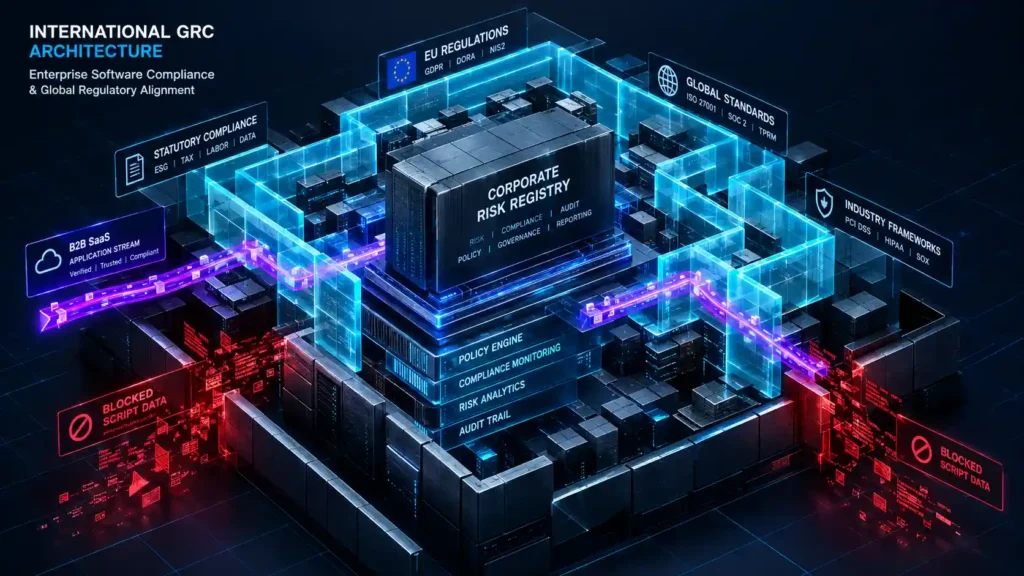
- Establish an immutable, centralized corporate risk register: Every single artificial intelligence feature, embedded model instance, or automated endpoint deployed across the organisation must appear inside a single authoritative register. Moving completely away from fragmented team wikis or forgotten pull request descriptions prevents hidden tracking visibility gaps.
- Document model data provenance for every registry entry: Your core risk register must maintain an unshakeable, auditable record showing exactly where a model’s underlying training data or fine-tuning datasets originated. Provenance mapping gaps operate as a primary tracking finding that external regulatory inspectors target during system audits.
- Record fine-tuning parameters and functional intent profiles: Beyond raw data provenance tracking, your compliance ledger must capture exactly what a model was fine-tuned to execute and its explicit boundaries. Deploying an operational model outside its documented intent profile creates an immediate compliance variance that invalidates adjacent security controls.
STEP 2: HARDENING THE TRANSPARENCY REGISTRY AND USER-FACING DISCLOSURE LAYERS
Statutory transparency obligations exist to guarantee that any individual interacting with a synthetic system is explicitly aware of its nature. Small development divisions must transform this baseline operational requirement into a non-bypassable, code-enforced gate embedded directly within their frontend interface layer.
- Design explicit user-facing notification interfaces: A compliance statement buried deep within a generic terms-of-service block fails to satisfy either the spirit or the letter of international transparency mandates. The warning notification must render visibly right at the immediate point of user interaction.
- Build automated model interaction disclosure gates: Before a user can pass a query string into a synthetic generation system, an unavoidable, clear disclosure gate must programmatically verify they understand they are interacting with an artificial intelligence model rather than a human representative.
- Inform EU citizens the exact millisecond an interaction begins: The disclosure mechanism must fire at the precise point of first contact, rather than waiting until several data exchanges have already occurred. Retroactive notifications are treated as a compliance failure by external regulatory authorities.
- Prevent unvetted content output without data provenance logging: Any content generated by a model and surfaced to an end-user must carry a cryptographically logged record of its exact origin. Building this tracking path ensures your technical teams can programmatically demonstrate the source of a synthetic response to a regulator during an audit.
STEP 3: ENFORCING CONTINUOUS DATA LOGGING AND COMPREHENSIVE TELEMETRY LEDGERS
Documentation and policy sheets operating without an underlying technical data trail function purely as a corporate promise that an international regulator cannot verify. To achieve a defensible posture, development teams must build automated, machine-generated evidence streams directly into their host environments rather than relying on reactive manual reports.
- Build low-latency, automated logging pipelines: Every single inference cycle, system runtime variable shift, and model state transition across distributed microservices must be programmatically captured at the code layer. Relying on manual engineering entries or fragmented diagnostic metrics fails to satisfy structural validation bounds, requiring the system itself to auto-generate tracking outputs to prevent forensic gaps.
- Record inference cycles as they happen rather than in aggregate: Summary statistics and rolled-up totals do not satisfy the evidentiary bar demanded during a regulatory investigation. Auditing teams require an unbroken, timestamped record of individual inference events to accurately trace what occurred at a specific millisecond, isolating systemic runtime anomalies from routine transactional noise.
- Ground your logging architecture in the actual statutory text: Engineering groups constructing these telemetry pipelines must work directly from comprehensive, clause-level legal references to ensure technical workflows align with the official EU Artificial Intelligence Act record-keeping standards. Cross-referencing system behaviors straight against the explicit provisions of Regulation (EU) 2024/1689 guarantees that your data provenance trails, post-market monitoring parameters, and model validation logs satisfy external administrative oversight.
- Treat telemetry ledgers as tamper-evident by architectural design: A log management system that can be silently edited, overwritten, or reconfigured after the fact provides zero evidentiary value during an international compliance evaluation. Ledger entries must be structured with cryptographic validation tags and restricted write-once parameters, ensuring any external modification attempt is instantly detected and flagged by system alarms.
STEP 4: ARCHITECTURAL COMPLIANCE DRILLS AND CONTINUOUS GRC CONFORMANCE TRACKING
The final step transitions the organization completely away from treating regulatory alignment as an annual event and toward treating it as a standing engineering discipline. Lean SaaS startups must integrate automated validation checks directly into their active version-control pipelines to enforce absolute compliance stability over time.
- Move away from point-in-time reviews entirely: An annual compliance evaluation captures a superficial system snapshot that is already stale by the exact time it is filed with your legal department. Your underlying architecture must maintain a system that can answer strict regulatory data questions accurately on any given day, rather than scrambling once a year to generate manual tracking metrics.
- Deploy continuous auditing engines across your microservices: Automated configuration management tooling that programmatically verifies your system settings against documented regulatory criteria catches operational drift the exact millisecond it manifests, preventing unvetted data paths from sitting hidden for months.
- Track configuration shifts as they occur in real time: Every single adjustment to an internal model’s deployment state, interface access scope, or persistent data handling parameters must be instantly logged and checked against your master risk register. This prevents an individual developer update from silently altering your system’s overall risk classification tier.
- Map third-party API dependencies continuously across all integration loops: A perfectly compliant internal code pipeline can still create massive legal exposure if it links out to a third-party model or vendor API whose own data governance posture has deteriorated since onboarding. Enforcing continuous tracking ensures your perimeters drop non-compliant upstream hooks automatically.
- Simulate regulatory audit drills before official oversight initializes: Running an internal, mock administrative audit surfaces process vulnerabilities and log collection gaps in a highly controlled setting. This grants your incident response and engineering teams sufficient space to remediate structural flaws long before an actual regulator or enterprise procurement board asks the same hard questions.
Assuming a SaaS pipeline or custom software workflow is automatically compliant simply because it builds upon an upstream foundational model provided by a massive, multi-billion-dollar vendor (such as OpenAI or Anthropic) introduces a highly dangerous false sense of security across your operational divisions. Upstream foundational providers explicitly scope their own statutory compliance matrices to end at their direct API boundary lines; your specific application wrapper, downstream native integrations, vector database persistence choices, and local customer data storage regions are what international regulators ultimately measure for systemic compliance.
Relying on your model provider’s corporate certificates to shield your custom B2B scaleup allows unlogged data handling anomalies to quietly proliferate across your stack, destroying your enterprise GRC perimeters and leaving your legal leadership heavily exposed to multi-million dollar fines.
CONCLUSION & GOVERNANCE BOUNDARY SUMMARY
A resilient privacy and corporate safety posture operates as an active, ongoing system engineering discipline rather than a static stack of boardroom compliance templates signed off once a year and forgotten. Genuine EU AI Act compliance—built deliberately on rigorous risk classification, enforced transparency disclosures, continuous data logging, and standing audit drills—turns regulatory obligations into functional operational infrastructure rather than a recurring legal fire drill.
Anchoring the perimeter gateway on automated token telemetry, credential isolation, and disciplined network blocks actively shields your compute cluster from the kind of catastrophic financial and operational drain that follows an unmanaged classification gap. Maintain an unyielding governance posture by transforming your statutory requirements into active programmatic limits, running routine validation sweeps to ensure your business preserves market access permanently.
Balancing rapid application feature deployment velocity with rigid cross-border regulatory compliance remains one of the most complex orchestration challenges facing modern B2B SaaS and identity access teams. We invite you to join the technical discussion in the comments section below: What specific automated policy-as-code linting engines, cloud risk registers, or low-latency telemetry logging platforms are you utilizing to audit your multi-tenant nodes against international statutory mandates? Have you successfully shifted your model workloads to automated configuration tracking systems, or are you running manual data provenance reviews during procurement loops? Drop your architectural layouts, custom evidence-collection patterns, and hard-earned advice below!
Related: Prompt Injection Defense: 4 Crucial Tactics to Shield Corporate Networks – How Semantic Kernel can help defend AI applications against prompt injection attacks using structured orchestration and layered safeguards.
Prevent API Key Leakage: 4 Crucial Steps to Shield Corporate Networks – A layered framework for keeping API keys out of local AI application code — externalized configs, vaulted secrets, pre-commit/pipeline scanning, and proxy-isolated credential handling.
Private Background Removal Tools: 5 Crucial Options to Stop Corporate Leaks – The blog explains how organizations can use private, locally processed background-removal tools and layered governance controls to prevent sensitive client assets from leaking through unvetted third-party services.
Block Credential Stuffing: 4 Crucial Steps to Shield Hiring Portals – A practical guide to defending hiring portals against credential stuffing using layered telemetry, adaptive rate limiting, centralized logging, and fail-secure controls.
NIST Framework Alignment: 6 Crucial Rules to Stop Compliance Drift – A practical NIST-aligned GRC roadmap for turning compliance into continuous security governance through asset visibility, strong access controls, detection, response, recovery, and audit readiness.
Check Point Cyber Security Report 2026: Crucial Tactics to Shield Networks – A strategic look at Check Point’s 2026 cybersecurity outlook, revealing how AI-driven threats, evolving attack vectors, and unified security are reshaping enterprise cyber defense.
FREQUENTLY ASKED QUESTIONS (FAQ)
Q1. If a growth-stage SaaS platform operates entirely outside the European Union, does it still face statutory liability under the EU AI Act?
Yes, the regulation enforces an extraterritorial reach similar to the GDPR. If your artificial intelligence system outputs results, automates tasks, or processes data that is used or consumed inside the EU market—regardless of where your servers or corporate entities are physically located—your infrastructure falls directly under the scope of the act and must meet its compliance mandates.
Q2. We use an upstream foundational API (like OpenAI or Anthropic) for our B2B application. Why isn’t model-level compliance handled entirely by the provider?
Foundational model providers are only legally responsible for the base model tier itself. Regulators evaluate your complete custom workflow, which includes how your specific codebase intercepts strings, maps access to external plugins, holds data caches locally, and implements user interfaces, meaning you must audit your own application logic for complete architectural alignment.
Q3. How can a lean SaaS engineering team log individual inference events at scale without incurring massive cloud storage costs or application latency?
Instead of capturing and storing high-volume raw conversational logs or massive system inputs in standard databases, deploy an asynchronous, event-driven streaming pipeline. This gateway should capture an ultra-lightweight metadata string containing only a timestamp, unique user identifier, model version string, and a cryptographic hash of the input signature, routing this stream straight to cold storage buckets to satisfy technical audit criteria smoothly.
Q4. Does the act require a growth-stage SaaS platform to surface heavy, disruptive user-interface alerts for low-risk features like text summarization?
No, minimal or low-risk use cases do not require massive modal blockages that interrupt workflows. Instead, implement clean, low-friction visual signifiers directly into your product’s native UI—such as a small, clean semantic label or subtle watermarked text inside the generation canvas—to cleanly inform the user they are engaging with an AI engine without breaking user experience.
Q5. What is the fastest technical control an IT department can implement to ensure a team doesn’t introduce compliance drift via shadow model deployments?
Enforce declarative policy-as-code linting checks straight inside your central version-control and CI/CD pipelines. By forcing all model orchestrations to register their intent profile and risk tier inside a production deployment configuration file, the build engine programmatically checks the variables against your master risk registry, automatically dropping any unreviewed or unmapped API routes before they hit live servers.
DISCLAIMER
Educational Notice: This article is published on AI Security Watch strictly for technical educational and general cybersecurity awareness purposes. The configurations and research discussed are based on public threat intelligence data. This content does not constitute professional IT architecture, legal, or financial advice. Because network configurations vary, always verify settings in an isolated test environment or consult with a qualified engineer before modifying live hardware or registries. AI Security Watch contains informational links to external resources; we are not responsible for third-party site accuracy or platform content.