
⚡ TL;DR — Key Takeaways
- Administrative access controls: Establishing absolute data processing constraints protects your underlying infrastructure—standardise on verified, contract-vetted private background removal tools across your entire media production footprint before any graphic designer or external editor touches a single row of client media.
- Vendor/client parameter validation: Restructuring file boundaries provides critical protection against data leaks; define strict media access perimeters to structurally lock down where uploaded brand assets are allowed to travel across your ecosystem.
- Stream-optimized runtime flags: Monitoring third-party vendor parameters eliminates configuration drift across distributed workflows; validate data handling constraints by confirming retention timelines, model training-use exclusions, and automated data deletion parameters in writing.
- Perimeter isolation validation: Shielding sensitive corporate computing networks demands continuous application visibility and active verification testing—streamline software usage flags to monitor which design applications are approved, flagged, or banned across team production tiers, and execute perimeter isolation tests via network-layer audits to verify privacy claims rather than relying on unverified vendor promises.
Table of Contents
Distributed design workflows and agile marketing groups function within an environment that explicitly prioritises execution velocity. Production designers routinely select whichever free, web-based utility clears a graphical background fastest, upload the client file to an external cloud interface, and instantly move to the next task. However, this unchecked operational habit is precisely how unvetted software-as-a-service (SaaS) platforms quietly establish an active data-exfiltration point within your creative ecosystem. These public processing forms systematically scrape uploaded graphical content, ingest the imagery into third-party cloud containers, and expose the agency to massive client Non-Disclosure Agreement (NDA) breaches and complex intellectual property complications that the business never legally agreed to sustain.
The resulting financial exposure and legal liabilities are far from abstract concepts. A single leaked prototype image, an unreleased corporate product shot, or a pre-launch marketing campaign asset can instantly trigger mandatory contract termination clauses, strict regulatory compliance reviews, and permanent brand reputation damage that heavily outlasts the lifecycle of the project itself. The technical reality remains absolute: the exact millisecond an unencrypted asset is ingested by an external system’s training pipeline, the enterprise loses all data portability rights, leaving your incident response teams with no programmatic method to claw back or delete the exposed records.
Deciding to deploy an explicit, structural roadmap that mandates a private background removal tools baseline across your entire technical footprint is a revenue-critical operational engineering requirement rather than a flexible design choice. Without code-enforced data boundaries, your asset-handling workflows will inevitably degenerate into ad hoc, high-risk application choices, your enterprise client compliance audits will become completely unpredictable, and your technical risk posture will continuously drift away from corporate governance targets with every active project cycle.
There is a profound, stomach-dropping sense of technical disbelief that hits you when you sit in a high-stakes, quarterly client performance review and realize that your own production team has inadvertently leaked a million-dollar product line. You listen to the client’s executive team explain that an unreleased, highly classified product prototype was discovered floating inside a public generative AI image database, and your heart sinks as a quick internal audit traces the breach back to a junior designer.
To save five minutes on a rush deadline, the artist unknowingly uploaded the client’s raw CAD renders straight to a free, ad-supported online background extraction webpage—completely blind to the reality that hitting the upload button automatically granted the third-party SaaS vendor a permanent, royalty-free license to ingest that proprietary intellectual property into its public model training loops. Watching a major multi-year agency contract implode because your graphic workflow treated basic data privacy as a secondary administrative pass is a brutal wake-up call that proves a single unvetted web tool can instantly compromise your organization’s legal stability.
PILLAR 1: THE DATA TRANSIT VETTING ENGINE AND LOCAL PROCESSING ISOLATION
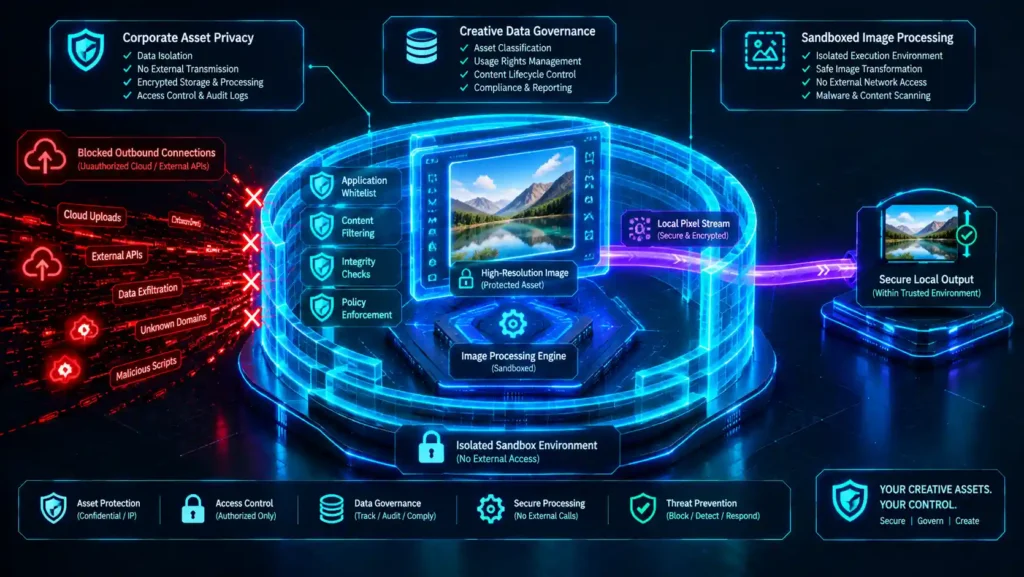
The primary structural decision when configuring your media pipeline dictates where the pixel data physically executes. Cloud-based image routing architectures transmit the full-resolution graphic asset over an external network connection to a remote, vendor-controlled server, execute the machine learning background-removal models in that external environment, and return the processed file back down the pipe. This workflow pattern means your critical corporate assets leave your hardware edge entirely and enter infrastructure outside your direct operational control, even if the processing duration takes only a few milliseconds.
Client-side local runtime processing utilizes an entirely separate technical architecture. Modern deployment models leverage highly optimized technologies like WebAssembly (Wasm) and on-device machine learning inference engines to execute the image segmentation models directly inside the browser’s local sandbox or local hardware layers. The raw image data tensor is completely decoded, processed, and rendered natively on the user’s immediate local machine. Because this workflow eliminates the network upload phase, no outbound traffic event occurs, and no third-party infrastructure ever receives access to the raw client asset files.
For creative agencies and engineering groups tasked with protecting unreleased corporate product lines or NDA-bound design configurations, this structural execution boundary functions as the primary vetting filter. Any utility that cannot explicitly demonstrate verified, local-only runtime processing must be classified as an unmitigated transit risk by default, regardless of how professional or secure the service interface appears on the surface. The foundational vetting criteria remains absolute: does the unreleased media asset ever leave the physical boundary of the edge device, even for a fraction of a second? If the programmatic answer is yes, or if the routing logic remains unverified, the software automatically fails to satisfy the core protection metrics of Pillar 1.
PILLAR 2: DECONSTRUCTING VENDOR TOS AND THE SHIELDING OF DATA RIGHT LEAKS
Once your structural data transit routing is verified, your next layer of protection is completely contractual. Vendor Terms of Service (ToS) agreements frequently contain broad, overreaching data-usage grants buried deep within standard boilerplate text. This language commonly permits the vendor to retain, analyze, or repurpose uploaded graphical content under the guise of “service improvement” or “product optimization”—phrases that, in current industry practice, almost always mean your client’s unreleased visuals will be used as training inputs for generative machine learning models.
Enterprise IT managers and legal teams reviewing these platform contracts should specifically flag any clause that requests a non-exclusive, perpetual, royalty-free, or sublicensable right to uploaded media assets. These are predatory data-mining parameters designed to quietly convert a client’s highly sensitive, proprietary assets into public model training material without providing your organization with any meaningful legal recourse once data ingestion has finalized.
The structural engineering fix requires mandating explicit, contractually binding Zero-Data-Retention (ZDR) architecture rules wherever a cloud-based processing step is completely unavoidable. A genuine, enterprise-grade ZDR commitment legally and technically forces the absolute deletion of all cache rows, temp files, and server memory allocations the exact millisecond the output file is delivered to the user interface. It does not wait for a rolling 30-day retention window, nor does it wait for a manual “upon request” deletion ticket; the clearing must be immediate, automated, and system-verified. Any vendor agreement that hedges on retention timing or utilizes vague compliance windows must be treated as completely non-compliant for all NDA-bound creative production.
PILLAR 3: RECTIFYING SHADOW CREATIVE IT VIA CENTRALIZED SOFTWARE WHITE-LIST MATRIXES
Even with robust contractual definitions and network architecture standards in place, enforcement fails completely if individual designers can independently select their own unvetted processing tools. This is the shadow IT problem: unmonitored, unapproved applications proliferate across creative teams because they are convenient, free, or simply the first search result that surfaces on a tight deadline.
The structural correction requires implementing a centralized, monitored application white-list, maintained at the design-group level and strictly enforced through automated endpoint management policies. Every approved private background removal tools entry on this administrative matrix must carry a documented vetting record detailing its data transit architecture, ToS compliance status, and explicit data retention terms—ensuring software approval operates as a continuously auditable state rather than a one-time onboarding choice.
Technical managers building this governance layer benefit from anchoring their white-list criteria to the same execution architecture referenced in Pillar 1. Reviewing the official WebAssembly sandboxing and security documentation gives IT auditors a concrete, authoritative reference point to analyze exactly how the browser runtime manages memory isolation and guarantees local-only data execution. This ensures white-list approvals are grounded in verifiable runtime mechanics rather than superficial vendor marketing claims.
PILLAR 4: ACTIVE PERIMETER RUNTIME VALIDATION VIA MOCK DATA EXTRUSION FILTERS
Documentation, legal compliance certs, and unverified vendor claims operate purely as an onboarding starting point rather than a definitive security conclusion. The final protective layer of your data lifecycle requires active, continuous runtime validation—confirming through direct, empirical observation that an evaluation tool behaves precisely the way its Terms of Service agreements and marketing descriptions claim.
- Execute out-of-band network packet inspection and proxy auditing: Enterprise IT divisions must route your design utilities’ live traffic through a monitored intercepting proxy while a background-removal task actively processes an image. Teams must watch for covert outbound calls, examining whether the tool initializes background connections to external domains associated with machine learning data collection or distributed model-training repositories, rather than interacting strictly with the tool’s documented licensing validation nodes.
- Treat unexplained outbound transit calls as an immediate disqualification: Any unexplained or hidden outbound network call initiated during an image segmentation task that claims to run local-only constitutes a critical, non-negotiable security boundary failure. This anomalous telemetry instantly disqualifies the tool from your white-list directory, regardless of how cleanly the service previously described its underlying architecture on a compliance sheet.
- Convert data vetting workflows into a verifiable engineering control: Moving completely away from paper-based assessments ensures that image data protections are dynamically enforced at your host-level perimeters. Running active network traffic inspection loops transforms asset security from a passive administrative exercise into a code-enforced boundary that malicious data-scraping workflows cannot bypass.
Assuming an image processing application or web-based editing interface is safe simply because it features a highly polished, professional user interface or displays prominent security compliance badges introduces a severe and dangerous false sense of security across your creative team. If an unvetted third-party service provider quietly modifies its backend retention parameters or alters its data portability agreements overnight, they can harvest your uploaded client media archives and exfiltrate proprietary designs without throwing a single infrastructure error flag or triggering an internal system warning.
Relying strictly on a tool’s surface-level presentation or trusting its static marketing copy allows unmonitored data-mining operations to quietly siphon off your client’s core intellectual property, destroying your enterprise security perimeters and leaving your legal divisions heavily exposed to massive breach penalties.
CONCLUSION & GOVERNANCE BOUNDARY SUMMARY
A resilient data privacy and asset safety posture operates as an active, ongoing system engineering discipline rather than a static stack of boardroom compliance checkboxes signed off once a year. It requires the same continuous operational attention as any other core production infrastructure.
Anchoring the perimeter gateway on automated token telemetry, strict credential isolation, and disciplined network blocks actively shields your agency’s compute cluster and high-value client relationships from catastrophic operational drain. Each of the four foundational pillars detailed above—transit isolation, contractual vetting, centralized white-listing, and active runtime validation—systematically reinforces the others; skipping a single layer inherently weakens the entire perimeter, creating hidden vulnerability windows that data-scraping workflows can easily exploit.
Standardising on properly vetted private background removal tools is ultimately a governance decision just as much as a technical configuration choice, and it must be actively reviewed on the same cadence as any other high-level security control in the organization.
Balancing rapid creative execution and high-velocity digital asset deployment with rigid, continuous GRC framework alignment remains one of the most complex orchestration challenges facing modern DevOps and compliance teams. We invite you to join the technical discussion in the comments section below: What specific passive network scanning architectures, automated framework tracking tools, or continuous third-party vendor monitoring platforms are you utilizing to audit your enterprise supply chains against global benchmark indexes?
Have you successfully automated your API token revocation playbooks to isolate external partner drift instantly, or are you running manual configuration updates inside your policy files during procurement loops? Share your network layouts, identity access blueprints, and hard-earned advice with the engineering community below!
Related: Block Credential Stuffing: 4 Crucial Steps to Shield Hiring Portals – A practical guide to defending hiring portals against credential stuffing using layered telemetry, adaptive rate limiting, centralized logging, and fail-secure controls.
NIST Framework Alignment: 6 Crucial Rules to Stop Compliance Drift – A practical NIST-aligned GRC roadmap for turning compliance into continuous security governance through asset visibility, strong access controls, detection, response, recovery, and audit readiness.
Check Point Cyber Security Report 2026: Crucial Tactics to Shield Networks – A strategic look at Check Point’s 2026 cybersecurity outlook, revealing how AI-driven threats, evolving attack vectors, and unified security are reshaping enterprise cyber defense.
OpenAI API Rate Limit: 5 Crucial Middleware Steps to Stop Billing Attacks – A practical guide to implementing OpenAI API rate limiting in Node.js, using middleware and distributed controls to prevent abuse, runaway costs, and AI service disruption.
IBM Cost of a Data Breach 2026: 7 Crucial Metrics to Stop Loss Exposure – IBM’s 2026 breach-cost analysis reveals how AI-driven security, faster containment, and stronger controls can significantly reduce the financial impact of data breaches.
Linux UFW Firewall WireGuard: 5 Crucial Steps to Secure Tunnels – A practical guide to securing Linux servers with UFW firewall rules and WireGuard VPN, combining controlled access, encrypted connectivity, and stronger host-level protection.
FREQUENTLY ASKED QUESTIONS (FAQ)
Q1. If a background removal tool runs locally inside the browser using WebAssembly, can malicious browser extensions still intercept or scrape our image assets?
Yes, a local WebAssembly sandbox isolates the pixel-level execution from cloud transit, but it operates within the context of the user’s browser. Highly privileged or malicious browser extensions with broad DOM access can potentially capture canvas element data or read memory segments from the page; to completely harden this boundary, enterprise IT policies should disable unverified, third-party browser extensions across all creative design workstations.
Q2. We use an enterprise-tier account with a major design vendor that includes an absolute zero-data-retention API. Is a local-only tool still necessary for client work?
While contractually sound enterprise ZDR agreements satisfy macro compliance filters, they still introduce data transit risk by moving full-resolution assets to a remote architecture over public networks. For highly sensitive, unreleased prototypes or pre-launch campaigns bound by extreme NDA penalties, a local-only runtime is structurally superior because it completely eliminates the possibility of intermediate man-in-the-middle interception or third-party server-side misconfigurations.
Q3. How can creative teams test whether an desktop background extraction tool is genuinely processing data locally without relying on IT network packet analysis?
A rapid, high-fidelity technical test involves opening the tool within your web browser, allowing the initial interface page layer to complete loading, and then entirely disconnecting your machine from the internet (disabling Wi-Fi or unplugging the ethernet cable). If you drop a high-resolution raw graphic file into the interface and the background separation executes instantly and flawlessly while completely offline, it confirms the segmentation model is running client-side on local hardware.
Q4. Many design platforms claim their model training algorithms only ingest anonymous image data metadata. Does this satisfy enterprise client data compliance parameters?
No, because anonymised metadata can still leak proprietary project dimensions, aspect shapes, corporate colors, and timing variables that violate strict confidentiality clauses. Most corporate legal teams and enterprise procurement groups treat any extraction of metadata from unreleased assets as an explicit governance breach, meaning your workflows must reject any system that does not support total data isolation.
Q5. What is the fastest technical mechanism to enforce our centralized software white-list across remote freelancers who work outside our core endpoint management software?
For external contractors or freelancers operating on unmanaged personal hardware, you must shift your security boundary to the data intake layer. Enforce an administrative proxy policy that mandates all deliverables pass through a centralized digital asset management portal equipped with automated metadata scanners, checking file properties to verify assets were handled strictly inside contract-compliant utilities before they are accepted into production workflows.
DISCLAIMER
Educational Notice: This article is published on AI Security Watch strictly for technical educational and general cybersecurity awareness purposes. The configurations and research discussed are based on public threat intelligence data. This content does not constitute professional IT architecture, legal, or financial advice. Because network configurations vary, always verify settings in an isolated test environment or consult with a qualified engineer before modifying live hardware or registries. AI Security Watch contains informational links to external resources; we are not responsible for third-party site accuracy or platform content.