
⚡ TL;DR — Key Takeaways
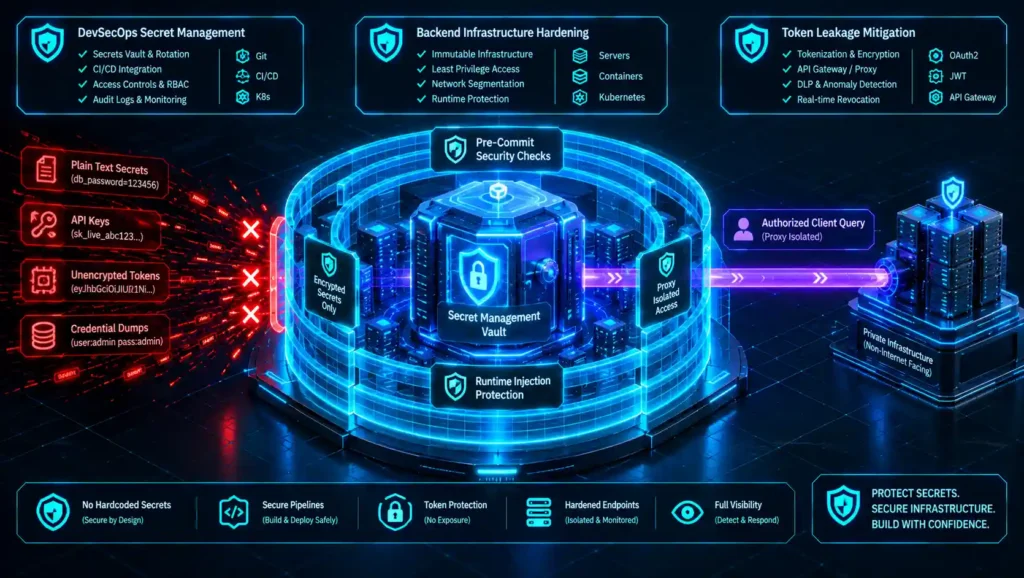
- Administrative access controls: Establishing absolute database processing constraints protects your underlying infrastructure—to prevent api key leakage at the source, your software architectures must ensure that connection credentials never exist as plaintext strings anywhere within the application code repositories.
- Vendor/client parameter validation: Restructuring build pipelines provides critical protection against accidental data exposure; deploy automated pre-commit scanning radars to catch hidden secrets before files ever commit to source control platforms, rather than relying on reactive cleanups.
- Stream-optimized runtime flags: Monitoring live execution memories eliminates configuration drift across distributed application microservices; enforce just-in-time credential injection loops so that access keys exist strictly in memory for the precise moment they are needed during the initial backend handshake.
- Perimeter isolation validation: Shielding private enterprise servers demands continuous traffic isolation and active verification testing under load—deploy a secure reverse-proxy gateway router to handle connection transactions at the network edge, ensuring downstream client applications never see or transmit the raw upstream model keys at all.
Table of Contents
Building application environments on local private servers using open-source models routinely creates a dangerous false sense of safety. Development teams often drop their operational guard specifically because the underlying infrastructure feels strictly internal, leading them to hardcode upstream API tokens, production database passwords, or vector database credentials straight into their active application scripts. The technical reality remains absolute: an unencrypted credential sitting as a plaintext string inside a local script is an immediate infrastructure risk, exposing the system to internal threat actors, lateral movement vectors, and compromised developer endpoints before front-line alerting systems can even register an anomalous access pattern.
Deciding to deploy an explicit, structural roadmap to enforce strict validation parameters that prevent api key leakage vectors is a critical operational engineering requirement rather than a loose afterthought reserved only for public-facing web systems. Enforcing rigid, code-driven perimeter boundaries is the only technical mechanism that successfully prevents code-level credential compromise, blocks lateral supply-chain exploits, and stops technical risk drift before a single leaked key turns into a full network infrastructure compromise. Without deep, automated secrets filtering layers across your deployment repositories, your private servers remain highly exposed, leaving your system variables completely vulnerable to token extraction pipelines that can paralyze your enterprise databases in seconds.
There is a profound, stomach-dropping sense of technical disbelief that hits you when you conduct a routine code audit on a private server and realize that an internal developer unknowingly committed unencrypted master API keys to a public source repository over the weekend. You look at the code histories and discover that because the staging workspace lacked a basic pre-commit token scanner, the programmer pushed a raw script containing active vector database credentials and upstream AI model keys straight into an open cloud repository.
Watching automated scraping bots extract those root credentials within milliseconds of the commit and launch high-velocity billing exploitation loops that completely drain your development budget before your morning coffee is a brutal wake-up call. It proves that assuming an internal pipeline is naturally secure simply because it runs on private hardware is a fatal security flaw that can instantly compromise an organization’s financial stability.
The four coordinated implementation steps detailed below construct that technical protection layer by layer, from the precise millisecond a credential parameter is defined to the exact moment it reaches a running application runtime.
STEP 1: DECOUPLING CONFIGURATION LAYERS VIA EXTERNALIZED ENVIRONMENT REGISTRIES
The most foundational architectural move required to prevent api key leakage is separating your application logic from the configuration credentials it depends on entirely. Small development teams must establish hard system boundaries between source files and secrets to eliminate accidental data exposure.
- Move configuration variables completely out of your codebase: Any credential embedded directly within your application code will eventually end up inside a commit history log, a backup archive, or an unvetted screen-share. The only reliable fix is ensuring the raw access token was never present inside the script files to begin with.
- Utilize externalized host-level environment registries: Sensitive configuration values, including master access keys, must reside exclusively within an environment registry managed at the underlying infrastructure layer. Your application should reference these keys dynamically at runtime rather than storing strings alongside the code footprint.
- Run memory-only state lookups to eliminate plaintext storage: Access tokens must never sit as plaintext strings on persistent server disks where unauthorized processes can parse them. Enforce a lookup mechanism that resolves credentials straight into execution memory at initialization, neutralizing exposure risks from disk imaging, file system compromises, or automated backup leaks.
- Treat configuration isolation as a core network architecture rule: Relying strictly on developer discipline or casual verbal agreements to avoid hardcoded secrets will eventually fail under release deadline pressures. Your system architecture itself must make hardcoding parameters structurally difficult, rather than treating compliance as a passive policy recommendation.
STEP 2: IMPLEMENTING LOCAL SECRET VAULTS AND CRYPTOGRAPHIC RUNTIME INJECTION
Externalizing configuration parameters solves half the security problem; where those externalized values actually reside and how they safely reach your running software is the other half. For local deployments, allowing secrets to sit unvetted inside unstructured local files leaves an enterprise open to quick internal extraction.
- Replace unencrypted configuration scripts with dedicated secret vaults: Purpose-built secret management engines, such as HashiCorp Vault or specialized hardware security modules, store variables inside an encrypted, access-controlled system. This replaces flat configuration file systems that any local user or service with basic filesystem access can read.
- Implement just-in-time runtime credential injection loops: Access tokens must be fetched dynamically straight into volatile execution memory during application initialization rather than being left persistently available at all times. This setup narrows the precise window during which a credential parameter remains exposed to an active process runtime.
- Wipe credentials from intermediate data paths after network handshakes finalize: Once an authenticated connection using an injected token is established, that token must not linger inside application memory blocks, temporary variables, or debugging log output. The system must clear the string as soon as its immediate handshake purpose is served.
- Rotate vaulted credentials on a strict, automated schedule: Even an exceptionally well-secured vault architecture requires a regular credential rotation program. Enforcing short lifecycles on all system keys directly limits the financial or operational damage an access token can cause if it is ever compromised without detection.
STEP 3: AUTOMATING PRE-COMMIT STREAM FILTERS AND BUILD-PIPELINE RADARS
Even with strong backend architecture in place, simple human error during daily development remains one of the most common paths to credential exposure. Implementing automated, code-driven checkpoints catches unencrypted connection variables before they can become a permanent part of your system’s version timeline.
- Deploy continuous pre-commit scanning filters: Small software divisions must implement scanning filters that programmatically inspect staging changes before they are committed to version control. This structural check catches an accidentally pasted key at the exact millisecond it attempts to enter your version history, allowing engineers to correct the leak before any code footprint is created.
- Add automated build-pipeline detection radars as a second checkpoint: Even if a secret manages to slip past your local pre-commit scanning hooks, a CI/CD build pipeline that programmatically scans every build artifact before deployment provides a vital second opportunity to catch it before it reaches a live staging or running environment.
- Intercept unencrypted strings before they ever reach source control repositories: Once an access token is committed to a repository—even a private one—it typically persists inside your historical git tracking logs indefinitely unless you execute a complex manual purge. This pattern proves that proactive edge prevention is infinitely more valuable than complex, after-the-fact forensic cleanup.
- Ground your detection architecture in community-vetted security frameworks: Engineering teams constructing these automated scanning pipelines should align their validation logic directly with the official OWASP secrets protection blueprints. This framework addresses this exact class of data exposure in depth, covering programmatic token centralization, build-pipeline hardening patterns, and specialized detection strategies explicitly engineered to prevent api key leakage across enterprise application lifecycles.
STEP 4: PROXY ARCHITECTURE GATEWAYS AND BACKEND CONTAINER PERIMETER ISOLATION
The final layer of your security stack ensures that even a properly injected, vaulted credential parameter never has to be exposed to the client applications consuming the resource. Implementing this defensive proxy perimeter is the ultimate step required to prevent api key leakage across public-facing application interfaces, keeping your upstream credentials entirely isolated within secure server boundaries.
- Set up isolated intermediary reverse-proxy gateways: All connection transactions to an upstream model or database must pass through this strict middleware boundary. This replaces allowing client applications to connect directly to the upstream endpoint using their own local copy of the token.
- Force every inbound client query through the abstract middleware boundary: The proxy layer authenticates to the upstream provider on the client’s behalf. This architecture ensures that the client application bundle never needs to see, host, or transmit the raw upstream model keys at all.
- Isolate the proxy layer itself from adjacent application containers: The proxy holding the raw credentials must execute within its own isolated container or process boundary. This micro-segmentation guarantees that a compromise of an unrelated frontend application component does not automatically grant a threat actor access to the master keys the proxy manages.
Assuming a private server or self-hosted deployment is completely immune to data leakage simply because it sits safely behind an internal corporate network layer introduces a highly dangerous false sense of security across your engineering team. If a single developer endpoint or internal workstation is compromised via a stealthy infostealer payload, malicious actors can effortlessly extract active environment variables from local process memories or unencrypted cache configurations. Once they possess these keys, threat actors can bypass your surface-level firewall perimeters entirely undetected—quietly siphoning off your private models, weaponizing your infrastructure, and executing massive lateral data breaches while your internal monitoring networks remain completely blind to the compromise.
CONCLUSION & GOVERNANCE BOUNDARY SUMMARY
A resilient privacy and secret safety posture operates as an active, ongoing system engineering discipline rather than a static boardroom compliance checkbox reviewed once and forgotten. A strategy built to prevent api key leakage—combining externalised configuration, vaulted credential injection, continuous pre-commit and pipeline scanning, and proxy-isolated perimeter architecture—actively shields your compute cluster from the kind of catastrophic financial and operational drain a single exposed credential can cause.
Anchoring the gateway on automated token telemetry, credential isolation, and disciplined network blocks turns what starts as a single hardcoded secret into infrastructure your team can trust, even when internal networks are assumed to be safe.
Balancing rapid application deployment velocity with rigid microservice isolation remains one of the most complex orchestration challenges facing modern DevSecOps and backend engineering teams. We invite you to join the technical discussion in the comments section below: What specific secrets management vault platforms, automated pre-commit scanners, or custom reverse-proxy layers are you utilizing to audit your private cloud servers against API token exposure? Have you successfully automated your Git pre-commit hooks to block credential commits instantly, or are you running manual auditing sweeps during deployment cycles? Share your network layouts, secret protection pipelines, and hard-earned advice with the engineering community below!
Related: Private Background Removal Tools: 5 Crucial Options to Stop Corporate Leaks – The blog explains how organizations can use private, locally processed background-removal tools and layered governance controls to prevent sensitive client assets from leaking through unvetted third-party services.
Block Credential Stuffing: 4 Crucial Steps to Shield Hiring Portals – A practical guide to defending hiring portals against credential stuffing using layered telemetry, adaptive rate limiting, centralized logging, and fail-secure controls.
NIST Framework Alignment: 6 Crucial Rules to Stop Compliance Drift – A practical NIST-aligned GRC roadmap for turning compliance into continuous security governance through asset visibility, strong access controls, detection, response, recovery, and audit readiness.
Check Point Cyber Security Report 2026: Crucial Tactics to Shield Networks – A strategic look at Check Point’s 2026 cybersecurity outlook, revealing how AI-driven threats, evolving attack vectors, and unified security are reshaping enterprise cyber defense.
OpenAI API Rate Limit: 5 Crucial Middleware Steps to Stop Billing Attacks – A practical guide to implementing OpenAI API rate limiting in Node.js, using middleware and distributed controls to prevent abuse, runaway costs, and AI service disruption.
IBM Cost of a Data Breach 2026: 7 Crucial Metrics to Stop Loss Exposure – IBM’s 2026 breach-cost analysis reveals how AI-driven security, faster containment, and stronger controls can significantly reduce the financial impact of data breaches.
FREQUENTLY ASKED QUESTIONS (FAQ)
Q1. If an API key is committed to an internal, private repository that never faces the public web, why do we still need to purge it from Git history?
Treating private repositories as trusted storage introduces severe insider threat vectors and lateral migration risks. If an employee’s personal device is compromised by info-stealer malware or an adversary gains access to a single developer’s version control credentials, the historical commit logs become an instant roadmap to your crown jewels—allowing attackers to clone historical trees and extract active master keys that were supposedly hidden behind a private repository setting.
Q2. Will routing all our local AI application model queries through an intermediate reverse-proxy gateway introduce significant processing latency?
No, if the proxy layer is engineered correctly using high-concurrency, asynchronous routing engines. When an intermediate proxy functions as a lightweight token-injection gateway rather than performing heavy content inspection, the networking handshake overhead adds less than a single millisecond of latency—a margin that is entirely negligible compared to the multi-second processing windows naturally required by large language model inference runtimes.
Q3. We use standard environment variables (.env files) loaded locally on our Linux servers. Does this approach satisfy enterprise-grade NIST or OWASP secret protection standards?
No, flat .env text files stored directly within system folders represent a weak compliance posture. Anyone who gains root command access to the server filesystem or reads automated backup snapshots can open the plaintext files to compromise your keys; enterprise guidelines mandate migrating past flat file configuration blocks toward dedicated, memory-encrypted secret vaults that inject variables into memory at execution runtime only.
Q4. How do we technically handle dynamic token rotation loops for applications running on private servers without causing unexpected production downtime?
To execute seamless token rotation, your application architecture must support dual-credential validation processing. When a vault engine rotates a master key, it must keep both the old token valid for a brief expiration overlap window while injecting the new key into the running microservice containers—ensuring active transactional network requests finalize cleanly using the old credential while new handshakes route through the fresh token string.
Q5. What is the primary operational limitation of relying entirely on pre-commit scanning tools like GitGuardian or TruffleHog to prevent data leakage?
Pre-commit utilities operate strictly at the developer’s local endpoint machine layer and can be bypassed if an engineer clones a repository without initializing the tracking hooks or executes commits with the --no-verify terminal override flag. To build an unshakeable defensive perimeter, pre-commit scanners must function as your first line of defense, backed by a secondary, non-bypassable automated scan running inside your central CI/CD build-pipeline before code is containerized.
DISCLAIMER
Educational Notice: This article is published on AI Security Watch strictly for technical educational and general cybersecurity awareness purposes. The configurations and research discussed are based on public threat intelligence data. This content does not constitute professional IT architecture, legal, or financial advice. Because network configurations vary, always verify settings in an isolated test environment or consult with a qualified engineer before modifying live hardware or registries. AI Security Watch contains informational links to external resources; we are not responsible for third-party site accuracy or platform content.