
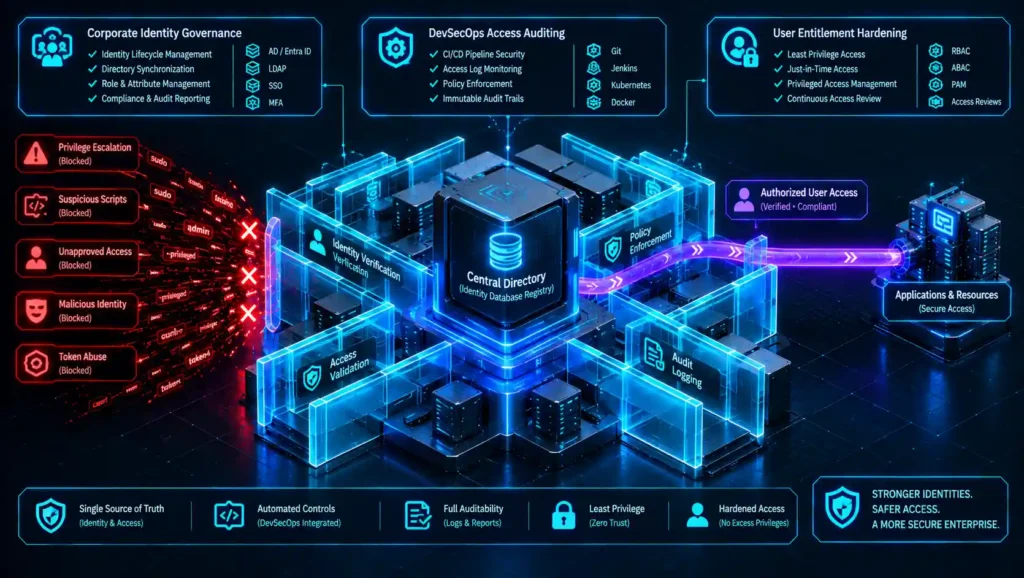
⚡ TL;DR — Key Takeaways
- Administrative access controls: Establishing absolute identity visibility protects your underlying infrastructure—you must construct an operational, script-assisted automated access review pipeline before your next SOC 2 or ISO 27001 compliance audit window initializes.
- Vendor/client parameter validation: Restructuring inbound communication properties provides vital protection against adversarial manipulation loops; enforce strict account access perimeters to map and track exactly who holds active permissions across every distributed corporate platform.
- Stream-optimized runtime flags: Monitoring live execution variables eliminates configuration drift across distributed microservices; validate parameter constraints dynamically by automatically flagging any custom user privilege that fails to match its documented operational justification.
- Perimeter isolation validation: Shielding distributed enterprise computing clusters demands active verification testing under load—structure low-overhead review flags to execute automated monthly delta checks rather than relying on chaotic annual fire drills, and execute perimeter containment insulation by programmatically de-provisioning user identities the exact millisecond an account goes stale.
Table of Contents
Distributed startup infrastructure accumulates permissions the way any living system accumulates debris—quietly, continuously, and without anyone explicitly deciding it should happen. A third-party contractor gets full administrative rights for a rapid two-week development sprint. A former employee’s access token never gets fully revoked from a secondary production cluster. Six months down the line, no one within the engineering group can say with any mathematical confidence who actually holds access to what. The technical reality remains absolute: allowing unstructured permission sets to linger across your cloud nodes turns your identity perimeter into a high-risk compliance liability, completely open to exploitation long before your monitoring dashboards throw an alert flag.
This operational baseline is not a casual digital hygiene issue; it is a severe corporate financial liability. Unmanaged, accumulating user permission sets leave lean operations teams highly vulnerable to catastrophic data breaches, internal insider exploits, and immediate audit failures the exact second an independent SOC 2 or ISO 27001 examiner uncovers orphaned employee credentials or unverified administrative privileges across your environments. Once that tracking gap is discovered mid-audit, the corporate cost is no longer preventive—it shifts entirely to complex, emergency forensic remediation, which demands far more capital and engineering bandwidth than proactive edge shielding.
Deciding to deploy an explicit, structural roadmap to construct a lightweight, code-enforced automated access review pipeline is a critical operational engineering requirement rather than a secondary compliance nicety reserved only for enterprises with massive GRC headcounts. Enforcing regular, script-assisted validation sweeps is the only technical mechanism that successfully prevents privilege creep, stabilizes high-stakes enterprise procurement reviews, and stops technical risk drift before it compounds into a non-negotiable compliance finding that an external auditor is legally forced to flag.
There is a profound, stomach-dropping sense of technical disbelief that hits you when you sit in a high-stakes customer compliance audit and realize that your own identity perimeter has completely fallen apart. You sit at the conference table while the client’s enterprise security team runs a routine verification check on your production database access logs, and your heart sinks as a completely unauthorized administrative account surfaces on the screen.
A quick internal review reveals the terrifying reality: a former freelance contractor who left the company nine months ago still possesses active, unmonitored administrative root access to your main production cloud databases simply because nobody bothered to run a comprehensive de-provisioning check on the access registries. Watching your startup’s biggest enterprise contract freeze on the spot because your identity onboarding relied on manual spreadsheet checklists rather than an active, code-enforced audit engine is a brutal wake-up call that proves a single orphaned credential can instantly derail your company’s market growth.
The four coordinated implementation steps detailed below construct that technical protection layer by layer, transitioning your startup away from point-in-time spreadsheet reviews and toward a continuous, automated identity governance state.
STEP 1: EDGE IDENTITY MAPPING AND LOW-OVERHEAD INVENTORY PIPELINES
Absolute infrastructure visibility must always establish the baseline parameter before active identity control gates can function. Before any repeatable audit review loop can successfully operate, a lean software division requires a single, consolidated mapping picture of who has access to what, completely bypassing the massive pricing tiers of enterprise identity access management suites engineered for organizations ten times their operational size.
- Export raw identity access states across all core platforms: Your administrative strategy must begin by scheduling automated exports of raw access parameters straight out of your primary cloud boundaries—including Google Workspace, AWS IAM, and GitHub APIs—into centralized, lightweight flat files. Fulfilling this tracking requirement does not mandate a complex, real-time telemetry dashboard; a lightweight, scheduled export routine running weekly or monthly provides ample resolution for a startup’s operational scope and budget.
- Isolate unverified access lines using differential sorting models: The exact millisecond your infrastructure snapshots drop side by side inside a secure container, automated differential sorting models must parse the files to isolate variations. This programmatic comparison instantly surfaces access anomalies—such as unauthorized permission elevations, untracked group modifications, or orphaned credentials that materialized without a corresponding onboarding HR directory log. Building this clean database baseline functions as the primary requirement upon which an automated access review pipeline depends; skipping this initial inventory cross-walk guarantees that downstream validation filters will operate from an incomplete layout.
STEP 2: HARDENING MONTHLY COMPLIANCE DRILLS AND DRIFT DETECTORS
Absolute infrastructure visibility operating without a rigid timeline decays remarkably fast. The second layer of your identity governance model structures raw directory data into a programmatic, monthly validation gate—establishing a fixed operational cadence where user access states are systematically checked against active expectations rather than assuming permissions remain correct over time.
- Deploy delta-tracking systems at the center of the auditing lifecycle: Rather than forcing a small team to re-review every single employee account and service token every month, your parsing scripts must dynamically isolate only the explicit changes that occurred since the last snapshot. The delta engine flags only systemic modifications—such as a new administrative grant, an irregular permission elevation, or a structural role change that fails to align with your HR database registries—keeping the governance loop lightweight enough for a lean startup to sustain without collapsing under administrative overhead.
- Route flagged anomalies straight to immediate administrator sign-off: Every single delta variation isolated by your tracking tools must immediately route to authorized system administrators for review rather than sitting in an unmonitored queue. The definitive objective of a monthly validation cadence is to keep the organizational drift window exceptionally small; the longer an unverified privilege sits unreviewed inside your architecture, the more likely it is to compound into a severe systemic variance that an external auditor will eventually discover on their own.
STEP 3: TAMPER-EVIDENT EVIDENCE LOGGING AND CENTRALIZED AUDIT TRAIL MATRICES
Detecting access drift and correcting it internally is entirely insufficient for external validation—an independent compliance examiner requires definitive proof that the control actively operated, consistently and repeatedly, throughout the entire review window. This elevates evidence logging into a standalone architectural requirement rather than a passive afterthought tacked onto the end of a sprint.
- Format every review approval and account revocation into a structured, immutable log output: The data string must be explicitly hardcoded with automated, time-stamped parameters that cannot be retroactively edited, modified, or deleted by any administrative account. A log record that an administrator can quietly rewrite or adjust following an operational security incident does not constitute verifiable evidence; it functions as a critical compliance liability that will instantly trigger an audit failure.
- Ground your identity logging layers directly in authoritative compliance standards: Engineering teams building these evidence repositories must align their technical telemetry outputs straight with the official AICPA trust services criteria for access governance. This authoritative baseline defines the exact tracking expectations a SOC 2 examiner looks for, mandating that the organization demonstrate continuous control operation across the entire audit period—proving via an unbroken chain of tamper-evident log matrices that your identity perimeters were actively monitored every single week rather than showcasing a single point-in-time snapshot generated right before the audit window closed.
STEP 4: PRIVILEGE LEAST-PRIVILEGE RECOVERY AND FAIL-SECURE USER DE-PROVISIONING
The final layer of your identity framework governs the precise technical response triggered the exact millisecond access drift is detected. Containment must execute automatically via machine-driven workflows rather than listing it as a secondary, manual clean-up task that an administrator promises to look at next week. Enforcing this approach applies the absolute fail-secure principle to identity management: when a credential profile’s validity is in doubt, the system must structurally default to a zero-trust state of minimized access rather than leaving open pathways live.
- Deploy automated, fail-secure de-provisioning workflows instantly: Your boundary tools must immediately strip unverified permissions, isolate elevated credentials, or lock out inactive system users the moment an active review cycle flags an account as abandoned or anomalous. The automated script layout must never pause to wait for a manager’s manual confirmation before acting on a clearly stale or orphaned account profile.
- Prioritize automated edge containment over manual human verification loops: Your identity architecture must contain the threat surface first and allow for rapid, administrative reinstatement later if the tracking flag turns out to be a false positive. Leaving a known-bad or unverified privilege live while a human engineer gets around to reviewing the alert opens a massive backdoor window that threat actors can easily exploit to compromise adjacent networks.
Assuming an access review framework is completely secure simply because team managers sign off on a manual spreadsheet checklist once a quarter introduces a highly dangerous and severe false sense of security across your operational divisions. Manual tracking arrays are highly prone to pencil-whipping, data entry errors, and a complete lack of verifiable historical evidence tracking that leaves your perimeters wide open to lateral post-compromise movement. If you rely on a static spreadsheet as your standalone identity shield, an administrative team can easily overlook an orphaned contractor token or misread a high-privilege service account override, quietly leaving a critical backdoor active for months while your team remains entirely blind to the vulnerability.
CONCLUSION & GOVERNANCE BOUNDARY SUMMARY
A resilient identity safety posture operates as an active, ongoing system engineering discipline rather than a static boardroom compliance checkbox reviewed once a quarter and forgotten. It must function continuously in the background of your business operations, rather than surfacing exclusively when an audit deadline approaches.
Anchoring your perimeter gateway on automated token telemetry, strict credential isolation, and disciplined network blocks actively shields your compute cluster and enterprise relationships from the kind of catastrophic financial and operational drain a single forgotten administrative account can eventually cause.
The four coordinated implementation phases detailed in this guide—edge identity mapping, monthly drift detection, tamper-evident logging, and automated fail-secure de-provisioning—collectively form a comprehensive, repeatable automated access review cycle. This lean layout is engineered specifically so that bootstrapped startup teams can sustain it flawlessly without needing an enterprise IAM software budget, delivering an unshakeable identity governance record that holds up under real external audit scrutiny rather than just looking good on a boardroom slideshow deck.
Balancing rapid user acquisition and software feature deployment velocity with rigid, continuous endpoint verification remains one of the most complex orchestration challenges facing modern DevOps and identity access teams. We invite you to join the technical discussion in the comments section below: What specific web application firewalls, proxy layers, or automated log correlation tools do you deploy to monitor your Node.js application perimeters against candidate-portal abuse? Have you successfully shifted your form endpoints to dynamic sliding window rate limiters, or are you running basic fixed-window middleware validation checks during staging builds? Drop your architectural layouts, custom endpoint protection patterns, and hard-earned advice with the engineering community below!
Related: EU AI Act Compliance: 4 Crucial Steps to Stop Compliance Drift – EU AI Act compliance isn’t a one-time checklist—build a continuous SaaS roadmap for risk classification, transparency, logging, and audit readiness.
Prompt Injection Defense: 4 Crucial Tactics to Shield Corporate Networks – How Semantic Kernel can help defend AI applications against prompt injection attacks using structured orchestration and layered safeguards.
Prevent API Key Leakage: 4 Crucial Steps to Shield Corporate Networks – A layered framework for keeping API keys out of local AI application code — externalized configs, vaulted secrets, pre-commit/pipeline scanning, and proxy-isolated credential handling.
Private Background Removal Tools: 5 Crucial Options to Stop Corporate Leaks – The blog explains how organizations can use private, locally processed background-removal tools and layered governance controls to prevent sensitive client assets from leaking through unvetted third-party services.
Block Credential Stuffing: 4 Crucial Steps to Shield Hiring Portals – A practical guide to defending hiring portals against credential stuffing using layered telemetry, adaptive rate limiting, centralized logging, and fail-secure controls.
NIST Framework Alignment: 6 Crucial Rules to Stop Compliance Drift – A practical NIST-aligned GRC roadmap for turning compliance into continuous security governance through asset visibility, strong access controls, detection, response, recovery, and audit readiness.
FREQUENTLY ASKED QUESTIONS (FAQ)
Q1. How can small teams running automated access reviews efficiently track “shadow” accounts created outside primary providers, like standalone SaaS tools used by marketing or sales?
Small teams should connect their review pipeline to an automated web-hook monitor or a centralized single sign-on (SSO) integration layer. Any unmapped, external SaaS tool that tries to hook into company communications or financial networks should trigger an immediate administrative flag, ensuring that independent department platforms are discovered and cataloged before they drift completely out of control.
Q2. Will running automated differential sorting scripts on our raw user directories introduce noticeable latency or processing bottlenecks on our live management instances?
No, because the inventory extraction and sorting scripts operate out-of-band and deal entirely with flat structural data files rather than database transaction records. By scheduling your diff scripts to run as background cron tasks during off-peak windows (like midnight on a Sunday), you process identity logs at near-wire speeds without introducing a single millisecond of lag to live developer or user environments.
Q3. What is the primary technical limitation of relying on a centralized spreadsheet for identity audits, even if it is updated programmatically?
The core limitation is that spreadsheets do not support immutable, native data logging features—meaning any administrative user with write permissions can accidentally modify or delete historical rows without leaving a clear trail. If an auditor asks to see proof that an access control was operated cleanly six months ago, a basic spreadsheet grid cannot provide the tamper-evident proof that a true, cryptographically hashed ledger file generates naturally.
Q4. How do we balance an aggressive, automated de-provisioning loop with remote workers who might be inactive due to parental leave or extended vacations without locking them out entirely?
Your automated scripts must separate complete account termination from temporary account suspension states. When an identity hits your inactive threshold (e.g., 30 days without a valid login token), the system should place the account into an isolated, “frozen” group container that drops active access rights while preserving all local profiles and encryption metrics—allowing a returning worker to trigger a safe administrative reinstatement loop instantly.
Q5. What is the fastest technical control a bootstrapped team can deploy to verify that an external vendor has properly cleaned up its access footprints after a project concludes?
Configure your identity provider to enforce an automatic, non-extendable expiration variable right at the moment the vendor profile is created. By binding the contractor’s credentials to a hard-coded time-to-live (TTL) flag (e.g., exactly 14 days), the underlying infrastructure automatically revokes all session variables and blocks the access perimeter the exact millisecond the timeline ends, completely independent of human follow-up tasks.
DISCLAIMER
Educational Notice: This article is published on AI Security Watch strictly for technical educational and general cybersecurity awareness purposes. The configurations and research discussed are based on public threat intelligence data. This content does not constitute professional IT architecture, legal, or financial advice. Because network configurations vary, always verify settings in an isolated test environment or consult with a qualified engineer before modifying live hardware or registries. AI Security Watch contains informational links to external resources; we are not responsible for third-party site accuracy or platform content.