
⚡ TL;DR — Key Takeaways
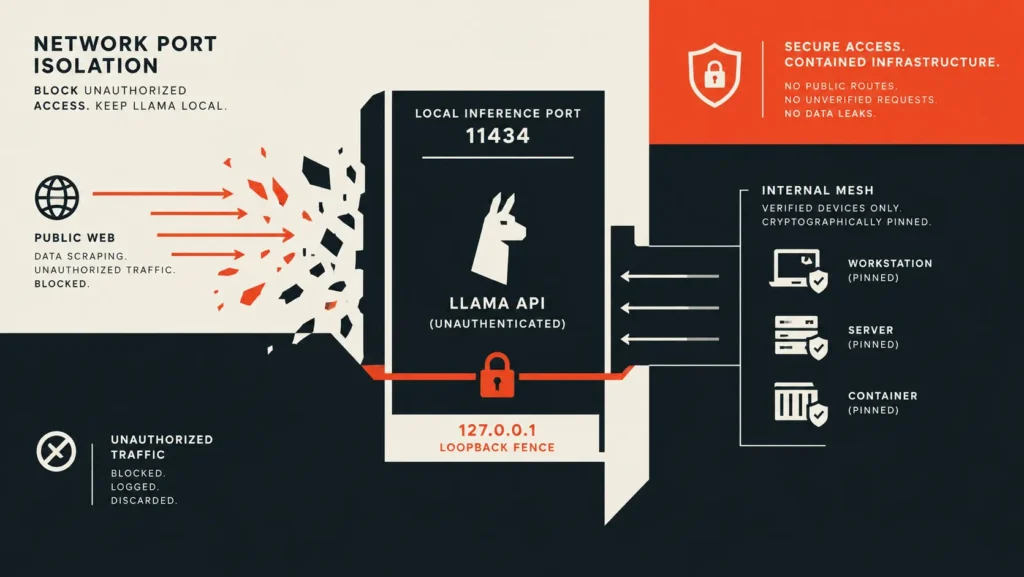
- Administrative access controls: Eliminating internal wildcard listening perimeters shields your underlying development infrastructure—the baseline roadmap to restrict llama api access requires that software engineers systematically audit environment variables to confirm the raw inference port is bound strictly to local loopback addresses rather than a wildcard interface.
- Vendor/client parameter validation: Restructuring default network transport layers blocks public internet-wide interception loops; deploy a software-defined mesh overlay network to function as an isolated, virtual backbone, ensuring that legitimate development traffic runs across a cryptographically partitioned plane without ever touching the public web.
- Stream-optimized runtime flags: Monitoring client node connectivity parameters prevents unvetted hardware endpoints from bridging into your compute clusters—enforce a strict cryptographic pinning protocol that rejects inbound connections unless the source device possesses a verified, pre-approved machine signature.
- Perimeter isolation validation: Shielding local server boundaries demands continuous network boundary validation under load rather than point-in-time reviews—perform continuous boundary drift audits across your host firewalls, since an active network packet rule configured correctly today can silently revert after a system update or automated daemon restart.
Table of Contents
Engineering groups routinely spin up local open-source foundational models on high-compute development boxes without realizing that default environment variables often bind raw inference ports to wildcard addresses. That single default setting can expose an entire local development machine to internet-wide scanning botnets and remote execution attempts. Failing to mathematically map and insulate these local execution nodes allows automated collection scripts to locate and harvest compute resources long before standard network tracking systems raise a configuration alert or drop an exposed storage endpoint.
Deciding to deploy an explicit, structural roadmap to construct strict validation parameters and restrict llama api access protocols is a critical operational engineering requirement, not a concern reserved for production systems alone. Enforcing these centralized data lifecycles is the only technical mechanism that successfully prevents asset-handling drift, stabilizes enterprise procurement loops, and stops technical risk drift before a scanning bot finds an open port that was never meant to leave the building. Moving past passive security assumptions allows backend teams to transform raw network boundaries into active, code-enforced perimeters, locking down network interfaces before an outdated local deployment triggers a complete compliance failure.
There is a profound, stomach-dropping sense of technical disbelief that hits you when you run a quick external port scan on your company’s public IP range and realize a massive security hole has been left wide open. I was auditing our network perimeter assets and watched my heart sink as I discovered an open, completely unauthenticated port 11434 routing directly into a local development machine’s high-end GPU cluster.
Realizing that anyone on the public web could have directly prompted our internal hardware, manipulated our model environments, or executed a sophisticated container breakout payload entirely undetected is a brutal wake-up call. It proves that buying top-tier hardware arrays means absolutely nothing if your developers leave the front door wide open to public scanning botnets because they didn’t check their environment listener variables.
The step-by-step infrastructure isolation blueprints detailed below provide a hardcoded operational checklist to map out these network perimeters systematically.
THE STEP-BY-STEP DATA LIFE CYCLE PURGING LANDSCAPE
STEP 1: HARDCODING NATIVE LOCAL LOOPBACK BINDINGS AND NEUTRALIZING WILDCARD LISTENERS
The single most common misconfiguration behind an exposed inference server is an administrative binding address that nobody deliberately chose. This foundational step corrects that exposure vector straight at the source to programmatically restrict Llama API access before external scanning loops map the hardware.
- Understand why wildcard address binding introduces severe server risks: A service bound to a wildcard address automatically listens on every active network interface the host possesses—including any interface exposed directly to the public internet—rather than restricting its communication pathways to local, internal traffic loops only.
- Enforce strict loopback-only binding parameters as your unyielding default: Configuring the self-hosted inference service to bind exclusively to the local loopback interface ensures the target port is exclusively reachable from processes running on that identical physical machine, closing off external reachability at the core transport layer.
- Treat wildcard binding as a critical system vulnerability rather than a convenience: Wildcard configuration variables might make multi-device development testing marginally easier during initial prototyping setups, but it converts an administrative convenience into a standing infrastructure liability the exact moment that box connects to any public network.
- Audit active interface binding configurations immediately following every system deployment: A service correctly pinned to local loopback bounds during initial installation can silently revert back to permissive wildcard listening defaults after a container restart, a package update, or an automated daemon config override.
STEP 2: ENFORCING SOFTWARE-DEFINED MESH OVERLAY NETWORKS VIA ZEROTIER VIRTUAL BACKBONES
Loopback binding completely solves local exposure vectors, but legitimate remote developers still require a secure mechanism to communicate with the service. This architectural step engineers that route without ever exposing traffic to the public internet.
- Deploy a software-defined mesh overlay network boundary: A virtual mesh overlay creates a private, isolated virtual network layer that legitimate client devices must explicitly authenticate to join, avoiding any reliance on public IP routing, unencrypted domain names, or dangerous port-forwarding rules.
- Route all legitimate inference traffic through the virtual backbone: Once the mesh layer is provisioned, configure the local inference daemon to listen exclusively on the virtual interface address assigned by the mesh topology, completely isolating it from any standard physical interface exposed to the broader internet.
- Eliminate the need for traditional edge port forwarding entirely: Standard remote access architectures typically require forwarding internal ports through a hardware router or perimeter firewall—which is the exact configuration mistake most responsible for accidental public exposures. A mesh overlay completely removes this perimeter vulnerability.
- Treat the virtual mesh network itself as a strict security boundary: Granting access to the mesh overlay must remain a deliberate, tightly controlled administrative process; an internal overlay network that any machine can join without explicit multi-factor approval simply shifts the exposure window rather than solving it.
STEP 3: CRYPTOGRAPHICALLY PINNING AUTHORIZED DEVELOPER DEVICES AND PEER-TO-PEER BRIDGES
Membership in the virtual mesh network alone is not sufficient to fully isolate your endpoints. This step layers device-level cryptographic verification on top of network-level isolation, establishing absolute transport containment across developer nodes.
- Cryptographically pin authorized developer devices to enforce strict identities: Each client device permitted to reach the endpoint must carry a unique, verifiable cryptographic signature. This measure ensures you restrict Llama API access through absolute machine verification rather than relying on network location alone to imply trust.
- Reject inbound connections from unpinned machine signatures by default: A peer-to-peer bridge attempting to reach the inference service without a pre-approved cryptographic identity must be dropped automatically by the network layer, regardless of whether it is technically present on the mesh network.
- Maintain a living registry of allowed machine identities to prevent access decay: Device pinning is only as strong as the process governing who gets added or removed from that registry. A former employee’s still-pinned laptop represents a standing risk equivalent to an active credential that nobody revoked.
- Ground this architectural layer in established federal networking guidance: Teams building this containment tier should reference the official CISA networking defense and perimeter isolation parameters to map their access rules. Aligning your infrastructure with these public directives ensures your segmentation and identity verification principles satisfy elite security metrics.
STEP 4: AUTOMATED COMPLIANCE DRIFT SWEEPS AND BOUNDARY FIREWALL AUDITS
Every network parameter built across the preceding phases can degrade quietly over time due to system updates or human error. This final step exists specifically to catch that configuration degradation before an attacker does, ensuring your transport constraints remain permanently enforced to restrict Llama API access across your distributed developer subnets.
- Run scheduled sweeps confirming loopback bindings remain intact: Implement a recurring, automated validation sweep of every inference host’s interface configuration to catch wildcard binding regressions before they can become an active exposure window for scanning botnets.
- Validate default-deny host firewall postures continuously: The host-level firewall governing the local inference server must default to denying all inbound traffic except explicitly permitted virtual mesh and loopback interface paths. This posture must be confirmed on a recurring basis rather than assuming it persists unchanged.
- Cross-check the pinned device registry against current personnel and asset records: A device pinning list that has not been reconciled against active employment logs or asset inventory records will inevitably accumulate stale, unauthorized entries over time, introducing an access control gap.
- Log and review every configuration change to networking and firewall rules: Ensure any modification to binding addresses, mesh membership, or firewall policy rules generates an auditable record showing who made the change and why, closing the gap that allows configuration drift to go unnoticed until an external scan finds it first.
THE CRITICAL RECONNAISSANCE BLIND SPOT OF MESH RECONNAISSANCE
Reconnaissance and vulnerability assessment tooling have hard structural limits when analyzing software-defined mesh overlay networks. Traditional network scanner utilities and external security frameworks look at endpoints, open host ports, and perimeter firewalls, but they cannot parse what traffic occurs inside a cryptographically pinned tunnel or how a model limits its processing bounds after initializing a session. This blind spot matters most in physically mixed network environments. A conference room, a shared coworking space, or a hybrid office subnet can place an unpinned device on the same local network segment as an inference host, and without the cryptographic pinning layer from Step 3 actively enforced, physical proximity alone can substitute for legitimate authorization.
To systematically restrict Llama API access, system architects must treat individual hardware identities, rather than the physical corporate building network, as the true infrastructure perimeter. Relying on basic office router isolation to protect unauthenticated ports invariably fails external audits, as it ignores the high mobility of modern developer machines. Engineering teams must hardcode loopback bindings and cryptographically authenticate every client node at the OS tier, ensuring that physical proximity to a machine never grants a bad actor entry to your compute cluster.
Assuming an inference server is secure simply because it runs inside a localized office building or behind an unmonitored office router introduces a dangerous false sense of security across your engineering divisions. If an employee connects their development machine to a public Wi-Fi network without a cryptographically pinned overlay network, an attacker sitting on that same local subnet can address the unauthenticated port directly and manipulate the host hardware. Storing open-source models with wildcard listeners simply because an environment is ‘internal’ turns your physical endpoints into immediate targets, ensuring that a single connection slip transforms a routine testing session into a catastrophic infrastructure takeover.
CONCLUSION & GOVERNANCE BOUNDARY SUMMARY
A resilient privacy and identity safety posture operates as an active, ongoing system engineering discipline rather than a static boardroom compliance checkbox reviewed once a year and forgotten. A deliberate, code-enforced effort to restrict Llama API access—combining strict loopback bindings, software-defined mesh overlays, cryptographic device pinning, and continuous firewall drift audits—is the only technical mechanism that successfully keeps a local inference server from becoming the next open port a scanning botnet harvests on the public internet. Transitioning toward this automated network isolation framework completely eliminates the human oversights that inevitably occur during rapid infrastructure scaling, ensuring that local development instances remain permanently partitioned, locked down, and safe from unauthorized external queries.
Balancing high-performance local model development with rigid network perimeter isolation remains one of the ultimate engineering challenges facing modern DevSecOps architects and platform developers. We invite you to join the technical discussion in the comments section below: What specific passive scanning architectures, framework tracking layers, or automated log monitoring platforms do you currently use to audit your infrastructure perimeters against global threat matrix indexes and manage your restrict Llama API access configurations? Have you successfully shifted your host deployments to hardcoded loopback configurations, or are you running basic router-level firewalls during staging builds? Drop your organizational workflows, active directory patterns, and hard-earned runtime security advice with the engineering community below!
Related: Microsoft Copilot Data Leakage: 5 Vital Blueprints to Shield Corporate Networks – Microsoft Copilot can surface more than users expect—secure enterprise data by fixing permissions, enforcing sensitivity labels, and controlling AI indexing paths.
Data Retention Policy: 4 Practical Rules to Stop Compliance Drift – A strong data retention policy turns regulatory compliance into automated control—classify, retain, purge, and continuously verify every record.
AI Safety Risk Register: 4 Masterful Frameworks to Stop Compliance Drift – Enterprise AI safety isn’t just about compliance—it’s about tracking risks, ownership, data exposure, and mitigation before they become deal-breakers.
Indirect Prompt Injection: 7 Elite Strategies to Shield Corporate Networks – A practical guide to mitigating indirect prompt injection in RAG systems using trusted data pipelines, input sanitization, retrieval controls, and output validation to prevent malicious content from influencing AI responses.
Secure Docker LLM Deployment: 5 Practical Blueprints to Shield Corporate Networks – A practical guide to hardening containerized LLM environments against misconfigurations, exposed services, and AI-specific security threats.
Block Grok AI Scraping: 4 Vital Adjustments to Shield Corporate Networks – A practical guide to blocking Grok AI scraping on X, using privacy controls, access restrictions, and defensive measures to reduce unauthorized use of brand content for AI training and data extraction.
FREQUENTLY ASKED QUESTIONS (FAQ)
Q1. How can small development teams verify if a local Llama 3 instance running inside a Docker container is accidentally bypassing the host loopback 127.0.0.1 restriction?
System teams must explicitly trace container network bindings using internal diagnostic utilities to confirm the containerised daemon maps strictly to the host loopback interface rather than bridging directly to the docker0 network interface, preventing adjacent containers on the same host from addressing the unauthenticated endpoint.
Q2. Will routing heavy model tensor streams across a ZeroTier virtual backbone significantly impact token-generation latency or throughput for remote developer teams?
No, because software-defined overlay meshes establish direct peer-to-peer UDP punch-through connections that encapsulate network traffic with minimal overhead, maintaining identical raw inference processing performance while ensuring the data pipeline remains structurally isolated from public web path hops.
Q3. How do we prevent our ZeroTier mesh overlay network tokens from being leaked if an engineer commits their global configuration repository to a public GitHub project?
Infrastructure leads must integrate pre-commit secret tracking hooks within the local development lifecycle to automatically block deployment scripts containing network IDs, pairing this barrier with strict ZeroTier controller policies that require manual administrator approval inside the management panel before any new device signature can actively route packets.
Q4. External compliance auditors frequently flag unauthenticated local APIs even if they operate within a private mesh network—what technical metric satisfies this objection?
Developers must configure a local reverse proxy directly on the loopback interface ahead of the Llama 3 port to enforce mandatory mutual TLS (mTLS) certificate validation, providing a hardcoded cryptographic authentication token string that satisfies standard corporate application-layer transit security guidelines.
Q5. What is the fastest technical mechanism an operations team can deploy to isolate an inference host machine if an automated drift sweep flags a wildcard binding regression?
Infrastructure engineers must script an automated firewall trigger within the configuration tracking framework that instantly drops all inbound network traffic to port 11434 at the OS level the exact millisecond a wildcard exposure is detected, isolating the server interface while alert notifications route to your SIEM platform.
DISCLAIMER
Educational Notice: This article is published on AI Security Watch strictly for technical educational and general cybersecurity awareness purposes. The configurations and research discussed are based on public threat intelligence data. This content does not constitute professional IT architecture, legal, or financial advice. Because network configurations vary, always verify settings in an isolated test environment or consult with a qualified engineer before modifying live hardware or registries. AI Security Watch contains informational links to external resources; we are not responsible for third-party site accuracy or platform content.