⚡ TL;DR — Key Takeaways
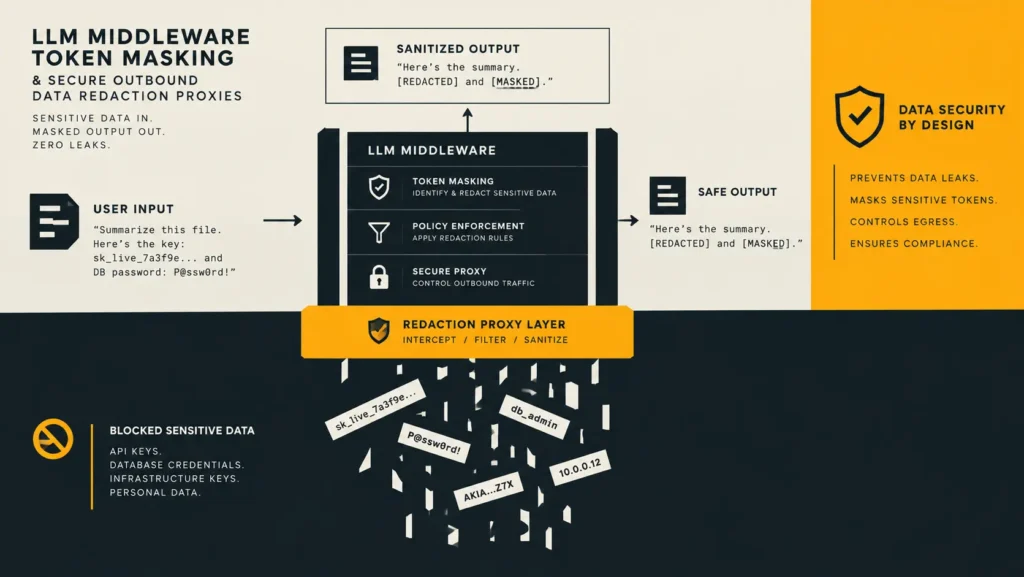
- Administrative access controls: Eliminating raw model outbound leak vectors shields client-facing web surfaces—implementing LLM middleware token masking mandates that software architects route all generated strings through an isolated intermediate proxy layer before rendering tokens on external panels.
- Vendor/client parameter validation: Running automated regex engines captures deterministic credential patterns, forcing the proxy tier to redact raw API keys or system environment signatures before they reach external surfaces.
- Stream-optimized runtime flags: Integrating named-entity recognition models isolates unstructured personal data blocks, keeping production client interfaces partitioned, restricted, and clean.
- Perimeter isolation validation: Shielding core database metadata environments demands continuous output parsing validation under load—regularly run automated mock verification sweeps to ensure proxy layers systematically scrub hidden system identifiers.
Table of Contents
Engineering groups routinely build highly capable orchestration layers but route raw generated text strings straight to frontend web panels without validation. Non-deterministic model outcomes can cause the engine to output sensitive system variables, internal database metadata, or cached user parameters completely unredacted, introducing a severe data leakage vector that nobody explicitly designed for. Failing to mathematically map and insulate these exit token streams allows automated collection scripts to scrape and harvest compute resources long before standard network tracking systems raise a configuration alert or drop an exposed storage endpoint.
Deciding to deploy an explicit, structural roadmap to construct strict validation parameters and robust LLM middleware token masking architectures is a critical operational engineering requirement, not an edge case reserved for adversarial testing. Enforcing these centralized data lifecycles is the only technical mechanism that successfully prevents asset-handling drift, stabilizes enterprise procurement loops, and stops technical risk drift before a single leaked credential turns into a full billing exploitation event. Moving past passive security assumptions allows backend teams to transform raw network boundaries into active, code-enforced perimeters, locking down network interfaces before an outdated local deployment triggers a complete compliance failure.
There is a profound, stomach-dropping sense of technical disbelief that hits you when you sit through a staging build review, execute an unvetted model agent query, and watch the system output a raw AWS secret access key and internal SQL schema paths directly onto a user-facing dashboard. We were testing a new multi-tenant database connector when a subtle prompt boundary collapse occurred. Instead of rendering a standard summary response, the model interface started printing out cleartext infrastructure tokens and administrative database metadata parameters in real time.
Realizing that your central application tier is casually broadcasting root credentials to external web panels simply because nobody placed a validation gateway between the model engine and the client interface is a brutal wake-up call. It proves that scaling up compute nodes means absolutely nothing if your engineering division leaves legacy customer profiles rotting in unmanaged cloud silos without a code-enforced destruction routine.
The six elite middleware redaction blueprints detailed below provide a hardcoded operational checklist to map out these network perimeters systematically.
THE 6 ELITE MIDDLEWARE REDACTION FRAMEWORKS
STRATEGY 1: DESIGNING THE INTERMEDIATE PROXY LAYER AND EGRESS INTERCEPTION GATEWAYS
Every subsequent execution step within this architecture depends entirely on a foundational architectural decision: no raw generative model output must ever reach a client application without passing through a dedicated, isolated inspection checkpoint first. Enforcing this structural routing topology is the primary infrastructure method used to establish robust LLM middleware token masking before text variables access external web targets.
- Build a mandatory intermediate proxy layer between the model and the client: This middle tier’s sole technical function is to programmatically intercept every single outbound string before it reaches a frontend panel, evaluating the character array against the rigorous validation rules the remaining strategies establish.
- Treat the proxy as a hardened egress interception gateway rather than a passive logger: The proxy tier requires absolute system authority to modify, redact, or terminate content streams in transit rather than simply observing and recording what passed through. A logging-only layer catches data leaks after the fact, when the compromise has already occurred.
- Ensure the proxy layer cannot be bypassed by any code path or microservice routing: If even one application integration point sends model output directly to a client interface without routing through this processing checkpoint, that single unvalidated path becomes the default route an adversary will find and exploit.
- Design the validation proxy to fail closed by default across all production subnets: If the proxy layer itself experiences a resource bottleneck, errors out, or becomes unavailable under heavy loads, the system must block the outbound response entirely rather than defaulting to passing raw, unvalidated content through to the client panel.
STRATEGY 2: CONFIGURING AUTOMATED REGEX ENGINES FOR DETERMINISTIC CREDENTIAL EXTRACTION
Certain categories of leaked infrastructure secrets follow predictable, well-documented structural string signatures. Implementing LLM middleware token masking at the egress boundary requires deploying specialized, high-performance regex engines to catch these deterministic patterns before passing tokens to computationally heavy processing tiers.
- Deploy automated regex matching for standard key prefixes: Cloud provider API keys, database connection strings, and common cryptographic credential formats follow recognizable structures that a well-tuned pattern engine can intercept with absolute reliability.
- Maintain and expand the regex pattern library continuously: New microservices and credential formats emerge regularly across the industry; a pattern library that was comprehensive a year ago will possess major validation gaps today unless it is actively updated against modern vendor token designs.
- Apply deterministic regex checks ahead of computationally expensive models: Because regex matching is fast and deterministic, executing it as the first pass in the egress pipeline catches the most obvious leakage vectors cheaply, before slower, non-linear analysis stages need to run.
- Treat an active regex match as an automatic token block rather than a soft system warning: A string matching a known credential pattern must never reach the client interface under any operational scenario; there is zero semantic ambiguity in this category that would justify a softer response than immediate redaction at the server edge.
STRATEGY 3: DEPLOYING NAMED-ENTITY RECOGNITION (NER) MODELS FOR UNSTRUCTURED PII PROTECTION
Not every sensitive data leak follows a rigid, fixed pattern that can be easily caught by standard rule-based pattern matching. A human name, physical address, or phone number embedded naturally within generated prose requires a fundamentally different detection approach. Deploying advanced LLM middleware token masking structures demands that systems architects combine deterministic pattern engines with context-aware machine learning layers.
- Deploy a lightweight NER model as a dedicated pipeline stage: Named-entity recognition frameworks are trained specifically to identify categories of sensitive information—such as human names, physical locations, and financial details—embedded within natural, unstructured text streams where standard string matching typically fails.
- Isolate the NER pipeline from the primary model’s execution context: Running entity recognition as a separate, sandboxed verification step prevents the added computational latency and resource load of this analysis from disrupting the primary generative model’s own inference performance.
- Tune NER sensitivity based on actual false-positive tolerance bounds: A model tuned too aggressively will over-redact legitimate response variables constantly, while one tuned too loosely will miss genuine PII; this threshold must be calibrated against real production traffic rather than left at a default environment setting.
- Align this verification layer with established application safety standards: Teams engineering this pillar should ground their approach in the official OWASP application security verification standards and token handling directives to validate data boundaries. Aligning your infrastructure with these public frameworks ensures your text sanitization and data minimization workflows satisfy elite industry metrics before tokens access client interfaces.
STRATEGY 4: HARDCODING STRUCTURAL MASKING REPLACEMENTS AND DETERMINISTIC TOKEN CANARIES
Detecting a high-risk leak represents only half of the validation lifecycle. Enforcing an institutional LLM middleware token masking architecture dictates a predictable, standard remediation response the exact millisecond a data exposure is flagged by your validation engines.
- Hardcode structural masking replacements for every detected threat category: A discovered API key or system identifier must never simply be sliced out of the text payload. It must be cleanly replaced with a consistent, distinct placeholder tag that preserves the surrounding sentence logic without exposing the underlying secret value.
- Deploy deterministic token canaries to test the pipeline dynamically: Periodically feed artificial, credential-like canary strings through your text generation pipelines to confirm your inspection filters catch and redact them seamlessly. This active validation proves your architecture functions under load, rather than assuming it works simply because no actual leak has been flagged recently.
- Standardize masking formats across every text detection category: Enforcing a predictable, hardcoded placeholder output format allows downstream monitoring platforms and SIEM systems to instantly distinguish a correctly sanitized model response from an anomalous layout that slipped past the proxy gates.
- Preserve enough surrounding text context for the response to remain usable: Over-aggressive redacting filters that strip out adjacent text elements degrade the client application’s actual functionality. Secure development life cycles demand that you target the sensitive variable exclusively, removing the risk without breaking the value of the output.
STRATEGY 5: DECOUPLING PROXY INSPECTION SUBNETS FROM CENTRAL MODEL INGESTION BLOCKS
Where the text validation layer physically or logically executes relative to the primary model instance introduces critical infrastructure security implications that are easy to overlook. Deploying an effective LLM middleware token masking architecture requires a clean network separation of concerns to prevent lateral exploit migration if an adversary breaches your backend systems.
- Decouple the proxy inspection subnet from the model’s core ingestion infrastructure: Running the data filtration proxy layer on isolated, independent hardware subnets limits the ultimate blast radius if either system component is individually compromised during a perimeter exploit.
- Prevent the model ingestion block from holding direct network reachability to client devices: If the central compute cluster has no physical or logical path to client-facing web panels, an attacker who compromises the model layer still cannot bypass the masking proxy to exfiltrate raw tokens to a client browser.
- Apply distinct network access control policies to each independent subnet: Manage the proxy tier and the model ingestion node under separate, non-overlapping access policies, ensuring that a system credential compromised on one side of the network does not automatically grant access to the other.
- Monitor cross-subnet traffic patterns continuously for network anomalies: Any inbound or outbound traffic between these two isolated network segments that does not explicitly match the expected proxy-to-model transaction pattern must trigger an immediate security alert, as it indicates a deliberate attempt to bypass the intended architecture.
STRATEGY 6: AUTOMATED COMPLIANCE DRIFT SWEEPS AND ADVERSARIAL EGRESS VALIDATION CADENCES
An active masking pipeline that functioned perfectly at launch can quietly experience configuration drift and stop intercepting the high-risk variables it was engineered to catch. Implementing a continuous LLM middleware token masking strategy requires automated, recurring validation routines to detect filtering degradation before an unredacted string reaches external client panels.
- Execute scheduled adversarial egress validation testing: Deliberately pipe known sensitive text corpuses, fake credential strings, and simulated customer records through the active production pipeline on a recurring schedule to confirm your inspection filters continue to drop data exposures.
- Track token detection rates over time instead of relying on deployment-time metrics: A gradual decline in filtration catch rates against a standardized testing suite indicates non-deterministic model drift, a configuration file regression, or an unhandled tokenization edge case that is quietly eroding your perimeter’s effectiveness.
- Validate NER and regex filtering components independently: Because these two core detection layers operate on completely different algorithmic logic, you must isolate and evaluate their performance metrics separately rather than assuming a single, aggregated pass-rate score reflects your true risk posture.
- Log every token masking action for downstream audit reviews: Ensure every data match, redaction trigger, and replacement execution creates a secure, write-only log entry indicating what was caught, when, and by which specific validation tier, giving incident response teams the exact evidence needed to verify control execution.
MANDATORY OPERATIONAL EXTRACTION PAPERS & REDACTION BOUNDARIES
A resilient data privacy and prompt safety posture operates as an active, ongoing system engineering discipline rather than a static boardroom compliance checkbox reviewed once an audit cycle and forgotten. Real-world telemetry across enterprise application layers makes the operational path clear: achieving true infrastructure resilience requires development teams to treat proxy layer design, regex pattern execution, named-entity recognition models, structural placeholder replacements, subnet decoupling, and continuous validation sweeps as a single, code-enforced technical matrix to protect client-facing interfaces permanently.
Assuming an orchestration framework like LangChain or LlamaIndex natively sanitizes its outbound data arrays introduces a dangerous and severe false sense of security across your engineering divisions. These popular integration tools prioritize feature deployment velocity, multi-model compatibility, and rapid prototyping capabilities while leaving output validation entirely to developer implementation. If your development team operates without an independent LLM middleware token masking proxy fence before tokens hit client interfaces, a single prompt injection attack or runtime system exception will transform your user-facing dashboards into an unmonitored channel for raw corporate data exfiltration.
CONCLUSION & GOVERNANCE BOUNDARY SUMMARY
A resilient privacy and identity safety posture operates as an active, ongoing system engineering discipline rather than a static boardroom compliance checkbox reviewed once a year and forgotten. Implementing an intermediate proxy tier that enforces LLM middleware token masking—by combining deterministic regex filters, context-aware NER analysis, structural placeholder replacements, decoupled subnet layouts, and continuous adversarial egress validation sweeps—is the only technical mechanism that successfully keeps a non-deterministic model generation from broadcasting infrastructure secrets. Transitioning toward this automated text validation layout completely eliminates the human oversights that inevitably occur during rapid feature development, ensuring that generated token streams remain permanently sandboxed, redacted, and safe before they access external web dashboards.
Balancing fluid real-time chat response speeds with rigid, multitenant output validation remains one of the ultimate engineering challenges facing modern DevSecOps architects and application security developers. We invite you to join the technical discussion in the comments section below: What specific passive scanning architectures, framework tracking layers, or automated log monitoring platforms do you currently use to audit your infrastructure perimeters against global threat matrix indexes and manage your LLM middleware token masking configurations? Have you successfully shifted your egress filtration to isolated proxy subnets, or are you running basic string checks within your primary codebase? Drop your organizational workflows, active directory patterns, and hard-earned runtime security advice with the engineering community below!
Related: Restrict Llama API Access: 4 Vital Blueprints to Shield Corporate Networks – Lock down your Llama API with loopback binding, ZeroTier isolation, device-level authentication, and continuous firewall audits.
Microsoft Copilot Data Leakage: 5 Vital Blueprints to Shield Corporate Networks – Microsoft Copilot can surface more than users expect—secure enterprise data by fixing permissions, enforcing sensitivity labels, and controlling AI indexing paths.
Data Retention Policy: 4 Practical Rules to Stop Compliance Drift – A strong data retention policy turns regulatory compliance into automated control—classify, retain, purge, and continuously verify every record.
AI Safety Risk Register: 4 Masterful Frameworks to Stop Compliance Drift – Enterprise AI safety isn’t just about compliance—it’s about tracking risks, ownership, data exposure, and mitigation before they become deal-breakers.
Indirect Prompt Injection: 7 Elite Strategies to Shield Corporate Networks – A practical guide to mitigating indirect prompt injection in RAG systems using trusted data pipelines, input sanitization, retrieval controls, and output validation to prevent malicious content from influencing AI responses.
Secure Docker LLM Deployment: 5 Practical Blueprints to Shield Corporate Networks – A practical guide to hardening containerized LLM environments against misconfigurations, exposed services, and AI-specific security threats.
FREQUENTLY ASKED QUESTIONS (FAQ)
Q1. How can small development teams prevent custom output proxies from introducing significant latency bottlenecks into real-time streaming LLM architectures?
Engineering teams must implement token-by-token processing loops using chunk-buffered evaluation loops rather than waiting for full completion buffers to aggregate. Running deterministic regex checks on small rolling window chunks while routing heavier Named-Entity Recognition (NER) inference calls across parallel background threads allows you to minimize latency overhead down to milliseconds without sacrificing security coverage.
Q2. Will routing outbound text through an independent proxy layer break dynamic Markdown or JSON structural formatting generated by the primary model engine?
No, if the inspection proxy decodes character payloads directly inside the raw text nodes before structural layout serialization occurs. Software developers should build custom string sanitization logic that strips text arguments from within JSON objects or Markdown blocks while leaving structural tokens—such as bracket characters or layout syntax flags—completely intact to protect downstream rendering engines.
Q3. How do we prevent our intermediate proxy layers from generating a massive data footprint that leaks user information within internal system logs during high-volume auditing?
System architects must configure application monitoring engines to utilize highly secure, ephemeral logging structures that explicitly throw away raw text outputs. Your monitoring infrastructure should record binary verification passes, match count integers, and custom performance metrics exclusively, routing actual redacted text patterns directly to volatile scratch memory spaces that automatically clear at transaction completion.
Q4. If a prompt injection exploit instructs the model to encode sensitive secrets using Base64 or Hex patterns, can standard regex engines intercept the payload?
No, simple signature rules fail to identify obfuscated character strings, making it vital to integrate automated decoding layers at the very front of your inspection pipeline. Hardcoding an immediate string translation filter ahead of the validation engine ensures that any encoded text block is systematically converted back into plain text before parsing begins, exposing hidden payloads to downstream detection models.
Q5. What is the primary operational mistake engineers make when setting up Named-Entity Recognition (NER) confidence limits for enterprise middleware systems?
The most common architectural bottleneck is relying on static default confidence scores without testing against high-volume domain vocabularies. Failing to calibrate confidence parameters on custom enterprise datasets inevitably leads to massive false-positive blocks that consistently redact harmless industry jargon, necessitating continuous testing sweeps to optimize target boundary thresholds under realistic load patterns.
DISCLAIMER
Educational Notice: This article is published on AI Security Watch strictly for technical educational and general cybersecurity awareness purposes. The configurations and research discussed are based on public threat intelligence data. This content does not constitute professional IT architecture, legal, or financial advice. Because network configurations vary, always verify settings in an isolated test environment or consult with a qualified engineer before modifying live hardware or registries. AI Security Watch contains informational links to external resources; we are not responsible for third-party site accuracy or platform content.