
⚡ TL;DR — Key Takeaways
- Administrative access controls: Establishing absolute endpoint gateway constraints protects your underlying infrastructure—a properly enforced openai api rate limit begins at the root perimeter, requiring security layers to cleanly verify and identify every client profile before tracking or counting a single request payload.
- Vendor/client parameter validation: Restructuring incoming request parameters provides vital protection against advanced proxy-rotation vectors—backend architectures must combine client IP parsing, cryptographically verified user tokens, and unique device fingerprinting parameters, as no single data signal is strong enough on its own.
- Stream-optimized runtime flags: Transitioning configuration profiles into locked, system-managed states prevents memory misalignment across microservice nodes—track dynamic request counts within a shared, low-latency distributed cache matrix rather than relying on volatile, local application process memory.
- Perimeter isolation validation: Securing downstream enterprise networks requires active runtime verification testing—systematically execute mock volumetric script attacks from an external vantage point before malicious actors do, because an untested configuration threshold operates purely as an unverified text file.
Table of Contents
Hosting an unthrottled upstream artificial intelligence endpoint represents a severe corporate liability within modern backend architectures. Automated scripting loops, aggressive scrapers, and malicious bot vectors can easily trigger millions of rapid token requests in a matter of hours. Unlike legacy web traffic that primarily consumes fixed-cost compute or predictable bandwidth bandwidth pools, every single large language model (LLM) request carries a direct, variable, and metered dollar cost. Operating an exposed gateway without restricting user profiles means an automated attacker can scale your resource usage infinitely, converting unmonitored infrastructure loops into massive financial overages before your front-line alerting systems can even register the anomalous access patterns.
Deciding to deploy an explicit, multi-layered defense layout to manage your openai api rate limit policies is a critical operational engineering requirement rather than a secondary configuration pass. Enforcing strict, code-driven perimeter constraints is the only technical mechanism that successfully stands between a normal user traffic spike and a catastrophic billing attack that drains corporate credit parameters through an automated denial-of-wallet (DoW) vector. Without deep, interface-specific filtering layers, your public-facing application remains highly exposed, leaving your development budget completely vulnerable to malicious token-exhaustion scripts that can paralyze your operational capital in a single weekend.
There is a profound, stomach-dropping sense of technical disbelief that hits you when you log into a cloud infrastructure dashboard on a Monday morning only to discover that an unthrottled, public-facing AI endpoint was targeted by an automated bot script over the weekend.
You look at the active billing telemetry and realize that because the route lacked an explicit middleware-enforced rate limiter, a malicious loop spent 48 hours spamming high-token recursive prompts straight into your upstream model keys. Watching a simple development oversight rack up tens of thousands of dollars in automated processing fees that completely drain your company’s credit cards and smash your monthly budget is a brutal wake-up call. It proves that a single unprotected API route can instantly compromise an organization’s fiscal stability.
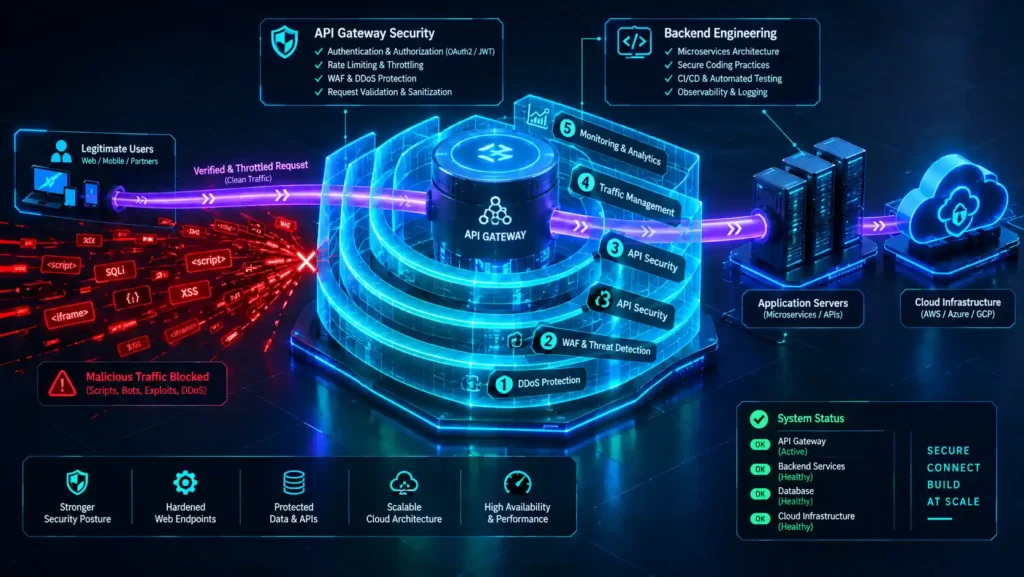
The five middleware coordination layers detailed below construct that technical defense from the external network edge inward, culminating in the automated perimeter validation testing required to prove your configuration actively holds under severe traffic pressure.
LAYER 1: CLIENT IDENTIFICATION AND HARDENED IP SCHEMAS
An traffic containment architecture is only as precise as the transactional identity it tracks against. Getting this initial layer wrong introduces a severe systemic vulnerability, causing every downstream security layer to inherit the exact same structural weakness and allowing malicious actors to manipulate data counters at will.
- Track incoming connections with multi-tiered identification logic: Relying strictly on a single, isolated network signal like a raw IP address is incredibly fragile. Sophisticated threat actors can seamlessly rotate through automated proxy networks, abuse residential VPNs, or spoof standard inbound routing headers to present themselves as a completely fresh client on every single request loop. Implementing deep edge identity verification is a mandatory engineering parameter when configuring middleware to block credential stuffing attacks before malicious traffic can reach your backend endpoints.
- Combine network-level IP parsing with cryptographically verified JWT payloads: For any inbound request payload traversing your perimeter with a valid session state, the authenticated user identity must take absolute precedence over the raw network address. This structural parameter is exceptionally difficult for an attacker to forge without executing a full account takeover.
- Add device fingerprinting as an auxiliary validation signal: Evaluating specialized connection metadata—such as exact header structures, localized user-agent arrays, request sequence patterns, and negotiated transport parameters—makes it significantly more expensive for a malicious script to spin up a new identity immediately after its previous profile has been throttled.
- Treat identity verification as a multi-factored decision matrix: The technical objective of an advanced openai api rate limit middleware layer is to maximize the resource cost of adversarial evasion. Structuring your verification checks in a multi-layered matrix guarantees that an attacker who successfully masks one identification signal is still caught and blocked by the adjacent tracking parameters.
LAYER 2: THE ALGORITHMIC ENGINE — SLIDING WINDOW COUNTERS
The mathematical algorithm underpinning your openai api rate limit enforcement directly dictates whether attackers can exploit predictable window boundaries to execute asymmetric volumetric spikes. Selecting a weak mathematical model creates an architectural loophole, allowing automated script arrays to artificially double their allowed consumption limits.
- Understand the weakness of fixed-window counters: A basic fixed-window approach resets its internal integer count at a defined clock boundary, such as the top of every hour. This layout introduces a severe scheduling vulnerability; a malicious client can burst through their maximum allowed request allocation in the final seconds of an active window, and immediately burst through it again in the opening seconds of the next, effectively doubling the intended capacity over a short time span.
- Deploy a rolling sliding window counter instead: A sliding window model continuously evaluates the inbound traffic velocity over a dynamic, rolling time period rather than matching a fixed clock boundary. This algorithmic approach effectively eliminates edge-of-window burst exploits entirely, forcing all connection request paths to stay strictly beneath your baseline threshold.
- Consider the token bucket algorithm as an alternative: Token bucket logic allocates a fixed capacity of transaction tokens that programmatically refill at a steady, predefined rate. Each inbound payload consumes a single token from the pool, and requests are rejected with an immediate drop the exact millisecond the bucket hits empty—this approach naturally smooths out bursty traffic while still allowing brief, legitimate user spikes to traverse the edge.
- Choose the algorithm based on traffic shape, not habit: Select your traffic orchestration engine based entirely on real-world workload dynamics. Sliding windows suit steady, highly predictable connection environments, while token buckets are structurally better suited to workflows that require legitimate, short-term bursts, such as bulk API generation or large batch processing jobs.
LAYER 3: LOW-LATENCY CACHING STRATEGIES VIA MEMORY CLUSTERS
Where request records are stored matters just as much as how they are calculated. The second your deployment expands beyond a single backend container, your selection of storage infrastructure determines whether your security perimeter remains intact or collapses under load.
- Store connection histories in a dedicated, low-latency data store: A shared, distributed caching layer like a Redis cluster is explicitly built for the high-frequency read and write operations that rate limiting demands. It keeps tracking metrics available across all application nodes without introducing processing bottlenecks.
- Avoid native local application memory entirely: Storing request counts inside a single server process’s local memory causes severe session misalignment the moment a load balancer distributes traffic across multiple containers. A malicious client could be completely rate-limited on one instance while remaining completely uncounted on an adjacent node, silently defeating the entire security control.
- Design for precise cache expiration alignment: The Time-to-Live (TTL) values configured on your cached request records must match your rate limiting window exactly. If these values are misaligned, stale data entries will either under-count or over-count client activity, leading to false-positives for legitimate users or unmetered access for attackers.
- Ground your caching architecture in established enterprise patterns: Backend engineers constructing this high-throughput validation layer should align their technical layout directly with the official Node.js production security blueprints. This reference framework outlines the exact deployment models required to manage stateful, high-concurrency traffic checks safely within high-volume production subnets.
LAYER 4: STRUCTURING DOWNSTREAM VENDOR HEADERS AND HTTP 429 SHIELDING
Once incoming connection requests are measured and throttled, how your middleware architecture communicates those structural boundaries back to the client operates as its own critical security surface. Designing weak response states or leaking internal variables can provide threat actors with the exact parameters they need to optimize their automated evasion strategies.
- Return clean HTTP 429 status responses for excessive traffic: A properly structured HTTP 429 “Too Many Requests” payload must terminate the transaction immediately at your own network edge, well before it can ever reach the upstream vendor API. Blocking the transaction early is the exact mechanism that actively shields your billing exposure, rather than simply relying on client-side compliance.
- Translate upstream vendor rate limit metrics into downstream headers: Map tracking data fields—such as remaining request allocations and exact epoch reset timestamps—into standard downstream headers. Providing this clear, programmatic feedback allows legitimate client applications to self-throttle their retry logic instead of hammering your gateway blindly with repeated requests.
- Never expose master upstream vendor credentials through this layer: The intermediary proxy boundary that enforces your openai api rate limit policies must ensure that no system exception, debug trace, or header payload ever leaks details about your master account configurations or upstream API keys.
- Distinguish between client-facing and vendor-facing rate limit states: Your custom network edge threshold and the upstream vendor’s platform limit operate as two completely separate boundaries. Conflating these distinct environments within your exception messaging can leak sensitive information about your backend architecture that should always stay internal.
Blindly embedding your upstream vendor API keys directly into client-side code applications without routing requests through a secure, intermediary middleware proxy layer completely destroys your security perimeter. If you expose master credentials within client-side bundles, malicious actors can instantly extract the raw text string using basic browser developer tools. Once they possess your root access keys, automated threat loops can bypass your surface-level rate limiters entirely—executing high-velocity token exhaustion scripts directly against your master corporate billing account, resulting in catastrophic financial liability that the organization cannot recover from.
LAYER 5: PERIMETER RUNTIME VALIDATION VIA MOCK VOLUMETRIC ATTACKS
An enterprise rate limiting architecture that has not been aggressively tested under live adversarial conditions operates purely as an unverified assumption rather than a functional security control. Failing to stress-test your defensive perimeters leaves your application stacks highly vulnerable to silent configuration degradation and runtime execution failures.
- Run automated external script simulators against your own perimeter: Executing high-velocity, programmatic request floods from an external cloud node mimics the exact behavior of an actual “Denial-of-Wallet” attack. This testing confirms whether your openai api rate limit middleware actively engages and drops traffic at the precise threshold defined in your configuration files.
- Stress-test middleware routers under high-concurrency conditions: A packet filter that processes sequential requests flawlessly under light staging loads can experience severe architectural failures when subjected to hundreds of simultaneous connections. Volumetric testing isolates hidden race conditions and read-write lock latencies inside your tracking databases before they can impact production uptimes.
- Evaluate status dashboard responses and alerting triggers during testing: Closely monitor your telemetry dashboards, error log streams, and automated notification loops throughout the duration of the mock attack. This evaluation ensures your security operations center inherits the clean visibility required to instantly identify a live exploitation event rather than flying blind during a breach.
- Confirm the perimeter drops unauthenticated traffic without leaking architecture details: The definitive benchmark of a successful stress test is absolute: excessive, unverified request strings must be terminated instantly at the network edge. The generated error payloads must never leak internal stack details, unmasked server names, or upstream vendor variables that an attacker could leverage to re-engineer their evasion tactics.
CONCLUSION & GOVERNANCE BOUNDARY SUMMARY
A resilient privacy and API safety posture operates as an active, ongoing system engineering discipline rather than a static stack of template configurations deployed once and left untouched. A properly enforced openai api rate limit—built deliberately on layered client identification, sliding window or token bucket algorithms, distributed caching, disciplined 429 shielding, and continuous adversarial validation—actively shields your compute cluster from the kind of catastrophic financial drain a single unthrottled endpoint can cause.
Anchoring the gateway on automated telemetry, proxy isolation, and disciplined network blocks turns what starts as a single exposed API route into infrastructure your team can trust under real attack conditions, not just in a quiet testing environment.
Enforcing zero-trust endpoint protections across distributed cloud services introduces complex architectural trade-offs for backend developers. We invite you to join the technical discussion in the comments section below: Which specific gateway tools, proxy architectures, or automated token-tracking layers do you deploy to monitor your Node.js subnets against billing attack vectors? Have you successfully shifted your infrastructure to dynamic sliding window counters, or are you running basic fixed-window middleware rules during staging builds? Drop your architectural layouts, custom rate-limiting middleware patterns, and hard-earned advice below!
Related: IBM Cost of a Data Breach 2026: 7 Crucial Metrics to Stop Loss Exposure – IBM’s 2026 breach-cost analysis reveals how AI-driven security, faster containment, and stronger controls can significantly reduce the financial impact of data breaches.
Linux UFW Firewall WireGuard: 5 Crucial Steps to Secure Tunnels – A practical guide to securing Linux servers with UFW firewall rules and WireGuard VPN, combining controlled access, encrypted connectivity, and stronger host-level protection.
Global Cybersecurity Outlook 2026: Crucial Tactics to Defeat Systemic Threats – A deep dive into the 2026 global cybersecurity landscape, revealing how AI, supply-chain dependencies, geopolitical risk, and boardroom gaps are reshaping enterprise cyber resilience.
5 Crucial Steps to Harden Adobe AI Content Privacy Settings Now – A practical five-step strategy to harden Adobe AI content privacy settings, control telemetry, protect sensitive creative assets, and prevent unauthorized AI data analysis.
5 Critical Pillars of the Global Cybersecurity Index 2024 Revealed – The Global Cybersecurity Index 2024 reveals how legal, technical, organizational, capacity-building, and international cooperation shape national cyber resilience—and where critical security gaps still remain.
5 Practical Ways Vetting Third Party SaaS Vendors Combats Supply Chain Risks – Vetting third-party SaaS vendors helps organizations reduce supply-chain risk by validating compliance, enforcing least-privilege access, securing integrations, and continuously monitoring vendor security.
FREQUENTLY ASKED QUESTIONS (FAQ)
Q1. If an attacker spoof-rotates their headers and routes request payloads through thousands of distinct residential proxies, how does our multi-tiered middleware stop them?
This is exactly why your gateway shouldn’t rely on network address signals alone. When a distributed proxy pool masks the client’s network layer, your middleware depends on application-layer identifiers—enforcing strict cryptographic verification checks on active JWT session tokens and mapping hardware fingerprints like canvas configurations or browser TLS client handshakes to instantly drop requests from matching machine footprints regardless of their routing path.
Q2. We use an automated API gateway like Kong or AWS API Gateway. Is it technically necessary to write custom Node.js middleware on top of those infrastructure tools?
Yes, because native cloud-layer gateways excel at broad traffic protection, but they cannot inherently parse your internal application context. Standard infrastructure routers filter traffic based on hardcoded header rules or IP bounds, whereas an embedded application-layer middleware can look deeper—dynamically adjusting an individual client’s consumption allowance based on their live subscription tire metadata, upstream token balances, or specific payload complexities.
Q3. When our Node.js app cluster scale-spikes to handle high traffic, does a shared Redis cache bottleneck the connection loop and add latency to valid user streams?
Only if you execute blocking database routines or structure your key spaces inefficiently. By using highly performant atomic Redis structures (like pipelines and hashes) and configuring your middleware to utilize non-blocking asynchronous lookups, connection validations execute entirely in memory within single-digit milliseconds, ensuring your security gates process request metrics well within standard I/O cycle limits.
Q4. How do we securely deliver accurate HTTP 429 Retry-After values to legitimate clients without providing attackers with timing data to optimize their next exploit burst?
The technical trick is to avoid returning hyper-precise milliseconds or sliding windows inside your exception headers. Provide legitimate users with a clean, rounded integer timestamp indicating general window reset times, while configuring your perimeter to introduce subtle, randomized timing delays (jitter) to your error responses—preventing automated script networks from tracking and weaponizing your precise cache expiration loops.
Q5. What is the fastest technical approach to instantly revoke an individual API key during a live billing breach without restarting our microservices?
Never restart your backend infrastructure to kill a compromised token. Instead, design your validation middleware to execute a fast, front-line check against a dynamic Redis blacklist array before it ever counts a request or routes it to upstream models; the exact millisecond a billing anomaly is detected, write that specific token hash to your blacklist to instantly drop any subsequent connection attempts at the edge.
DISCLAIMER
Educational Notice: This article is published on AI Security Watch strictly for technical educational and general cybersecurity awareness purposes. The configurations and research discussed are based on public threat intelligence data. This content does not constitute professional IT architecture, legal, or financial advice. Because network configurations vary, always verify settings in an isolated test environment or consult with a qualified engineer before modifying live hardware or registries. AI Security Watch contains informational links to external resources; we are not responsible for third-party site accuracy or platform content.