
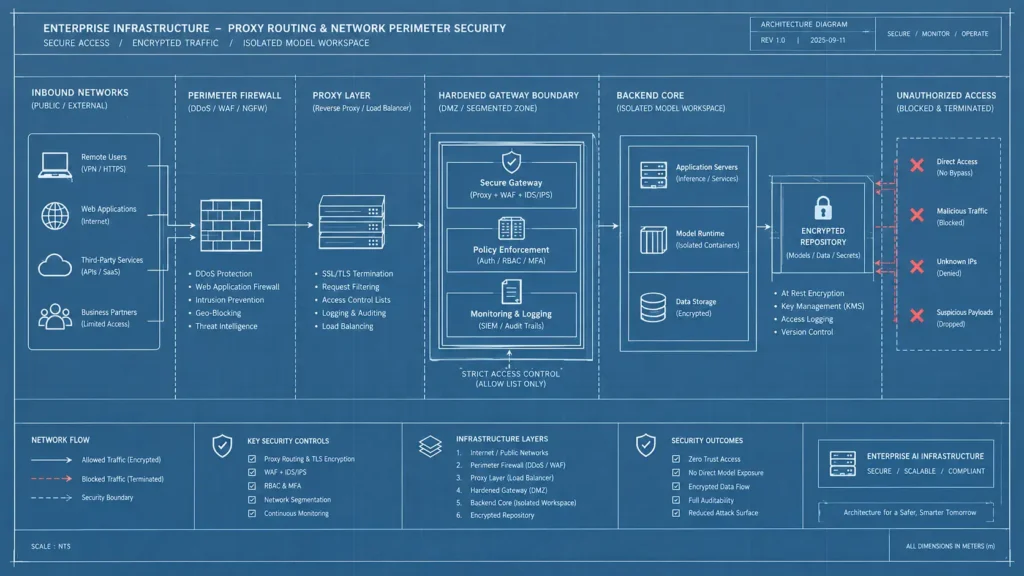
⚡ TL;DR — Key Takeaways
- Administrative access controls: Establishing absolute reverse-proxy constraints protects your underlying infrastructure—efforts to secure open webui nginx architectures dictate that backend teams force every inbound network connection request to terminate entirely at the proxy gateway layer, completely blocking direct external tracking lines from reaching the local model execution engine.
- Vendor/client parameter validation: Restructuring endpoint parameter configurations provides vital protection against unauthorized credential manipulation loops; deploy client-side cryptographic handshakes and Unix domain socket isolation to systematically close the two most common pathways adversarial actors target to compromise an exposed model orchestration interface.
- Stream-optimized runtime flags: Monitoring internal network transit volumes eliminates resource exhaustion across self-hosted clusters; enforce high-concurrency sliding-window rate limiters to intercept and drop malicious automated script sweeps before aggressive scraping syndicates can drain your local hardware compute blocks.
- Perimeter isolation validation: Shielding down-market server interfaces demands strict runtime fingerprint obfuscation rather than passive logging routines—inject advanced browser security headers and deploy proactive error-page masking to completely deny external reconnaissance botnets the precise operating system data they require to orchestrate targeted infiltration loops.
Table of Contents
Hosting open-source AI orchestration interfaces on local Debian instances without an isolated authentication perimeter exposes local model backends to direct public indexing, scanning botnets, and unauthenticated API routing exploits. A default installation was never designed to survive direct internet exposure, as it natively lacks structural network shielding layers. Failing to mathematically insulate open local container nodes allows public script sweeps to probe your local endpoints, mapping internal pathways long before legacy system logs can even throw an anomaly flag.
Deciding to deploy an explicit, structural roadmap to construct strict validation parameters and secure open webui nginx setups is a critical operational engineering requirement rather than a loose optional hardening pass reserved only for production computing clusters. Enforcing rigid reverse-proxy boundary conditions is the only technical mechanism that successfully prevents corporate asset-handling compromise, blocks unauthorized model utilization, and stops technical risk drift before a high-velocity scanning bot discovers the gap first. Without deep network-layer session filtering, your self-hosted orchestrators remain highly exposed to unauthenticated parameter injections that can exhaust your compute hardware capabilities in seconds.
There is a profound, stomach-dropping sense of technical disbelief that hits you when you conduct a routine internal network audit and realize that a high-privilege corporate asset is completely exposed to the open web. You pull up your scanning tools and discover that a self-hosted Open-WebUI portal—wired directly to internal enterprise model pipelines and core vector databases—is entirely visible to public indexing engines without any perimeter authentication.
Watching an unauthenticated external actor effortlessly execute custom model configurations, query private corporate datasets, and draw down local server compute cycles without the platform throwing a single security exception or login validation alert is a brutal wake-up call. It proves that local container sandboxing means absolutely nothing if your edge gateway leaves the front-facing user interface completely wide open to the public web.
The seven coordinated procedural steps detailed below build that infrastructural protection from the network edge inward, ending with the rate limiting that keeps sustained volumetric abuse from ever reaching your compute nodes.
STEP 1: ISOLATING PORT RECOVERY VIA ENFORCED REVERSE-PROXY BOUNDARIES
The foundational architectural decision behind any effort to secure open webui nginx deployments is ensuring absolutely nothing can reach the model interface except through a single, heavily controlled network path. Implementing this absolute perimeter boundary is the primary structural hurdle systems administrators must clear to insulate local compute environments.
- Block direct public access to local model application ports: The core application port that your Open WebUI framework listens on must never be directly reachable from the public internet. The reverse proxy must act as the exclusive entity capable of seeing or receiving inbound packets before they undergo evaluation.
- Establish the reverse proxy as the single authoritative transit conduit: Every inbound network connection, completely independent of its origin or client credentials, must pass through this one boundary. Exposing an administrative service with two separate entry paths effectively doubles your overall perimeter attack surface.
- Force all inbound communication channels to terminate at the proxy layer: Network traffic must be comprehensively evaluated, authenticated, and filtered at this initial proxy boundary line before a single data packet is allowed to be forwarded upstream to the underlying application runtime.
- Treat any bypass pathway as a critical security finding rather than an active convenience: Any minor firewall rule deviation or temporary port-forwarding shortcut that allows traffic to skip the proxy—even if enabled briefly for local debugging runs—instantly undoes every other structural control in your security list.
STEP 2: DOCKER NETWORK MICRO-SEGMENTATION AND LOOPBACK BINDING
Container networking defaults are built entirely for development convenience rather than infrastructure safety. Enforcing rigid network micro-segmentation is an absolute operational necessity for any deployment team working to secure open webui nginx architectures running on shared production hosts.
- Mitigate public exposure vectors hidden inside default internal bridges: Docker’s standard bridge networking configurations can inadvertently expose internal container ports to the public internet if port bindings are not explicitly scoped at initialization. This risk compounds on cloud instances running permissive firewall rules, where raw application interfaces can be indexed by external scanners without passing through designated security checkpoints.
- Bind container sockets exclusively to the local loopback interface: Technical architectures must strictly bind the application container’s listening ports to the loopback interface (
127.0.0.1). Restricting the socket scope directly guarantees that the underlying orchestration service remains reachable only from the host machine itself, completely isolating the runtime from external network adapters.
- Route all external connection requests through the front-facing proxy engine only: By confining the orchestrator container to loopback space, the reverse proxy becomes the exclusive process on the host capable of establishing upstream connections. External network requests are left with zero structural pathways to reach the container without first satisfying the proxy’s validation layers.
- Audit container network configurations after every deployment modification: A container layout that was correctly scoped to loopback can silently drift back to a public binding after an automated stack update or an environment redeployment. Security groups must treat container network schema verification as a standing engineering check rather than a one-time setup task.
STEP 3: IMPLEMENTING MUTUAL TLS ACCESS GATES VIA CLIENT SSL VALIDATION
Standard TLS configurations function exclusively to verify the server’s identity to the client. Incorporating mutual TLS (mTLS) adds the critical missing defensive piece: programmatically validating the client’s identity to the server completely before an inbound request payload can undergo upstream processing.
- Replace unauthenticated entry fields with strict cryptographic handshakes: Rather than trusting surface-layer login credentials or form inputs to secure your endpoints, the reverse proxy itself must demand a valid client certificate. This verification layer must occur before a TCP network connection is established or registered by internal infrastructure logs.
- Configure mutual TLS (mTLS) parameters straight at the proxy layer: Embedding client validation directly within your edge proxy moves session verification significantly earlier in the communication lifecycle. This network alignment ensures an incoming connection attempt lacking a verified certificate never advances far enough to trigger application-layer login checks.
- Drop connections that fail to present a verified, organization-issued token: The proxy engine must be configured to drop any inbound request that fails to present a trusted client certificate. Terminating the session dynamically during the initial handshake prevents the traffic from reaching the backend compute slots.
- Maintain a rigorous certificate issuance and automated revocation program: The operational strength of an mTLS barrier depends entirely on the technical discipline behind your identity registry management. An unrevoked certificate lingering on an offboarded contractor’s workstation presents a standing threat vector equivalent to an active password string sitting exposed on the open web.
STEP 4: HARDENING UPSTREAM DIRECTIVES AND UNIX SOCKET COMMUNICATION
The technical execution of how your reverse proxy communicates internally with the application behind it matters just as much as how external clients interface with the proxy gateway itself. Hardening this internal communication path is an essential step required to secure open webui nginx architectures on Debian platforms.
- Move away from local TCP loops toward dedicated Unix domain socket streams: A standard TCP loopback connection between your proxy engine and the application container, even when both run locally on the same host, still exposes a network-visible port that could theoretically be scanned, enumerated, or targeted by localized cross-container exploits.
- Eliminate internal port-scanning opportunities entirely: Utilizing a Unix domain socket avoids occupying a network port at all. Because it functions strictly as a local file system object, it completely eliminates internal port enumeration and port hijacking opportunities as an architectural attack vector.
- Restrict proxy-to-application connections to filesystem-level access boundaries: Communication paths through a local socket file can be tightly restricted using standard Linux filesystem ownership configurations and permissions. This design injects a durable layer of role-based security that a standard TCP port cannot natively provide.
- Confirm file system permissions are correctly scoped after configuration: A local socket file configured with overly permissive filesystem permissions defeats the entire architectural objective of migrating away from TCP loops, requiring deployment teams to verify file restrictions right after initialization.
STEP 5: PROACTIVE ERROR-PAGE MASKING AND SERVER SNIFFER OBFUSCATION
Automated reconnaissance establishes the preliminary phase of almost every exploit attempt targeting a self-hosted model orchestration portal. Implementing this validation checkpoint denies scanning botnets the granular system fingerprinting telemetry they depend on, creating a vital administrative layer required to secure open webui nginx perimeters against follow-on backend infiltration.
- Hide default backend error headers to prevent framework identification: Default application error responses frequently reveal the exact software version, framework dependencies, or server operating system running behind the gateway. This environmental data is highly valuable to an adversary, as it allows threat actors to match exposed ports to explicit system vulnerabilities.
- Mask server version tokens across every outbound HTTP response packet: Standard headers containing server version signatures allow automated scanners to instantly narrow down which known vulnerabilities apply to your specific infrastructure stack. Masking these variables strips away the architectural details that turn a broad, generic scan into a highly targeted exploit cycle.
- Stop reconnaissance botnets from mapping container configuration metrics: Public perimeter script sweeps rely heavily on gathering distinct endpoint fingerprinting signatures to prioritize which exposed nodes are worth a deeper, more resource-intensive exploitation attempt. Obfuscating your server identity forces scanning tools to register a non-descript interface response, causing automated networks to drop the node.
- Standardize error responses across every independent backend path: Inconsistencies between error layouts on different application routes can itself leak technical details about your underlying container architecture. System architects must enforce a single, uniform error response across the entire proxy directory configuration to prevent secondary structural data leakage.
STEP 6: SECURITY HEADER INJECTION AND BROWSER-RUNTIME CONTENT ISOLATION
Even an exceptionally well-secured container backend can be entirely undermined by a browser rendering the interface insecurely. Injecting defensive boundary controls at this client-facing layer is an essential requirement to secure open webui nginx deployments against runtime browser manipulation exploits.
- Inject defensive HTTP headers to completely isolate the rendered user interface: Structural headers controlling resource framing, content sourcing, and dynamic script execution must be hardcoded at the proxy layer. Applying these variables at the gateway ensures they remain consistently active, completely independent of what the underlying application container sets.
- Deploy strict X-Frame-Options to block clickjacking exploits at the edge: Without this defensive header active, a malicious external site can silently embed your model orchestrator frontend inside an invisible iframe overlay—tricking an authenticated, legitimate employee into executing unintended administrative model actions or modifications.
- Enforce a rigid Content Security Policy (CSP) to stop cross-site scripting (XSS) paths: A well-scoped CSP explicitly restricts which specific sources of scripts, styles, and external assets the browser-runtime engine is allowed to execute. Enforcing these boundaries successfully blocks a major class of injection-based attack vectors, even if an unpatched vulnerability exists elsewhere in the application code.
- Align your header configurations directly with community-maintained guidance: Development divisions constructing these proxy validation matrices should map their parameters directly to the official OWASP secure gateway configuration guidelines. Grounding your proxy layout in these vetted security frameworks guarantees that your transport configurations, header definitions, and framing limits satisfy rigorous modern infrastructure criteria.
- Neutralize cross-origin resource extraction vectors across all active sessions: Beyond blocking clickjacking and script injection loops, headers managing cross-origin resource sharing (CORS) must be scoped tightly. Restricting these cross-origin configurations ensures that no unrelated web domain can silently extract sensitive data out of an active, authenticated model session.
STEP 7: SLIDING-WINDOW RATE LIMITING AND AUTOMATED EDGE DROPS
The final layer of your edge infrastructure configuration assumes that determined threat syndicates will still attempt to interface directly with your exposed perimeters. Implementing high-concurrency rate limiters ensures that sustained volumetric abuse or automated brute-force scripts are systematically dropped at the network edge before they can strain your backend environments.
- Deploy high-velocity request counters using sliding-window filters: Your gateway proxy configuration must evaluate inbound request volumes over a continuously rolling timeline rather than fixed time brackets. Utilizing a sliding-window mechanism cleanly closes the predictable reset-boundary gap that traditional fixed-window counters leave exposed, preventing sophisticated script networks from launching well-timed traffic bursts to bypass filtering perimeters.
- Block scraping syndicates attempting low-and-slow volumetric attacks: Not every abusive automated traffic pattern materializes as a massive spike that triggers surface-level firewalls. Many contemporary extraction tools are deliberately paced to stay just below naive, static threshold limits, which is the exact natural-language and programmatic exploit profile that a tightly tuned sliding-window linter is designed to catch.
- Protect local compute nodes from hardware resource exhaustion: Unlike a standard static web server layout, a private self-hosted model orchestration backend draws heavy hardware execution blocks and has direct, metered compute constraints behind every inference cycle. Implementing aggressive rate limiting at this boundary is not merely an availability control; it serves as a critical operational cost safeguard that prevents automated tools from running high-velocity query sequences that spike processing expenses.
- Tune traffic limit parameters based on actual institutional usage patterns: Systems administrators must move away from applying generic, out-of-the-box threshold defaults copied from unrelated web application manual blueprints. A traffic rate limit must be mathematically modeled against the actual workflow footprints that a local model interface generates, ensuring your security blocks are restrictive enough to drop automated scraping networks while keeping access lines completely fluid for legitimate internal developers.
CONCLUSION & GOVERNANCE BOUNDARY SUMMARY
A resilient privacy and gateway safety posture operates as an active, ongoing system engineering discipline rather than a static boardroom compliance checkbox reviewed once and forgotten. A unified deployment engineered to secure open webui nginx architectures—combining deep reverse-proxy isolation, container network micro-segmentation, mutual TLS authentication gates, Unix socket communication, server fingerprint reduction, defensive browser security headers, and sliding-window rate limiting—actively shields your local compute cluster from the kind of catastrophic financial and operational drain a single exposed model interface can cause.
Assuming a self-hosted AI portal or local orchestrator environment is completely secure simply because it sits behind a localized Docker container network introduces a highly dangerous and severe false sense of security across your operational divisions. Docker’s internal network bridges excel at isolating container communication properties on the local host filesystem, but they provide zero protection against client-side browser interface manipulation or direct port indexing loops. If your edge proxy server fails to map out rigid loopback bindings or leaves your security headers unconfigured, a malicious external site or public scanning botnet can easily map out your underlying container configurations, accessing your high-privilege model orchestrator backends entirely undetected while your systems teams remain entirely blind to the lateral entry path.
Anchoring the gateway on automated token telemetry, strict credential isolation, and disciplined network blocks turns what starts as a single self-hosted AI portal into hardened infrastructure your engineering team can trust implicitly, even when it sits on the identical shared network as everything else in your stack.
Balancing rapid deployment velocity with rigid infrastructure security remains one of the ultimate challenges facing modern self-hosted dev environments. We want to hear from you in the comments section below: What specific reverse-proxy parameters, mutual TLS configuration pipelines, or custom sliding-window rate limiters are you running to secure your local Open-WebUI instances on Debian? Have you encountered unexpected connection latency when shifting your container hooks to filesystem Unix sockets, or are you managing dynamic upstream container IP routing through automated service discovery tools? Share your architectural layouts, proxy configuration snippets, and hard-earned runtime security advice with the engineering community below!
Related: Disable Apple Intelligence Training: 3 Crucial Steps to Stop Corporate Leaks – A practical guide to disabling Apple Intelligence across enterprise Macs using MDM controls, configuration hardening, and continuous endpoint validation to reduce background telemetry and corporate data leakage.
ENISA Threat Landscape 2025: Ultimate Summary to Shield Corporate Networks – A comprehensive summary of the ENISA Threat Landscape 2025, examining evolving cyber threats, supply-chain risks, ransomware, AI-driven attacks, vulnerabilities, and the controls organizations need for stronger resilience.
Automated Access Review: 4 Crucial Steps to Stop Compliance Drift – A practical framework for small teams to automate access reviews, detect privilege drift, maintain audit-ready evidence, and securely remove stale permissions.
EU AI Act Compliance: 4 Crucial Steps to Stop Compliance Drift – EU AI Act compliance isn’t a one-time checklist—build a continuous SaaS roadmap for risk classification, transparency, logging, and audit readiness.
Prompt Injection Defense: 4 Crucial Tactics to Shield Corporate Networks – How Semantic Kernel can help defend AI applications against prompt injection attacks using structured orchestration and layered safeguards.
Prevent API Key Leakage: 4 Crucial Steps to Shield Corporate Networks – A layered framework for keeping API keys out of local AI application code — externalized configs, vaulted secrets, pre-commit/pipeline scanning, and proxy-isolated credential handling.
FREQUENTLY ASKED QUESTIONS (FAQ)
Q1. How can small teams running automated access reviews efficiently track “shadow” accounts created outside primary providers, like standalone SaaS tools used by marketing or sales?
Small teams should connect their review pipeline to an automated web-hook monitor or a centralized single sign-on (SSO) integration layer. Any unmapped, external SaaS tool that tries to hook into company communications or financial networks should trigger an immediate administrative flag, ensuring that independent department platforms are discovered and cataloged before they drift completely out of control.
Q2. Will running automated differential sorting scripts on our raw user directories introduce noticeable latency or processing bottlenecks on our live management instances?
No, because the inventory extraction and sorting scripts operate out-of-band and deal entirely with flat structural data files rather than database transaction records. By scheduling your diff scripts to run as background cron tasks during off-peak windows (like midnight on a Sunday), you process identity logs at near-wire speeds without introducing a single millisecond of lag to live developer or user environments.
Q3. What is the primary technical limitation of relying on a centralized spreadsheet for identity audits, even if it is updated programmatically?
The core limitation is that spreadsheets do not support immutable, native data logging features—meaning any administrative user with write permissions can accidentally modify or delete historical rows without leaving a clear trail. If an auditor asks to see proof that an access control was operated cleanly six months ago, a basic spreadsheet grid cannot provide the tamper-evident proof that a true, cryptographically hashed ledger file generates naturally.
Q4. How do we balance an aggressive, automated de-provisioning loop with remote workers who might be inactive due to parental leave or extended vacations without locking them out entirely?
Your automated scripts must separate complete account termination from temporary account suspension states. When an identity hits your inactive threshold (e.g., 30 days without a valid login token), the system should place the account into an isolated, “frozen” group container that drops active access rights while preserving all local profiles and encryption metrics—allowing a returning worker to trigger a safe administrative reinstatement loop instantly.
Q5. What is the fastest technical control a bootstrapped team can deploy to verify that an external vendor has properly cleaned up its access footprints after a project concludes?
Configure your identity provider to enforce an automatic, non-extendable expiration variable right at the moment the vendor profile is created. By binding the contractor’s credentials to a hard-coded time-to-live (TTL) flag (e.g., exactly 14 days), the underlying infrastructure automatically revokes all session variables and blocks the access perimeter the exact millisecond the timeline ends, completely independent of human follow-up tasks.
DISCLAIMER
Educational Notice: This article is published on AI Security Watch strictly for technical educational and general cybersecurity awareness purposes. The configurations and research discussed are based on public threat intelligence data. This content does not constitute professional IT architecture, legal, or financial advice. Because network configurations vary, always verify settings in an isolated test environment or consult with a qualified engineer before modifying live hardware or registries. AI Security Watch contains informational links to external resources; we are not responsible for third-party site accuracy or platform content.